The 2026 CMG Spring Festival Gala has brought surging foot-traffic and revenue to its sub-venues during the nine-day Chinese New Year holiday, which concluded on Monday.
Since its first broadcast in 1983, the gala has been recognized as the most-watched annual television program on the planet, celebrating the most important holiday for the Chinese people.
The 2026 Gala had four sub-venues alongside its main venue in Beijing: Harbin City in northeast China's Heilongjiang Province, Yiwu City in east China's Zhejiang Province, Hefei City in east China's Anhui Province, and Yibin City in southwest China's Sichuan Province.
In recent years, such sub-venues have become an important window to showcase the images, cultural features and local customs of various cities, boosting tourism in these destinations by leveraging the broadcast's popularity.
In Yibin, the Gala has turned local landmarks into viral travel destinations. Hejiangmen Square and Yangtze River Park, featured prominently in the broadcast, have quickly become must-visit spots for holiday travelers.
"We saw the performance in the Yibin sub-venue on the Spring Festival Gala, so today I brought our family here to watch the drone show on site. It's absolutely spectacular," said tourist Zhang Jing.
The surge in visitors delivered record-breaking results for the city. During the holiday period, Yibin received over 9.5 million tourists, generating 6.2 billion yuan (about 900 million U.S. dollars) in tourism consumption, both hitting historic highs, according to the city's tourism bureau. Multiple scenic areas also saw single-day visitor numbers breaking previous records.
In Hefei, the sprawling Luogang Park, which staged performances for the gala, also held a grand carnival combining musical performances, cuisine and garden attractions.
During the holiday period, the park's foot traffic exceeded one million visitors, driving surrounding restaurant revenues up 20 to 50 percent year on year, while hotel bookings in the area doubled compared to the previous year. According to restaurants in the area, the number of diners has also swelled.
"We start work at 09:00 in the morning and don't leave until 22:30 at night. There's no time to rest at noon -- we're basically constantly preparing food, and our procurement also increased," said Liu Nana, manager of a restaurant at Luogang Park.
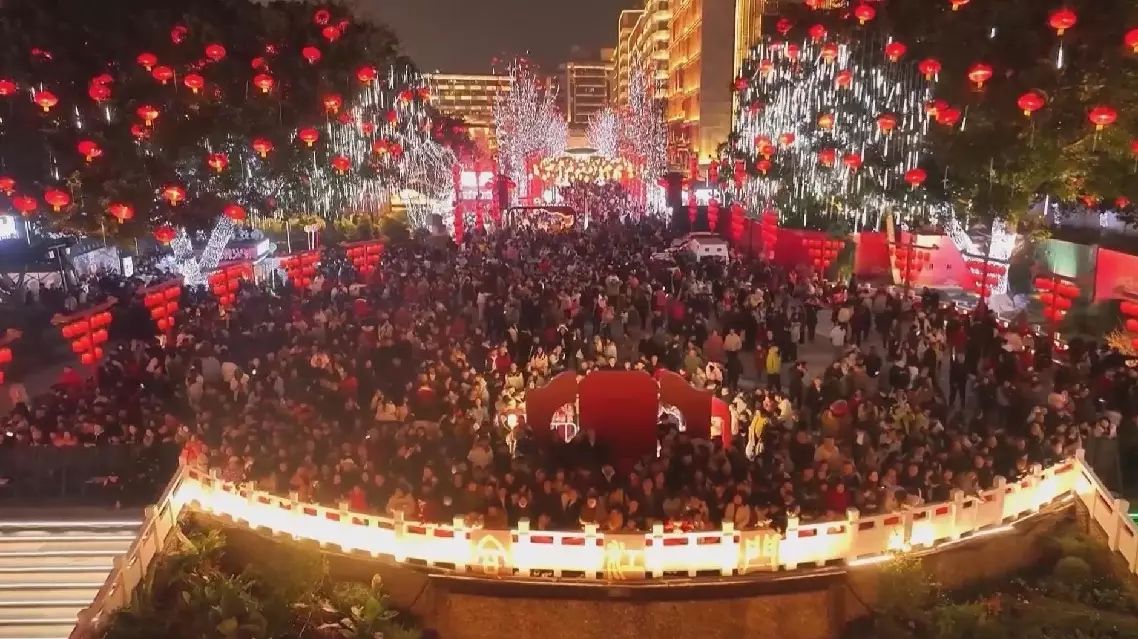
Spring Festival Gala boosts holiday economy in sub-venue cities