WASHINGTON (AP) — The Central Intelligence Agency offered help to potential informants in Iran on Tuesday, providing Farsi-language instructions on ways to safely contact the U.S. spy agency as President Donald Trump mulls possible military strikes.
The post is the latest in a series of recruitment pitches in Farsi, Korean, Russian and Mandarin that offered secure ways to contact the CIA. The Farsi-language message posted Tuesday to X, Instagram and YouTube, however, comes at an especially uneasy time in U.S.-Iran relations and as the Iranian theocracy faces new protests at home.
The U.S. has assembled its largest military force in the Mideast in decades as tensions with Iran have risen. Trump threatened military action in January in response to the government's fierce crackdown on national protests before shifting his focus to Iran's disputed nuclear program and warning it to make a deal. Another round of nuclear talks is planned for later this week.
In a sign of new unrest in Iran, students held anti-government protests at universities in Tehran on Monday.
“Hello. The Central Intelligence Agency hears you and wants to help,” the agency wrote in the message, according to an English translation. “Here are some tips on how to make a secure virtual call with us.”
The Farsi-language post racked up millions of views within just a few hours.
The agency won't say if earlier recruitment videos have resulted in tips or new sources, but Director John Ratcliffe has said the posts are having an impact.
“Last year, CIA’s Mandarin video campaign reached many Chinese citizens, and we know there are many more searching for a way to improve their lives and change their country for the better," Ratcliffe said earlier this month when a new Mandarin video was posted.
The CIA's tips include using a virtual private network, or VPN, to circumvent internet restrictions and surveillance, and the use of a disposable device that can’t easily be traced back to the user. The CIA also urged potential informants to use private web browsers and to delete their internet history to cover their tracks.
The instructions include ways to reach the CIA on its public website or on the darknet, a part of the internet that can only be accessed using special tools designed to hide the user’s identity. The CIA has also posted similar instructions in Russian.
A spokesperson for Iran's Mission to the United Nations did not immediately respond to a message seeking comment about the new video.
Associated Press writer Farnoush Amiri contributed to this report from New York.

Women walk at the shrine of Saint Saleh during the Muslim holy fasting month of Ramadan in northern Tehran, Iran, Thursday, Feb. 19, 2026. (AP Photo/Vahid Salemi)

People drive their motorbikes in a square in downtown Tehran, Iran, Tuesday, Feb. 24, 2026. (AP Photo/Vahid Salemi)

Pedestrians walk past a billboard depicting a U.S. aircraft carrier with damaged fighter jets on its deck and a sign in Farsi and English reading, "If you sow the wind, you'll reap the whirlwind," at Enqelab-e-Eslami (Islamic Revolution) Square in Tehran, Iran, Sunday, Feb. 22, 2026. (AP Photo/Vahid Salemi)
STARKE, Fla. (AP) — A man convicted of killing a grocery store owner during a robbery in Florida was set to be executed on Tuesday, which will make him the second person put to death in the state this year.
Melvin Trotter, 65, was initially convicted of first-degree murder and sentenced to death in 1987. However, the state Supreme Court found the trial court had erred in handling aggravating factors in his case and ordered a new sentencing, and Trotter again drew the death penalty in 1993. He is scheduled to receive a three-drug injection starting at 6 p.m. at Florida State Prison near Starke.
Tuesday's planned execution and another earlier this month in Florida follow a record 19 executions in the state last year. In 2025, Gov. Ron DeSantis oversaw more executions in a single year than any other Florida governor since the death penalty was reinstated in the U.S. in 1976. The previous Florida record was eight executions in 2014.
According to court records, Trotter strangled and stabbed Virgie Langford at her store in Palmetto in 1986. A truck driver found Langford alive after the attack, and she was able to describe her attacker before eventually dying at a hospital.
Besides recalling Trotter's physical appearance, Langford said her attacker had a Tropicana employee badge with the name “Melvin” on it. According to court records, police later found a T-shirt with Langford's blood type at Trotter's home and the man's handprint on a meat cooler at the grocery store.
Last week, the Florida Supreme Court denied appeals filed by Trotter. His attorneys had argued that Florida corrections officials had mismanaged its own death penalty protocols. Attorneys also argued that Trotter's advanced age of 65 should exempt him from execution.
The U.S. Supreme Court denied Trotter's appeal on Tuesday afternoon. In a separate opinion, Justice Sonia Sotomayor raised questions about the state's administration of lethal drugs. In his appeal to the court, Trotter's attorneys noted that he does not challenge Florida's use of lethal injection or claim that the state's lethal injection protocol is unconstitutional. Instead he argues that Florida could “maladminister” the protocol in a way that increases the risk for a “mangled” execution that violates the Eighth Amendment prohibition on cruel and unusual punishment.
Sotomayor wrote that she hopes going forward the state and its courts “will recognize the paramount importance of ensuring that it conducts executions consistently” with the proper protocols.
A total of 47 people were executed in the U.S. in 2025. Florida led the way with a flurry of death warrants signed by DeSantis. Alabama, South Carolina and Texas tied for second with five executions each last year.
So far this year, Texas, Oklahoma and Florida have carried out one execution each.
On Feb. 10, a man convicted of killing a traveling salesperson who he and his brother had met at a bar become the first person executed in Florida this year. Ronald Palmer Heath, 64, was convicted of first-degree murder and other charges in the 1989 killing of Michael Sheridan.
Two more Florida executions have already been scheduled for next month: Billy Leon Kearse, 53, is scheduled to receive a lethal injection on March 3, and Michael Lee King, 54, on March 17.
All Florida executions are carried out by injecting a sedative, a paralytic and a drug that stops the heart, according to the Department of Corrections.
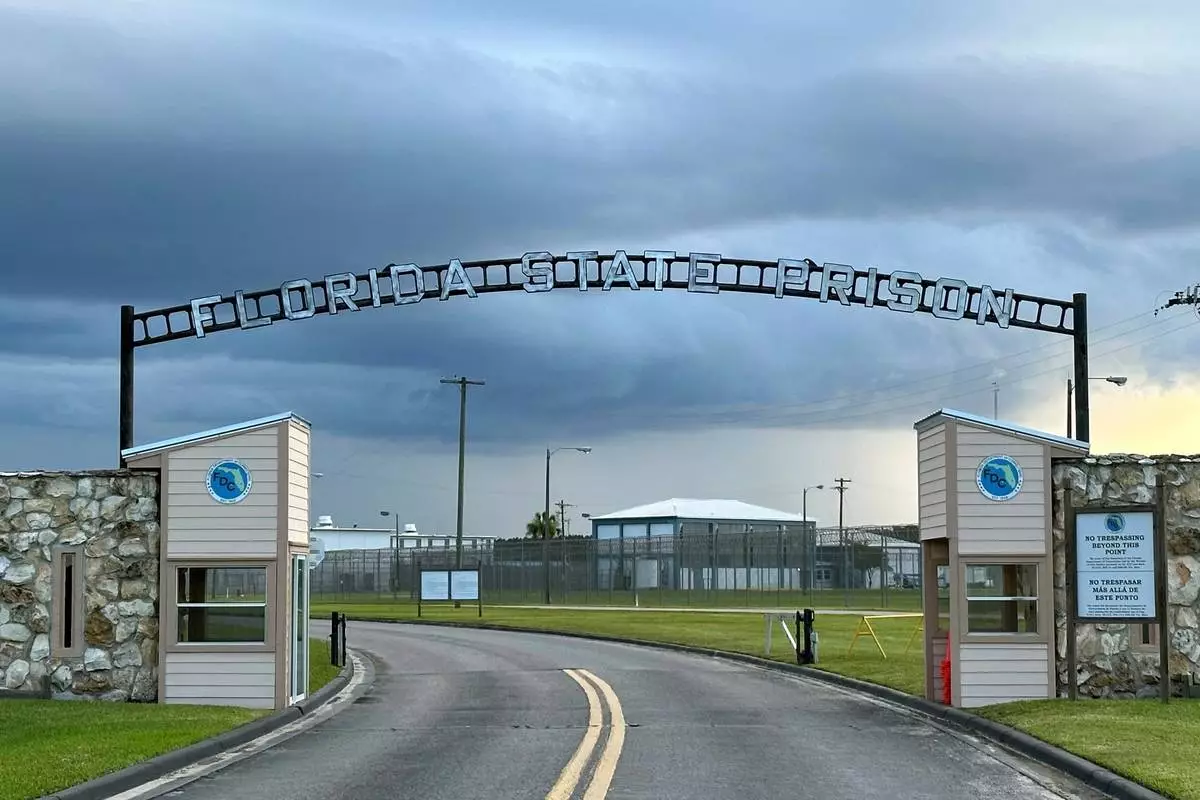
FILE - Clouds hover over the entrance of the Florida State Prison in Starke, Fla., Aug. 3, 2023. (AP Photo/Curt Anderson, File)