Chinese researchers have developed AI-powered glasses that act as artificial eyes, converting visual data into audio cues to help blind and low-vision users "see" the world with greater clarity and independence.
Cai Qionghui lost her sight at the age of seven. Now a skilled piano tuner, she can finely discern every note of an instrument, yet she often finds herself lost in the physical world when going out alone.
"Most navigation software actually fails in the last 10 meters, so I often get lost and cannot find my destination. Visually impaired people are actually very eager to go out, but we can't because we fear this situation," said Cai.
This year, Cai has a New Year's wish: to attend a Spring Festival concert on her own.
To help turn her dream into reality, researchers at an AI-powered glasses maker in Hangzhou City, east China's Zhejiang Province, went to great lengths to perfect the device's obstacle avoidance function. The team spent more than half a year navigating city's streets, collecting data on crossings, steps, and other hazards to train their AI.
Beyond simply identifying the road conditions, the system also needed to issue alerts quickly enough. Through relentless refinement, they slashed the glasses' reaction time from 500 milliseconds to 300 milliseconds, bringing Cai's wish a step closer.
"After the reaction time was optimized, I felt less afraid when going out with its guidance," said Cai.
Using image analysis and scene comprehension, the AI glasses can instantly recognize menus and navigate surroundings, transforming visual information into spoken words for the visually impaired. This thoughtful feature is powered by a homegrown large AI model.
"Because a large model interacts with the environment almost like a human, it can, for visually impaired people or those in need of assistance, serve as their eyes, their mouths, and their ears — ultimately improving their quality of life," said Xu Dong, general manager of Alibaba Cloud's Tongyi Qianwen LLM service.
Recently, Cai donned the repeatedly tested and optimized AI glasses and, for the first time, confidently stepped out alone onto an unfamiliar street, making her way to the theater to perform.
"Never give up lightly! In fact, there are always more solutions than difficulties, especially with the rapid development of science and technology. All difficulties can be solved step by step as long as we don't give up," said Cai.
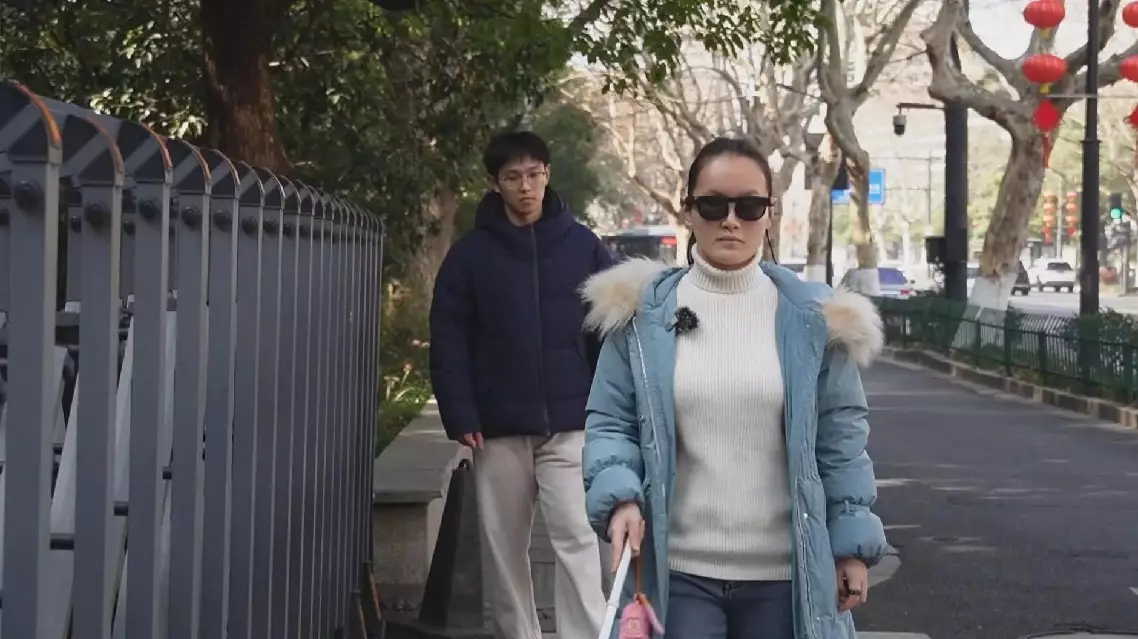
AI glasses serve as 'eyes' for visually impaired people, bringing world into focus