German Chancellor Friedrich Merz's visit to China is expected to prioritize cooperation on the renewable energy sector, where access to advanced Chinese technology is seen as crucial for advancing Germany's green transition as experts say China remains an "ideal partner" in helping the country pursue its own environmental goals.
Merz arrived in Beijing on Wednesday for a two-day official visit to China, his first since taking office last May. The chancellor will hold talks with Chinese President Xi Jinping and Premier Li Qiang, with the leaders set to exchanges views on bilateral relations and discuss issues of mutual interest.
As Germany struggles with a sluggish economy and high energy prices, the expected focus on green development is viewed as one of the key focuses of Merz's China trip.
It comes after European leaders agreed to work more closely on offshore wind development, signing a cooperation deal in Hamburg last month. During that event, Merz said offshore energy is becoming significantly more efficient, but stressed that closer coordination would be needed on wind, hydrogen and energy network planning.
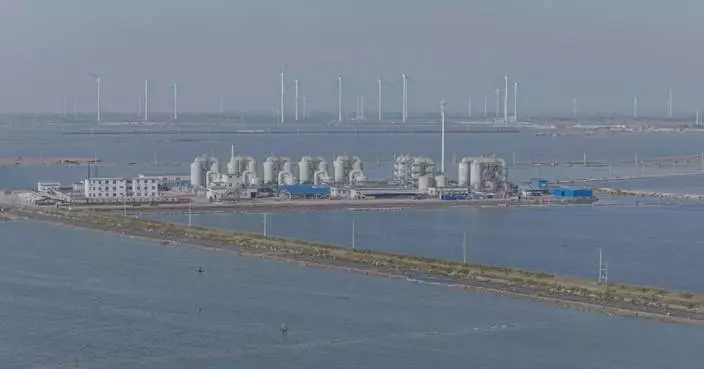
Germany's renewable expansion depends heavily on imported technology, with the vast majority of solar panels and components installed across Europe being supplied by Chinese manufacturers.
Chinese technology already plays a central role in Germany's energy transition, with the country reliant on China for around 90 percent of the rare earth magnets used in wind turbines, a dependency that is expected to grow as capacity expands.
Analysts argue that deepening cooperation with China, rather than decoupling, is the pragmatic option as the German economy faces up to various headwinds.
One former German official pointed to China's commitment to pushing forward its green goals in the 15th Five-Year Plan (2026-2030) -- a key blueprint mapping out the country's development priorities for the coming years -- and said this makes China an "ideal partner" for Germany, particularly as the current U.S. administration backs away from previous climate targets.
"German industry is not so well off and they need really investments. China takes its environmental policy very seriously, that shows the goals now in the newest [15th Five-Year Plan]. I think they are an ideal partner, and I don't see anything like this at the side of the other big world player, the USA, there is nothing comparable," said Michael Borchmann, former head of the European and International Affairs Department of the German state of Hesse.
Energy costs remain a major pressure point for German manufacturers, with electricity prices ranked among the highest globally, eroding competitiveness and weighing on industrial output. Those costs are also shaping domestic political debate.
As the far-right Alternative for Germany (AfD) party gains ground in the polls, energy policy has become a key line of political attack, with the AfD claiming the German government is going in the wrong direction.
"The big problem is that we are moving from a market economy to a planned economy with a planned economic energy policy. This is complete mistake. We must return to nuclear energy, the cheapest, most environmentally friendly and most reliable form of energy," said AfD energy spokesman Stefan Kotre.
After two years of economic contraction, Germany's economy grew by around 0.2 percent last year, a modest recovery still constrained by high energy prices and weak industrial performance.
Many believe that whether Merz can secure affordable energy and reliable access to green technology during his current China visit will prove decisive in determining whether Germany can build on its fragile growth and sustain its industrial base in an increasingly competitive global economy.
Green energy cooperation expected to dominate discussions during Merz’s China visit: experts