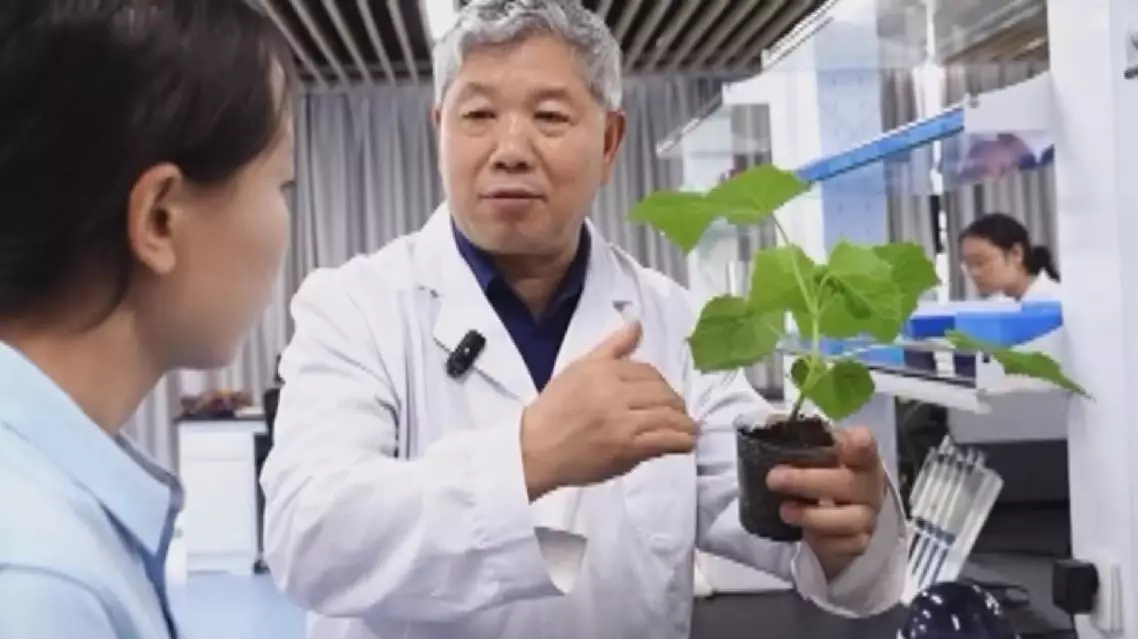
Fan Guoqiang, a political advisor and a renowned paulownia expert, has actively advanced the application of artificial intelligence (AI) in forest tree breeding, calling for training of composite talents in the industry.
Fan, a member of the National Committee of the Chinese People's Political Consultative Conference (CPPCC), has long dedicated his career to teaching and research in forest tree genetics and breeding.
His key focus at this year's "two sessions" is to promote high-quality development in forestry by shortening breeding cycles and reducing costs through innovative methods, particularly the integration of AI technologies.
Over the past year, Fan has conducted extensive field surveys at many tree cultivation bases across the country.
He found that breeding remains a bottleneck. Traditional cross-breeding methods often require decades to develop a superior variety, involving long cycles, high investments, and substantial risks, which hinder China's push for high-quality development of forestry industry.
At the "two sessions" last year, Fan submitted a proposal to accelerate the research, development, and application of AI in forest tree breeding.
At the Forestry Department of Henan Agricultural University, where he serves as dean, Fan has actively advanced the research on AI-assisted breeding.
"Many traits of forest trees are controlled by the expression of corresponding genes in the genome. By leveraging AI to organically link the phenome and the genome, we can precisely cultivate new varieties. Unlike before when it was done based on experience, this approach significantly shortens the breeding cycle," he said.
However, during his research, Fan identified several factors hindering breakthroughs in breeding technology, such as low levels of digitization in China's forest tree germplasm resources, inadequate data-sharing mechanisms, and mismatches in AI algorithm models tailored to forestry applications.
He also highlighted a major talent gap in this interdisciplinary field.
"There remains a shortfall in training composite talents for AI-driven tree breeding. A graduate student must master molecular biology, biotechnology, AI and more, which all require time to learn before integrating and applying this knowledge to forest tree breeding, especially in developing new varieties. The process is lengthy," Fan said.
As the "two sessions" are around the corner, Fan said that he will continue to offer targeted suggestions on forestry breeding. He calls for intensified efforts to overcome key challenges in AI breeding technologies and to build a comprehensive innovation system covering the entire forestry breeding chain.
The "two sessions" refer to the annual meetings of China's top legislature, the National People's Congress (NPC), and the top political advisory body, the National Committee of the Chinese People's Political Consultative Conference (CPPCC).
The fourth session of the 14th NPC is scheduled to open on March 5, while the fourth session of the 14th CPPCC National Committee is set to begin on March 4.
CPPCC member calls for AI revolution in forest tree breeding