Chinese agricultural scientists are helping boost food security in Laos by developing high-yield, locally adapted crop varieties, enabling farmers on Don Khong Island along the Mekong to pioneer triple-cropping rice for the first time.
In Laos, as across much of Southeast Asia, farming is the backbone of daily life and rice is the staple that sustains it. Faced with rising demand and limited land, farmers are searching for ways to produce more from the same fields.
On Don Khong, a lush island cradled by the Mekong River in southern Laos, farmers are experimenting with triple-copping rice for the first time. The system involves growing and harvesting three successive plantings on the same land, instead of the usual two.
"In the whole of Laos, usually, no more than two crops are planted per year. Don Khong Island is the first place to grow three-season rice," said Bhandi Sinhatan, director of the Bureau of Agriculture and Forestry of Don Khong Island.
Three-season rice requires varieties with short growth cycles that don't compromise on quality or resilience.
Due to limited agricultural infrastructure and technology, Laos has historically introduced rice varieties from neighboring countries with similar climates, such as Thailand and Vietnam. In recent years, however, climate change poses substantial risks to food security and livelihoods. Laos has turned its attention to China for new ideas in rice.
China has decades of experience in cultivating high-yield, resilient rice varieties. But what succeeds in one country can't simply be transplanted to another. The challenge isn't copying the technology, but adapting it to local land and local lives.
Ma Jingliang, a rice-breeding specialist from Hunan Province, one of China's major rice-growing regions, has spent the past decade on Don Khong, working patiently to develop high-quality rice varieties suited to local conditions.
"The key technological challenge lies in selecting and breeding wild rice and high-quality rice varieties across Southeast Asia, and then subjecting them to our own breeding and hybridization processes," said Ma who now works as an agricultural technology expert at the Asia-Potash Tiantian Agricultural Development Company.
"It was not until 2025 that we finally developed our own independently bred rice varieties. Now, we have more than a dozen varieties, which is the result of years of efforts and significant investment in manpower, energy, financial resources and time," said Liu Jiabin, deputy general manager of the company.
After a decade of dedicated efforts, the three-season rice demonstration base in Don Khong has achieved an annual yield per unit of land that is eight to ten times higher than traditional farming methods.
Further north in Vientiane, the country's capital, the Laos-China Fine Crop Varieties Experimental Station serves as a living laboratory for bilateral cooperation. Jointly established by the Guangxi Vocational University of Agriculture and the Laos National Institute of Agriculture, Forestry and Rural Development, the center brings together technicians from both countries to test, adapt, and promote resilient crop varieties.
"Our main work is introducing high-quality crop varieties, like fruit trees, vegetables, corn and rice, and selecting and cultivating them. This includes testing planting techniques and conducting trial experiments here in Laos," said Bounsavath Phongdara, deputy director of the experimental station, who once worked in China for many years.
During his time in China, Phongdara developed a fondness for Chinese corn porridge. Upon returning to Laos, his primary work shifted to corn breeding.
Working alongside Phongdara is Lv Feng from China, who has been working at the experimental station for six years.
"We selected a corn variety called C188, which has gained relatively high local acceptance and also yields well. After selecting it, we promoted it in southern Laos, with a planting area of over 3,333 hectares," said Lv.
At the experimental station, there are not only staple crops like rice and corn, but also a large number of fruit and vegetable varieties.
So far, the station has introduced and tested over 400 crop varieties, selected more than 80 for promotion, and formulated over 20 localized agricultural technical procedures. Additionally, it has trained over 3,500 agricultural technicians for Laos.
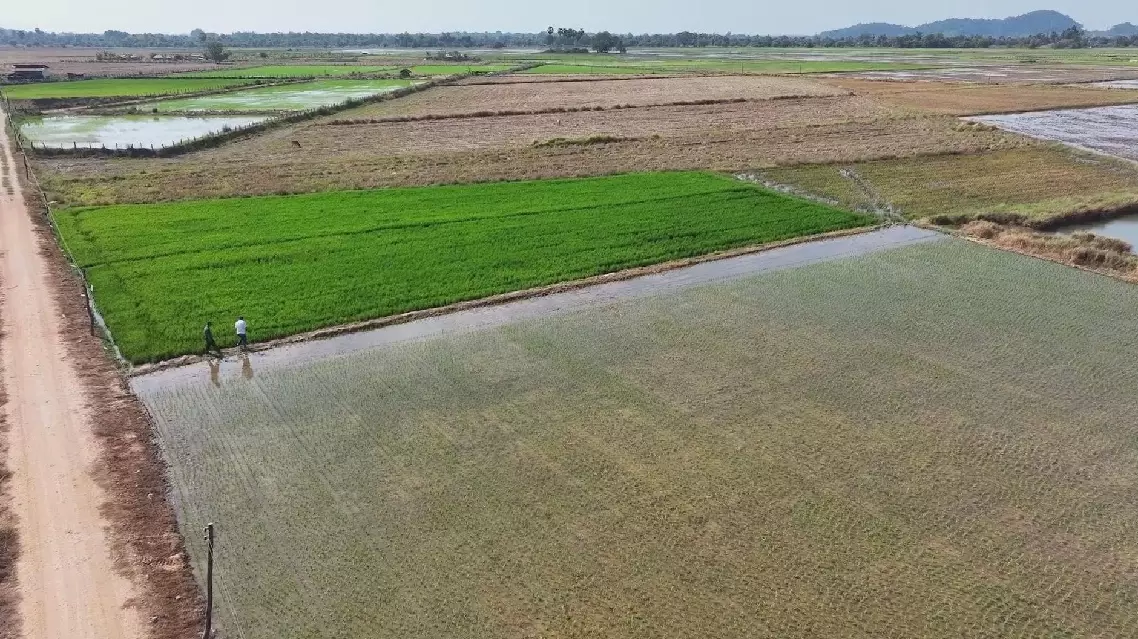
Chinese expertise helps boost yields for Lao farmers via locally adapted crop varieties