A diminutive teenager from south China's Guangxi Zhuang Autonomous Region is proving her small stature is no obstacle as she outmaneuvers her unsuspecting taller peers with her sharp skills and nifty style around the basketball court. Feng Minmin, a 17-year-old high schooler, has poured nearly all her spare time into her love of basketball, defying expectations of many of her classmates and leaving many opponents with egg on their face as they write her off due to her 1.55-meter frame.
Feng has gained some online fame after a video of her performing a layup went viral on social media, with the unlikely outcome delighting netizens. In the clip, Feng, a petite girl wearing glasses, is seen executing an incredibly nimble spin and a between-the-legs ball switch in mid-air, showcasing her exceptional coordination and body control.
This signature technique, which has captivated netizens and earned her widespread praise, is the result of countless hours of practice and self learning.
Feng's bond with basketball began in the third grade during a simple shooting game in physical education class. The thrill of sinking her first shot planted a passion that has grown ever since. With no professional coaches to guide her, she turned to online tutorials and highlights, then carried them to the court for endless practice.
"You might try many times without making a single shot, but as long as you keep attempting, nothing is impossible," she said.
Basketball has become a source of joy and achievement for Feng. Even during brief afternoon breaks, she can be found on the court, seizing every spare moment to drill her shots.
"I require myself to make five shots in a row before stopping. When I succeed, I still feel I need to keep refining it. Finding that feeling makes me happy," she shared. In the family's yard in a small village in Longzhou County, stands a second-hand basketball hoop, a simple fixture that carries deep meaning. Once destined for the scrap heap, it was rescued by Feng's father, who paid 500 yuan (a little over 70 U.S. dollars) to bring it home and support his daughter's dream.
"Once her homework is done, she heads out to play. Her dad says no matter how tough life gets, we have to support her, and we installed a hoop at home," said her mother Lyu Huifen.
"We support whatever she wants to do. She has that never-give-up spirit, whether it's in the scorching sun or rain, she's out there day and night because she truly loves basketball," said her father Feng Ziquan.
Last year, Feng represented her school at the Guangxi Youth 3x3 Basketball Championship. She leveraged her nimble style, relentless running and accurate shooting, to help her team achieve strong performances. Her outstanding individual contribution earned her the title of national second-level athlete.
Though her ultimate dream of pursuing a professional basketball career may cruelly prove a step too far due to her height, Feng remains optimistic about sticking with the sport in future and sharing her love with others.
"I have to face current realities and stay positive looking forward. I'll have more time for basketball in university. If possible, I could join a college team. But first, I aim for a good university. Later, if I can, I'd love to open a basketball gym and teach kids how to play, or be a teacher," Feng said.
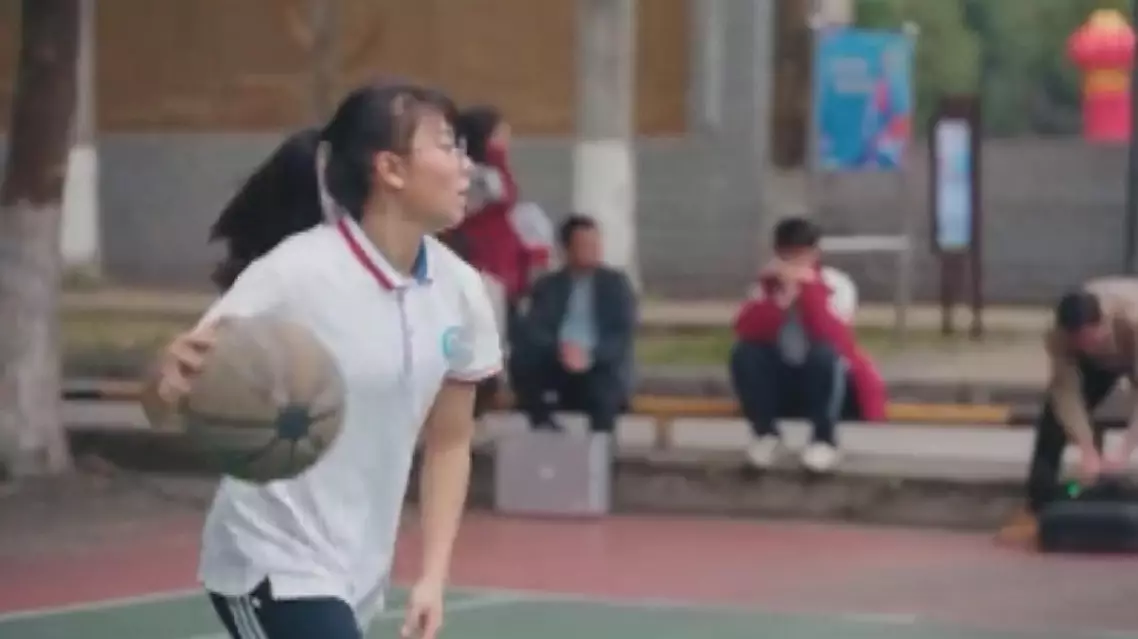
Guangxi schoolgirl defies height, stuns peers with nifty basketball skills
Facilitated by favorable nation-level policies and strategies, Chinese businesses are working to promote large-scale commercialization of humanoids, propelling humanoid robots out of laboratories and into factories, family homes and classrooms.
Since embodied intelligence was highlighted in China's 2025 Government Work Report as a new engine of economic growth, humanoid robots have been flexing their skills for years, running marathons, fighting close-range battles, and performing stunts on television.
Beyond their position as a technology spectacle, humanoids are clocking in for real jobs in China, and robot data centers are providing them their compulsory trainings.
One of the robot schools is the data factory of Agibot, one of China's major humanoid producers, in Shanghai. Resembling a miniature "human world," trainers are teaching robots all kinds of daily and professional tasks, and it's open sourced. The data generated here can be used by many other companies to train their own robots.
Nearly 1,000 humanoids are learning their tricks here every day. By guiding each motion of the robots, human trainers are generating what the engineers call the "expert data" for the robots to master their skills.
"I think that data, hardware and algorithms improve together in a positive spiral. The more data we have, the better our models and algorithms will be. In this way, we will have better means to enable the entire community of developers to make greater contributions, and to enable the overall technological development of the community to become faster," said Wang Sukai, an algorithm expert from Agibot.
Their open approach is paying off. Global shipments of humanoid robots surged to around 18,000 units in 2025, more than five times the figure from the year before, with Chinese firms dominating the market. Agibot alone shipped over 5,100 units last year, which is nearly 40 percent of the global total.
"China now has an 'engineer dividend' built upon the 'dividend of human resources'. Our teams bring strong innovation experience from making smart vehicles, drones, laser radars and more. We also benefit from very remarkable advantages in terms of a complete industrial chain. The sensor ecosystems from EV, sensor, and computing power can be recalibrated for robotics. We get rent discounts and talent subsidies, too. And finally, our customers joined us early, and we are now experiencing rapid growth with more stable products," said Wang Chuang, president of Agibot General Business Division.
And as demand grows, schools are rethinking what they teach. In Shanghai, vocational schools are introducing robotic engineering programs.
"At the national level, AI education is being promoted with great efforts. Exposing human resources early to embodied intelligence gives them a deeper understanding and stronger ability to apply it later on," said Yin Hua, principal of Shanghai Fengxian Secondary Vocational School.
Regarding the widespread concerns on unemployment, analysts argue that AI and robots are not exterminating jobs, but facilitates a technology up-skilling.
"We are designing these robots to address a fundamental challenge within the human society. We are having smaller families. We are having lesser young folks that can be dedicated to sort of a heavy blue-collar jobs. As long as we have sufficient coverage from a policy standpoint, from an up-skilling standpoint. And we are already seeing some enterprises very keen to train up their existing workforces. We are on a right track," said Su Lian Jye, chief AI analyst of technology research and advisory group Omdia.
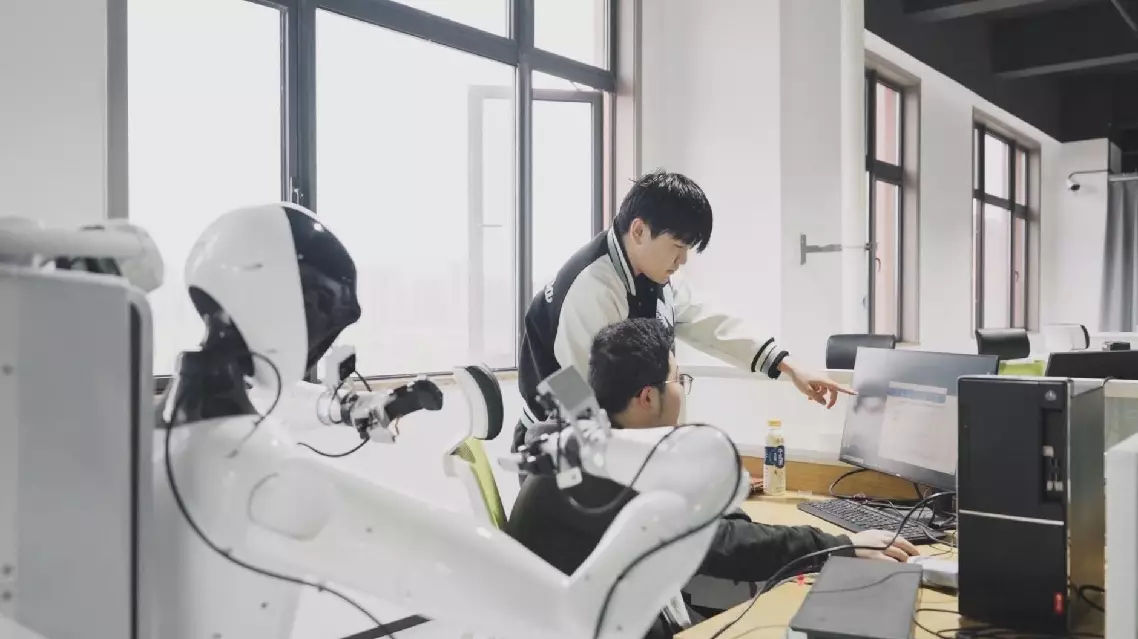
Chinese companies seek to propel humanoids into factories, homes