|
- As the 2026 Best Workplaces for Women Australia List set to drop, Great Place To Work's GM has thoughts on International Women's Day, performative targets and being a voice for the next generation.
SYDNEY, Feb. 27, 2026 /PRNewswire/ -- Rebecca Moulynox has a low tolerance for cupcakes. Not the bakery treats themselves, she's not a monster, it's the specific genus of ballerina pink or bubble-gum purple cupcake that appears in office kitchens every March. You know the ones, they're always spread out next to a sagging "Happy International Women's Day!" sign with several complicated hashtags.
"I find the morning tea bit condescending," she says of the scene. "It's superficial, performative, and that bit feels ridiculous to me. But I love hearing about what amazing women are doing, and International Women's Day does create opportunities for these stories to come out." she says.
Moulynox is the General Manager for Great Place To Work across Australia and New Zealand, which means she sits in the nexus of workplace culture and the data that measures it, two things corporate Australia absolutely loves to invoke but rarely reconcile. On March 5 the global authority on workplace culture will release their annual Best Workplaces for Women Australia List, timed to land days before International Women's Day.
Women, Work And The Numbers That Matter
The Best Workplaces for Women list isn't organisations marking their own homework. Companies need at least 100 employees, with a minimum of 50 women. At least 30 per cent of the total workforce must be female, and 20 per cent of management excluding the executive suite, where the numbers can be inflated by a single appointment.
From there, the methodology layers survey scores from women employees with Workplace Gender Equality Agency benchmarks, awarding extra points to companies that employ more women than the industry average. A gender pay gap below 10 per cent attracts more points; if the gap blows out beyond 25 per cent, companies lose them.
"They don't mess around, it's a really rigorous methodology. And I genuinely like working on the list because I've used it myself. I want to know who has good flexible work and fair pay practices, and who has women in leadership," she says. "I don't want to go and work for a company with 50 men in charge and no women."
This year's list surfaces some genuinely striking data. "Unfortunately there are still plenty of companies in Australia where up to 70 per cent of their workforce is women and the gender pay gap is still 35 per cent in favour of men," Moulynox says. "When you see numbers like that you kind of go, how do you even manage that? There must be absolutely no work going on to really address the pay parity if it's still that big when you've got more women than men in a company."
Before becoming the GM of Great Place To Work for Australia and New Zealand, Moulynox spent years in finance, a sector notorious for making gender targets with the enthusiasm of someone doing community service. She has opinions about this, too.
"Companies put targets in place and try to track towards them, but in my experience, targets don't really move the needle on people understanding why it matters," she says. "If you really want to make actual change, you need leadership at the top to genuinely understand the business impact."
She floats a scenario that a company chasing a 40 per cent female headcount can simply "hire them all as EAs and clerical administration" to hit the target. What separates genuine commitment from compliance? "I think if an organisation really cares about equality, they track it for the right reasons, not because they have to."
Finding Your Voice And Using It To Help
"A lot of the time women, particularly in male‑dominated industries like tech or finance, still try not to rock the boat," Moulynox says. "We're often the ones bringing harmony and working through things with gentle influence rather than sheer force of will."
It is the kind of emotional labour that rarely shows up in a performance review. "As I've gotten older and recognised my own value and what I bring to the table, I've become more confident about saying when I actually know what I'm talking about."
"We don't have to be forceful, but we also don't have to be meek and mild, making sure everyone's happy. You can say, 'We keep having the same conversation with the same people. Let's change that.'"
That earned confidence, she believes, comes with an obligation. "Flexibility has been framed as this unambiguous win for women and for a lot of senior women it genuinely is," Moulynox says. "But for young women, especially in their first three to five years, early‑career development has always depended on proximity. Being in the room, seeing how decisions get made, having those informal mentoring moments. When you move work online without redesigning how development happens, those moments just disappear, and they disappear unevenly."
"I think it's really important for women who hold any type of leadership role or role of influence to not just mentor, but sponsor and champion the younger generation," she says. "When we look across five years of our data, the gap between junior and senior women is a cliff. Junior women report roughly half the recognition, half the sense that promotions are fair, and barely half the enthusiasm about coming to work that senior women do and that pattern is so consistent. We need to make space for them. Be their opportunity advocates."
"That matters even more when you look at where AI is heading," Moulynox says. "Young women are concentrated in exactly the administrative and junior support roles that generative AI is coming for first. If those entry‑level roles disappear and we haven't built real pathways into higher‑value work, we shrink the whole pipeline of future female leaders."
The unfrosted truth is that when it comes to International Women's Day, women don't want cake; they want fairness, a seat at the table and transparency – and the data shows they can tell the difference, especially the young women watching how employers treat the floor, not just the ceiling.
The 2026 Best Workplaces for Women Australia List will be released on 5 March, in the lead-up to International Women's Day. To find out which 50 companies made the list subscribe here.
Media Contact:
Alice Williams
alice.williams@greatplacetowork.com
- As the 2026 Best Workplaces for Women Australia List set to drop, Great Place To Work's GM has thoughts on International Women's Day, performative targets and being a voice for the next generation.
SYDNEY, Feb. 27, 2026 /PRNewswire/ -- Rebecca Moulynox has a low tolerance for cupcakes. Not the bakery treats themselves, she's not a monster, it's the specific genus of ballerina pink or bubble-gum purple cupcake that appears in office kitchens every March. You know the ones, they're always spread out next to a sagging "Happy International Women's Day!" sign with several complicated hashtags.
"I find the morning tea bit condescending," she says of the scene. "It's superficial, performative, and that bit feels ridiculous to me. But I love hearing about what amazing women are doing, and International Women's Day does create opportunities for these stories to come out." she says.
Moulynox is the General Manager for Great Place To Work across Australia and New Zealand, which means she sits in the nexus of workplace culture and the data that measures it, two things corporate Australia absolutely loves to invoke but rarely reconcile. On March 5 the global authority on workplace culture will release their annual Best Workplaces for Women Australia List, timed to land days before International Women's Day.
Women, Work And The Numbers That Matter
The Best Workplaces for Women list isn't organisations marking their own homework. Companies need at least 100 employees, with a minimum of 50 women. At least 30 per cent of the total workforce must be female, and 20 per cent of management excluding the executive suite, where the numbers can be inflated by a single appointment.
From there, the methodology layers survey scores from women employees with Workplace Gender Equality Agency benchmarks, awarding extra points to companies that employ more women than the industry average. A gender pay gap below 10 per cent attracts more points; if the gap blows out beyond 25 per cent, companies lose them.
"They don't mess around, it's a really rigorous methodology. And I genuinely like working on the list because I've used it myself. I want to know who has good flexible work and fair pay practices, and who has women in leadership," she says. "I don't want to go and work for a company with 50 men in charge and no women."
This year's list surfaces some genuinely striking data. "Unfortunately there are still plenty of companies in Australia where up to 70 per cent of their workforce is women and the gender pay gap is still 35 per cent in favour of men," Moulynox says. "When you see numbers like that you kind of go, how do you even manage that? There must be absolutely no work going on to really address the pay parity if it's still that big when you've got more women than men in a company."
Before becoming the GM of Great Place To Work for Australia and New Zealand, Moulynox spent years in finance, a sector notorious for making gender targets with the enthusiasm of someone doing community service. She has opinions about this, too.
"Companies put targets in place and try to track towards them, but in my experience, targets don't really move the needle on people understanding why it matters," she says. "If you really want to make actual change, you need leadership at the top to genuinely understand the business impact."
She floats a scenario that a company chasing a 40 per cent female headcount can simply "hire them all as EAs and clerical administration" to hit the target. What separates genuine commitment from compliance? "I think if an organisation really cares about equality, they track it for the right reasons, not because they have to."
Finding Your Voice And Using It To Help
"A lot of the time women, particularly in male‑dominated industries like tech or finance, still try not to rock the boat," Moulynox says. "We're often the ones bringing harmony and working through things with gentle influence rather than sheer force of will."
It is the kind of emotional labour that rarely shows up in a performance review. "As I've gotten older and recognised my own value and what I bring to the table, I've become more confident about saying when I actually know what I'm talking about."
"We don't have to be forceful, but we also don't have to be meek and mild, making sure everyone's happy. You can say, 'We keep having the same conversation with the same people. Let's change that.'"
That earned confidence, she believes, comes with an obligation. "Flexibility has been framed as this unambiguous win for women and for a lot of senior women it genuinely is," Moulynox says. "But for young women, especially in their first three to five years, early‑career development has always depended on proximity. Being in the room, seeing how decisions get made, having those informal mentoring moments. When you move work online without redesigning how development happens, those moments just disappear, and they disappear unevenly."
"I think it's really important for women who hold any type of leadership role or role of influence to not just mentor, but sponsor and champion the younger generation," she says. "When we look across five years of our data, the gap between junior and senior women is a cliff. Junior women report roughly half the recognition, half the sense that promotions are fair, and barely half the enthusiasm about coming to work that senior women do and that pattern is so consistent. We need to make space for them. Be their opportunity advocates."
"That matters even more when you look at where AI is heading," Moulynox says. "Young women are concentrated in exactly the administrative and junior support roles that generative AI is coming for first. If those entry‑level roles disappear and we haven't built real pathways into higher‑value work, we shrink the whole pipeline of future female leaders."
The unfrosted truth is that when it comes to International Women's Day, women don't want cake; they want fairness, a seat at the table and transparency – and the data shows they can tell the difference, especially the young women watching how employers treat the floor, not just the ceiling.
The 2026 Best Workplaces for Women Australia List will be released on 5 March, in the lead-up to International Women's Day. To find out which 50 companies made the list subscribe here.
Media Contact:
Alice Williams
alice.williams@greatplacetowork.com
** The press release content is from PR Newswire. Bastille Post is not involved in its creation. **

Cut the Cupcakes. Rebecca Moulynox on What Women Really Want at Work
Highlights:
- First participant enrolled and dosed with NUZ-001 in Regimen I of the HEALEY ALS Platform Trial evaluating NUZ-001 for the treatment of ALS
- Approximately 160 participants with ALS will be enrolled in a 36-week randomised, double-blind, placebo-controlled adaptive Phase 2/3 clinical trial in leading ALS clinical centres across the United States
- Follows a successful Phase 1 clinical program in a small study population (n=12) in people living with ALS, which showed encouraging preliminary signals of efficacy and NUZ-001 was safe and well-tolerated
- Study is expected to complete enrolment in H2 CY2026
MELBOURNE, Australia, Feb. 27, 2026 /PRNewswire/ -- Neurizon® Therapeutics Limited (ASX: NUZ & NUZOA; OTCQB: NUZTF) ("Neurizon" or "the Company"), a clinical-stage biotechnology company dedicated to advancing innovative treatments for neurodegenerative diseases, is pleased to announce that the first participant has been dosed in Regimen I of the HEALEY ALS Platform Trial evaluating Neurizon's lead candidate, NUZ-001, for the treatment of amyotrophic lateral sclerosis (ALS).
HEALEY ALS Platform Trial
The HEALEY ALS Platform Trial (ClinicalTrials.gov identifier: NCT04297683) is a multicentre, double-blind, placebo-controlled adaptive Phase 2/3 clinical trial conducted by the Sean M. Healey & AMG Center for ALS at Mass General Hospital Brigham in the United States (US), created in partnership with the Network of Excellence for ALS (NEALS). Entry into the HEALEY ALS Platform Trial is competitive, with drug candidates reviewed and selected by expert committees based on scientific merit and evidence of potential benefit in ALS. The goal of the HEALEY ALS Platform Trial is to accelerate the development of potential new ALS therapies. The trial evaluates multiple investigational drugs (Regimens) concurrently under a single framework or master protocol, leveraging shared infrastructure across over 70 participating clinical sites. By streamlining start-up and enrollment processes, it accelerates study execution and delivers results more efficiently.
Regimen I
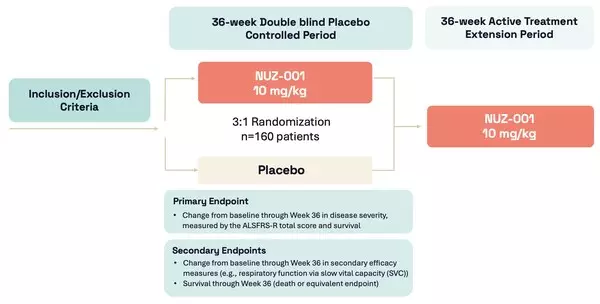
Regimen I (NUZ-001) includes a randomised, placebo-controlled treatment (RCT) phase followed by an active treatment extension (ATE) phase, both with a 36-week treatment period. Approximately 160 participants with ALS will be randomised to receive either daily NUZ-001 at the recommended Phase 2 dose of 10 mg/kg or placebo at a 3:1 ratio. The primary objective is to evaluate the efficacy of NUZ-001 compared with placebo on ALS disease progression, with secondary objectives including additional measures of disease progression and safety.
Figure 1: Regimen I Study Design
Participation in the HEALEY ALS Platform Trial provides Neurizon with access to an established clinical development framework supported by the world's most highly regarded ALS investigators and leading clinical centres across the US. This infrastructure improves trial efficiency, supports consistent data generation and facilitates ongoing engagement with regulatory authorities, including the U.S. Food and Drug Administration (FDA), as the trial progresses.
Professor Merit Cudkowicz, Principal Investigator, HEALEY ALS Platform Trial & Director, Sean M. Healey & AMG Center for ALS, Mass General Brigham, commented: "We look forward to working with Neurizon on this new regimen in the HEALEY ALS Platform Trial and implementing our updated master protocol. Beginning enrolment is a significant step for the regimen, and would not be possible without the dedication of people living with ALS and their families, collaborators, and our top trials sites."
Managing Director and Chief Executive Officer, Dr Michael Thurn commented: "The dosing of the first participant in Regimen I of the HEALEY ALS Platform Trial marks a defining milestone for Neurizon and for NUZ-001. This study represents our registrational trial in ALS - a rigorous, adaptive Phase 2/3 program designed to generate the clinical evidence required to support potential regulatory submissions."
"Entry into the HEALEY ALS Platform Trial reflects our scientific data package and the favourable safety and tolerability profile observed in our Phase 1 and Open Label Extension studies. The master protocol structure enables efficient study execution across leading ALS centres in the United States, while maintaining the scientific rigour required at this stage of development."
"We are deeply grateful to the participants and their families who commit their time and energy to clinical research, often while navigating the significant challenges associated with living with ALS. For people living with ALS, urgency matters. Through this pivotal study, we are advancing NUZ-001 with scientific discipline, operational focus, and deep respect for the ALS community as we work toward delivering meaningful progress in this devastating disease."
This announcement has been authorized for release by the Board of Neurizon Therapeutics Limited.
About Neurizon Therapeutics Limited
Neurizon Therapeutics Limited (ASX: NUZ) is a clinical-stage biotechnology company dedicated to advancing treatments for neurodegenerative diseases. Neurizon is developing its lead drug candidate, NUZ-001, for the treatment of ALS, which is the most common form of motor neurone disease. Neurizon's strategy is to accelerate access to effective ALS treatments for patients while exploring the potential of NUZ-001 for broader neurodegenerative applications. Through international collaborations and rigorous clinical programs, Neurizon is dedicated to creating new horizons for patients and families impacted by complex neural disorders. NUZ-001 is an investigational product and is not approved for commercial use in any jurisdiction.
About the HEALEY ALS Platform Trial
The HEALEY ALS Platform Trial is a multicenter, double-blind, placebo-controlled, adaptive trial for ALS created in partnership with the Network of Excellence for ALS (NEALS). The goal of the HEALEY ALS Platform trial is to accelerate the development of potential new ALS therapies. The trial tests and evaluates multiple investigational drugs simultaneously, shares infrastructure across trial sites, and improves start up and enrollment efficiencies, allowing for fast results.
Neurizon® is a registered trademark of Neurizon Therapeutics Limited
** The press release content is from PR Newswire. Bastille Post is not involved in its creation. **
Neurizon Initiates Dosing of NUZ-001 in HEALEY ALS Platform Trial