Pakistani Defense Minister Khawaja Asif declared on Friday that Pakistan has run out of patience and is in "open war" with Afghanistan.
An Afghan attack on Thursday evening that destroyed Pakistani border posts and key installations has triggered a sharp escalation, with Pakistan launching retaliatory airstrikes early Friday on major Afghan military facilities, according to military sources.
Asif posted Friday on X that Pakistan's "cup of patience has overflowed" and is now in "open war" with Afghanistan. "Now it is open war between us and you. We are your neighbors; we know your ins and outs," he wrote.
Earlier in the morning of Friday, Pakistan launched airstrikes on Afghan Taliban facilities, destroying key targets including a major ammunition depot, three Afghan battalions, and a sector headquarters in different areas of Afghanistan.
Pakistan conducted the air strikes as part of the Operation Ghazab Lil Haq (The Wrath of Justice) which was launched after the Afghan Taliban started attacks on Pakistani posts.
Afghan government spokesperson Zabihullah Mujahid confirmed the strikes on social media platform X, saying Pakistani forces had hit targets in Kabul, southern Kandahar, and eastern Paktia province.
He added that extensive retaliatory operations were carried out against Pakistani military positions in Kandahar and Helmand.

Pakistan declares "open war" with Afghanistan after cross-border strikes

Pakistan declares "open war" with Afghanistan after cross-border strikes

Pakistan declares "open war" with Afghanistan after cross-border strikes
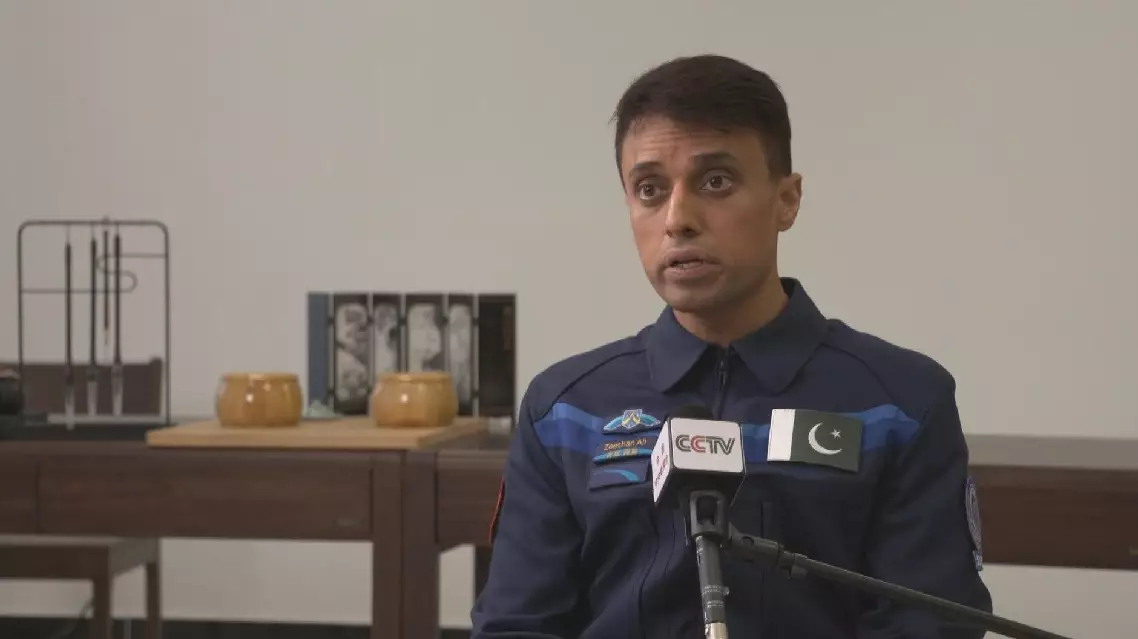
Pakistani astronaut Muhammad Zeeshan Ali, selected as a payload specialist to join the Shenzhou-24 spaceflight mission, will participate in four science experiments aboard China's Tiangong space station.
China's Shenzhou-24 crewed spaceship is scheduled to be launched at 08:18 (Beijing Time) Wednesday from the Jiuquan Satellite Launch Center in northwest China, the China Manned Space Agency announced on Tuesday.
The crew will consist of commander Tang Hongbo, flight engineer Wu Yi, and Pakistani payload specialist Muhammad Zeeshan Ali, marking the first joint flight involving Chinese and foreign astronauts in the history of China's manned space program.
In orbit, Ali will join in the crew's routine work and focus on joint China-Pakistan space science experiments, primarily installing experiment samples and units and carrying out in-orbit experiments as scheduled.
In preparation for the first joint flight involving Chinese and foreign astronauts, the crew has carried out extensive ground training, including task allocation, coordination, and emergency response procedures.
"The mission itself doesn't comprise of visiting the space station, it has many stages. The first one I've already talked about is the flying the Shenzhou spaceship, getting safely out of the atmosphere, going to the space station and then obviously returning safely back to the Earth. This is a huge part of this mission and we've already mastered the flight procedure for the Shenzhou spaceship," Ali said.
Pakistan had issued a nationwide call for proposals for space science experiments and received a total of 300 submissions. After multiple rounds of expert review, four projects were selected that are suitable for the space station's in-orbit conditions and possess scientific value.
These experiments will be conducted in orbit by the Pakistani payload specialist, who has also brought a set of specialized scientific experimental equipment from Pakistan.
"There are four experiments that I will be going with this Shenzhou-24 mission. Out of those four experiments, two are pertaining to life sciences and two are pertaining to the material sciences. And out of these four experiments, three are for the long duration experiments that would be there on the space station for one year and sequentially they will be conducted. But very important out of these experiments is the green micro factory experiment that I would be doing myself at the space station. If we are able to get a progress out of this, I think that can be very valuable for long-duration human flights as well as a regenerative life support and also it will improve the food security and the agricultural practices of human beings on the Earth as well," Ali said.
Ali will return to Earth aboard the Shenzhou-23 spaceship after completing a short-term joint flight, said Zhang.
Pakistani astronaut to participate in four science experiments aboard China's space station
Pakistani astronaut to participate in four science experiments aboard China's space station