NYON, Switzerland (AP) — Bodø/Glimt is a feelgood soccer story for the ages just as the divisive and cash-driven Super League project finally ended this month. The timing seems richly ironic.
At the Champions League draw on Friday, Manchester City’s potential opponents in the round-of-16 bracket were two teams representing wildly different visions of European soccer.
Bodø/Glimt, the homely and humble club from a small Norwegian fishing town, or Real Madrid, the aristocrat which drove the Super League toward trying to destroy the Champions League.
“For modern football I think it’s important that a club like ours are a bigger part of this,” Bodø/Glimt chief executive Frode Thomassen told the Associated Press at UEFA headquarters after his club was paired with Sporting Lisbon.
Man City had earlier been given its other option, two games in back-to-back midweeks against Real Madrid. For the fifth straight season. Facing each other for the 12th and 13th times in the Champions League in just over six years.
This is the kind of regular fixture Madrid, Man City and the other 10 storied members of Super League wanted when plotting their breakaway from UEFA in April 2021.
In April 2021, Bodø/Glimt was nowhere near being invited to the Super League and had never even played in the European Cup or Champions League.
The Super League collapsed within 48 hours amid a backlash from fans and lawmakers, especially in England.
Five years on, Bodø/Glimt is a Champions League standout reeling off four straight wins in five weeks against wealthy Super League founders: Man City, Atletico Madrid and Inter Milan, twice. Since winning on Tuesday at San Siro, Bodø/Glimt's followers on Instagram doubled to more than 400,000.
“We deserve to be here now,” Thomassen said. “It’s not always about money, it’s about the people and what kind of effort you put into it. To be able every year to take new steps."
Bodø/Glimt's Champions League debut was in July 2021 in the unglamorous first qualifying round. The first-time champion of Norway lost to Legia Warsaw 3-2 at its tiny Aspmyra Stadium, and then 2-0 in Poland.
It was the start of a magical European run. Bodø/Glimt switched to qualifying rounds of the inaugural Europa Conference League, and 18 games later lost to José Mourinho’s Roma in the quarterfinals.
In 2022 and in 2024, Bodø/Glimt lost in the Champions League playoffs round in August. Last season, a switch to the Europa League ended in the semifinals against Tottenham.
Last August, Bodø/Glimt cracked the code. Another Norwegian title lifted the team direct to the qualifying playoffs where Sturm Graz was easily beaten.
The elite stage beckoned after steady progress under Thomassen and coach Kjetil Knutsen, who both joined Bodø/Glimt in 2017, and a loyal group of staff.
Thomassen laughs at comparisons with Leicester’s English Premier League title in 2016, as close to a miracle as any in modern sports.
“Leicester and those clubs had a lot bigger organization than we have,” he said, reflecting on his club nine years ago. “We were just 40 people employed in the company and that was including players. We had a 4.2 million euros ($5 million) budget in total.
“There’s a lot of people who have been on the journey with us. We are a small group of people but it’s a lot of heart and passion for the game and the work that they do.
“It’s the same as family,” Thomassen said. “For some people a hug is just a hug. When you see our players hug, and they meet every day, it is like a relationship built on respect and, in a way, love.”
The team-first ethic of mostly Norwegian and Danish players, he believes, helped the team grow after “we struggled a little bit” starting the Champions League with no wins, three draws and three losses through December.
“We often see that the other team has individual elements in their play, some of them at a high, high level,” Thomassen said. “We are more of a team, a solid team.”
UEFA prize money is starting to pile up: More than 26 million euros ($30 million) last season, and now approaching the kind of 61 million euros ($72 million) total Club Brugge earned last season when reaching the Champions League round of 16.
Beating Sporting will mean a 12.5 million euros ($14.8 million) bonus from UEFA for the quarterfinals against Arsenal or Bayer Leverkusen.
“It’s a not always about money, it’s about the people and what kind of effort you put into it,” Thomassen said. “That’s one of our main ideas — to be grounded.”
Still, a new stadium, the 10,000-seat Arctic Arena, is being built on the edge of town.
“For the game of football it’s kind of beautiful,” Thomassen said, “that a club like ours can be among the 16 last clubs left in the Champions League.”
AP soccer: https://apnews.com/hub/soccer

Bodø/Glimt's Jens Petter Hauge celebrates after scoring against Inter Milan during a Champions League soccer match, Wednesday, Feb 18, 2026, in Bodo, Norway. (Thomas Andersen/NTB Scanpix via AP)

Glimt's Hakon Evjen celebrates after scoring his side's second goal during a Champions League playoff soccer match between Inter Milan and Bodo Glimt, at the San Siro stadium in Milan, Italy, Tuesday, Feb.24, 2026. (AP Photo/Luca Bruno)

Glimt's head coach Kjetil Knutsen reacts during a Champions League playoff soccer match between Inter Milan and Bodo Glimt, at the San Siro stadium in Milan, Italy, Tuesday, Feb.24, 2026. (AP Photo/Luca Bruno)
DIBBINE, Lebanon (AP) — Israel’s air force struck different parts of southern Lebanon on Friday, and its military issued evacuation warnings for nine villages, including one that has been spared much of the destruction and has sheltered thousands of people displaced by the three-month war.
The Israeli strikes killed nine people in six locations in southern Lebanon, the state news agency reported.
Meanwhile, the new warnings forced hundreds of families to flee the village of Anqoun and the area of Aarnaya, on the edge of the predominantly Christian community of Maghdoucheh, near the southern port city of Sidon. Elsewhere, people began to return to their homes to survey the aftermath of fighting between Israeli forces and the Hezbollah militant group.
Wide parts of the south have already been devastated by the war. An Associated Press team traveling in the south Friday saw multiple villages in ruins, including Dibbine, near Marjayoun town, from which Israeli troops withdrew a day earlier.
It was the first time Israeli troops pulled out of an area in southern Lebanon since the latest Israel-Hezbollah war began in early March. U.N. peacekeepers and Lebanese troops were at an entrance of Dibbine, clearing rubble and opening roads.
But the Lebanese army set up barbed wire at one of the entrances, preventing residents from returning yet.
At least one family arrived to search the rubble of its home along the road leading to the village, while the owner of a petrol station in Dibbine looked at his destroyed property and called village residents to report on the destruction he saw from behind the barbed wire.
Israel had warned Lebanese residents against returning to villages in the south, saying the area is still a combat zone.
The current ceasefire agreement calls for Lebanon’s armed forces to take control of security zones in Lebanon from which the militants would be banned. But the latest deal between Israel and the Lebanese government has been rejected by Hezbollah, which demanded a complete Israeli withdrawal from Lebanon.
Lebanese Parliament Speaker Nabih Berri, a strong ally of Hezbollah who has been acting as a mediator on behalf of the group, echoed the militants' demands. In his first comments since the agreement was announced Wednesday in Washington, Berri said that he accepts Hezbollah’s withdrawal from the areas south of the Litani River as long as it coincides with the withdrawal of Israeli troops from southern Lebanon.
The river, about 30 kilometers (20 miles) north of the border with Israel, forms the boundary of a 2006 U.N.-established buffer zone in which Hezbollah is banned. Israeli troops have pushed far past the river into southern Lebanon.
Berri added in a written statement that the ceasefire should be “complete and comprehensive,” without any exceptions for land, sea or air, and “without bulldozing and demolishing everything that exists.” He was referring to wide areas that have been demolished by Israeli troops.
The war in Lebanon, where Israeli forces have seized large swaths of the south since March 2, threatens efforts to end the Iran war and reopen the Strait of Hormuz, a globally important conduit for oil, natural gas, fertilizer and other commodities.
Iran has demanded that any lasting truce extend to Lebanon. Israeli Prime Minister Benjamin Netanyahu, who faces elections later this year, wants to press ahead with Israel’s offensive until Hezbollah no longer poses a threat.
In Iran developments, American forces boarded a sanctioned oil tanker linked to the Islamic Republic in the Indian Ocean, the U.S. military said Friday.
U.S. Indo-Pacific Command posted on X that the forces boarded the MT Davina, without offering details. U.S. forces around the world have sought to prevent Iran from profiting off its oil and other goods. They have been directed to stop ships tied to Tehran or those suspected of carrying supplies that could help its government.
The U.S. Navy has imposed a blockade of Iran’s ports as part of an effort to force Tehran to open the strait and accept a deal to extend a tenuous ceasefire in the war.
Nearly three hours after Friday's evacuation warnings were issued by the Israeli military’s Arabic spokesperson, Israeli warplanes struck the Lebanese villages, including Anqoun. About 2,500 people displaced by the fighting were sheltering in Anqoun, the Lebanese news agency NNA reported.
Shrapnel and pieces of missiles were seen in the rubble of homes lining the road into Dibbine. Israeli troops entered the village weeks ago for the first time and were engaged in heavy clashes with Hezbollah fighters in the area. The troops returned this week, before withdrawing Thursday.
The road to Dibbine was dotted with villages entirely emptied of residents and destroyed by Israeli strikes, including Khiam. But no Israeli troops were visible from the road.
Nearby Christian villages were largely untouched, and many of their residents decided to stay. The strategic Beaufort castle, captured by Israel last week, appeared in the distance, with a flag of the Israeli Golani Brigade. Smoke from strikes around the nearby Nabatiyeh city billowed above.
Israeli troops have seized around a fifth of Lebanon, pushing further into the country’s south than at any time since the end of Israel’s 1982-2000 occupation. The latest declared ceasefire came about through U.S.-brokered talks between Israel and Lebanon’s government, which accuses Hezbollah of dragging the country into war and had made efforts to disarm it before the latest hostilities.
On Thursday night, an airstrike in the southern city of Tyre killed three and wounded seven people, including three children and two women, the Health Ministry said.
In northern Israel on Thursday, drone alert sirens sounded in several border communities, including a town where Netanyahu had met earlier with local officials. The Israeli military later said the sirens were triggered by attempts to intercept several drones that hit near soldiers in southern Lebanon. No injuries were reported.
More than 3,500 people have been killed in Lebanon since the war began. The fighting has killed at least 29 Israeli soldiers and three civilians.
Associated Press writers Bassem Mroue in Beirut and Ben Finley in Washington contributed to this report.
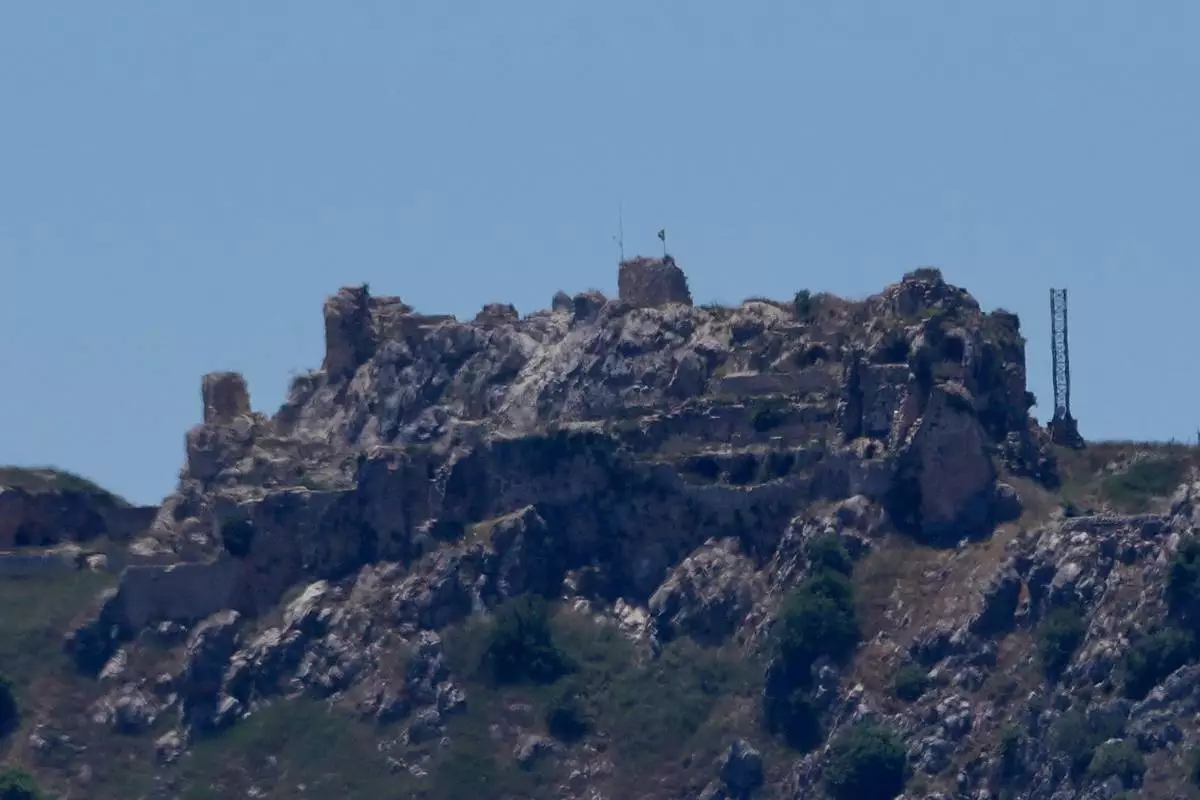
A view of Beaufort Castle, southeast Lebanon, Friday, June 5, 2026. (AP Photo/Hussein Malla)
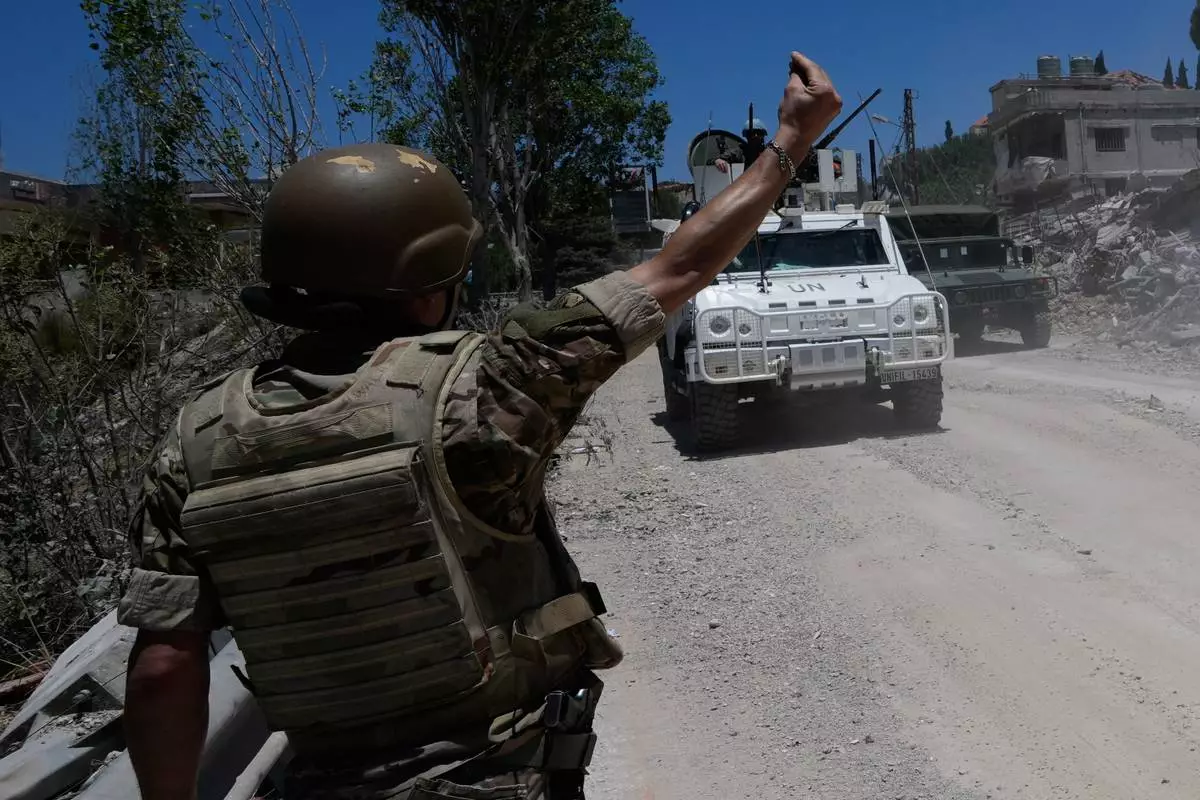
A Lebanese soldier gestures in front of a Spanish U.N peacekeeper vehicle Dibbine village, southeast Lebanon, Friday, June 5, 2026, a day after Israeli forces withdrew following clashes with Hezbollah fighters. (AP Photo/Hussein Malla)
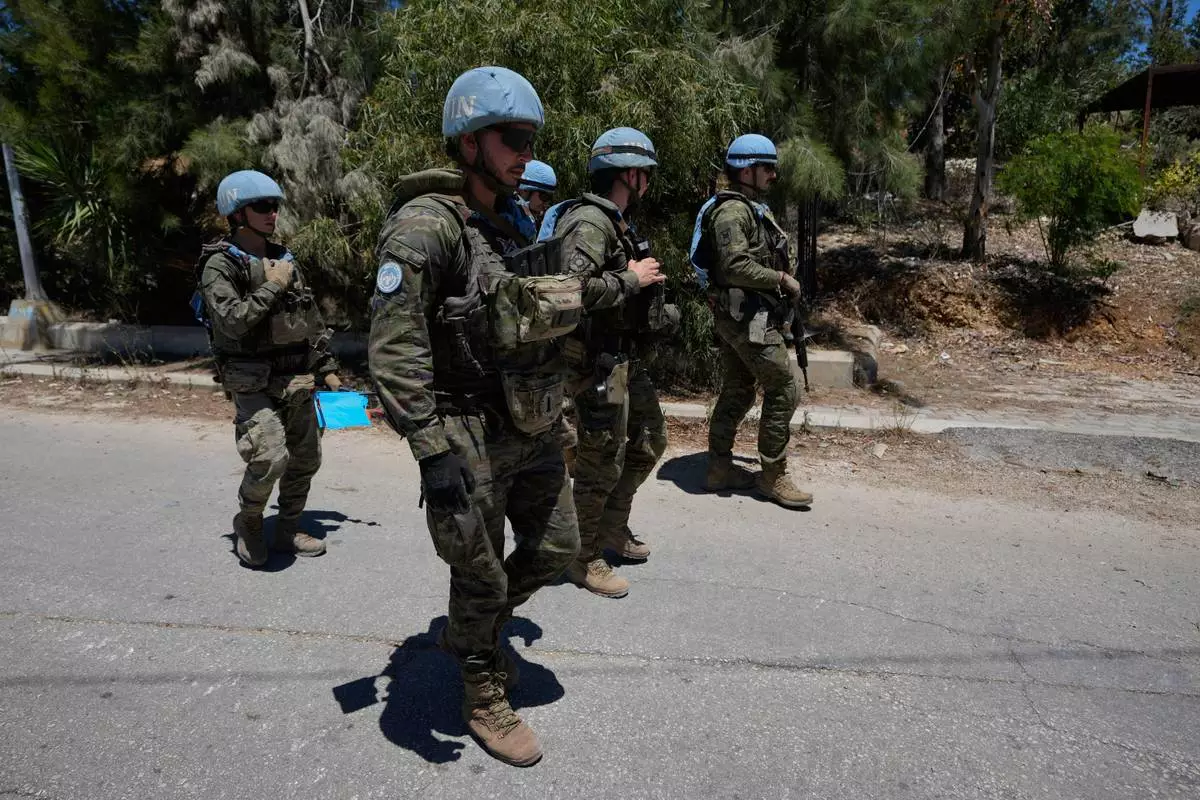
Spanish U.N peacekeepers patrol at an entrance of Dibbine village, southeast Lebanon, Friday, June 5, 2026, a day after Israeli forces withdrew following intense clashes with Hezbollah fighters. (AP Photo/Hussein Malla)
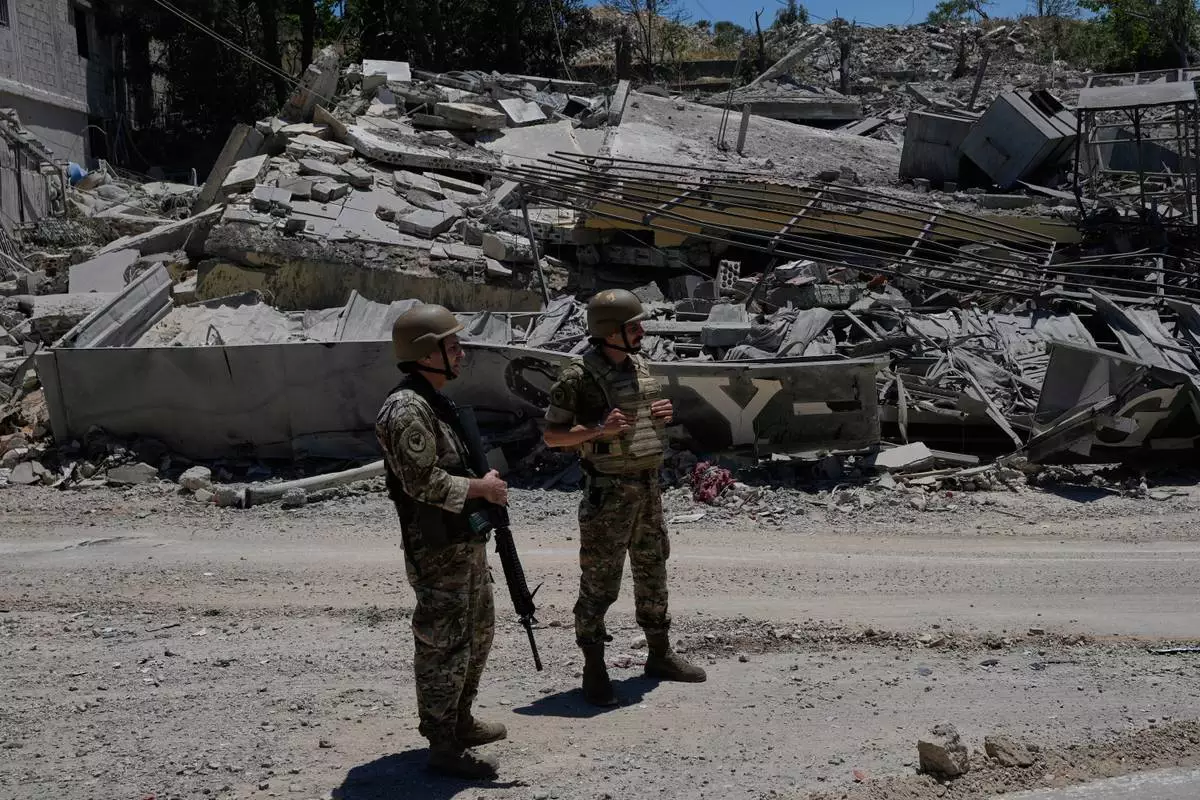
Lebanese army soldiers stand in front of a house that was destroyed in the recent clashes between Hezbollah fighters and Israeli troops in Dibbine village, southeast Lebanon, Friday, June 5, 2026, a day after Israeli forces withdrew. (AP Photo/Hussein Malla)
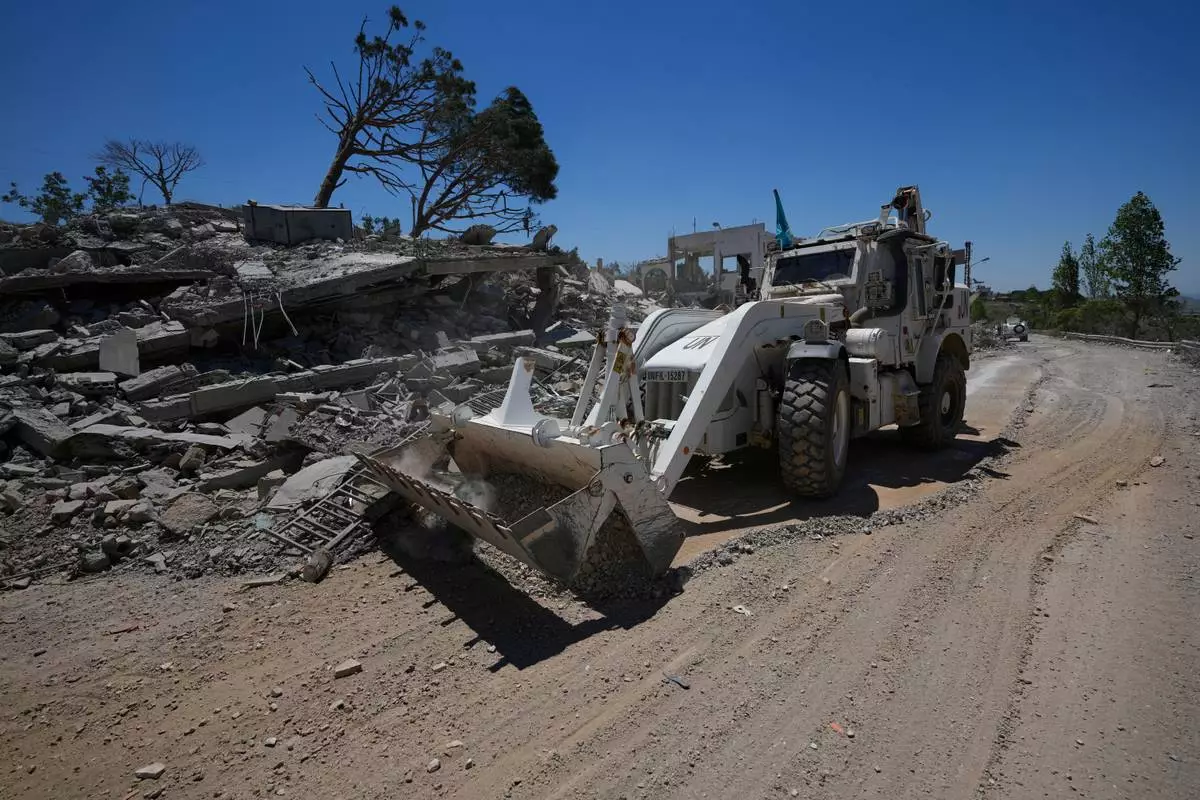
A bulldozer for the Spanish U.N peacekeeper opens a road in front of a house that was destroyed in the recent clashes between Hezbollah fighters and Israeli troops in Dibbine village, southeast Lebanon, Friday, June 5, 2026, a day after Israeli forces withdrew. (AP Photo/Hussein Malla)
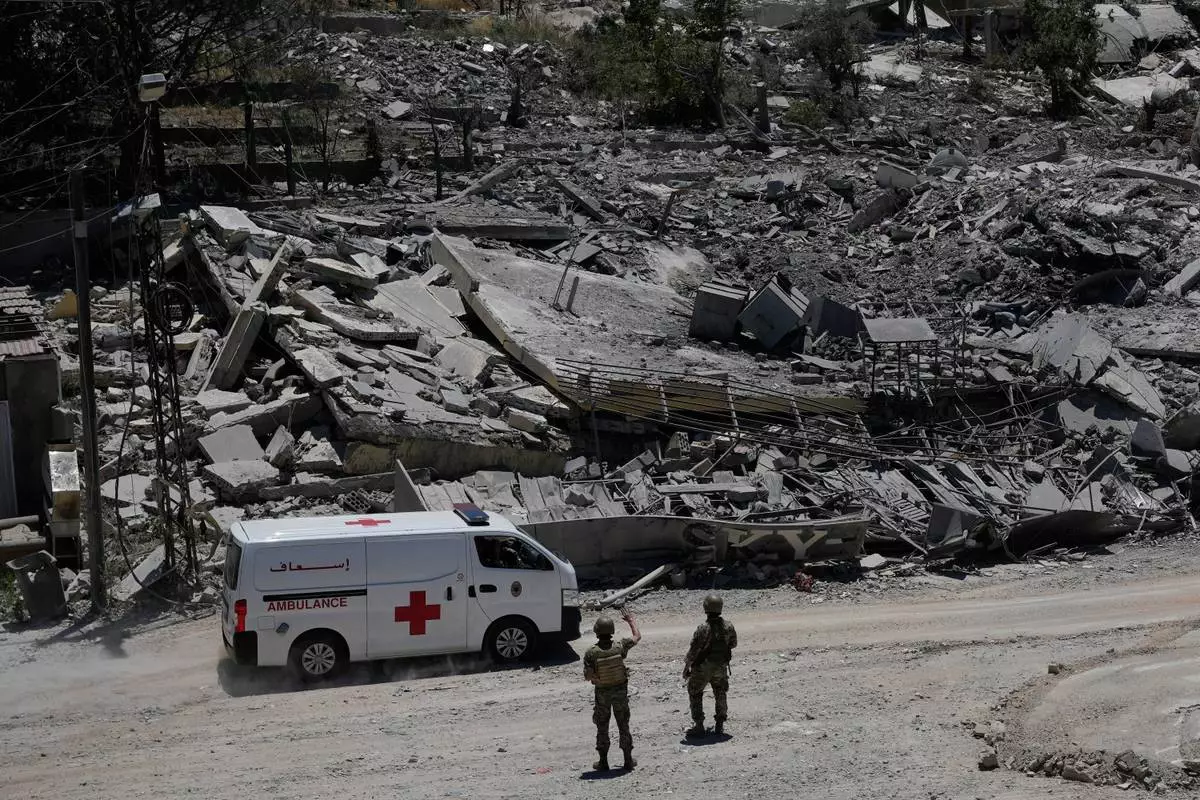
Lebanese soldiers deploy at a road in front of destroyed houses in Dibbine village, southeast Lebanon, Friday, June 5, 2026, a day after Israeli forces withdrew following clashes with Hezbollah fighters. (AP Photo/Hussein Malla)
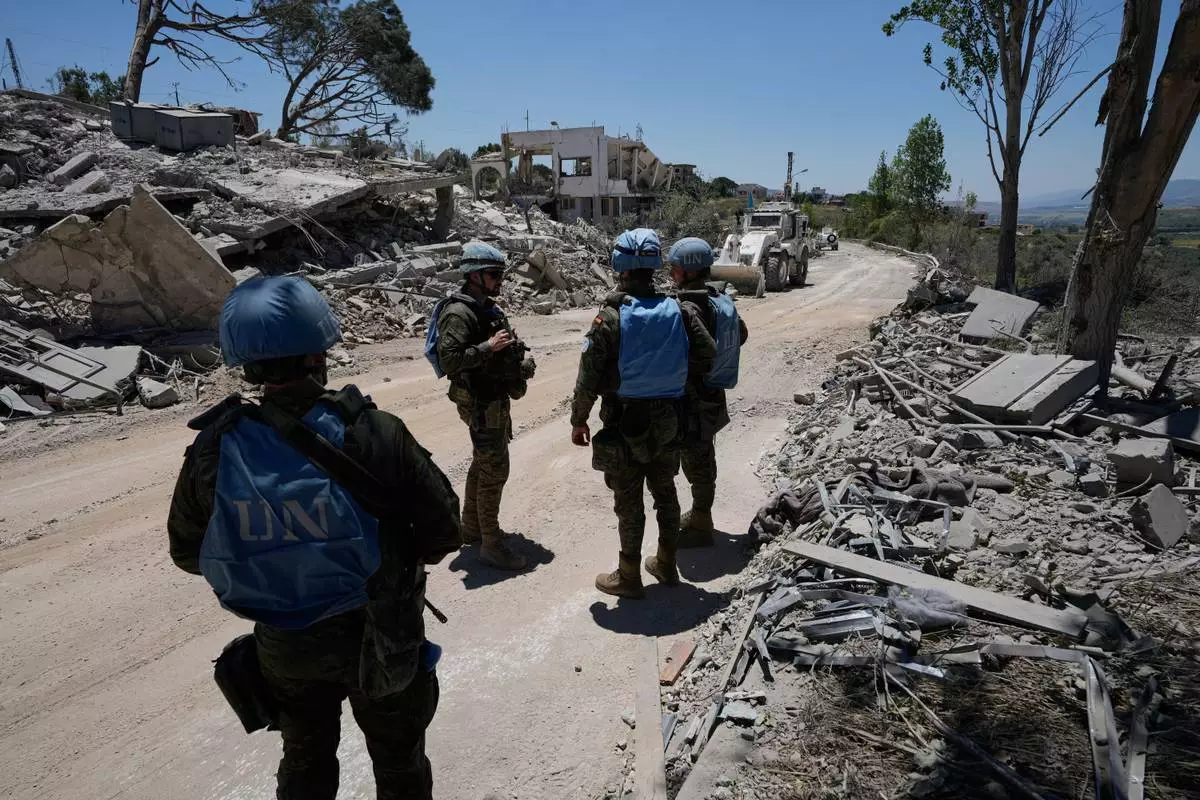
Spanish U.N peacekeepers deploy at a road in Dibbine village, southeast Lebanon, Friday, June 5, 2026, a day after Israeli forces withdrew following intense clashes with Hezbollah fighters. (AP Photo/Hussein Malla)
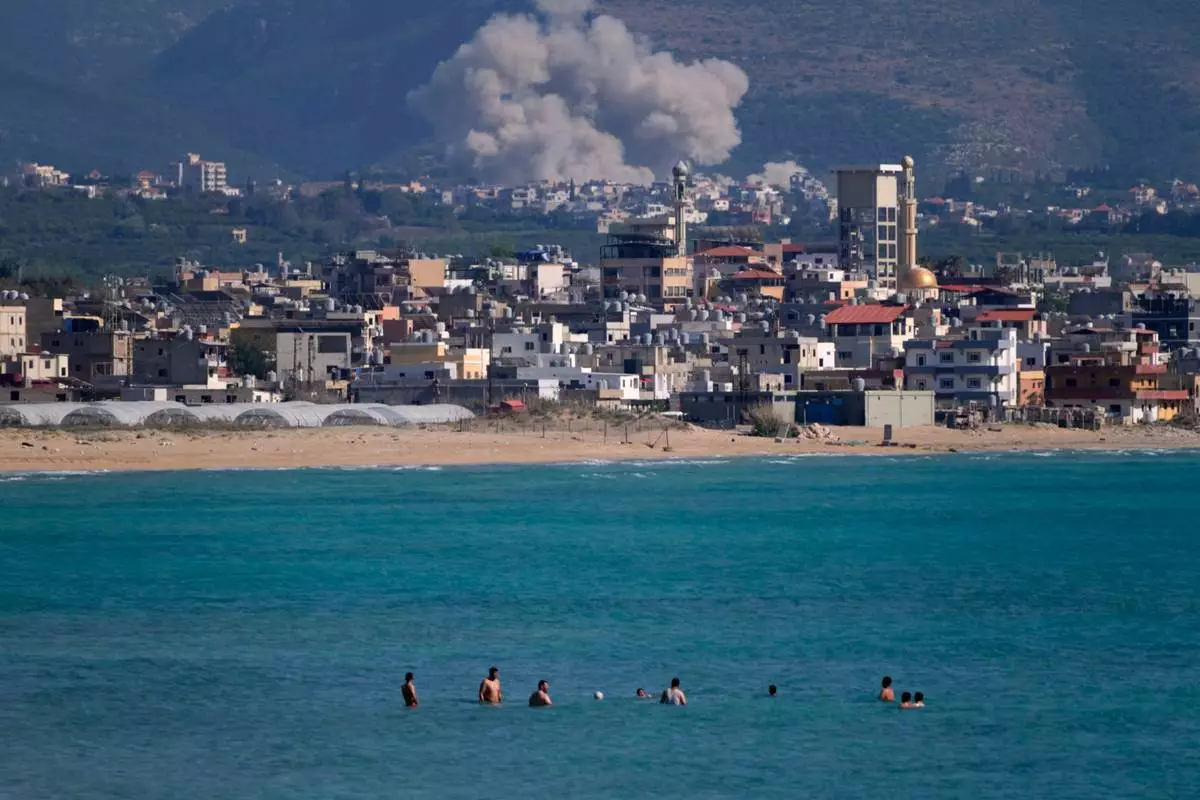
People swim on a public beach as smoke, background, rises from an Israeli airstrike that hit the Qlaileh village, seen from the southern port city of Tyre, Lebanon, Tuesday, June 2, 2026. (AP Photo/Mohammed Zaatari)
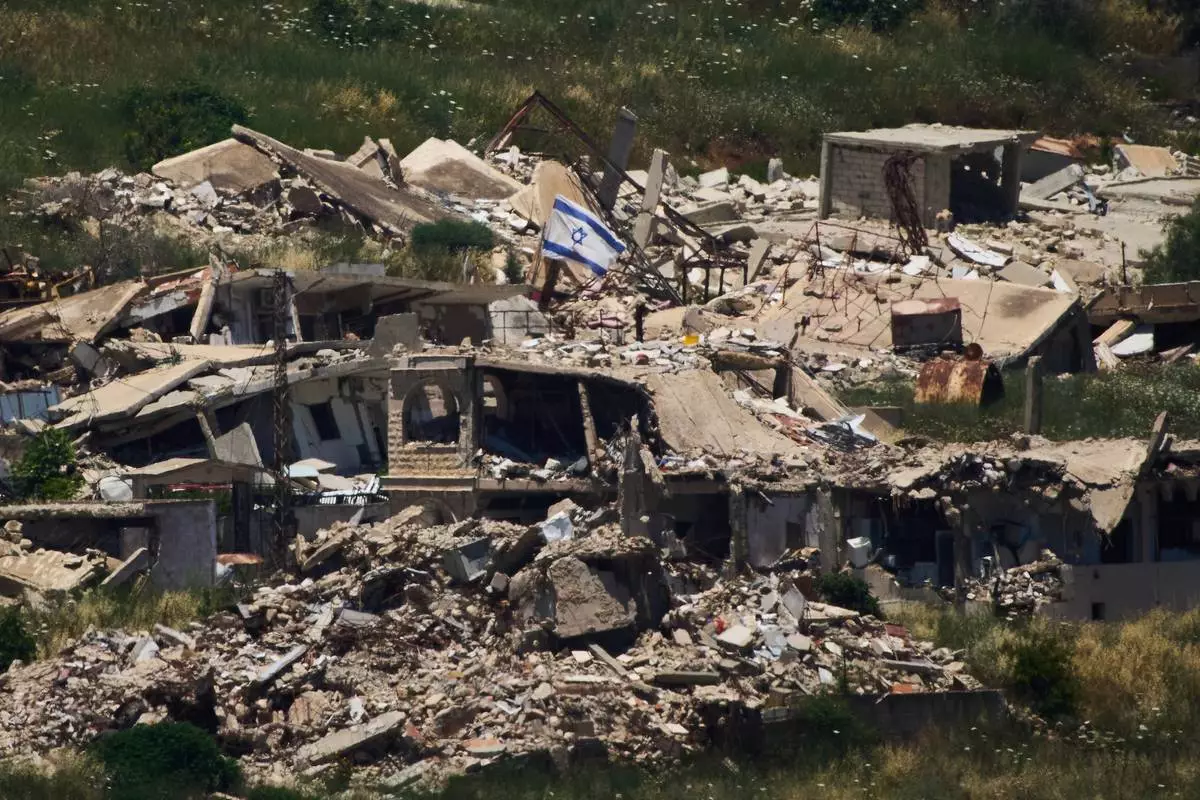
An Israeli flag hangs on a destroyed building in southern Lebanon as seen from northern Israel, Thursday June 4, 2026. (AP Photo/Ariel Schalit)