Skip to Content Facebook Feature Image

What to know about the clash between the Pentagon and Anthropic over military's AI use

News

What to know about the clash between the Pentagon and Anthropic over military's AI use
News

News

What to know about the clash between the Pentagon and Anthropic over military's AI use

2026-03-01 06:30 Last Updated At:14:45

WASHINGTON (AP) — A high-stakes dispute over military use of artificial intelligence erupted into public view this week as Defense Secretary Pete Hegseth brusquely terminated Anthropic's work with the Pentagon and other government agencies, using a law designed to counter foreign supply chain threats to slap a scarlet letter on a U.S. company.

President Donald Trump and Hegseth accused rising AI star Anthropic of endangering national security after its CEO Dario Amodei refused to back down over concerns the company’s products could be used for mass surveillance or autonomous armed drones.

The San Francisco-based company has vowed to sue over Hegseth's call to designate Anthropic a supply chain risk, an unprecedented move to apply a law intended to counter foreign threats to a U.S. company.

Anthropic said it would challenge what it called a legally unsound action “never before publicly applied to an American company.”

The looming legal battle could have huge implications on the balance of power in Big Tech during a critical juncture, as well as the rules governing military use of AI and other guardrails that are set up to prevent a technology from posing threats to human life.

The dustup already has resulted in a coup for ChatGPT maker OpenAI, which seized upon an opportunity to step into the void to make its technology available to the Pentagon after Anthropic objected to some of the Trump administration's terms. It's a turn of events likely to deepen the animosity between OpenAI CEO Sam Altman, who was temporarily ousted by his own board in late 2023 over questions about his trustworthiness, and Amodei, who left OpenAI in 2021 to launch Anthropic partly because of concerns about AI safety.

The Department of Defense's move to label Anthropic a risk to the nation's defense supply chain will end its up to $200 million contract with the AI company. It will also, according to the Pentagon, prohibit other defense contractors from doing business with Anthropic.

Trump wrote on Truth Social that most government agencies must immediately stop using Anthropic’s AI but gave the Pentagon a six-month period to phase out the technology that is already embedded in military platforms.

Anthropic argues that Hegseth doesn’t have the legal authority to stop business relationships with other defense contractors. Any company that still holds a commercial contract with Anthropic can continue to use its products for non-defense projects, the company wrote in a statement.

The supply chain risk designation was created to give American military leaders a way to limit the Pentagon's exposure to companies posing a potential security risk. The list has typically included firms with ties to adversaries, such as telecom giant Huawei, which has links to China, or cybersecurity specialist Kaspersky, which has links to Russia.

In the case of Anthropic, the designation serves as a warning to other AI and defense companies: Fail to meet our demands and you will be blacklisted.

“We don’t need it, we don’t want it, and will not do business with them again!” Trump said on social media.

Trump's six-month grace period for the Pentagon essentially opens a window for other companies to get the classified security clearances that are needed to work with the agency.

Anthropic says it has yet to be formally notified of Hegseth's designation.

“When we receive some kind of formal action, we will look at it, we will understand it and we will challenge it in court,” Amodei vowed during an interview with CBS News that will be aired Sunday morning.

For now, Anthropic is trying to convince the businesses and government agencies that the Trump administration's supply chain risk designation only affects the usage of Claude, its AI chatbot and computer coding agent, for military contractors when they are using the tool on work for Department of Defense work.

"Your use for any other purpose is unaffected,” Anthropic wrote in its statement.

Making that distinction clear is crucial for Anthropic because most of its projected $14 billion in revenue this year comes from businesses and government agencies that are using Claude for computer coding and other tasks. More than 500 customers are paying Anthropic at least $1 million annually for Claude, according to an announcement disclosing an investment that had valued the company at $380 billion.

Anthropic’s Claude technology has been gaining so much traction that it has emerged a viable replacement for a wide range of business software tools that is currently sold by major tech companies such as Salesforce and Workday. That potential has caused the stocks of companies that sell business software as a service to plunge this year.

But now that Anthropic has been labeled as a supply chain risk, there is some uncertainty about whether its customers will still feel comfortable using Claude for non-military work and risk drawing Trump’s ire. Any widespread reluctance to use Claude, despite all the inroads it has made during the past year, might slow the advance of AI in the U.S. at a time the country is racing to staying ahead of China in a technology that is expected to reshape the economy and society.

At the same time, Anthropic and Amodei may now have a bully pulpit to push their agenda for erecting sturdier guardrails around how AI operates.

“No amount of intimidation or punishment from the Department of War will change our position on mass domestic surveillance or fully autonomous weapons,” the company said. “We will challenge any supply chain risk designation in court.”

In his interview with CBS, Amodei portrayed Anthropic’s dispute with the Trump administration as a stand for democracy.

“Disagreeing with the government is the most American thing in the world,” Amodei said. ”And we are patriots. In everything we have done here, we have stood up for the values of this country.”

Hours after its competitor was punished, OpenAI's Altman announced on Friday night that his company struck a deal with the Pentagon to supply its AI to classified military networks. But Altman said that the same AI restrictions that were the sticking point in Anthropic’s dispute with the Pentagon are now enshrined in OpenAI’s new partnership.

In a memo obtained by The Associated Press, Altman told OpenAI employees: “We have long believed that AI should not be used for mass surveillance or autonomous lethal weapons, and that humans should remain in the loop for high-stakes automated decisions. These are our main red lines.”

It is unclear why the Pentagon agreed to OpenAI's red lines but not Anthropic's. But in his memo, Altman wrote that the company believes it can “de-escalate things” by working with the Pentagon while still adhering to sound safety protections.

OpenAI's deal with the Trump administration came on the same day it announced raising another $110 billion as part of an infusion that values the San Francisco-based company at $730 billion.

But OpenAI also may face a potential backlash if its work with the Pentagon is widely viewed by U.S. consumers who use ChatGPT as an instance of putting the pursuit of profit ahead of AI safety.

The Anthropic rift could also open new opportunities Musk, who co-founded OpenAI with Altman in 2015 before the two had a bitter falling out over safety concerns and financial issues. Musk has accused Altman of fraud and other deceitful behavior in a case scheduled to go to trial in late April.

Musk now oversees the AI chatbot, Grok, which the Pentagon also plans to give access to classified military networks despite its safety and reliability on top of government investigations into its creation of sexualized deepfake images. Musk has already been cheering on the Trump administration in its spat with Amodei, saying on his social media platform X that “Anthropic hates Western Civilization.”

Google, which has developed a suite of widely used AI tools on its Gemini technology, also could be in the running for more business from the U.S. military, although an outspoken flank of its workforce have been imploring executives to avoid doing deals that would violate the company's former motto, “Don't be evil.” Google's executives so far haven't publicly discussed Anthropic's falling out with the Trump administration.

Liedtke reported from San Ramon, California.

_
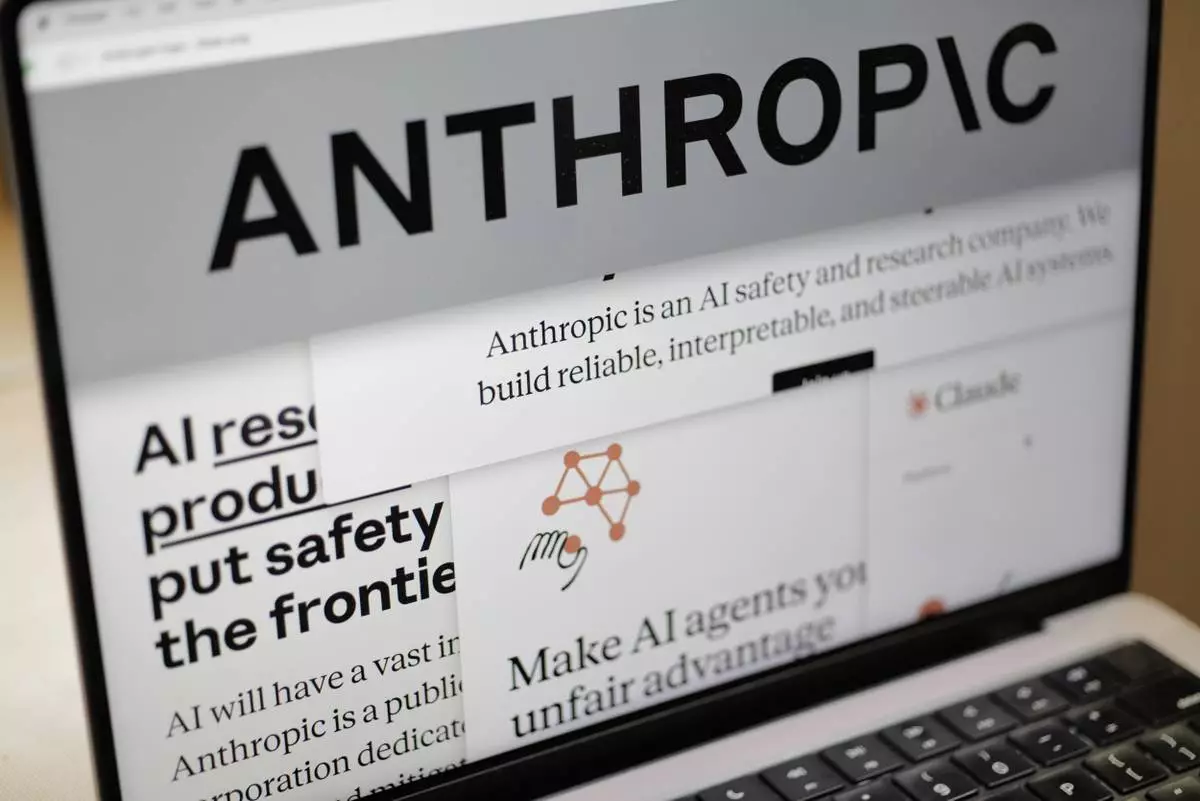
Pages from the Anthropic website and the company's logo are displayed on a computer screen in New York on Thursday, Feb. 26, 2026. (AP Photo/Patrick Sison)

Pages from the Anthropic website and the company's logo are displayed on a computer screen in New York on Thursday, Feb. 26, 2026. (AP Photo/Patrick Sison)

FILE - Defense Secretary Pete Hegseth stands outside the Pentagon during a welcome ceremony for the Japanese defense minister at the Pentagon in Washington, Jan. 15, 2026. (AP Photo/Kevin Wolf, File)
FILE - Defense Secretary Pete Hegseth stands outside the Pentagon during a welcome ceremony for the Japanese defense minister at the Pentagon in Washington, Jan. 15, 2026. (AP Photo/Kevin Wolf, File)

The Virginia Supreme Court on Friday struck down a voter-approved Democratic congressional redistricting plan, delivering another major setback to the party in a nationwide battle against Republicans for an edge in this year's midterm elections.

The court ruled 4-3 that the state's Democratic-led legislature violated procedural requirements when it placed the constitutional amendment on the ballot to authorize the mid-decade redistricting. Voters narrowly approved the amendment April 21, but the court's ruling renders the results of that vote meaningless.

Writing for the majority, Justice D. Arthur Kelsey wrote that the legislature submitted the proposed constitutional amendment to voters “in an unprecedented manner.”

“This violation irreparably undermines the integrity of the resulting referendum vote and renders it null and void," he wrote.

Democrats had hoped to win as many as four additional U.S. House seats under Virginia's redrawn U.S. House map as part of an attempt to offset Republican redistricting done elsewhere at the urging of President Donald Trump. That ruling, combined with a recent U.S. Supreme Court decision severely weakening the Voting Rights Act, has supercharged the Republicans' congressional gerrymandering advantage heading into this year's midterm elections.

Richard Hudson, chairman of the National Republican Congressional Committee said the ruling was another sign of GOP momentum heading into the midterms.

"We’re on offense, and we’re going to win,” he said in a statement.

Don Scott, the Democratic speaker of the Virginia House of Delegates, said Democrats respect the court’s opinion but lamented that it overturned the will of the voters: “They voted YES because they wanted to fight back against the Trump power grab.”

Suzan DelBene, chairwoman of the Democratic Congressional Campaign Committee, criticized the court majority for what she said was a decision that “cast aside the will of the voters,” but she said the people will have the final say.

“In November, they will, and they’ll power Democrats to the House majority,” she said in a statement.

Legislative voting districts typically are redrawn once a decade after each census to account for population changes. But Trump started an unusual flurry of mid-decade redistricting last year when he encouraged Republican officials in Texas to redraw districts in a bid to win several additional U.S. House seats and hold on to their party's narrow majority in the midterm elections.

California responded with new voter-approved districts drawn to Democrats' advantage, and Utah's top court imposed a new congressional map that also helps Democrats. Meanwhile, Republicans stand to gain from new House districts passed in Florida, Missouri, North Carolina, Ohio and Tennessee. They could add even more after the U.S. Supreme Court's ruling in the Voting Rights Act case, which has prompted some other Republican states to consider redrawing their maps in time for this year’s elections.

Virginia currently is represented in the U.S. House by six Democrats and five Republicans who were elected from districts imposed by a court after a bipartisan redistricting commission failed to agree on a map after the 2020 census. The new districts could have given Democrats an improved chance to win all but one of the state's 11 congressional seats.

The Supreme Court's majority was critical of the state’s redrawing of the congressional maps to benefit one political party. Those justices noted that 47% of the state’s voters supported GOP congressional candidates in 2024 but the new map could result in Democrats making up 91% of the state’s House delegation.

Under the Democratic-drawn map, five districts would have been anchored in the Democratic stronghold of northern Virginia, including one stretching out like a lobster to consume Republican-leaning rural areas. Revisions to four other districts across Richmond, southern Virginia and Hampton Roads would have diluted the voting power of conservative blocs in those areas. And a reshaped district in parts of western Virginia would have lumped together three Democratic-leaning college towns to offset other Republican voters.

The state Supreme Court’s seven justices are appointed by the state legislature, which has toggled back and forth between Democratic, Republican and split control over recent years. Legal experts say the body doesn’t have a set ideological profile

The case before the court focused not on the shape of the new districts but rather on the process the General Assembly used to authorize them.

Because the state’s redistricting commission was established by a voter-approved constitutional amendment, lawmakers had to propose an amendment to redraw the districts. That required approval of a resolution in two separate legislative sessions, with a state election sandwiched in between, to place the amendment on the ballot.

The legislature’s initial approval of the amendment occurred last October — while early voting was underway but before it concluded on the day of the general election. The legislature’s second vote on the amendment occurred after a new legislative session began in January. Lawmakers also approved a separate bill in February laying out the new districts, subject to voter approval of the constitutional amendment.

Judicial arguments focused on whether the legislature’s initial approval of the amendment came too late, because early voting already had begun for the 2025 general election.

Attorney Matthew Seligman, who defended the legislature, argued that the “election” should be defined narrowly to mean the Tuesday of the general election. In that case, the legislature’s first vote on the redistricting amendment occurred before the election and was constitutional, he told judges.

But, the Supreme Court said in its ruling, “this view appears to be wholly unprecedented in Virginia’s history.”

An attorney for the plaintiffs, Thomas McCarthy, argued that an “election” should be interpreted to cover the entire period during which people can cast ballots, which lasts several weeks in Virginia. If that’s the case, he told justices, then the legislature’s initial endorsement of the redistricting amendment came too late to comply with the state constitution.

The Supreme Court agreed with that argument, writing: “The General Assembly passed the proposed constitutional amendment for the first time well after voters had begun casting ballots during the 2025 general election.”

By the time lawmakers initially endorsed the constitutional amendment, statewide voters already had cast more than 1.3 million ballots in the general election, about 40% of the total votes ultimately cast, the court said.

The Supreme Court’s ruling affirms a decision by a judge in rural Tazewell County, in southwestern Virginia. The court had placed a hold on that ruling and allowed the redistricting vote to proceed before hearing arguments on the case.

In the dissent to Friday's ruling, Chief Justice Cleo Powell said the election for the purpose of considering the amendment does not include the early voting period.

“The majority’s definition creates an infinite voting loop that appears to have no established beginning,” she wrote, “only a definitive end: Election Day.”

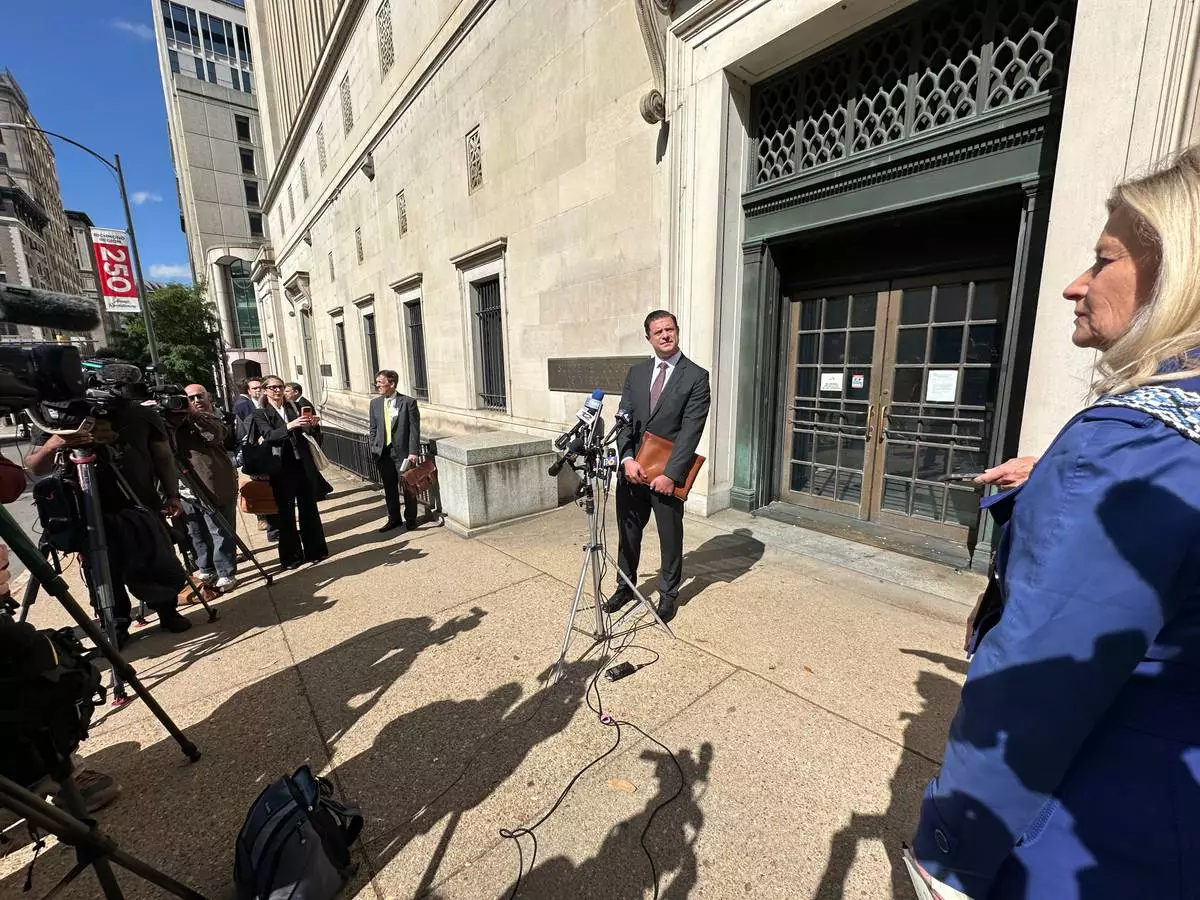
Attorney Matthew Seligman, representing Democratic state legislators, speaks with the media following a hearing on new congressional maps before the state Supreme Court in Richmond, Va., on Monday, April 27, 2026. (AP Photo/Allen G. Breed)

Attorney Matthew Seligman, representing Democratic state legislators, speaks with the media following a hearing on new congressional maps before the state Supreme Court in Richmond, Va., on Monday, April 27, 2026. (AP Photo/Allen G. Breed)

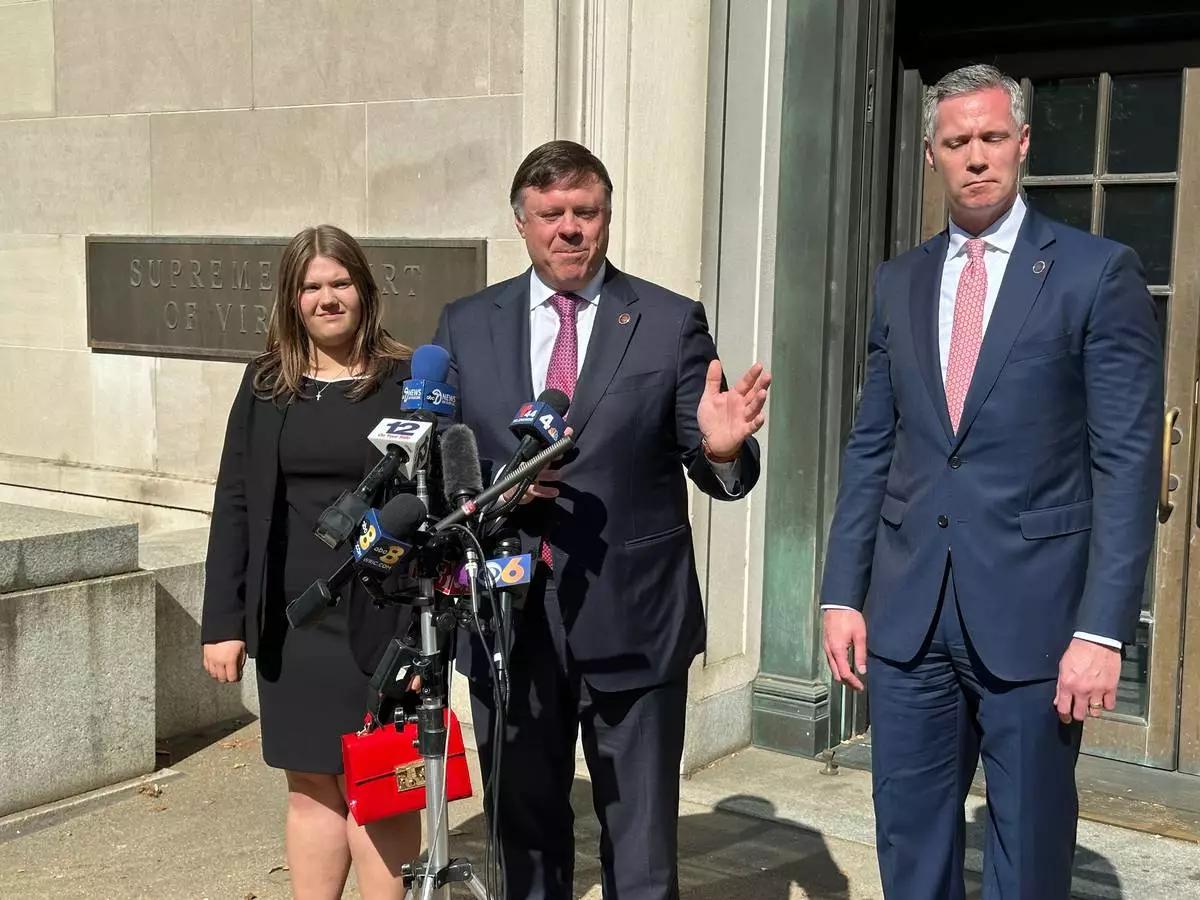
State Senate Minority Leader Ryan McDougle, center, speaks outside the Supreme Court of Virginia after arguments were heard in a redistricting-related case at the court in Richmond, Va., on Monday, April 27, 2026. (AP Photo/Allen G. Breed)

State Senate Minority Leader Ryan McDougle, center, speaks outside the Supreme Court of Virginia after arguments were heard in a redistricting-related case at the court in Richmond, Va., on Monday, April 27, 2026. (AP Photo/Allen G. Breed)

Recommended Articles