MIAMI (AP) — If Kevin Durant ultimately decides to chase more Olympic gold, Erik Spoelstra seems interested in coaching him.
Spoelstra, the Miami Heat coach who will lead the U.S. men's basketball team at the 2028 Los Angeles Olympics, said Saturday he's aware of Durant's recent comments about the potential of playing for what would be a fifth gold medal.
And the concept is clearly intriguing.
“Just him saying that is incredible," Spoelstra — an assistant on the 2024 Olympic team — said before the Heat beat Durant and the Houston Rockets 115-105. "You know, that’s the culture of USA Basketball. You just want the best American players to raise their hand and say, ‘I want to do this.’”
When the 2024 Games were complete, Durant said he wouldn't rule out a chance at playing in the Olympics again. And Durant told ESPN in a recent interview that he “would love to" play in the Los Angeles Games, adding that he wants his level of play between now and then to convince USA Basketball managing director Grant Hill, national team director Sean Ford, Spoelstra and anyone else involved in the selection process that he's worthy of a spot.
“Hopefully I get that chance," Durant said Saturday. “I've got to stay on top of my game. I keep saying that. I want to earn my spot on the team. Got to stay on top of my game and hopefully I'm out there with Coach Spo and his staff.”
Durant gave his time with Spoelstra at the Paris Games rave reviews.
“I've always been impressed with Coach Spo from afar, but to be in the same locker room with him, to see his intensity, his scouts just made me want to run through a wall,” Durant said. “He was so enthused about being an assistant coach on Team USA and he understood that we wanted to make a statement out there as a team and he backed us."
Durant's place in USA Basketball lore was secured long ago.
He's the only four-time gold medalist in men's Olympic basketball history, after winning golds in London 2012, Rio de Janeiro 2016, the Tokyo Games that were delayed a year until 2021, then Paris in 2024. In Paris, he became the career leader in points for the U.S. in Olympic competition, passing Lisa Leslie for that mark.
“You can feel his passion for representing the country and having the USA on the jersey," Spoelstra said. “He's been incredible in those competitions.”
Durant said one of the big takeaways from his time with Spoelstra in Paris was how someone who is a head coach — an NBA champion head coach, at that — serve as an assistant. As part of Golden State coach Steve Kerr's staff in Paris, Spoelstra was on the floor after practices and before games to work with players individually, throw them passes in warm-ups, even rebound for them.
“Just doing the dirty work. Spo was great at that,” Durant said. “He made it exciting to come into work every day.”
Spoelstra says the 37-year-old Durant's game is timeless — proven by the fact that the No. 6 scorer in NBA history, who is on pace to pass Michael Jordan for the No. 5 spot in the coming weeks, is still putting up numbers almost unheard of for someone at that age. At 26.2 points per game this season — 32 of them coming on Saturday — Durant could pass Jordan in about 10 games, or sometime around the third week of March.
“He's an absolute tactician in terms of his work ethic and how he drills,” Spoelstra said. "It’s a great lesson for all the young players coming into the league. There’s one thing to get up shots and there’s another thing to really work player development and I think that’s a takeaway that we all had, watching him work during the summer, those six weeks.
"After practice, before practice, the days in between, he’s going in there with intention to try — even at this age — to get better and improve. What a beautiful mindset that is.”
AP NBA: https://apnews.com/hub/NBA

Houston Rockets forward Kevin Durant, right, goes to the basket against Orlando Magic center Wendell Carter Jr. during the second half of an NBA basketball game, Thursday, Feb. 26, 2026, in Orlando, Fla. (AP Photo/John Raoux)
LONDON (AP) — America and Israel's attack on Iran disrupted flights across the Middle East and beyond Saturday as countries around the region closed their airspace and key airports that connect Europe, Africa and the West to Asia were directly hit by strikes.
Hundreds of thousands of travelers were either stranded or diverted to other airports after Israel, Qatar, Syria, Iran, Iraq, Kuwait and Bahrain closed their airspace. There also was no flight activity over the United Arab Emirates, flight tracking website FlightRadar24 said, after the government there announced a “temporary and partial closure” of its airspace.
That led to the closure of key hub airports in Dubai, Abu Dhabi and Doha, and the cancellation of more than 1,800 flights by major Middle Eastern airlines. The three major airlines that operate at those airports — Emirates, Qatar Airways and Etihad — typically have about 90,000 passengers per day crossing through those hubs and even more travelers headed to destinations in the Middle East, according to aviation analytics firm Cirium.
Two airports in the United Arab Emirates reported incidents as the government there condemned what it called a “blatant attack involving Iranian ballistic missiles” on Saturday.
Officials at Dubai International Airport — the largest in the United Arab Emirates and one of the busiest in the world — said four people were injured, while Zayed International Airport in Abu Dhabi said that one person was killed and seven others were injured in a drone strike. Strikes were also reported at Kuwait International Airport.
Though Iran did not publicly claim responsibility, the scope of retaliatory strikes that Gulf nations attributed to Iran extended beyond the American bases that it previously said it would target.
“For travelers, there’s no way to sugarcoat this,” said Henry Harteveldt, an airline industry analyst and president of Atmosphere Research Group. “You should prepare for delays or cancellations for the next few days as these attacks evolve and hopefully end.”
Airlines that are crossing the Middle East will have to reroute flights around the conflict with many flights headed south over Saudi Arabia. That will add hours to those flights and consume additional fuel, adding to the costs airlines will have to absorb. So ticket prices could quickly start to increase if the conflict lingers.
The added flights will also put pressure on air traffic controllers in Saudi Arabia who might have to slow traffic to make sure they can handle it safely. And the countries that closed their airspace will miss out on the overflight fees airlines pay for crossing overhead.
But Mike McCormick, who used to oversee air traffic control for the Federal Aviation Administration before he retired and is now a professor at Embry-Riddle Aeronautical University, said over the next few days these countries might be able to reopen parts of their airspace once American and Israeli officials share with the airlines where military flights are operating and how capable Iran remains at firing missiles.
“Those countries then will be able to go through and say, okay, we can reopen this portion of our space but we’ll keep this portion of our airspace closed,” McCormick said. “So I think what we’ll see in the next 24 to 36 hours how the use of airspace evolves as the kinetic activity gets more well defined and as the capability of Iran to actually shoot missiles and create additional risk is diminished due to the attacks.”
But it is unclear how long the disruption to flight operations could last. For comparison, the Israeli and U.S. attack on Iran in June 2025 lasted 12 days.
The situation was changing quickly and airlines urged passengers to check their flight status online before heading to the airport.
Some airlines issued waivers to affected travelers that will allow them to rebook their flight plans without paying extra fees or higher fares.
Jonathan Escott and his fiance had arrived at the airport in Newcastle, England, on Saturday only to find out that his direct flight to Dubai on Emirates airline was canceled, leaving everyone on the flight stuck there.
Escott left to go back to where he was staying with family, about an hour from the airport, but has no idea when he may be able to travel.
“No one knows,” Escott said. “No one really knows what’s going on with the conflict, really. Not Emirates, Emirates don’t have a clue. No one has a clue.”
At least 145 planes that were en route to cities like Tel Aviv and Dubai early Saturday were diverted to airports in cities like Athens, Istanbul or Rome, according to FlightAware. Others turned around and returned to where they took off from. One plane spent nearly 15 hours in the air after leaving Philadelphia and getting all the way to Spain before turning around and returning to where it started.
Numerous airlines canceled international flights to Dubai through the weekend, as India’s civil aviation agency designated much of the Middle East — including skies above Jordan, Saudi Arabia and Lebanon — as a high-security risk zone at all altitudes.
Air India canceled all flights to Mideast destinations. Turkish Airlines said flights to Lebanon, Syria, Iraq, Iran and Jordan were suspended until Monday and flights to Qatar, Kuwait, Bahrain, the United Arab Emirates and Oman were suspended.
The airline said additional cancellations may be announced, and many other airlines were suspending flights into the region through the weekend.
U.S.-based Delta Air Lines and United Airlines suspended flights to Tel Aviv at least through the weekend. Dutch airline KLM had already announced earlier in the week that it was suspending flights to and from Tel Aviv.
Airlines including Lufthansa, Air France, Transavia and Pegasus canceled all flights to Lebanon, while American Airlines suspended flights from Philadelphia to Doha.
Virgin Atlantic said it would avoid flying over Iraq, meaning flights to and from India, the Maldives and Riyadh could take slightly longer. The airline already was not flying over Iran and said all flights would carry appropriate fuel in case they need to reroute on short notice.
British Airways said flights to Tel Aviv and Bahrain will be suspended until next week, and flights to Amman, Jordan, were canceled Saturday.
“Travelers should anticipate that there will be a lot of disruptions,” Harteveldt said. “To be honest, if you haven’t left home, chances are you won’t be leaving home if you’re supposed to travel to or through these destinations for at least several days, if not longer. And if you are returning home, you will have to be very creative about how you get home.”
Levy reported from Harrisburg, Pennsylvania, and Funk reported from Omaha, Nebraska. Associated Press writers Adam Schreck in Bangkok and Sam Metz in Ramallah, West Bank contributed
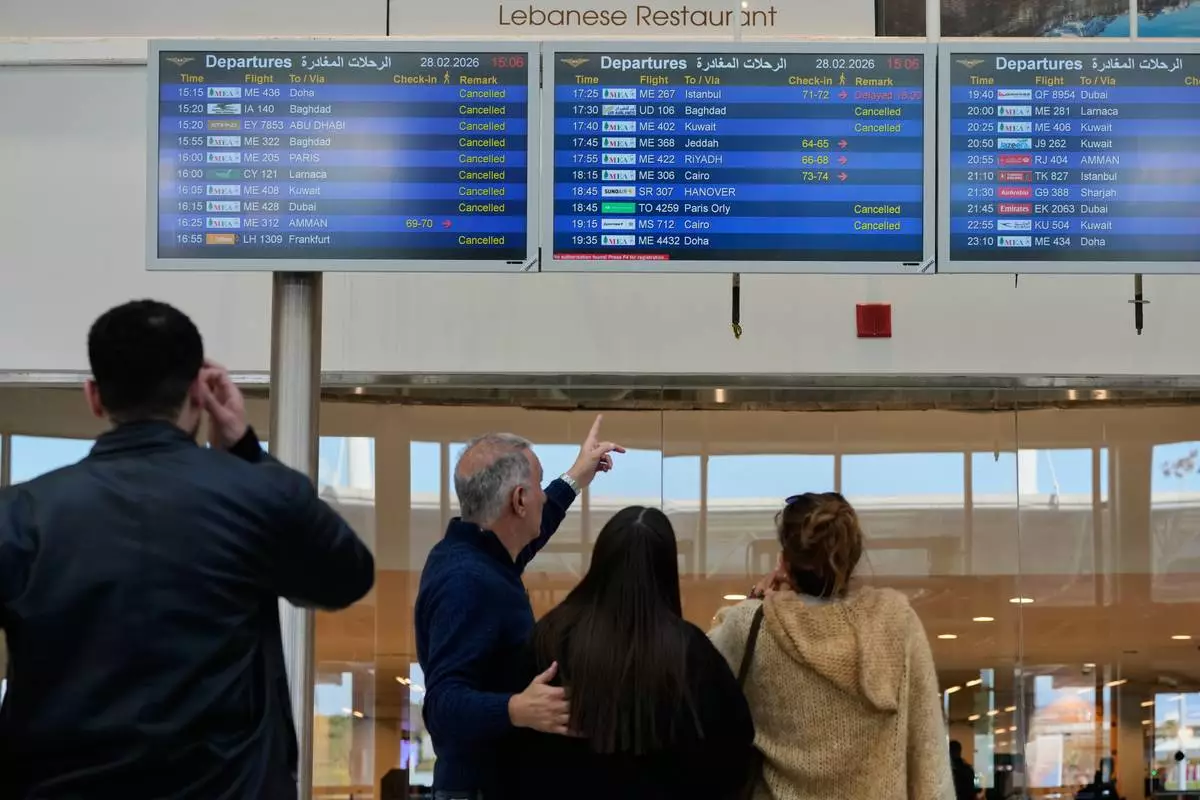
Travelers check departure times as many flights are cancelled at Beirut Rafik Hariri International Airport in Beirut, Lebanon, Saturday, Feb. 28, 2026, as many airlines canceled flights due to the conflict involving the United States, Israel and Iran. (AP Photo/Hassan Ammar)
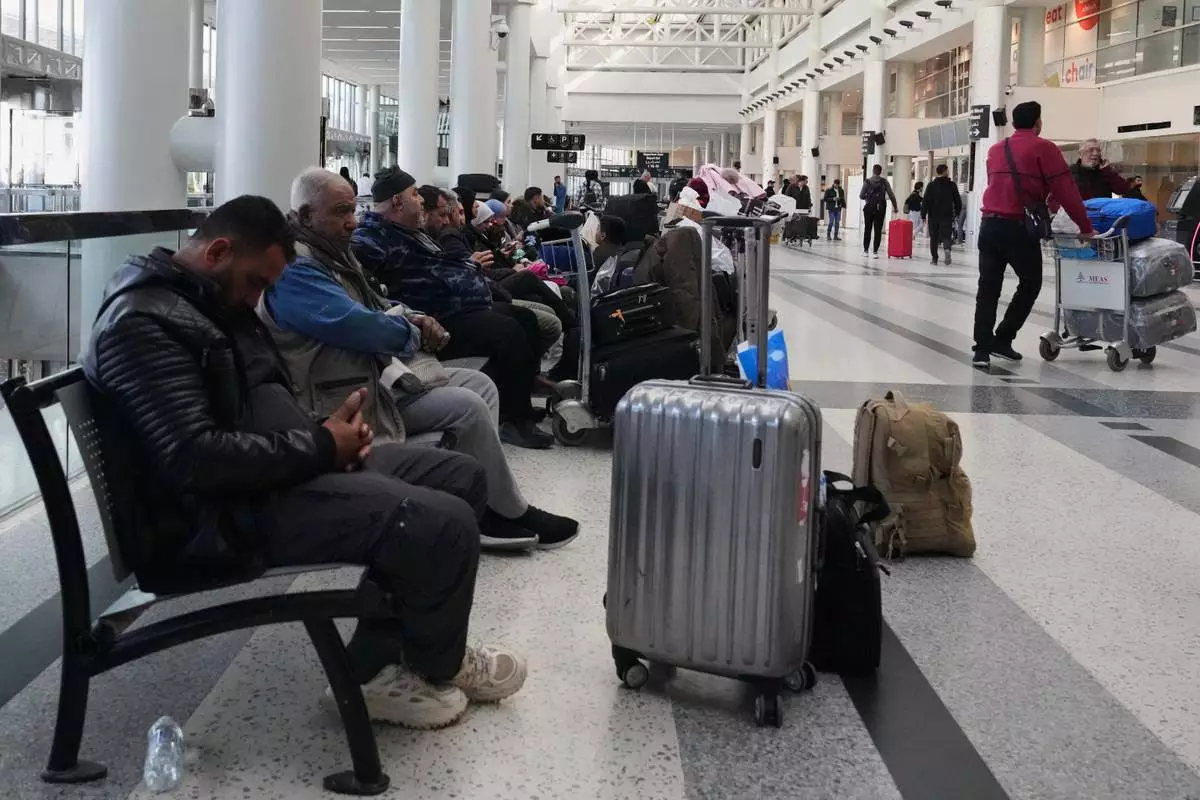
Passengers whose flights were cancelled, wait at the departure terminal of Rafik Hariri International Airport in Beirut, Lebanon, Saturday, Feb. 28, 2026, as many airlines canceled flights due to the conflict involving the United States, Israel and Iran. (AP Photo/Hassan Ammar)
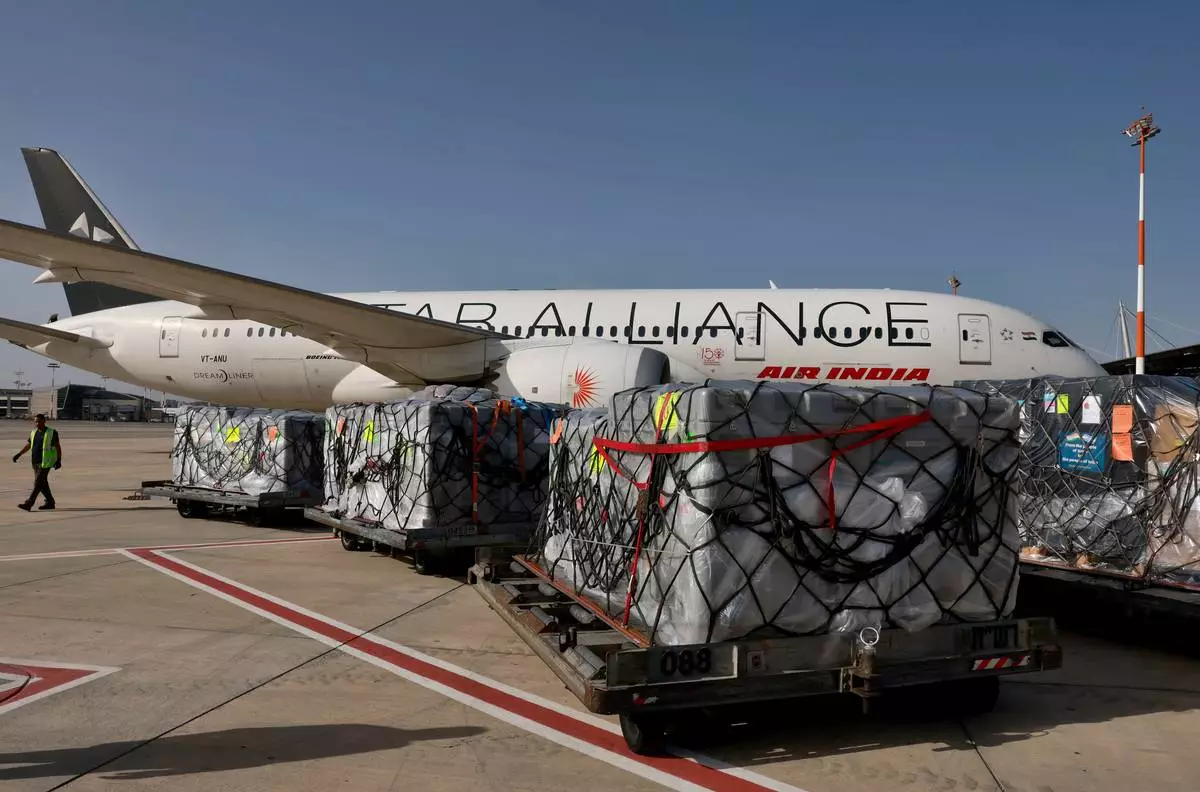
FILE -Workers load medical aid onto an Air India plane to be flown to India, at Ben Gurion Airport near Tel Aviv, Israel, May 4, 2021. (Menahem Kahana/Pool Photo via AP, File)