Skip to Content Facebook Feature Image

Middle East airports closed and thousands of travelers stranded after attack on Iran

News

Middle East airports closed and thousands of travelers stranded after attack on Iran
News

News

Middle East airports closed and thousands of travelers stranded after attack on Iran

2026-03-01 18:58 Last Updated At:19:00

LONDON (AP) — The attack on Iran by the United States and Israel disrupted flights across the Middle East and beyond as countries around the region closed their airspace and key airports that connect Europe, Africa and the West to Asia were directly hit by strikes.

More than 3,400 flights were canceled Sunday across seven airports in the Mideast, according to flight tracker Flightradar24. Airports in Dubai and Abu Dhabi in the United Arab Emirates, and Qatar’s capital, Doha, and Manama in Bahrain were among those closed.

Emirates Airlines suspended all flights to and from Dubai until at least Sunday afternoon. The Qatar airport was closed until at least Monday morning, according to Qatar Airways. Israeli airspace also remained closed Sunday. Israeli airline El Al said it was preparing a recovery effort to bring home Israelis stranded abroad once the airspace reopened.

Travelers were either stranded or diverted to other airports Saturday after Israel, Qatar, Syria, Iran, Iraq, Kuwait and Bahrain closed their airspace. There also was no flight activity over the United Arab Emirates, FlightRadar24 said, after the government there announced a “temporary and partial closure” of its airspace.

That led to the closure of key hub airports in Dubai, Abu Dhabi and Doha. The three major airlines that operate at those airports — Emirates, Qatar Airways and Etihad — typically have about 90,000 passengers per day crossing through those hubs and even more travelers headed to destinations in the Middle East, according to aviation analytics firm Cirium.

Two airports in the United Arab Emirates reported incidents as the government there condemned what it called a “blatant attack involving Iranian ballistic missiles” on Saturday.

Officials at Dubai International Airport — the largest in the United Arab Emirates and one of the busiest in the world — said four people were injured, while Zayed International Airport in Abu Dhabi said that one person was killed and seven others were injured in a drone strike. Strikes were also reported at Kuwait International Airport.

Though Iran did not publicly claim responsibility, the scope of retaliatory strikes that Gulf nations attributed to Iran extended beyond the American bases that it previously said it would target.

“For travelers, there’s no way to sugarcoat this,” said Henry Harteveldt, an airline industry analyst and president of Atmosphere Research Group. “You should prepare for delays or cancellations for the next few days as these attacks evolve and hopefully end.”

Airlines that are crossing the Middle East will have to reroute flights around the conflict with many flights headed south over Saudi Arabia. That will add hours to those flights and consume additional fuel, adding to the costs airlines will have to absorb. So ticket prices could quickly start to increase if the conflict lingers.

The added flights will also put pressure on air traffic controllers in Saudi Arabia who might have to slow traffic to make sure they can handle it safely. And the countries that closed their airspace will miss out on the overflight fees airlines pay for crossing overhead.

But Mike McCormick, who used to oversee air traffic control for the Federal Aviation Administration before he retired and is now a professor at Embry-Riddle Aeronautical University, said over the next few days these countries might be able to reopen parts of their airspace once American and Israeli officials share with the airlines where military flights are operating and how capable Iran remains at firing missiles.

“Those countries then will be able to go through and say, ok, we can reopen this portion of our space but we’ll keep this portion of our airspace closed,” McCormick said. “So I think what we’ll see in the next 24 to 36 hours how the use of airspace evolves as the kinetic activity gets more well-defined and as the capability of Iran to actually shoot missiles and create additional risk is diminished due to the attacks.”

But it is unclear how long the disruption to flight operations could last. For comparison, the Israeli and U.S. attack on Iran in June 2025 lasted 12 days.

The situation was changing quickly and airlines urged passengers to check their flight status online before heading to the airport.

The reverberations echoed far outside the Middle East — for example, airport authorities in the resort island of Bali in Indonesia said more than 1,600 tourists were stranded at I Gusti Ngurah Rai International Airport on Sunday after five flights to the Middle East were canceled or postponed.

Some airlines issued waivers to affected travelers that will allow them to rebook their flight plans without paying extra fees or higher fares.

Jonathan Escott and his partner had arrived at the airport in Newcastle, England, on Saturday only to find out that his direct flight to Dubai on Emirates airline was canceled, leaving everyone on the flight stuck there.

Escott left to go back to where he was staying with family, about an hour from the airport, but has no idea when he may be able to travel.

“No one knows,” Escott said. “No one really knows what’s going on with the conflict, really. Not Emirates, Emirates don’t have a clue. No one has a clue.”

Harteveldt said travelers should anticipate a lot of disruptions.

“To be honest, if you haven’t left home, chances are you won’t be leaving home if you’re supposed to travel to or through these destinations for at least several days, if not longer," he said. "And if you are returning home, you will have to be very creative about how you get home.”

Levy reported from Harrisburg, Pennsylvania, and Funk reported from Omaha, Nebraska. Associated Press writers Adam Schreck in Bangkok, Sam Metz in Ramallah, West Bank, Melanie Lidman in Jerusalem and Niniek Karmini in Jakarta contributed.
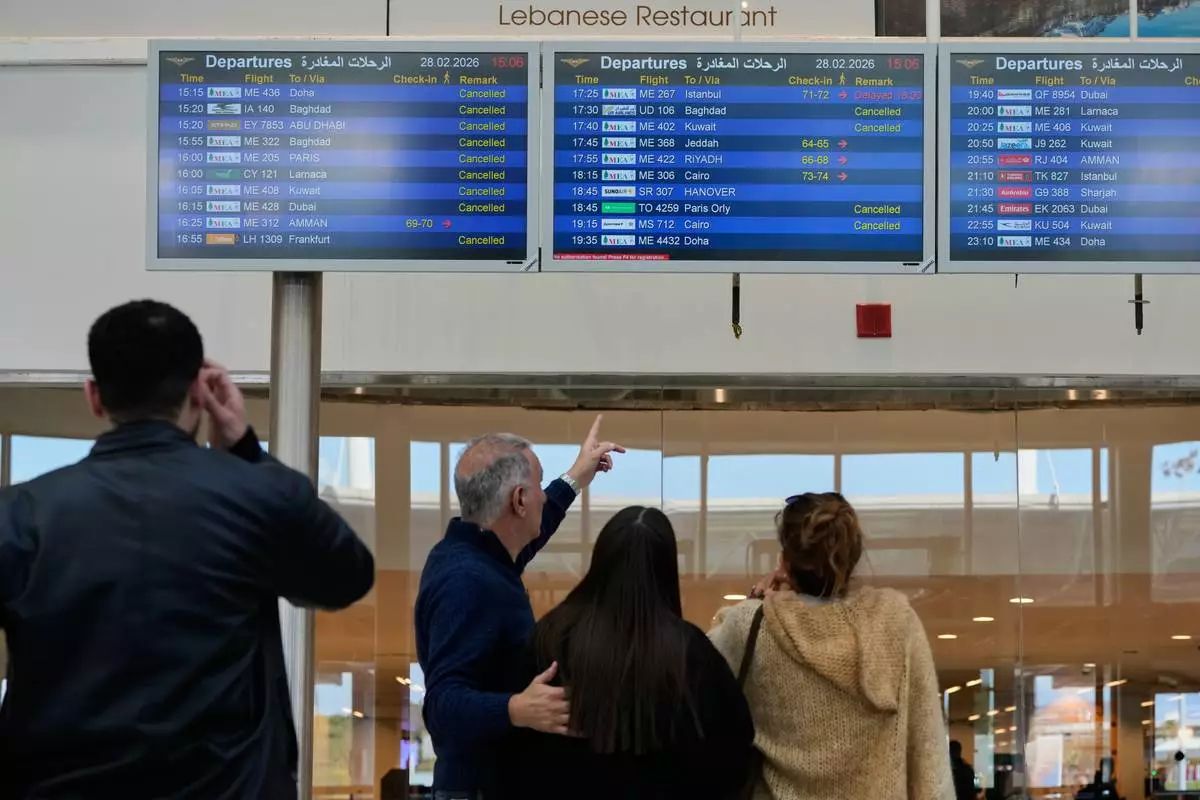
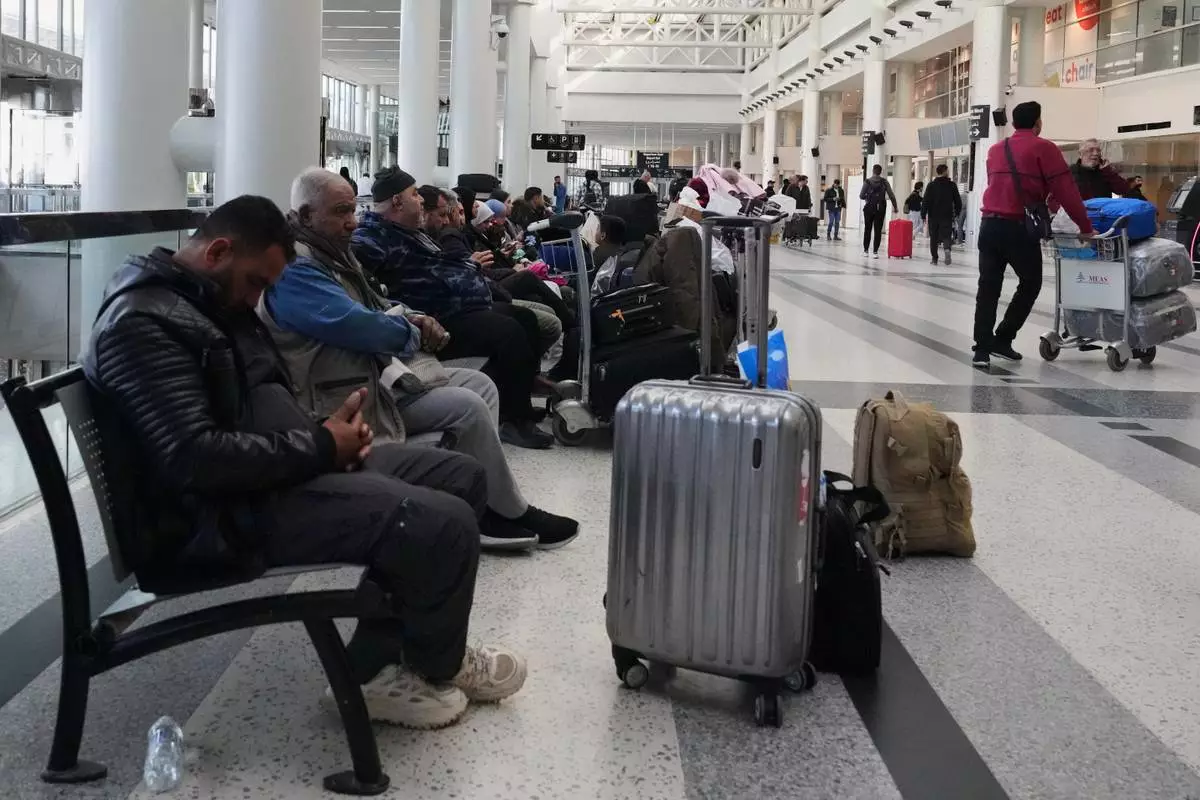
Travelers check departure times as many flights are cancelled at Beirut Rafik Hariri International Airport in Beirut, Lebanon, Saturday, Feb. 28, 2026, as many airlines canceled flights due to the conflict involving the United States, Israel and Iran. (AP Photo/Hassan Ammar)
Travelers check departure times as many flights are cancelled at Beirut Rafik Hariri International Airport in Beirut, Lebanon, Saturday, Feb. 28, 2026, as many airlines canceled flights due to the conflict involving the United States, Israel and Iran. (AP Photo/Hassan Ammar)

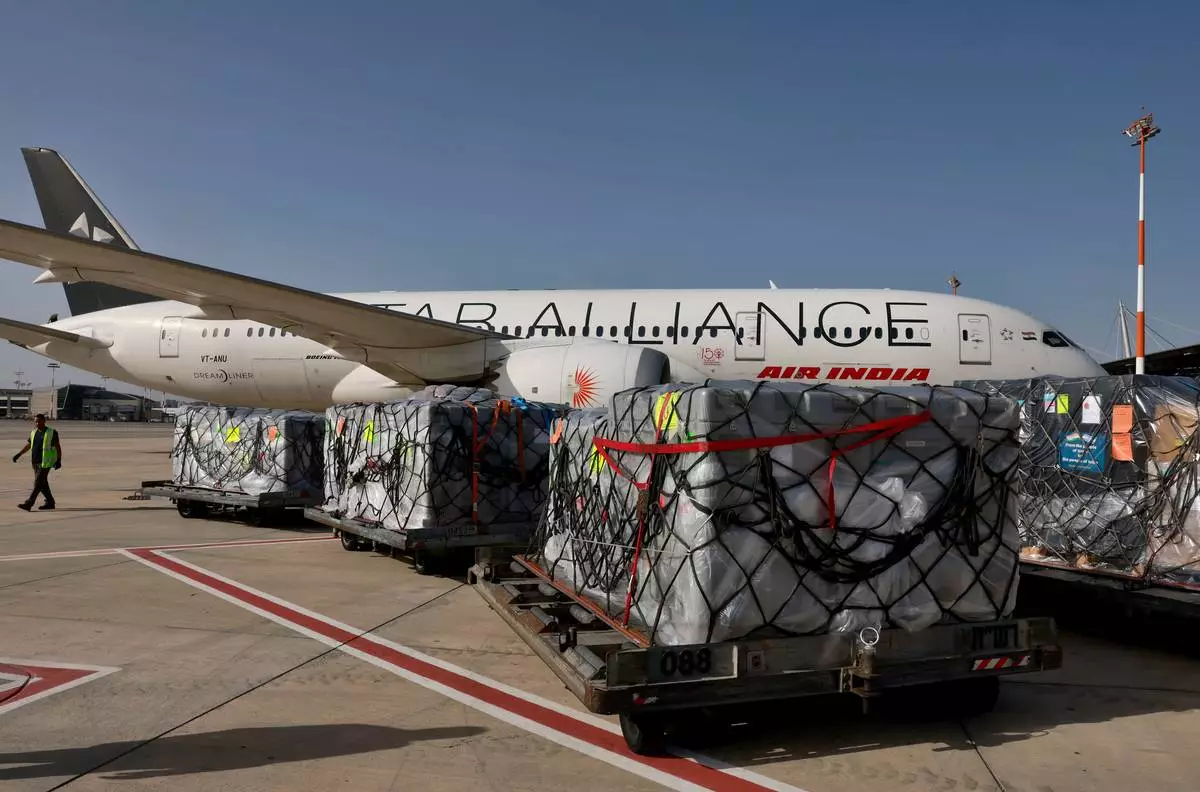
FILE -Workers load medical aid onto an Air India plane to be flown to India, at Ben Gurion Airport near Tel Aviv, Israel, May 4, 2021. (Menahem Kahana/Pool Photo via AP, File)
FILE -Workers load medical aid onto an Air India plane to be flown to India, at Ben Gurion Airport near Tel Aviv, Israel, May 4, 2021. (Menahem Kahana/Pool Photo via AP, File)

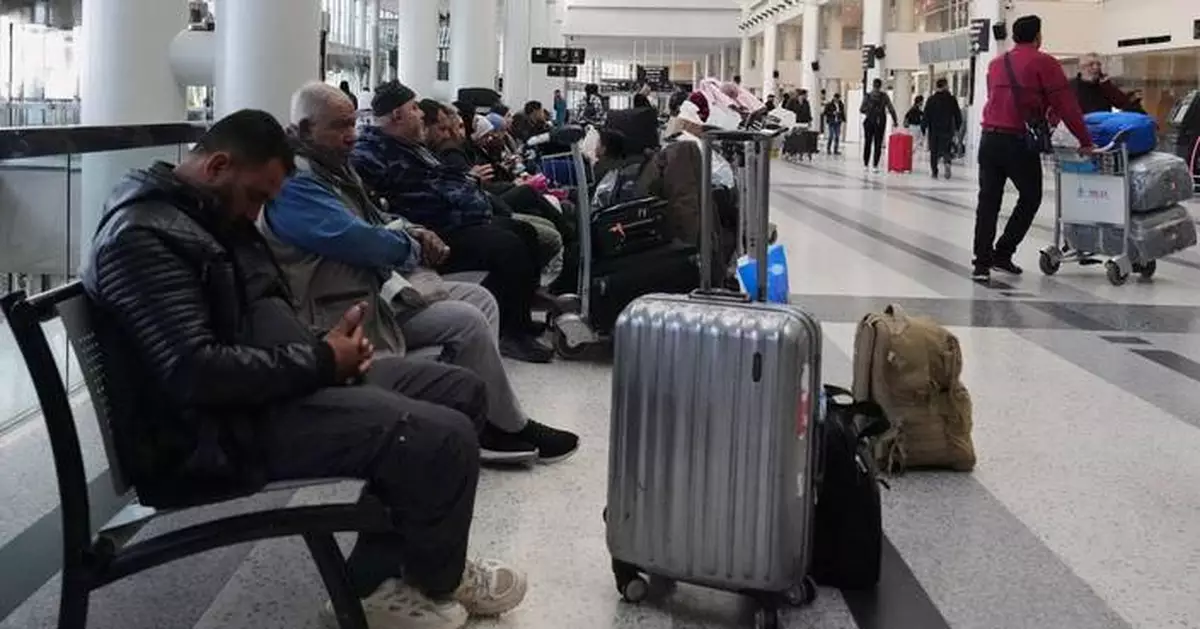
Passengers whose flights were cancelled, wait at the departure terminal of Rafik Hariri International Airport in Beirut, Lebanon, Saturday, Feb. 28, 2026, as many airlines canceled flights due to the conflict involving the United States, Israel and Iran. (AP Photo/Hassan Ammar)


Passengers whose flights were cancelled, wait at the departure terminal of Rafik Hariri International Airport in Beirut, Lebanon, Saturday, Feb. 28, 2026, as many airlines canceled flights due to the conflict involving the United States, Israel and Iran. (AP Photo/Hassan Ammar)
BRUSSELS (AP) — World leaders urged peace and a return to talks as the military strikes by the United States and Israel on Iran raised concerns about whether the violence could spread across the region and tensions rose with Iran vowing devastating blows after the killing of Iran’s Supreme Leader Ayatollah Ali Khamenei.

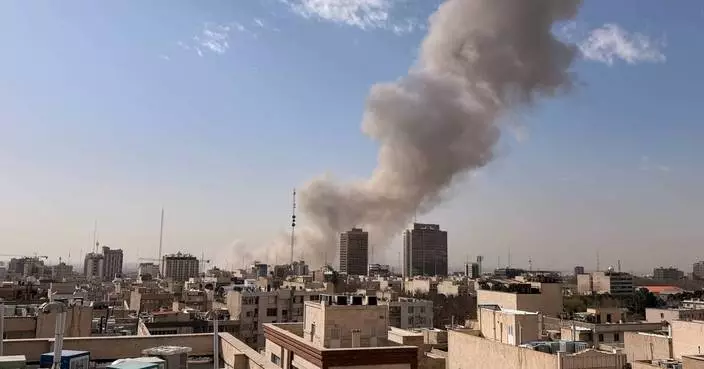
A massive explosion rocked the Iranian capital on Sunday morning as the Israeli military said it was targeting the “heart” of the city after stating it cleared the path to Tehran the day before. Meanwhile, Iran pressed on with its retaliation campaign: Qatar, Kuwait and Bahrain said they intercepted a barrage of missiles.

Oman, which served as an interlocutor between Tehran and Washington in recent nuclear talks, said an oil tanker in the strategic Strait of Hormuz came under attack and its port at Duqm, used by the U.S. Navy as a logistical hub and capable of hosting aircraft carriers, was targeted in a drone attack.

The demise of Khamenei, who had no designated successor, will likely throw Iran's future into uncertainty and exacerbate already growing concerns of a broader conflict.

Top diplomats from the 27 European Union nations are holding an emergency meeting Sunday to discuss the situation around Iran and the next steps for the bloc. The United Nations Security Council met late Saturday.

Perhaps cautious about upsetting already strained relations with Trump, many nations, including several in the Middle East, refrained from commenting directly or pointedly on the joint strikes but condemned Tehran’s retaliation.

Other countries were more explicit: Australia and Canada expressed open support for the U.S. strikes, while Russia and China responded with direct criticism.

The United States and Israel launched a major attack against Iran on Saturday, and Trump called on the Iranian public to “seize control of your destiny” by rising against the Islamic theocracy that has ruled the nation since 1979.

During the U.N. Security Council on Saturday, the U.N. chief and many countries urged a halt to attacks and a return to negotiations to prevent the conflict from expanding further into the region and beyond.

Secretary-General António Guterres told the council that everything must be done to prevent an escalation. “The alternative,” he warned, “is a potential wider conflict with grave consequences for civilians and regional stability.”

Guterres said the U.S. and Israeli airstrikes violated international law, including the U.N. Charter. He also condemned Iran’s retaliatory attacks for violating the sovereignty and territorial integrity of Bahrain, Iraq, Jordan, Kuwait, Qatar, Saudi Arabia and the United Arab Emirates.

The Security Council meeting was tense as the U.S. and Iranian ambassadors traded warnings and direct rebuffs.

Further calls for de-escalation came from across the Middle East and Europe.

“Return to your senses ... and deal with your neighbors with reason and responsibility before the circle of isolation and escalation widens," Anwar Gargash, an adviser to the United Arab Emirates’ president, told the Iranian theocracy on Sunday.

In recent years, the UAE sought to de-escalate tensions with Iran despite its longtime suspicions of its northern neighbor.

The 22-nation Arab League called the Iranian attacks “a blatant violation of the sovereignty of countries that advocate for peace and strive for stability.” That coalition of nations has historically condemned both Israel and Iran for actions it says risk destabilizing the region.

“The Iranian regime’s indiscriminate attacks against its neighbours carry the risk of dragging the region into a broader war and we condemn this,” said EU foreign policy chief Kaja Kallas as she announced the bloc’s meeting on Sunday. “It is essential that the war does not spread any further. The Iranian regime has choices to make."

British Prime Minister Keir Starmer, French President Emmanuel Macron and German Chancellor Friedrich Merz called on the U.S. and Iran to resume talks in a statement on Saturday, saying they favored a negotiated settlement. The three countries have led efforts to reach a negotiated solution over Iran’s nuclear program.

“We condemn Iranian attacks on countries in the region in the strongest terms. Iran must refrain from indiscriminate military strikes," they said. "Ultimately, the Iranian people must be allowed to determine their future,” they said.

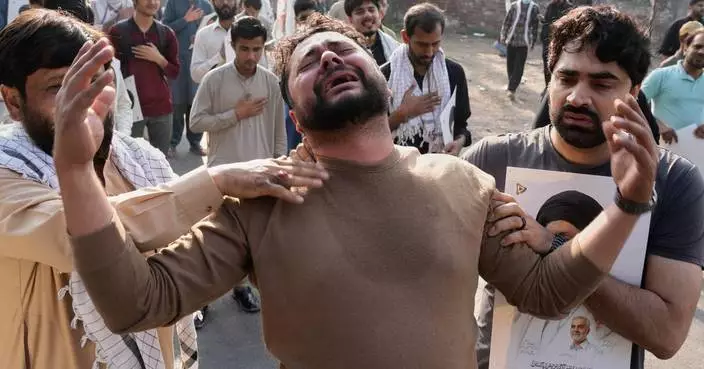
At least six people were killed in clashes with police Sunday after hundreds of protesters stormed the U.S. Consulate in the Pakistani port city of Karachi, authorities said.

In Indian-controlled Kashmir, tens of thousands of people on Sunday staged massive demonstrations to denounce Khamenei’s killing by the U.S. and Israel.

Demonstrations were also held from New York to Berlin and beyond by members of the Iranian diaspora and their supporters, celebrating the end of Khamenei’s rule.

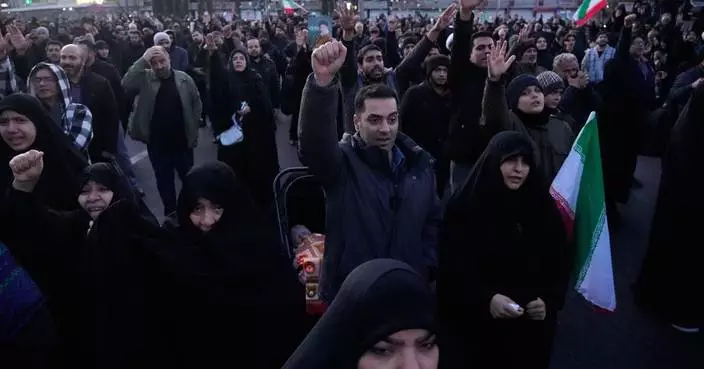
Iranians in Berlin were seen cheering and dancing to loud music on Saturday afternoon in celebration. Some of the demonstrators waved flags of the Iranian monarchy, with German, Israeli, and U.S. flags also on display. Hopeful Iranians also took to the streets in multiple U.S. cities.

Ciobanu reported from Warsaw and Metz from Ramallah. Josef Federman in Jerusalem, Melanie Lidman in Tel Aviv, Angela Charlton in Paris, Paolo Santalucia in Rome, Suman Naishadham in Madrid, Elise Morton and Krutika Pathi in London, Jamey Keaten in Geneva, Markus Schreiber in Berlin, Eileen Ng in Kuala Lumpur, Fatma Khaled and Sam Magdy in Cairo, Ken Moritsugu in Beijing, Adam Schreck in Bangkok and Rod McGuirk in Melbourne, Australia, contributed to this report.

German Chancellor Friedrich Merz speaks before media members as he visits facilities of Siemens Energy during his official visit, in Hangzhou, China, Thursday, Feb. 26, 2026. (Andres Martinez Casares/Pool Photo via AP)

German Chancellor Friedrich Merz speaks before media members as he visits facilities of Siemens Energy during his official visit, in Hangzhou, China, Thursday, Feb. 26, 2026. (Andres Martinez Casares/Pool Photo via AP)

British Prime Minister Sir Keir Starmer speaks with students and staff, during a visit to the Walbottle Academy Campus in Newcastle-upon-Tyne, England, Thursday, Feb. 26, 2026. (Scott Heppell/PA via AP)

British Prime Minister Sir Keir Starmer speaks with students and staff, during a visit to the Walbottle Academy Campus in Newcastle-upon-Tyne, England, Thursday, Feb. 26, 2026. (Scott Heppell/PA via AP)

Recommended Articles