A senior Chinese researcher has suggested that the U.S. may not have been sincere in its diplomatic talks with Iran, but merely seeking to provide cover for its attacks launched jointly with Israel on Saturday.
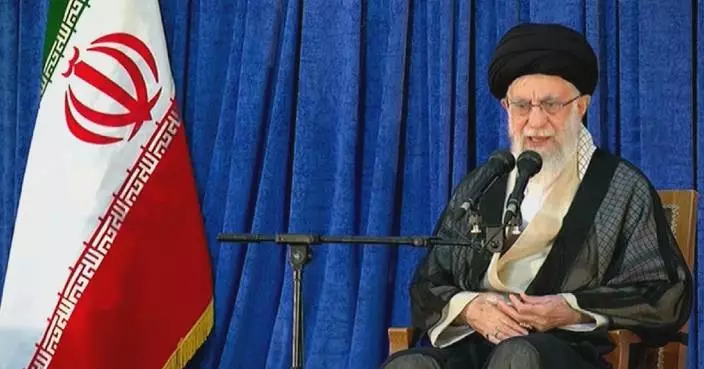
The United States and Israel on Saturday morning carried out coordinated strikes on Tehran and several other Iranian cities, shortly after the conclusion of the third round of nuclear talks. Iran's state media confirmed Sunday that Supreme Leader Ayatollah Ali Khamenei was killed in the attacks.
In a China Global Television Network (CGTN) interview, Rong Ying, a senior research fellow at China Institute of International Studies, said the attacks seem to indicate a failure to fully utilize diplomacy as a means of preventing conflict.
"It seems that these efforts, be it the diplomatic or mediation efforts, have not helped. Rather I think it provides just a cover for the final joint military operations of the United States and Israel against Iran. So these military strikes launched by Israel and the United States are going to bring and actually add more uncertainties and more attention for the region. This is a very dangerous, very, I think, worrying development in the region," Rong said.
The Israeli Defense Ministry said in a statement that Israel launched the "preemptive" strike against Iran "to remove threats to Israel."
Rong highlighted that this explanation fits into a long-spanning history of antagonism between Israel and Iran.
"The Israelis have always been, I think, taking Iran as their existential threat, and it is again, once again, has been expressed explicitly in the speech by Prime Minister (Benjamin) Netanyahu. I think the goal for this military operation is so-called to achieve a regime change. That's why I think both of them (the U.S. and Israel) had been calling upon the Iranian people to sort of rise up, to rise against the so-called regime," he said.
The analyst also warned that the outbreak of conflict could deeply impact not only the Middle East region as a whole, but the entire globe.
"I think we have to be keeping in mind that this time, the Iranian side, on one hand, they are certainly ready to talk. On the other hand, they also make, I think, quite preparations for any eventualities like that. It's bad news for the oil market, for energy, for security, and for the international community as a whole. But all in all, I think this is something we are now, we are having a war with wide-ranging impact and consequences, not only for these countries, but also for the region. This is something I think, really, nobody wants to see," said the research fellow.
Following the strikes, Iran's Red Crescent Society said at least 201 deaths and 747 injuries had been reported across the country. Among the hardest-hit sites was an elementary school in Minab, a city in southern Hormozgan Province, where at least 85 people were killed, most of them schoolgirls.

Nuclear talks provide cover as US, Israel seek regime change in Iran through strikes: analyst