Skip to Content Facebook Feature Image

Faraday Future Founder and Co-CEO YT Jia Shares Weekly Investor Update: Announces First Batch of EAI Robotics Deliveries During Ceremony on Feb. 27, Marks First U.S. “EAI Robot & Vehicle + Vacation Rental” Deployment

Business

Faraday Future Founder and Co-CEO YT Jia Shares Weekly Investor Update: Announces First Batch of EAI Robotics Deliveries During Ceremony on Feb. 27, Marks First U.S. “EAI Robot & Vehicle + Vacation Rental” Deployment
Business

Business

Faraday Future Founder and Co-CEO YT Jia Shares Weekly Investor Update: Announces First Batch of EAI Robotics Deliveries During Ceremony on Feb. 27, Marks First U.S. “EAI Robot & Vehicle + Vacation Rental” Deployment

2026-03-02 09:52 Last Updated At:17:50

LOS ANGELES--(BUSINESS WIRE)--Mar 1, 2026--

Faraday Future Intelligent Electric Inc. (NASDAQ: FFAI) (“Faraday Future”, “FF” or the “Company”), a California-based global Embodied AI (EAI) ecosystem company, today shared a weekly business update from YT Jia, Founder and Global Co-CEO of FF.

This press release features multimedia. View the full release here: https://www.businesswire.com/news/home/20260301605371/en/

Faraday Future announced that the first batch of the Company’s robots were delivered to Golden Hills Investment LLC, a Florida-based high-end vacation rental investor and operator - held at a ceremony in Los Angeles on Feb. 27, and marks a unique usage through a “EAI Robot & Vehicle + Airbnb Operator” commercial application.

“Today’s weekly report marks a historic milestone in turning FF’s EAI Robotics into true delivery phase. With the first EAI robot delivery season kicking off last Friday, we are delivering on our promise: Launch is sales, sales is delivery. We have also successfully entered a blue-ocean market: premium Airbnb home-sharing rentals, creating a breakthrough into a massive industry—and launching the innovative ‘Robot + Vehicle + Airbnb Operator’ real-world use case.

Two days ago, we delivered our first batch of robots to Golden Hill, a premium Airbnb property operator in Florida and Nevada, and based on our sales contract: 2 Master Ultra units, and 4 Aegis units for pilot delivery—including two Aegis Pro and two Aegis Ultra. Our humanoid EAI robots, Futurist and Master, have already passed compliance certification. Once Aegis completes compliance certification, targeted by the end of March, the four Aegis units delivered in this early pilot will be converted into formal deliveries.

This marks FF’s launch of our first EAI robot delivery season in 2026. In the first delivery month, we will focus on refining four priority scenarios: home-sharing short rental operators, premium restaurants, high-end hotels, and automotive dealerships. Our shipping target is 20 EAI robots in March, and 200 EAI robots for the first delivery season. For the two delivery seasons in the second half of the year, we will ramp up deliveries based on scenario-specific demand.

As a key use case within our ‘6-3-3 Industry Applications and Practical Values’ framework, the premium short rental scenario is the first to go live. Starting with the high-value, high-interaction short vacation rental industry, our EAI robots will begin creating practical value in the real world.

This delivery marks FF’s successful execution milestone, making us the first company to deliver humanoid robots and pre-deliver bionic robots in the U.S. market. Next, through continued deliveries, capacity ramp-up, and use case expansion, we will turn our first-mover advantage into a scale advantage—driving a flywheel of large-scale data collection and training, stronger product capability, and growing sales volume, and ultimately converting that into a sustained leadership position.

This delivery also represents the first real-world rollout of our Three-in-One FF EAI Robotics eco-strategy. We are delivering not only EAI devices, but a complete EAI ecosystem—including three categories of products and services: EAI devices, the EAI Brain & open-source and open developer platform, and EAI decentralized data factory nodes.

This has major value and significance for users, customers, industry partners, and FF: First, for users, the FF Robotics EAI device will serve throughout the entire stay as a true All-Ability EAI concierge & companion. It can deliver high-frequency, practical functions such as room tours, service communication during check-in, checkout and reminders, as well as educational and knowledge-based interaction with guests—significantly enhancing efficiency and service value. At the same time, in settings that call for a lively atmosphere, interactive companionship, and emotional connection, it creates social and entertainment value—achieving a balance between providing practical and emotional benefits. Very soon, we will step into premium vacation-rentals to demonstrate on-site the real-world deployment of this innovative use case—fully showcasing how EAI robots release capability and create value in live commercial environments.

For users who choose to become developers, the EAI robot is also a co-sharing platform. During their stay, users can personalize the system based on their own needs—building exclusive Agents and customized Skills Packages. Through FF’s open-source and open developer platform, they can also participate in global, cross-industry secondary development—jointly driving the continuous evolution of EAI.

Under strict privacy compliance and security mechanisms, user behavior data will flow through the EAI decentralized data factory to continuously optimize service experience—accumulating more precise and personalized scenario capabilities. Every real-world use is a real data collection and training event; every interaction node makes the robot understand the user better.

Second, for customers, EAI robots bring multi-dimensional value enablement: 1. Creating ‘robot-themed vacation rentals.’ This generates strong social-media virality and topic momentum, driving both traffic growth and pricing power, while reducing service costs and increasing operational efficiency and service value. 2. Through adding a 2C shared rental business model for EAI robots, operators can upgrade from ‘shared vacation rentals’ to ‘shared vacation rentals + shared robots,’ achieving a systematic upgrade of value proposition, service offering, and business model.

To serve guests that are also developers, vacation rental operators can customize differentiated EAI device and functional modules around specific themes, and cooperate with FF on building Skills. When newly developed Skills are successfully commercialized and deployed, both parties can share profits according to agreed terms—forming a sustainable, iterative, revenue-sharing ecosystem partnership.

Data generated in real-world scenarios is a critical digital asset. Guest-developers can leverage the decentralized data factory to collect and analyze data, optimize service models, and participate in data value sharing under the ecosystem framework.

Third, for FF, as EAI robots continue to be delivered in more practical scenarios, we will form a closed loop of ‘delivery-use-data-evolution.’ This will accelerate iteration and upgrading of the EAI Brain, while enabling the decentralized data factory to continuously accumulate higher-value real-world data—driving the Three-in-One ecosystem into a powerful flywheel effect.

In the future, FF EAI robots will become increasingly present in real-world settings—and we look forward to having you with us as we mark each milestone delivery.

Regarding Super One’s progress of production and delivery, I will see you and update you next week!”

ABOUT FARADAY FUTURE

Faraday Future is a California-based global intelligent Company founded in 2014 and is dedicated to reshaping the future of mobility through vehicle electrification, intelligent technologies, and AI innovation. Its flagship vehicle, the FF 91, began deliveries in 2023 and reflects the brand’s pursuit of ultra-luxury, cutting-edge technology, and high performance. FF’s second brand, FX, targets the high-volume mainstream vehicle market. Its first model, Super One, is positioned as a first-class EAI-MPV, with deliveries planned to begin in 2026. FF recently announced its entry into the Embodied AI Robotics business with sales beginning this year, connecting its future strategy of bringing a new era of EAI vehicles and EAI robotics. For more information, please visit https://www.ff.com/

FORWARD LOOKING STATEMENTS

This press release includes “forward looking statements” within the meaning of the safe harbor provisions of the United States Private Securities Litigation Reform Act of 1995. When used in this press release, the words “plan to,” “can,” “will,” “should,” “future,” “potential,” and variations of these words or similar expressions (or the negative versions of such words or expressions) are intended to identify forward-looking statements. These forward-looking statements, which include statements regarding FF’s entry into the embodied AI robotics market and robotics deliveries, involve a number of known and unknown risks, uncertainties, assumptions and other important factors, many of which are outside the Company’s control, which could cause actual results or outcomes to differ materially from those discussed in the forward-looking statements.

Important factors, that may affect actual results or outcomes include, among others: demand for our robotics products; competition in the robotics industry, which includes companies with far superior experience, funding and name recognition; our reliance on a single OEM for most of our robotics products; our ability to get the planned robotics products to comply with all applicable U.S. rules and regulations; the ability of the robotics OEM to timely supply robotics to the Company; tariff uncertainty for imported products, particularly from China; demand from automobile dealers for robotics products; the Company’s ability to maintain its listing on Nasdaq; the availability of sufficient share capital to execute on its strategy, which the Company currently lacks; the agreement of stockholders to substantially increase the Company’s share capital, which could result in substantial additional dilution; the Company's ability to homologate FX vehicles for sale; the Company’s ability to secure the necessary funding to execute on the FX strategy, which will be substantial; the Company’s ability to secure an occupancy certificate for its Hanford facility; the Company’s ability to continue as a going concern and improve its liquidity and financial position; the Company’s ability to pay its outstanding obligations; the Company's ability to remediate its material weaknesses in internal control over financial reporting and the risks related to the restatement of previously issued consolidated financial statements; the Company’s limited operating history and the significant barriers to growth it faces; the Company’s history of losses and expectation of continued losses; the success of the Company’s payroll expense reduction plan; the Company’s ability to execute on its plans to develop and market its vehicles and the timing of these development programs; the Company’s estimates of the size of the markets for its vehicles and cost to bring those vehicles to market; the rate and degree of market acceptance of the Company’s vehicles; the Company’s ability to cover future warranty claims; the success of other competing manufacturers; the performance and security of the Company’s vehicles; current and potential litigation involving the Company; the Company’s ability to receive funds from, satisfy the conditions precedent of and close on the various financings described elsewhere by the Company; the result of future financing efforts, the failure of any of which could result in the Company seeking protection under the Bankruptcy Code; the Company’s indebtedness; the Company’s ability to cover future warranty claims; the Company’s ability to use its “at-the-market” program; insurance coverage; general economic and market conditions impacting demand for the Company’s products; potential negative impacts of a reverse stock split; potential cost, headcount and salary reduction actions which may not be sufficient or may not achieve their expected results; circumstances outside of the Company's control, such as natural disasters, climate change, health epidemics and pandemics, terrorist attacks, and civil unrest; risks related to the Company's operations in China; the success of the Company's remedial measures taken in response to the Special Committee findings; the Company’s dependence on its suppliers and contract manufacturer; the Company's ability to develop and protect its technologies; the Company's ability to protect against cybersecurity risks; and the ability of the Company to attract and retain employees, any adverse developments in existing legal proceedings or the initiation of new legal proceedings, and volatility of the Company’s stock price. You should carefully consider the foregoing factors and the other risks and uncertainties described in the “Risk Factors” section of the Company’s Form 10-K filed with the SEC on March 31, 2025, and Form 10-Qs for the quarters ended June 30, 2025 and September 30, 2025 filed with the SEC on May 9, 2025, August 19, 2025 and November 21, 2025, respectively, and other documents filed by the Company from time to time with the SEC.

Faraday Future Founder and Co-CEO YT Jia Shares Weekly Investor Update: Announces First Batch of EAI Robotics Deliveries During Ceremony on Feb. 27, Marks First U.S. “EAI Robot & Vehicle + Vacation Rental” Deployment.
Faraday Future Founder and Co-CEO YT Jia Shares Weekly Investor Update: Announces First Batch of EAI Robotics Deliveries During Ceremony on Feb. 27, Marks First U.S. “EAI Robot & Vehicle + Vacation Rental” Deployment.

DUBAI, United Arab Emirates (AP) — Iran’s ambassador to the U.N. nuclear agency alleged on Monday that U.S.-Israeli airstrikes have targeted Iran’s Natanz nuclear enrichment site.

Israel and the U.S. have not acknowledged strikes at the site, which America bombed back in the 12-day war between Iran and Israel in June.

Iran’s Ambassador to the International Atomic Energy Agency, Reza Najafi, told journalists he condemned what he called the “unlawful, criminal and brutal” attacks by the U.S. and Israel against Iran.

“Again they attacked Iran’s peaceful safeguarded nuclear facilities yesterday,” he said. “Their justification that Iran wants to develop nuclear weapons is simply a big lie.”

When asked which site he was referring to, Najafi responded: “Natanz.”

THIS IS A BREAKING NEWS UPDATE. AP’s earlier story follows below.

DUBAI, United Arab Emirates (AP) — Iran and Iranian-backed militias fired missiles at Israel and Arab states, apparently hitting the U.S. Embassy compound in Kuwait, while Israel and the United States pounded targets in Iran as the war expanded on Monday with statements of defiance and increasing casualties.

At least 555 people have been killed in Iran so far by the U.S.-Israeli campaign, the Iranian Red Crescent Society said, and more than 130 cities across the country having come under attack. Eleven people have been killed in Israel, according to authorities there.

In Kuwait City, as fire and smoke rose from inside the U.S. Embassy compound, the country's defense ministry said “several” American warplanes had also crashed in the country. The ministry did not elaborate on what caused the crashes or how many aircraft were involved, but said the pilots were taken to a hospital and were in stable condition. The U.S. military did not immediately respond to a request for comment.

The embassy compound was hit not long after U.S. issued a warning to Americans there to take cover and for others to stay away. There were no immediate reports on damage or casualties.

Meantime, as the American and Israeli airstrikes continued, top Iranian security official Ali Larijani vowed on X that “we will not negotiate with the United States.”

In Iraq, a pro-Iranian militia claimed responsibility for a drone attack targeting U.S. troops at the Baghdad airport, the day after it said it fired at a U.S. base in the city of Irbil in the north, and Cyprus said a drone attack targeted a British base on the Mediterranean island nation.

Israel and the U.S. bombed Iranian missile sites and targeted its navy, claiming to have destroyed its headquarters and multiple warships.

With world markets already rattled by the fighting and oil prices soaring, Saudi Arabia’s Ras Tanura oil refinery came under attack Monday from drones, with defenses downing the incoming aircraft, a military spokesman made the announcement on the state-run Saudi Press Agency.

Online videos from the site appeared to show thick black smoke rising after the attack. Even successfully intercepted drones cause debris that can spark fires and injure those on the ground.

Ras Tanura, near the city of Dammam in eastern Saudi Arabia, is one of the world's largest with a capacity over half a million barrels of crude oil a day. It was temporarily shut down as a precaution after the attack, Saudi state television reported.

Earlier in the day, debris fell on Kuwait's Ahmadi oil refinery, injuring two workers, after drones were shot down, the state-run KUNA news agency reported.

Iran’s decision to expands its attacks to major regional oil infrastructure add a new element to the war gripping the Middle East, directly targeting the lifeblood of the area's economy.

“The attack on Saudi Arabia’s Ras Tanura refinery marks a significant escalation, with Gulf energy infrastructure now squarely in Iran’s sights,” said Torbjorn Soltvedt, an analyst at the risk intelligence company Verisk Maplecroft.

“An extended period of uncertainty lies ahead as Iran seeks to impose a heavy economic cost by putting tankers, regional energy infrastructure, trade routes and U.S. security partners in the crosshairs,” he added.

Already, Iran has been threatening ships in the Strait of Hormuz, the narrow mouth of the Persian Gulf through which a fifth of all oil traded passes. Several ships have been attacked as well there.

Sascha Bruchmann, a defense analyst with the International Institute for Strategic Studies in Bahrain, told The Associated Press that Iran's goal in hitting energy infrastructure is to 'cause global backlash and impose costs" on the U.S. president.

So far, however, “this is not the wholesome destruction of critical infrastructure the Iranian regime seeks,” Bruchmann said.

As the attacks on Iran continued, Hezbollah said it fired missiles from Lebanon into Israel early Monday in response to the killing of Iranian Supreme Leader Ali Khamenei and “repeated Israeli aggressions.” There were no reports of injuries or damage, and Israel said that it had intercepted one projectile while several fell in open areas.

Israel retaliated with strikes on Lebanon, killing at least 31 people and wounding 149 others, according to Lebanon's Health Ministry. About two thirds of the dead were in the country's south.

Lebanon’s government said it was holding an emergency meeting after Hezbollah’s attack on Israel triggered the Israeli airstrikes.

Iran has been firing missiles at Israel and Arab states in a counteroffensive since the joint America-Israeli attack Saturday that killed Khamenei and many top Iranian officials.

Gulf Arab states have warned that they could retaliate against Iran after strikes that hit key sites and killed at least five civilians, and U.S. President Donald Trump promised Washington would “avenge” the deaths of three American troops who were killed in Kuwait, while predicting more casualties.

“Sadly, there will likely be more before it ends,” Trump said. “That’s the way it is.”

Trump has urged Iranians to “take over” their government and, while he has also signaled he would be open to dialogue with new leadership there following the death of Khamenei, suggested Sunday there was no end in sight to the military operations.

“Combat operations continue at this time in full-force, and they will continue until all of our objectives are achieved,” he said in a video message. “We have very strong objectives,” he added, without elaborating.

The U.S. military said B-2 stealth bombers struck Iran’s ballistic missile facilities with 2,000-pound bombs. Trump said on social media that nine Iranian warships had been sunk and that the Iranian navy’s headquarters had been “largely destroyed.”

Others have mostly stayed out of the war and pressed for diplomacy. But in an indication that the conflict could draw in other nations, Britain, France and Germany said Sunday they were ready to work with the U.S. to help stop Iran’s attacks.

Early Monday, Cyprus said an uncrewed drone “caused limited damage” when it hit a British air base on the southern coast. Further details were not immediately available, but it came after British Prime Minister Keir Starmer said the U.K. would help the U.S. in the war against Iran.

The weekend attacks were the second time in eight months that the U.S. and Israel had combined against Iran, in a startling show of military might for an American president elected on an “America First” platform and pledged to keep out of “forever wars.”

In the 12-day war last June, Israeli and American strikes greatly weakened Iran’s air defenses, military leadership and nuclear program. But the killing of Khamenei, who ruled Iran for more than three decades, creates a leadership vacuum, increasing the risk of regional instability.

Hezbollah’s launch of missiles at Israel was the first time in more than a year that the militant group has claimed an attack.

Iran’s proxies were a chief concern for American and Israeli officials before they suspended negotiations with Iran last week and moved ahead with strikes on Iran.

Israel said the Lebanese militant Hezbollah group had “joined the campaign” alongside Iran as it retaliated with strikes on Beirut, Lebanon's capital.

Associated Press journalists in Beirut were jolted awake by a series of loud explosions that shook buildings and caused windows to shatter. Warplanes could be heard flying low overhead.

“The strikes continue,” said Maj. Gen. Rafi Milo, head of Israel’s Northern Command. “Their intensity will increase.”

The Iraqi Shiite militia Saraya Awliya al-Dam claimed a drone attack Monday targeting U.S. troops at the airport in the Iraqi capital, Baghdad, further widening the retaliation over the killing of Khamenei. It had claimed a drone attack on Sunday against a U.S. air base in Irbil, in Iraq’s north.

The group is one of a number of Shiite militias operating in Iraq. The U.S. and Iraq did not immediately comment on the claims.

In the Persian Gulf, Iran’s retaliatory strikes pushed the conflict into cities that have long marketed themselves as regional safe havens. Three people were reported killed in the United Arab Emirates and one each in Kuwait and Bahrain.

In the United Arab Emirates, authorities said most Iranian missiles and drones were intercepted. But some either got through or fell as debris, causing the deaths and significant damage. Bahrain and Kuwait said Iranian strikes in both countries hit civilian targets outside the U.S. bases where Iran had pledged to retaliate.

Tehran’s streets have been largely deserted with people sheltering during airstrikes. The paramilitary Basij force, which has played a central role in crushing recent protests, set up checkpoints across the city, according to witnesses.

In the northern Iranian city of Babol, a student, speaking anonymously over concerns of retribution, told the AP that armed riot police were on the streets Saturday night and into the early hours of Sunday after the death of Khamenei.

“We don’t know whether to be happy about the elimination of the criminals who oppress us or to remain silent in the face of the U.S. and Israel’s war against the country and its interests and the terror that is taking place,” he said.

In Israel, rescue services have confirmed several locations have been hit by Iranian missiles, including Jerusalem and a synagogue in Beit Shemesh, where nine people were killed and 28 wounded, bringing the overall death toll in the country to 11.

The World Health Organization called Monday for sparing civilians and healthcare facilities in the Middle East amid the escalating conflict.

“The protection of civilians and health care must be absolute,” Hanan Balkhy, regional dietitian at WHO wrote on social media. “All parties must … ensure medical facilities remain protected.”

Rising reported from Bangkok and Magdy from Cairo. Associated Press writers Bassem Mroue and Sally Abou AlJoud in Beirut contributed to this report.

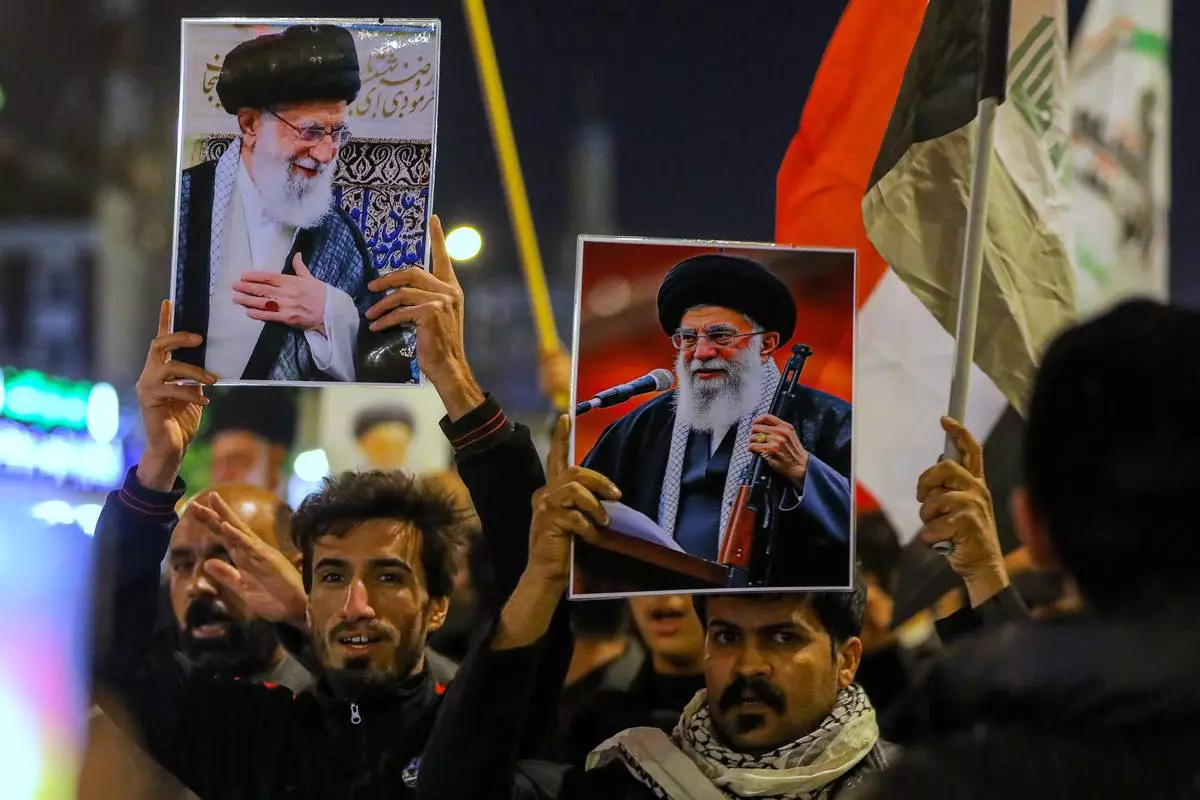
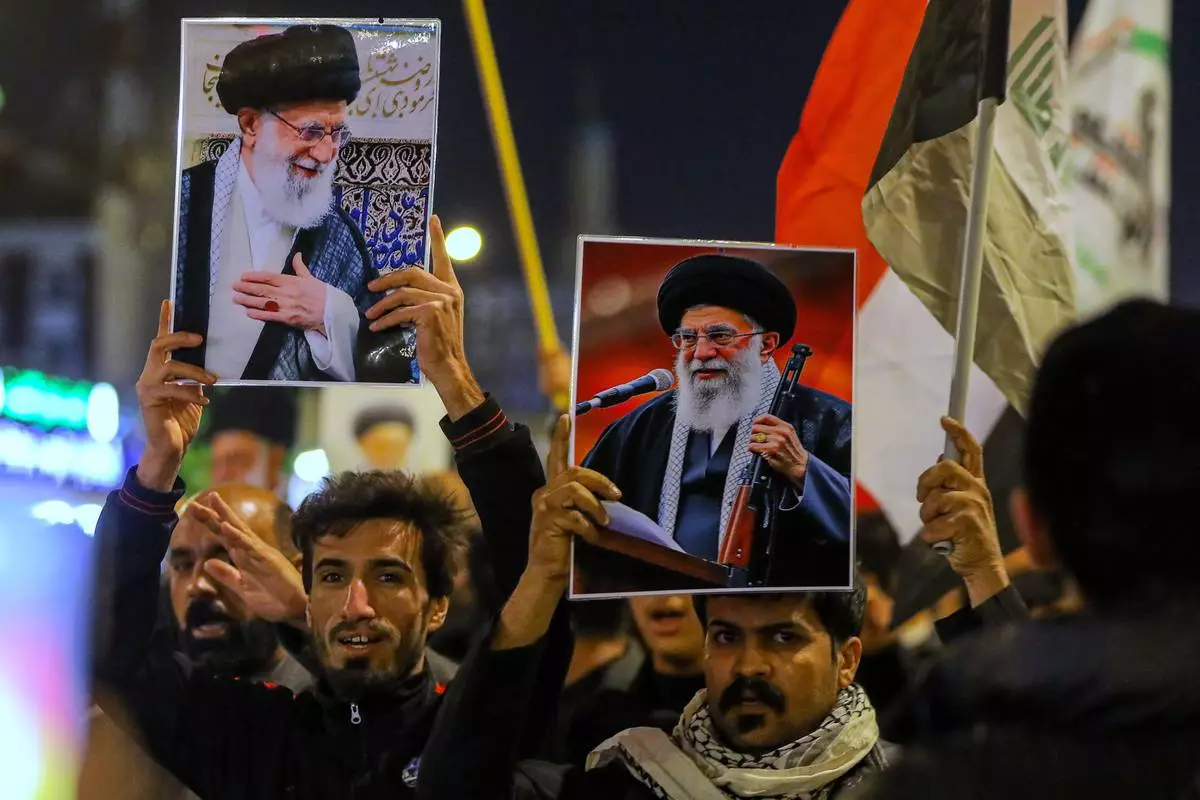
Iraqi Shiites hold pictures of Iranian Supreme Leader Ayatollah Ali Khamenei, who was killed by a U.S. airstrike in Tehran, during a symbolic funeral, in Najaf, Iraq, Sunday, March 1, 2026. (AP Photo/Anmar Khalil)

Iraqi Shiites hold pictures of Iranian Supreme Leader Ayatollah Ali Khamenei, who was killed by a U.S. airstrike in Tehran, during a symbolic funeral, in Najaf, Iraq, Sunday, March 1, 2026. (AP Photo/Anmar Khalil)

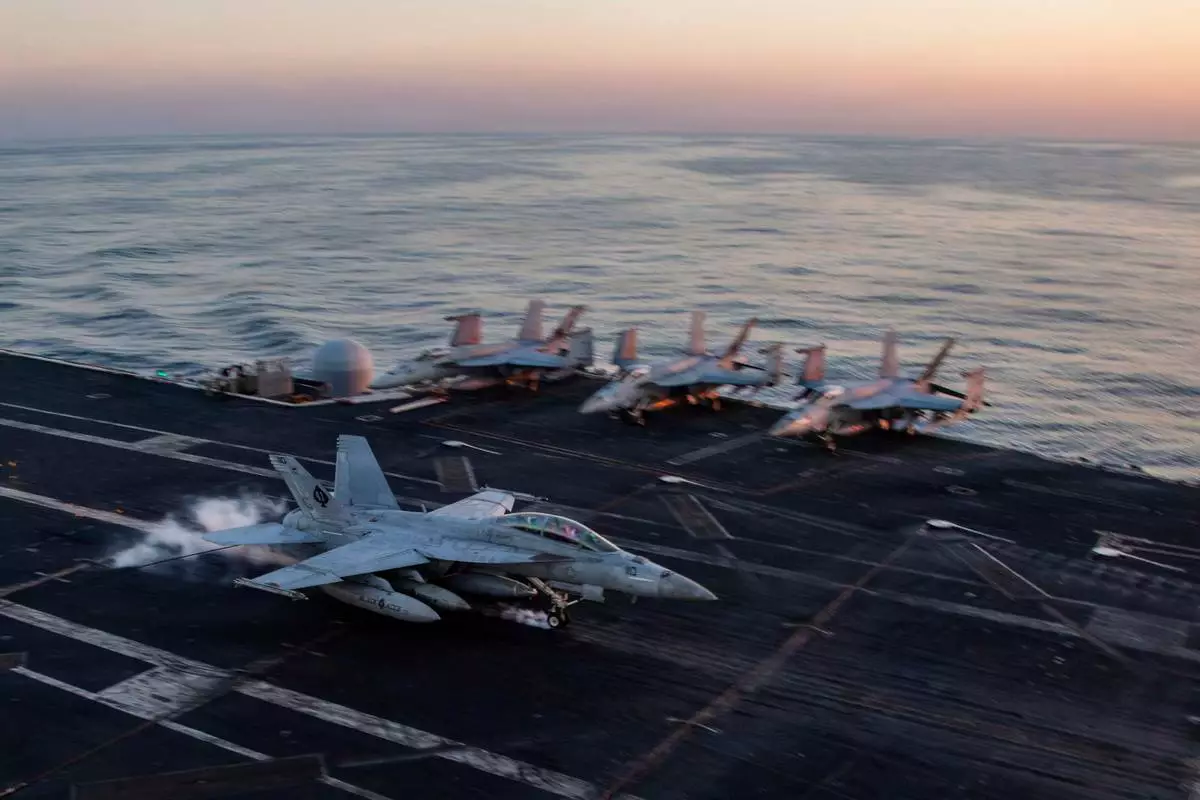
This image provided by U.S. Central Command shows a F/A-18F Super Hornet preparing to make an arrested landing on the USS Abraham Lincoln (CVN 72)) in support of Operation Epic Fury, on Saturday, Feb. 28, 2026. (U.S. Navy via AP)

This image provided by U.S. Central Command shows a F/A-18F Super Hornet preparing to make an arrested landing on the USS Abraham Lincoln (CVN 72)) in support of Operation Epic Fury, on Saturday, Feb. 28, 2026. (U.S. Navy via AP)

In this photo taken with a slow shutter speed, a Middle East Airlines plane flies over Beirut as smoke rises from Israeli airstrikes on Dahiyeh in Beirut's southern suburbs, early Monday, March 2, 2026. (AP Photo/Hassan Ammar)

In this photo taken with a slow shutter speed, a Middle East Airlines plane flies over Beirut as smoke rises from Israeli airstrikes on Dahiyeh in Beirut's southern suburbs, early Monday, March 2, 2026. (AP Photo/Hassan Ammar)

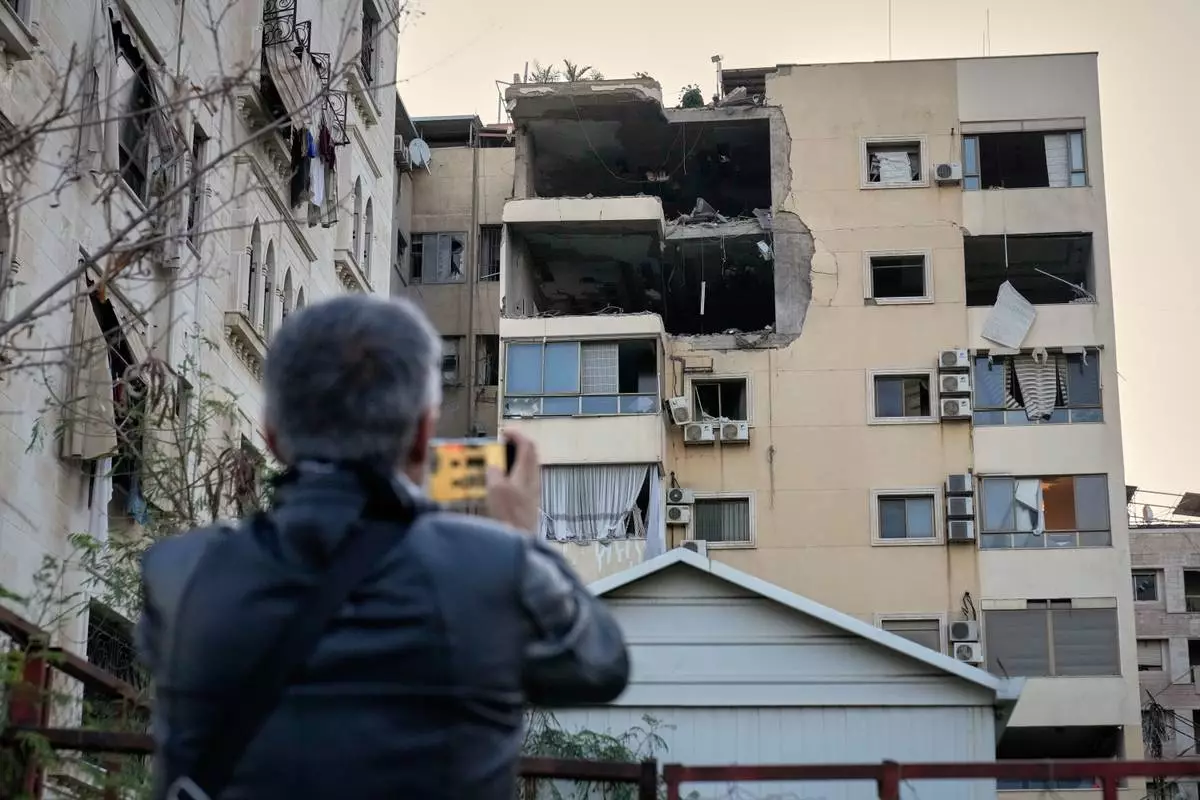
A man takes pictures of the damage in an apartment building after it was hit by an Israeli airstrike in Dahiyeh, Beirut's southern suburb, Lebanon, Monday, March 2, 2026. (AP Photo/Hussein Malla)

A man takes pictures of the damage in an apartment building after it was hit by an Israeli airstrike in Dahiyeh, Beirut's southern suburb, Lebanon, Monday, March 2, 2026. (AP Photo/Hussein Malla)

This image provided by U.S. Central Command shows a Navy sailor observing flight operations aboard the USS Abraham Lincoln (CVN 72)) in support of Operation Epic Fury, on Saturday, Feb. 28, 2026. (U.S. Navy via AP)

This image provided by U.S. Central Command shows a Navy sailor observing flight operations aboard the USS Abraham Lincoln (CVN 72)) in support of Operation Epic Fury, on Saturday, Feb. 28, 2026. (U.S. Navy via AP)

Iraqi Shiites hold pictures of Iranian Supreme Leader Ayatollah Ali Khamenei, who was killed by a U.S. airstrike in Tehran, during a symbolic funeral, in Najaf, Iraq, Sunday, March 1, 2026. (AP Photo/Anmar Khalil)

Iraqi Shiites hold pictures of Iranian Supreme Leader Ayatollah Ali Khamenei, who was killed by a U.S. airstrike in Tehran, during a symbolic funeral, in Najaf, Iraq, Sunday, March 1, 2026. (AP Photo/Anmar Khalil)

Recommended Articles