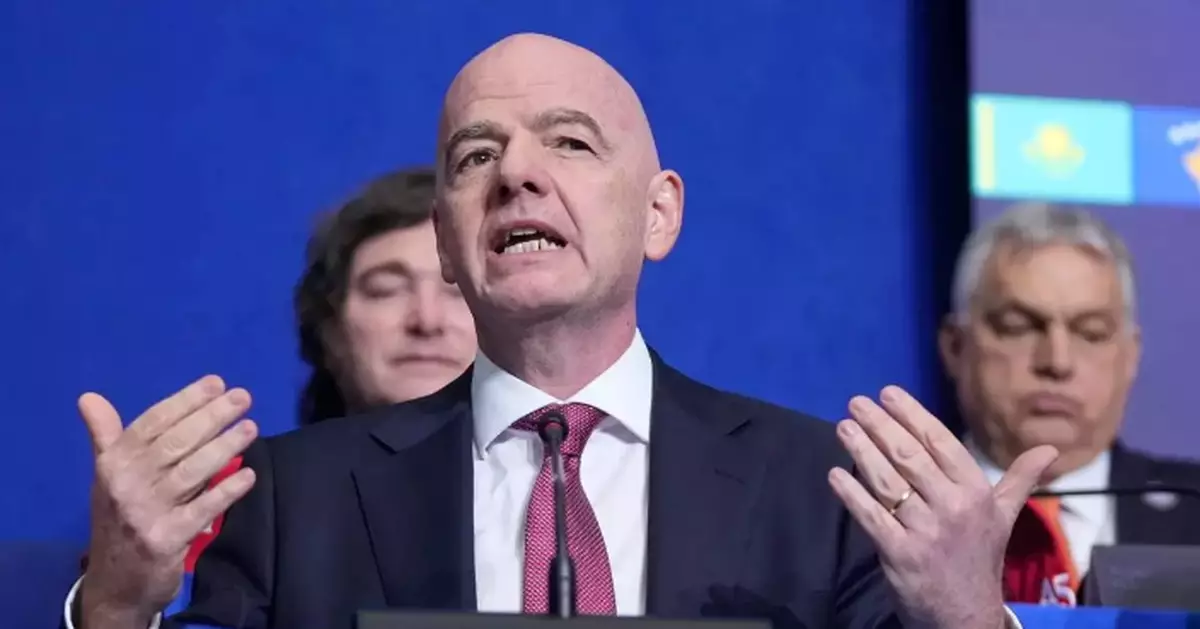
GENEVA (AP) — Iran’s place at the men’s World Cup in three months’ time was put in doubt Monday amid an escalating Middle East conflict sparked by the soccer tournament's co-host the United States.
Iran is due to play its three group stage games in the U.S. — two in Inglewood, California, then in Seattle — from June 15-26. Cities in Canada and Mexico also will host some of the 104 games.
The U.S. and Israel have targeted Iran in coordinated attacks since Saturday that killed Supreme Leader Ayatollah Ali Khamenei and dozens more senior officials.
It provoked an Iranian response that aimed missiles at U.S. allies including 2022 World Cup host Qatar and Saudi Arabia, which FIFA has picked to stage the 2034 edition.
“What is certain is that after this attack, we cannot be expected to look forward to the World Cup with hope,” said Iran’s top soccer official Mehdi Taj, a vice president of the Asian Football Confederation.
It is unclear if the state-backed Iranian soccer federation could refuse to send its team to the 48-nation tournament that starts June 11, or the U.S. government could effectively block the team.
FIFA has declined comment since Saturday, when secretary general Mattias Grafström said it would “monitor developments around all issues around the world.”
The White House's top official overseeing World Cup preparations, Andrew Guiliani, seemed unconcerned Saturday in a social media post.
“We’ll deal with soccer games tomorrow,” Guiliani wrote about Iran, “tonight, we celebrate their opportunity for freedom.”
Here is a look at the issues in play:
Iran has one of the best national teams in Asia and has qualified for six of the past eight World Cups.
It is No. 20 in the FIFA world rankings of 211 teams, and has not been lower than No. 24 since the last World Cup in Qatar.
Iran was among the second-seeded teams in the World Cup draw held in Washington, D.C. in December, minutes after U.S. President Donald Trump was presented with the inaugural FIFA Peace Prize.
Though Taj and other Iranian soccer officials were denied visas to enter the U.S., the draw outcome was favorable for Iran, especially in the expanded format where most third-place teams advance to the knockout rounds.
Iran starts against low-ranked New Zealand, then plays one of the weaker top-seeded nations, Belgium, and finishes against Egypt.
Iran is likely to be supported in stadiums by its diaspora in the U.S., though residents of the Middle East nation are subject to a ban on entering the country.
Trump's government has promised exemptions from its travels bans for athletes and coaches arriving for major sports events like the World Cup.
Politics around Iran inside World Cup stadiums is nothing new. Protests over domestic issues were aired by Iran fans at the last World Cup.
FIFA’s World Cup regulations envisage a team withdrawing, or being excluded, from the tournament though the legal language is vague to say the least.
In that scenario, according to Article 6.7, “FIFA shall decide on the matter at its sole discretion and take whatever action is deemed necessary.”
“FIFA may decide to replace the Participating Member Association in question with another association,” the rules say.
That legal framing seems to give FIFA president Gianni Infantino wide powers to shape any decision relating to Iran.
Just 18 months ago, the decision announced by Infantino to add Lionel Messi’s team Inter Miami to the 2025 Club World Cup lineup appeared to have no basis in formal tournament rules.
Should Iran pull out of the World Cup — still hugely speculative — its soccer federation would forfeit at least $10.5 million.
FIFA pays $9 million in prize money to each of the 16 federations whose teams fail to advance from the group stage, and all 48 qualified teams get $1.5 million “to cover preparation costs.”
The Iranian federation also would face disciplinary fines from FIFA — at least 250,000 Swiss francs ($321,000) for withdrawing up to 30 days before the tournament, and at least 500,000 Swiss francs ($642,000) if the decision is in the last month before kickoff.
Iran would risk being excluded by FIFA from qualifying for the next World Cup in 2030 as well.
Iran was a fast World Cup qualifier last March, earning one of eight guaranteed places allocated to the Asian Football Confederation.
Should Iran pull out, the likely replacement from Asia should be Iraq or the United Arab Emirates.
Iraq and the UAE were effectively the ninth and 10th-ranked Asian teams through the various qualifying groups and advanced to a two-leg playoff last November.
Iraq won 3-2 on aggregate — eliminating the UAE — to advance to the intercontinental playoffs in Mexico and, on March 31, it is scheduled to play an elimination game against Bolivia or Suriname with a World Cup place at stake.
One possible element of uncertainty is the language of the World Cup tournament rules.
FIFA wrote that it can decide to replace a withdrawn team “with another association,” though without specifying the replacement must come from the same continental confederation.
Denmark famously won the 1992 European Championship after getting a late invitation from UEFA, European soccer's ruling body.
Yugoslavia won a qualifying group ahead of the Danes but was removed by UEFA less than two weeks before the tournament because of a United Nations sanctions resolution during the widening Balkans conflict.
Teams have previously refused to travel to a World Cup, though not in the modern era.
Just 13 teams instead of 16 took part in the 1950 World Cup in Brazil, with India and Scotland among teams declining a place.
AP soccer: https://apnews.com/hub/soccer
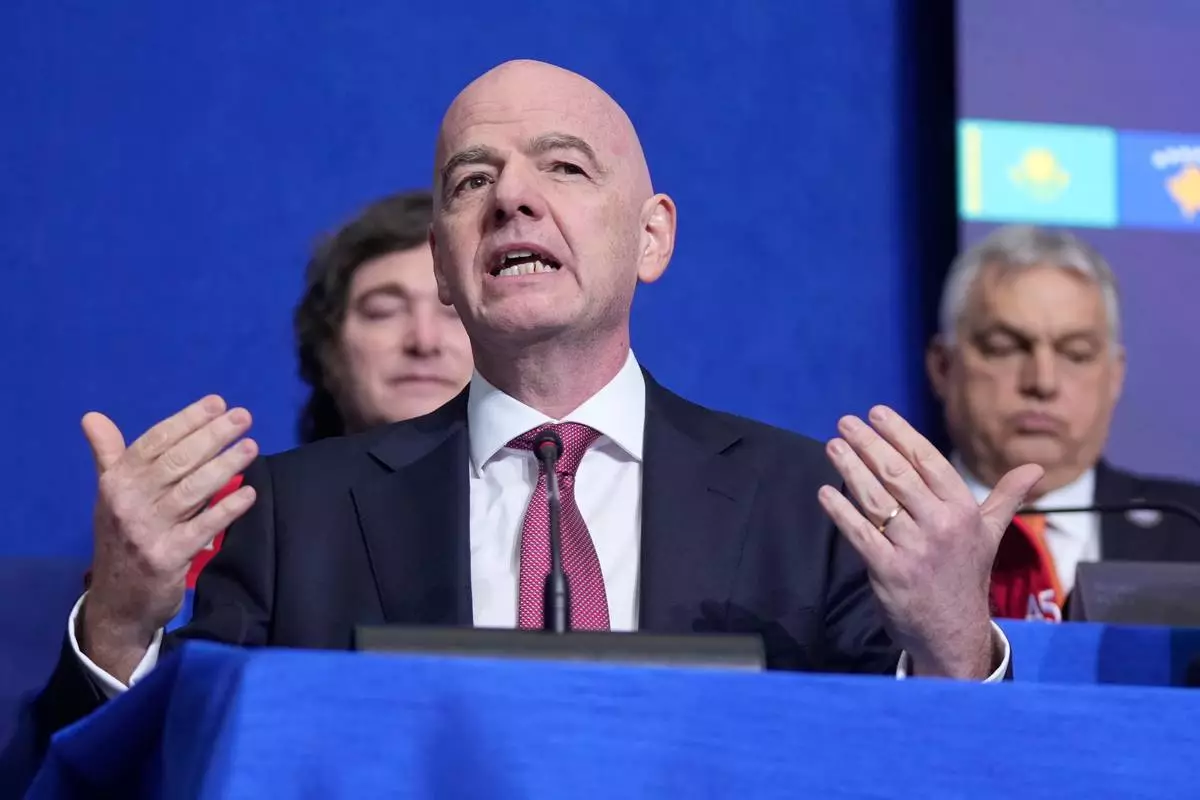
FIFA President Gianni Infantino speaks during a Board of Peace meeting at the U.S. Institute of Peace, Thursday, Feb. 19, 2026, in Washington. (AP Photo/Mark Schiefelbein)
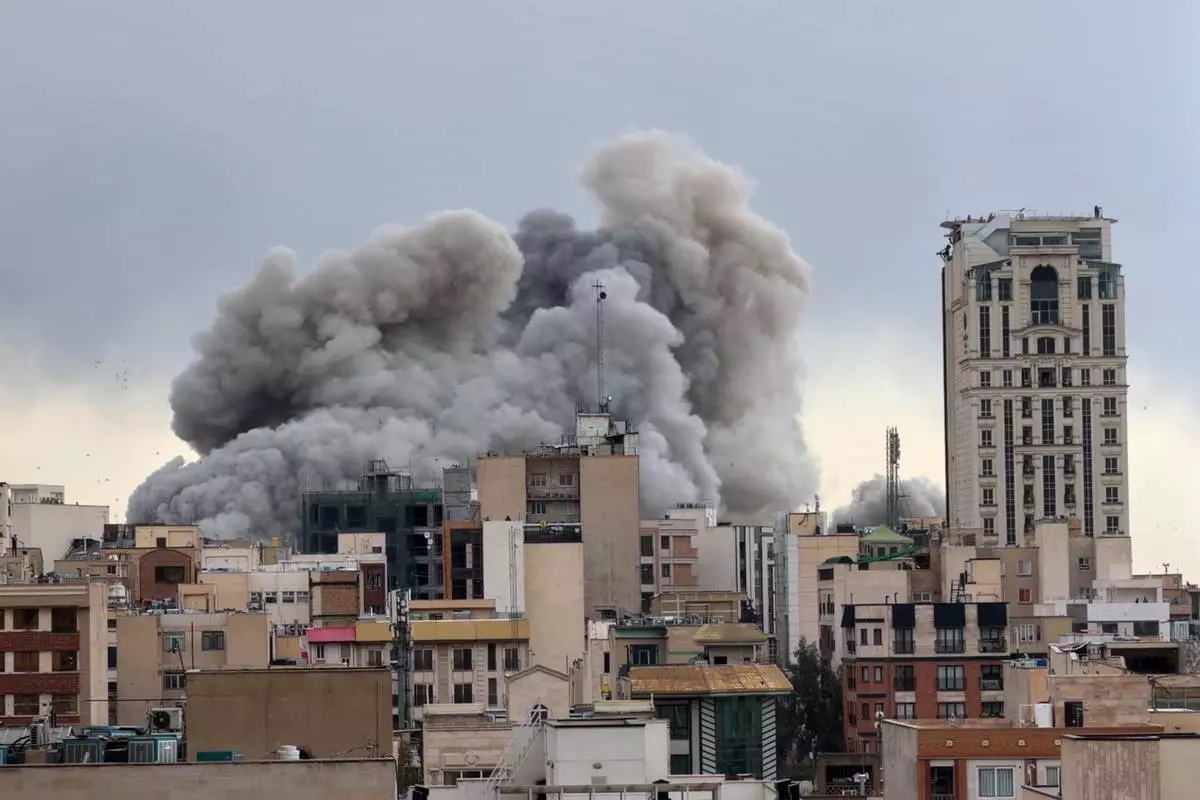
A plume of smoke rises after a strike in Tehran, Iran, Monday, March 2, 2026. (AP Photo/Mohsen Ganji)
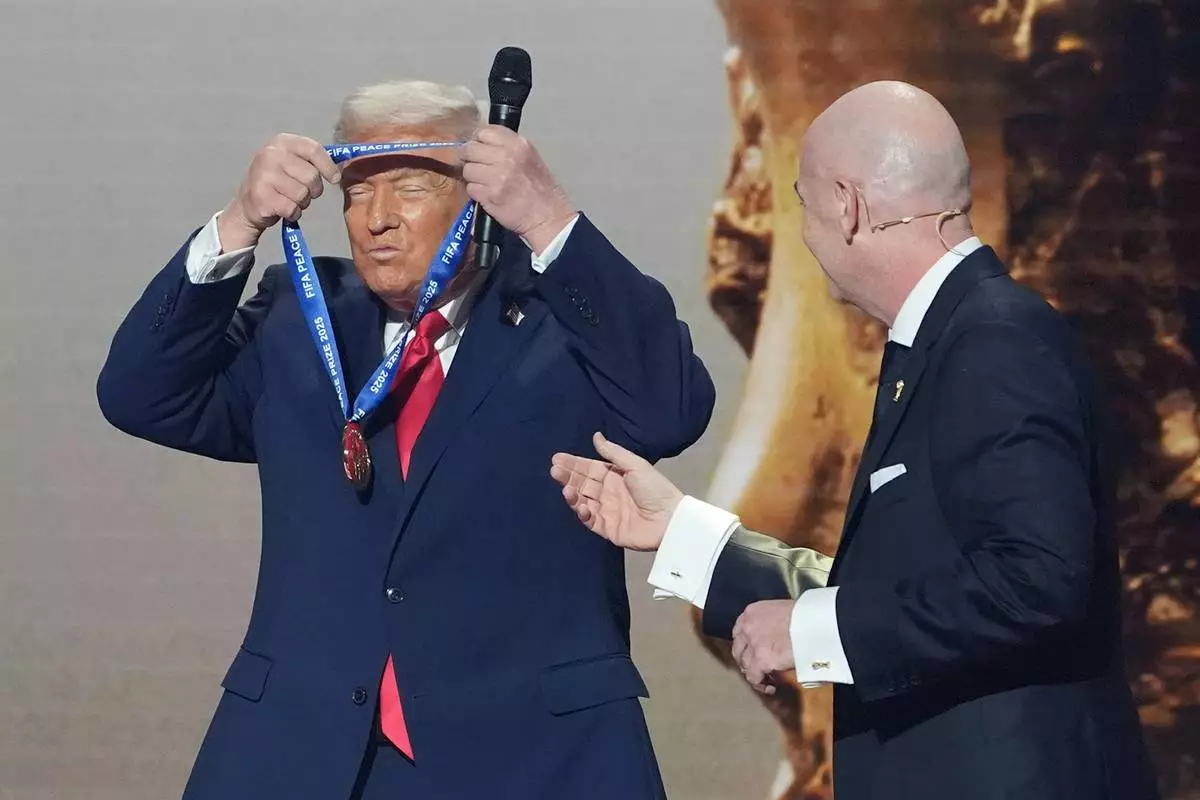
FILE - President Donald Trump is presented with the inaugural FIFA Peace Prize by FIFA President Gianni Infantino during the 2026 FIFA World Cup draw at the Kennedy Center, Dec. 5, 2025, in Washington. (AP Photo/Evan Vucci, file)

L’ILE LONGUE, France (AP) — French President Emmanuel Macron announced Monday that France will increase its nuclear arsenal and for the first time allow the temporary deployment of its nuclear-armed aircraft to allied countries, in a new strategy aimed at strengthening Europe’s independence.
Macron made the announcements during a speech outlining his country's nuclear strategy at a military base at L’Ile Longue in northwestern France that hosts the country’s ballistic missile submarines.
“To be free, one needs to be feared,” Macron said.
Macron said the new posture could “provide for the temporary deployment of elements of our strategic air forces to allied countries," but said there would be no sharing of decision-making with any other nation regarding the use of the nuclear weapons.
Talks about such arrangements have started with Britain, Germany, Poland, the Netherlands, Belgium, Greece, Sweden and Denmark, Macron said.
Macron’s long-planned speech, scheduled before the most recent outbreak of hostilities in Iran, was aimed at spelling out how French nuclear weapons fit into Europe’s security amid concerns raised on the continent by recurring tensions with U.S. President Donald Trump and Russia’s full-scale invasion of Ukraine.
France also will allow partners to participate in deterrence exercises and allow allies’ non-nuclear forces to participate in France’s nuclear activities, said Macron, who is the commander-in-chief of the armed forces under the French constitution.
European partners welcomed the new strategy of France, which has been the only nuclear power in the European Unio n since Britain’s exit from the bloc in 2020.
In a joint statement, Macron and German Chancellor Friedrich Merz said the two countries would deepen integration in deterrence starting this year, “including German conventional participation in French nuclear exercises and joint visits to strategic sites.”
In a letter to Dutch lawmakers, Defense Minister Dilan Yesilgöz-Zegerius and Foreign Minister Tom Berendsen said the Netherlands was in strategic talks with France on nuclear deterrence as "a supplement to, and not a replacement for, NATO’s collective defense and nuclear deterrence capabilities."
Polish Prime Minister Donald Tusk wrote on X that “we are arming up together with our friends so that our enemies will never dare to attack us.”
Macron also announced that France will increase its number of nuclear warheads from the current level of below 300, but did not give a figure for the increase. It will be the first time France increases its nuclear arsenal since at least 1992.
“I have decided to increase the numbers of warheads of our arsenal,” Macron said. “My responsibility is to ensure that our deterrence maintains — and will maintain in the future — its assured destructive power."
“If we had to use our arsenal, no state, however powerful, could shield itself from it, and no state, however vast, would recover from it,” Macron said.
European leaders have voiced growing doubts about U.S. commitments to help defend Europe under the so-called nuclear umbrella, a policy long intended to ensure that allies — particularly NATO members — would be protected by American nuclear forces in the event of a threat.
Macron said that recent changes in U.S. defense strategy amid the emergence of new threats have demonstrated a refocusing of American priorities and have encouraged Europe to take more direct responsibility for its own security. He said Europeans should take their destiny more firmly into their hands.
Some European nations have already taken up an offer Macron made last year to discuss France’s nuclear deterrence and even associate European partners in nuclear exercises.
Last month, Merz said he’d had “initial talks” with Macron on the issue and had publicly theorized about German Air Force planes possibly being used to carry French nuclear bombs. But Macron ruled out any such possibility in Monday's speech.
France and Britain also adopted a joint declaration in July that allows both nations' nuclear forces, while independent, to be “coordinated.” The U.K., no longer an EU member but a NATO ally, is the only other country in Western Europe with a nuclear deterrent.
Macron has consistently insisted any decision to use France’s nuclear weapons would remain only in the hands of the French president.
Macron added that the evolution of France competitors’ defenses, the emergence of regional powers, the possibility of coordination among adversaries, and the risks linked to proliferation led him to the conclusion that it was essential for France to enhance its nuclear arsenal.
The International Campaign to Abolish Nuclear Weapons, which won the Nobel Peace Prize in 2017, said Macron’s plan could cost billions of euros (dollars), jeopardize France's international commitments and lead Russia to interpret it as a “major provocation” that could risk escalation.
“This represents a significant step backward in light of France’s obligations under the Nuclear Non-Proliferation Treaty,” said Jean-Marie Collin, the head of the group’s French office. “Increasing its arsenal reflects a dynamic of participation in an arms race, contradicting the spirit, if not the letter, of this treaty, which commits nuclear-armed states to pursue nuclear disarmament.”
“On a strategic level, Russia would very likely consider this initiative as a major provocation, with risks of escalation.
Petrequin reported from Paris. Jamey Keaten in Geneva, Mike Corder in The Hague, Netherlands, and Claudia Ciobanu in Warsaw contributed to this report.
French President Emmanuel Macron delivers a speech next to the submarine 'Le Temeraire' (The Temerarious) at the Nuclear submarines Navy base of Ile Longue in Crozon, France, Monday March 2, 2026. (Yoan Valat/Pool Photo via AP)
FILE - France's Rafale B twin-seat multirole fighter performs during the Pegase 2024 mission at Halim Perdanakusuma airport in Jakarta, Indonesia, Wednesday, July 24, 2024. (AP Photo/Tatan Syuflana, File)
FILE - A Rafale M single seater fighter jet is catapulted on France's flagship Charles de Gaulle aircraft carrier in the Persian Gulf, Jan. 12, 2016. (AP Photo/Christophe Ena, File)
FILE - French Marine officers wait atop "Le Vigilant" nuclear submarine at L'Ile Longue military base, near Brest, Brittany, July 13, 2007. (AP Photo/Francois Mori, Pool, File)