NEW YORK (AP) — A man who repeatedly drove his car into the Chabad Lubavitch world headquarters in New York City earlier this year pleaded not guilty Monday to federal charges of intentionally damaging religious property.
Dan Sohail, 36, was previously arrested on hate crime charges following the Jan. 28 incident, which damaged an entrance to the revered Jewish site but did not cause any injuries. The new federal case comes on top of multiple state-level hate crime charges, including attempted assault.
He entered his federal not guilty plea Monday through lawyer Mia Eisner-Grynberg, who said Sohail's actions had not been “intentional in the manner described by the government.”
He is in the process of converting to Judaism and had visited the Chabad Lubavitch site before, she said. Sohail, who wore a yarmulke in court, didn't speak except for answering standard yes-or-no questions about aspects of the proceeding.
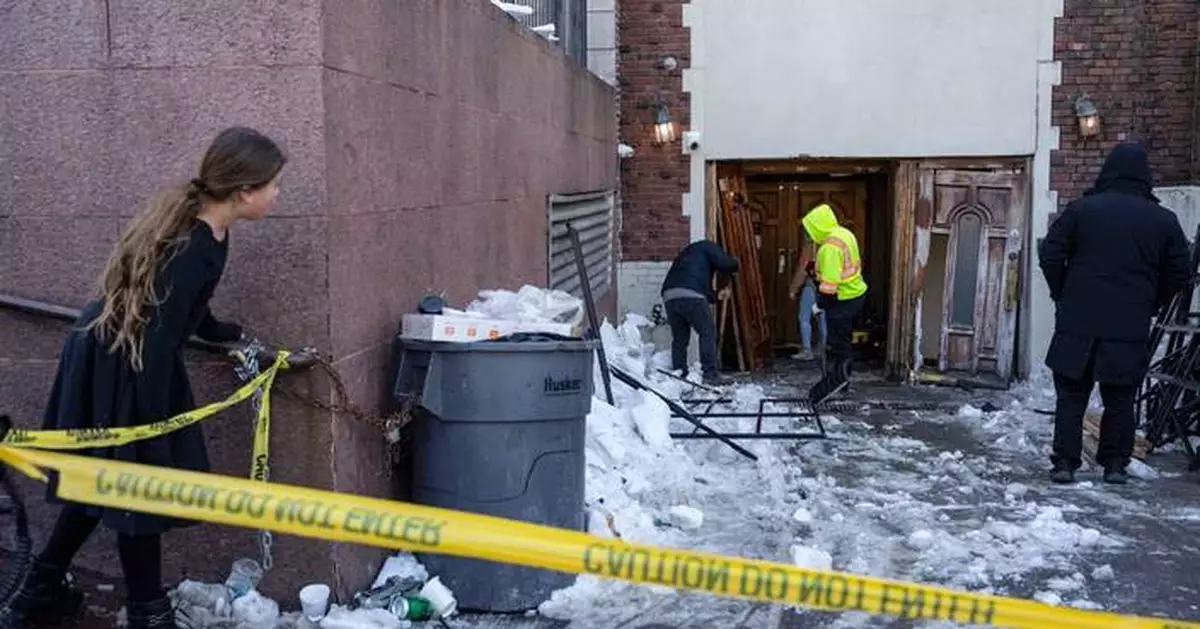
In a court complaint, federal authorities said Sohail deliberately rammed the side of the building with his car five consecutive times after clearing away stanchions and urging people to move out of the way. He then told police he had lost control of the vehicle and pressed on the gas with his heavy boots, according to the complaint.
From Washington, the Department of Justice's civil rights division chief, Harmeet Dhillon, highlighted the case in a social media post that deplored “attacks on houses of worship.”
Several people close to Sohail — including family members and Chabad rabbis — have said he did not seem to harbor any hatred toward Jews but suffered from mental health issues. Sohail's attorney said he was living with his mother in New Jersey, while working two jobs as a generator technician and a fertilizer technician.
Sohail’s father told The Daily News that his son suffered from “mental problems” but had “a very good friendship, relationship" with the Jewish community. Weeks before the incident, he had attended a social gathering at the Chabad headquarters, where he was seen on video dancing with Orthodox men, according to police.
At Sohail’s arraignment on Monday, prosecutor Eric Silverberg acknowledged “very significant mental health concerns” about the man but said that his behavior was dangerous and that he should be detained.
He will be held in a Brooklyn federal jail ahead of a bail hearing Wednesday. Sohail's attorney said he would rather have returned to Rikers Island, the city jail where he's been held since the crash, as he was eager to be settled back in for the start of Jewish holiday Purim at sunset Monday.
The charge carries a maximum penalty of three years in prison if the damage is found to have exceeded $5,000.
A spokesperson for Chabad declined to comment on the federal case and the cost of damage to the door.
Meanwhile, the Brooklyn district attorney's office declined Monday to discuss the future of the state case, saying only that it's ongoing. Sohail has pleaded not guilty to the state charges.
The crash occurred on the 75th anniversary of Rabbi Menachem Mendel Schneerson becoming the leader of the Lubavitch movement and prompted immediate concern in the city. Schneerson died in 1994 but remains a revered figure globally.
There has been a near-constant police presence around the Chabad Lubavitch world headquarters for years.
The site was at the epicenter of the Crown Heights riots in 1991, when Black residents of the neighborhood attacked Jews after a child was killed by a car traveling in Schneerson’s motorcade. In 2014, a disturbed man entered the synagogue and stabbed a rabbinical student, wounding him, before being shot dead by police.
This story has been corrected to attribute a comment about Sohail’s religious affiliation to his attorney, not to Sohail himself.
Associated Press writer Jake Offenhartz contributed.
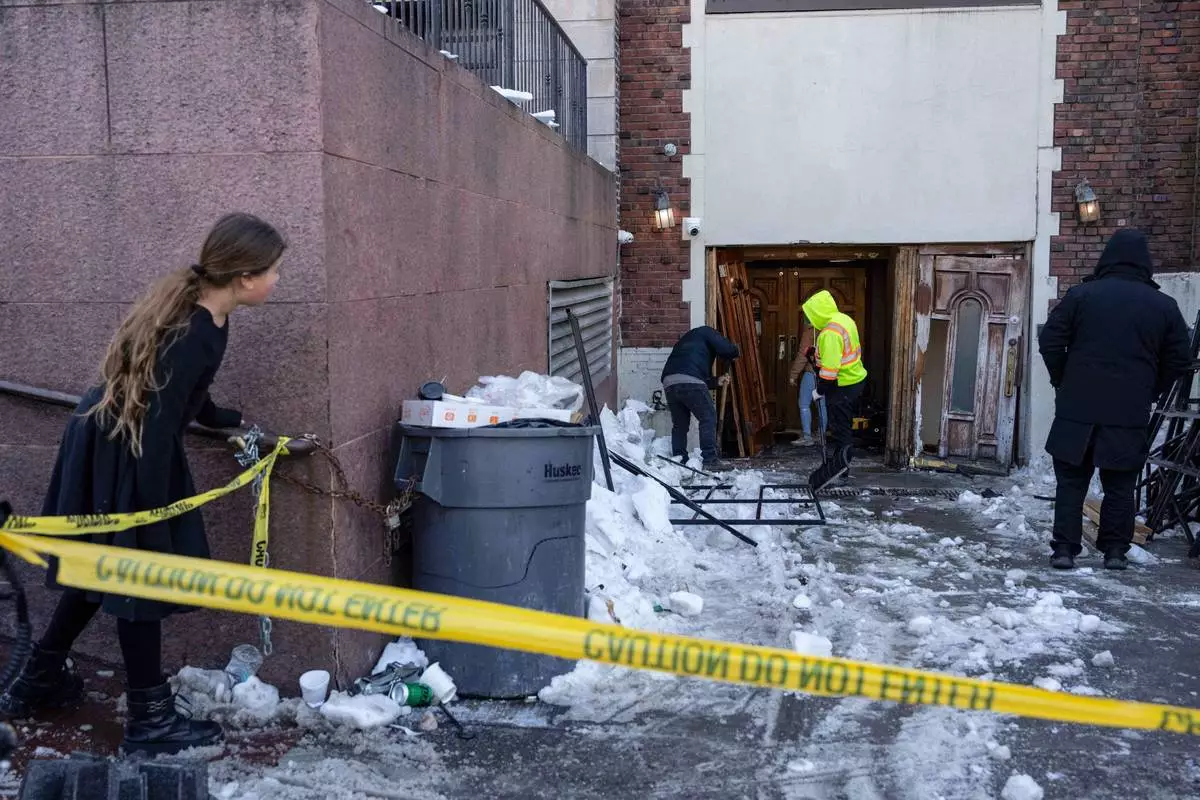
FILE - A person watches the scene where a car slammed into the entrance of the Chabad Lubavitch world headquarters, Jan. 29, 2026, in New York. (AP Photo/Yuki Iwamura, file)
L’ILE LONGUE, France (AP) — French President Emmanuel Macron announced Monday that France will increase its nuclear arsenal and, for the first time, allow the temporary deployment of its nuclear-armed aircraft to allied countries, in a new strategy aimed at strengthening Europe’s independence.
In speech planned long before the most recent outbreak of war in Iran, Macron outlined how French nuclear weapons fit into the security of Europe as leaders there express concerns over recurring tensions with U.S. President Donald Trump and Russia’s full-scale invasion of Ukraine.
France has been the only nuclear power in the European Union since Britain’s exit from the bloc in 2020.
“To be free, one needs to be feared,” Macron said at a military base at L’Ile Longue on France's Atlantic coast that hosts the country’s ballistic missile submarines.
Macron said the new posture, which he called “forward deterrence,” could “provide for the temporary deployment of elements of our strategic air forces to allied countries," but said there would be no sharing of decision-making with any other nation regarding the use of the nuclear weapons.
Talks about such deterrence cooperation have started with Britain, Germany, Poland, the Netherlands, Belgium, Greece, Sweden and Denmark, Macron said.
France also will allow partners to participate in deterrence exercises and allow allies’ non-nuclear forces to participate in France’s nuclear activities, said Macron, who is the commander-in-chief of the armed forces under the French constitution.
European partners welcomed the strategy.
In a joint statement, Macron and German Chancellor Friedrich Merz said the two countries would deepen integration in deterrence starting this year, “including German conventional participation in French nuclear exercises and joint visits to strategic sites.”
In a letter to Dutch lawmakers, Defense Minister Dilan Yesilgöz-Zegerius and Foreign Minister Tom Berendsen said the Netherlands was in strategic talks with France on nuclear deterrence as "a supplement to, and not a replacement for, NATO’s collective defense and nuclear deterrence capabilities."
Polish Prime Minister Donald Tusk wrote on X that “we are arming up together with our friends so that our enemies will never dare to attack us.”
Macron also announced that France will increase its number of nuclear warheads from the current level of below 300, but did not give a figure for the increase. It will be the first time France increases its nuclear arsenal since at least 1992.
“I have decided to increase the numbers of warheads of our arsenal,” Macron said. “My responsibility is to ensure that our deterrence maintains — and will maintain in the future — its assured destructive power."
“If we had to use our arsenal, no state, however powerful, could shield itself from it, and no state, however vast, would recover from it,” Macron said.
European leaders have voiced growing doubts about U.S. commitments to help defend Europe under the so-called nuclear umbrella, a policy long intended to ensure that allies — particularly NATO members — would be protected by American nuclear forces in the event of a threat.
Macron said that recent changes in U.S. defense strategy amid the emergence of new threats have demonstrated a refocusing of American priorities and have encouraged Europe to take more direct responsibility for its own security. He said Europeans should take their destiny more firmly into their hands.
Some European nations have already taken up an offer Macron made last year to discuss France’s nuclear deterrence.
Last month, Merz said he’d had “initial talks” with Macron on the issue and had publicly theorized about German Air Force planes possibly being used to carry French nuclear bombs. But Macron ruled out any such possibility in Monday's speech.
France and Britain also adopted a joint declaration in July that allows both nations' nuclear forces, while independent, to be “coordinated.” The U.K., no longer an EU member but a NATO ally, is the only other country in Western Europe with a nuclear deterrent.
Macron has consistently insisted any decision to use France’s nuclear weapons would remain only in the hands of the French president.
Macron added that the evolution of France competitors’ defenses, the emergence of regional powers, the possibility of coordination among adversaries, and the risks linked to proliferation led him to the conclusion that it was essential for France to enhance its nuclear arsenal.
The International Campaign to Abolish Nuclear Weapons, which won the Nobel Peace Prize in 2017, said Macron’s plan could cost billions of dollars, jeopardize France's international commitments and lead Russia to interpret it as a major provocation that could risk escalation.
“These are indiscriminate weapons that are banned under the Treaty on the Prohibition of Nuclear Weapons,” said the group’s executive director, Melissa Parke. "This announcement from French President Macron is a direct threat to the peace and security of the region, and the world.
“France already spent $6 billion on its nuclear weapons in 2024 and it is unclear how much this unexpected increase will add to that exorbitant sum. This is not progress, it’s a nuclear arms race that no one can afford,” Parke said.
Petrequin reported from Paris. Jamey Keaten in Geneva, Mike Corder in The Hague, Netherlands, and Claudia Ciobanu in Warsaw contributed to this report.
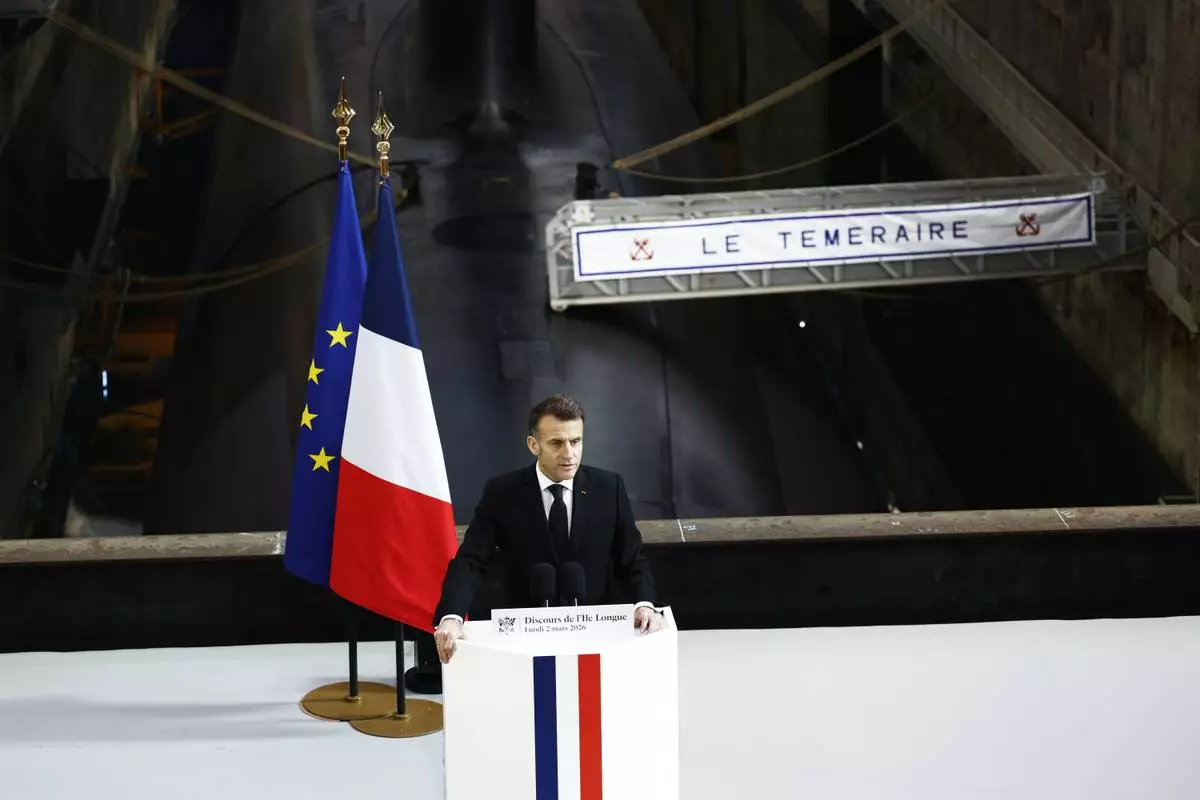
French President Emmanuel Macron delivers a speech next to the submarine 'Le Temeraire' (The Temerarious) at the Nuclear submarines Navy base of Ile Longue in Crozon, France, Monday March 2, 2026. (Yoan Valat/Pool Photo via AP)
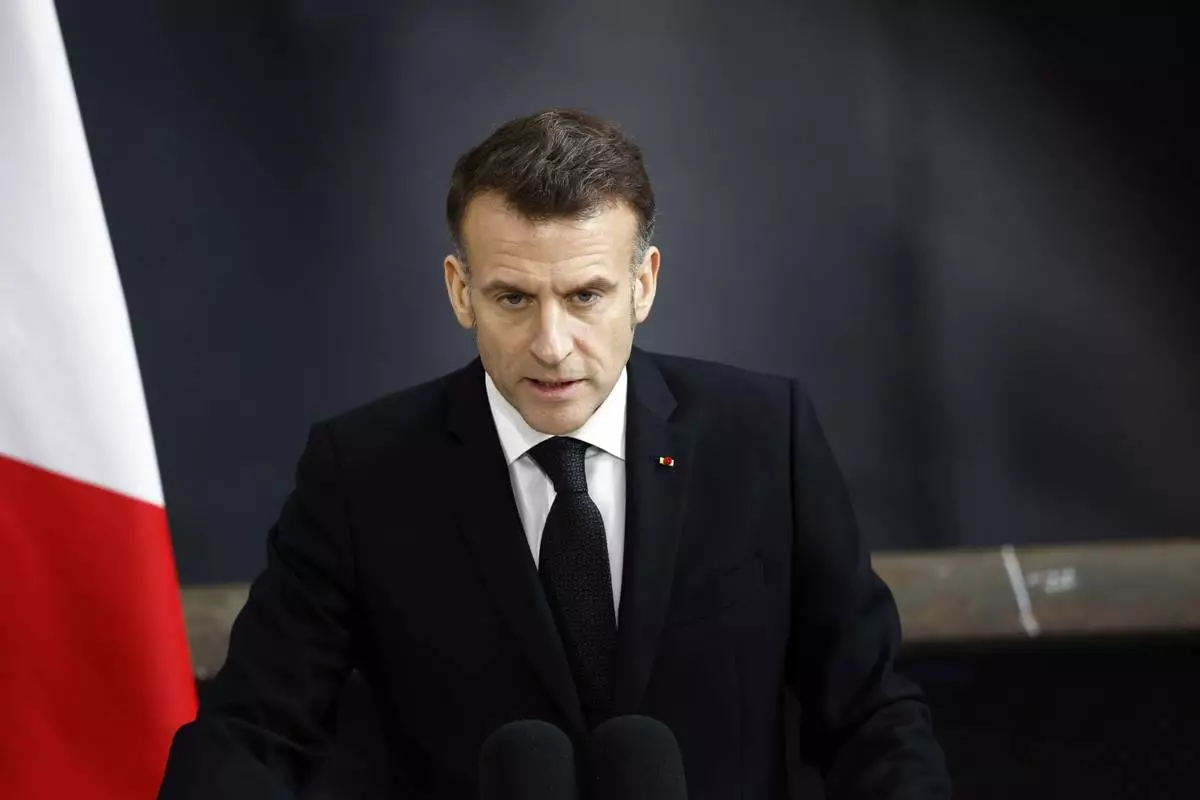
French President Emmanuel Macron delivers a speech next to the submarine 'Le Temeraire' (The Temerarious) at the Nuclear submarines Navy base of Ile Longue in Crozon, France, Monday March 2, 2026. (Yoan Valat/Pool Photo via AP)
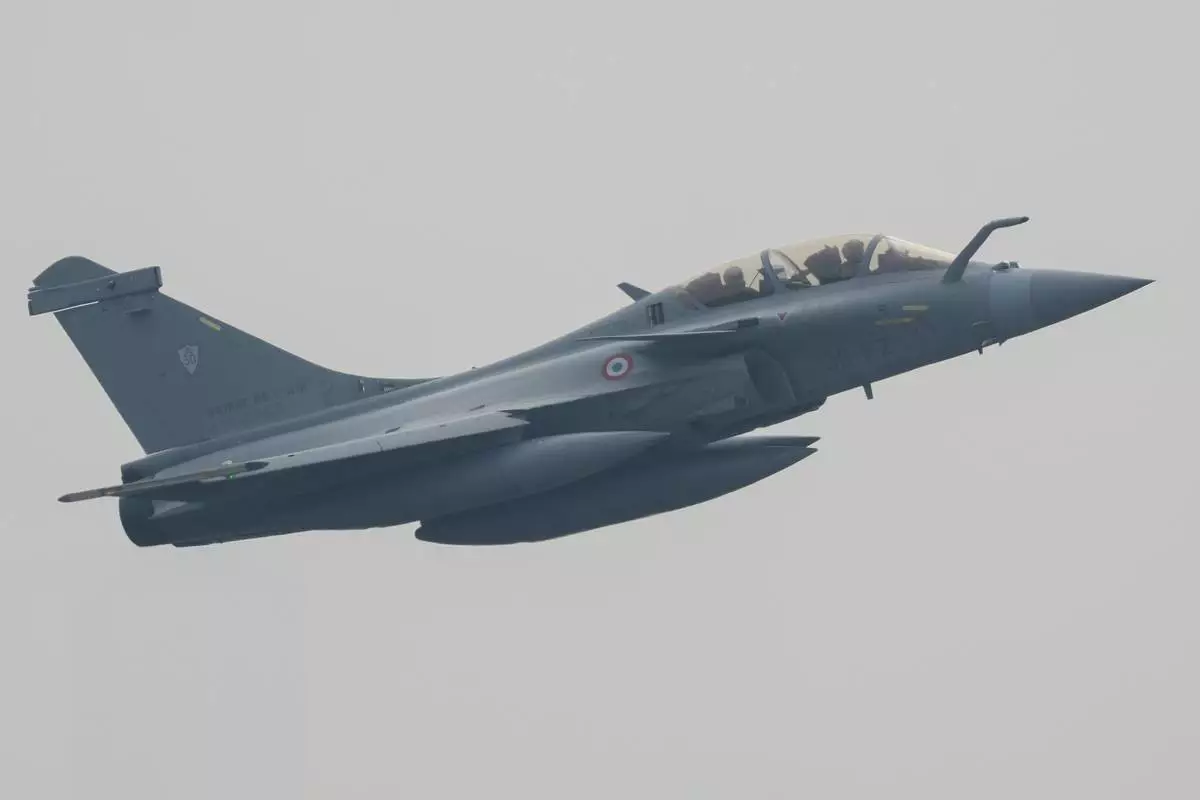
FILE - France's Rafale B twin-seat multirole fighter performs during the Pegase 2024 mission at Halim Perdanakusuma airport in Jakarta, Indonesia, Wednesday, July 24, 2024. (AP Photo/Tatan Syuflana, File)
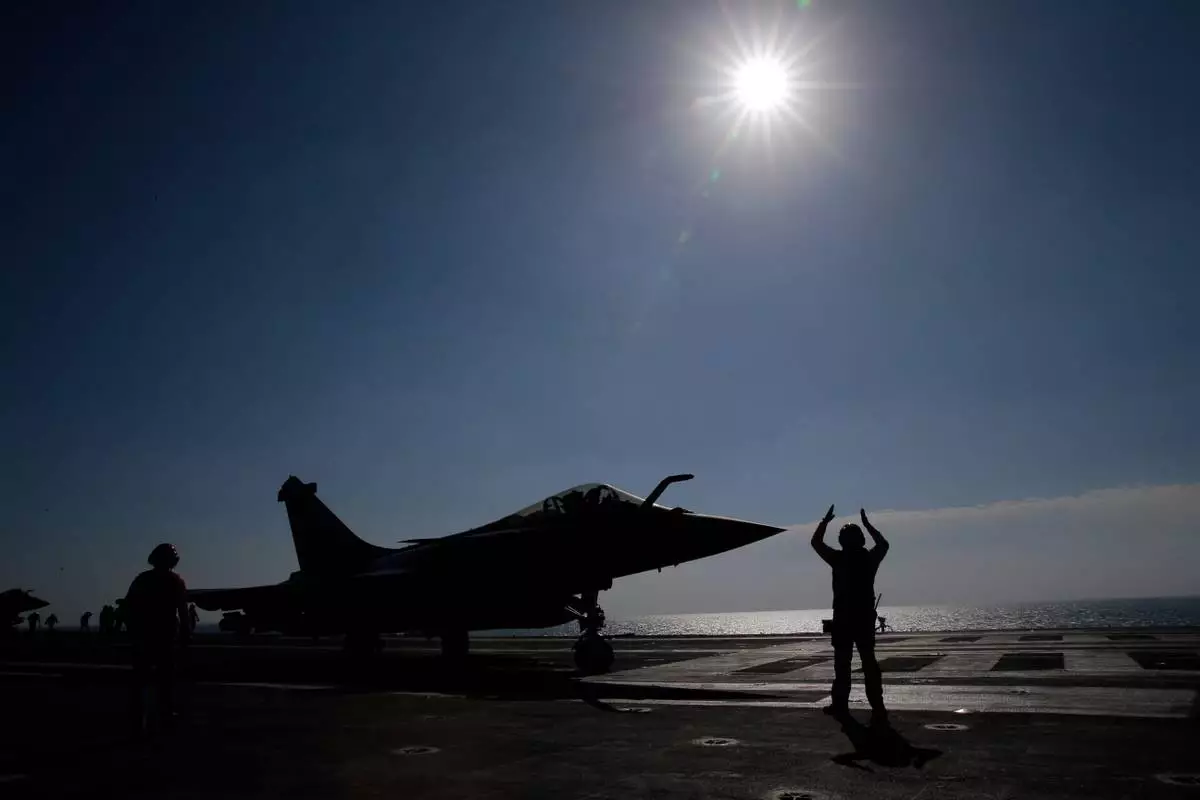
FILE - A Rafale M single seater fighter jet is catapulted on France's flagship Charles de Gaulle aircraft carrier in the Persian Gulf, Jan. 12, 2016. (AP Photo/Christophe Ena, File)
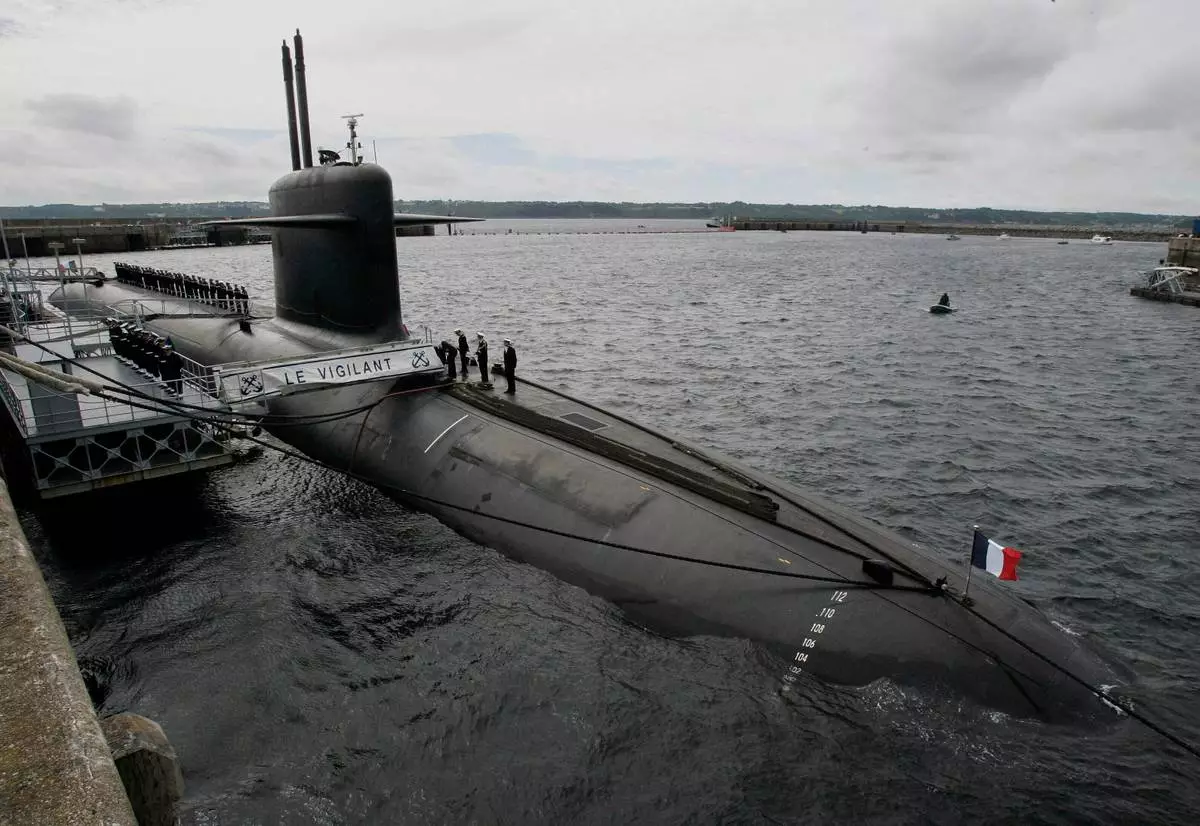
FILE - French Marine officers wait atop "Le Vigilant" nuclear submarine at L'Ile Longue military base, near Brest, Brittany, July 13, 2007. (AP Photo/Francois Mori, Pool, File)