BUENOS AIRES, Argentina (AP) — Argentina’s largest trade union group on Monday filed a lawsuit to block a sweeping labor reform promoted by President Javier Milei and aimed at radically altering labor relations in the South American country.
The reform, which was approved Friday by Congress, grants employers greater flexibility in matters of hiring, firing, severance and collective bargaining and seeks to limit the historical power of unions.
“This law represents a serious infringement of collective and individual rights that expressly violate constitutional principles,” the General Confederation of Labor, CGT, said in a statement after its lawyers filed the complaint in the courts of Buenos Aires.
The complaint challenges the reform’s constitutionality, arguing it violates both the “principle of progressivity,” which prevents the reversal of labor rights, and the “protective principle,” a legal standard aimed at preventing employer abuses and restoring balance to the workplace.
“The damages are not collateral effects of an isolated decision, but are consistent with the national government’s economic and social program,” the CGT said, warning that over 300,000 jobs have been lost since Milei took office in late 2023 with a mandate for austerity and deep economic reform.
Milei called the overhaul "historic" on Friday after its approval. "We have a labor modernization,” he said.
The legislative process has been fraught with tension between the governing party and the opposition. The friction boiled over last month during the bill’s debate in the lower house of Congress, as the GCT launched a 24-hour nationwide strike, while demonstrators from various leftist groups clashed with police outside Congress.
Milei considers the changes to Argentina’s half-century-old labor code crucial to his efforts to lure foreign investment, increase productivity and boost job creation in a country where about two in five workers are employed off the books.
Unions argue that the law will weaken the workers’ protections that have defined Argentina since the rise of Peronism, the country’s dominant populist political movement, in the 1940s.
Follow AP’s coverage of Latin America and the Caribbean at https://apnews.com/hub/latin-america

Argentina's President Javier Milei, left, greets Economy Minister Luis Caputo before delivering the annual State of the Nation address at Congress in Buenos Aires, Argentina, Sunday, March 1, 2026. (AP Photo/Gustavo Garello)

Argentina's President Javier Milei delivers the annual State of the Nation address at Congress in Buenos Aires, Argentina, Sunday, March 1, 2026. (AP Photo/Gustavo Garello)

Argentina's President Javier Milei arrives at Congress to deliver the annual State of the Nation address in Buenos Aires, Argentina, Sunday, March 1, 2026. (AP Photo/Gustavo Garello)
DUBAI, United Arab Emirates (AP) — Oil prices jumped Monday as the widening war in Iran disrupted tanker traffic through the Strait of Hormuz, highlighting how important the passageway is to the world's oil supply.
The Strait of Hormuz is the narrow mouth of the Persian Gulf through which about a fifth of the world's oil passes. Tankers traveling through the strait, which is bordered in the north by Iran, carry oil and gas from Saudi Arabia, Kuwait, Iraq, Qatar, Bahrain, the UAE and Iran. Most of that oil goes to Asia.
Any disruption to traffic through the Strait of Hormuz is highly disruptive to the oil trade.
“The scale of what is at stake cannot be overstated,” said Hakan Kaya, senior portfolio manager at investment management firm Neuberger Berman. He said a partial slowdown lasting a week or two could be absorbed by oil companies. But a full or near full closure lasting a month or more would push crude oil prices, trading around $70 on Monday, “well into triple digits” and European natural gas prices “toward or above the crisis levels seen in 2022.”
Here’s what to know about the strait and the widening Iran war.
The Strait of Hormuz is a bending waterway, about 33 kilometers (21 miles) wide at its narrowest point. It connects the Persian Gulf to the Gulf of Oman. From there, ships can then travel to the rest of the world. While Iran and Oman have their territorial waters in the strait, it's viewed as an international waterway all ships can ply. The United Arab Emirates, home to the skyscraper-studded city of Dubai, also sits near the waterway.
The Strait of Hormuz through history has been important for trade, with ceramics, ivory, silk and textiles moving from China through the region. In the modern era, it is the route for supertankers carrying oil and gas from Saudi Arabia, Kuwait, Iraq, Qatar, Bahrain, the UAE and Iran. The vast majority of it goes to markets in Asia, including Iran's only remaining oil customer, China.
While there are pipelines in Saudi Arabia and the UAE that can avoid the passage, the U.S. Energy Information Administration says “most volumes that transit the strait have no alternative means of exiting the region.”
Threats to the route have spiked global energy prices in the past, including during the Israel-Iran war in June.
The strait is not officially closed, but tanker traffic has dropped sharply as satellite navigation systems were disrupted, data and analytics firm Kpler said on X on Sunday. The U.K. Maritime Trade Operations Center reported attacks on several vessels in the area on either side of the strait and warned of elevated electronic interference to systems that show where ships are.
A bomb-carrying drone boat struck a Marshall Islands-flagged oil tanker in the Gulf of Oman, which leads into the strait from the east, killing one mariner, Oman said.
Iran has been threatening vessels approaching the Strait of Hormuz and is believed to have launched multiple attacks.
Global shippers have issued service alerts saying they have suspended operations in the area. Danish shipping company Maersk, the world’s biggest shipping company, said Sunday it is suspending all vessel crossings in the Strait of Hormuz until further notice. Other ocean carriers including Hapag-Lloyd, CMA-CGM and MSC made similar announcements.
“No one is wanting to navigate it, and there’s no insurer who’s willing to stand behind any transport going through there right now.,” said Tom Goldsby, logistics chairman in the Supply Chain Management Department at the University of Tennessee. “Those ships that got stuck in the Gulf are not going anywhere. ... There’s also a whole host of ships that were heading into the Gulf to replace them, and of course they’re anchored or going elsewhere now."
Data and analytics firm Kplr estimated there are 70 laden oil tankers and 75 clean tankers, which carry refined oil products, in the Mideast Gulf, seemingly waiting to pass through. That’s roughly twice as many as usual, according to Kplr. Meanwhile, about 60 tankers are sitting just outside the Mideast Gulf, east of the Strait of Hormuz, in a holding pattern.
Iran temporarily shut down parts of the strait in mid-February for what it said was a military drill. Oil prices jumped about 6% in the following days.
The decision was a rare, perhaps unprecedented shutdown of the strait.
In past times of tension and conflict, Iran has at times harassed shipping though the narrows, and during the 1980s’ Iran-Iraq war, both sides attacked tankers and other vessels, using naval mines to completely shut down traffic at points. But Iran has not carried out repeated threats to close the waterway altogether since the 1980s, even during last year’s 12-day war when Israel and the U.S. bombarded Iran’s key nuclear and military sites.
__
Anderson reported from New York.
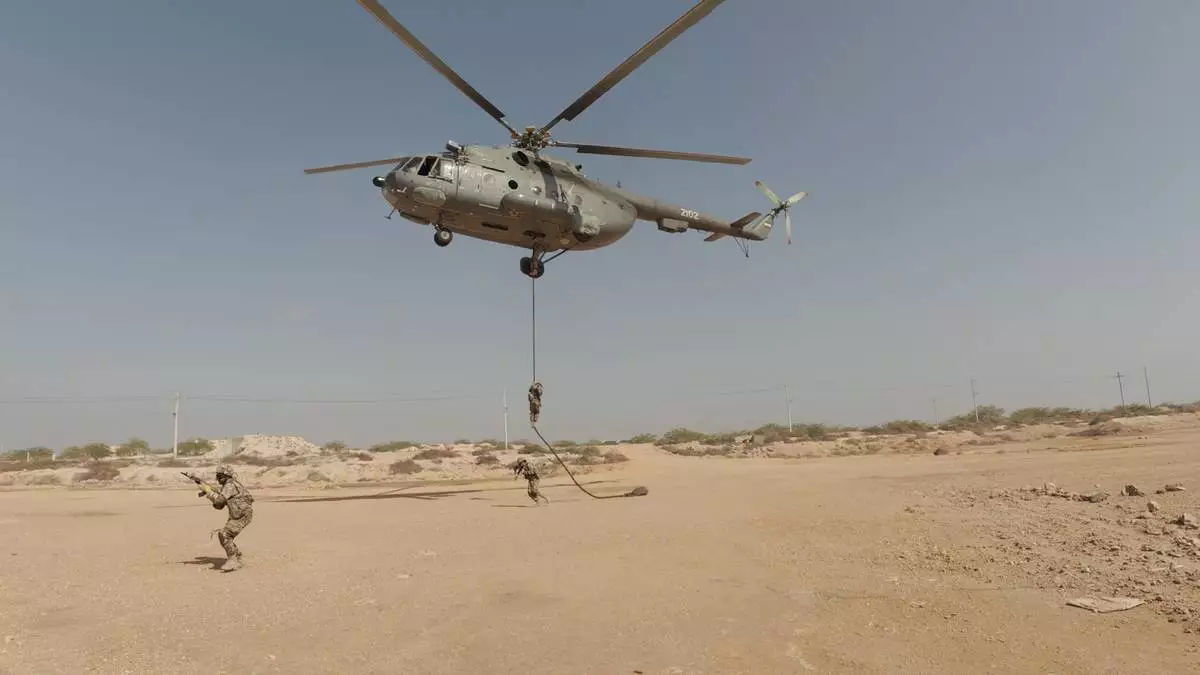
In this image provided by Sepahnews of the Iranian Revolutionary Guard on Feb. 16, 2026, shows the Iranian Revolutionary Guard's drill in the Persian Gulf on Monday, Feb. 16, 2026. (Sepahnews via AP)
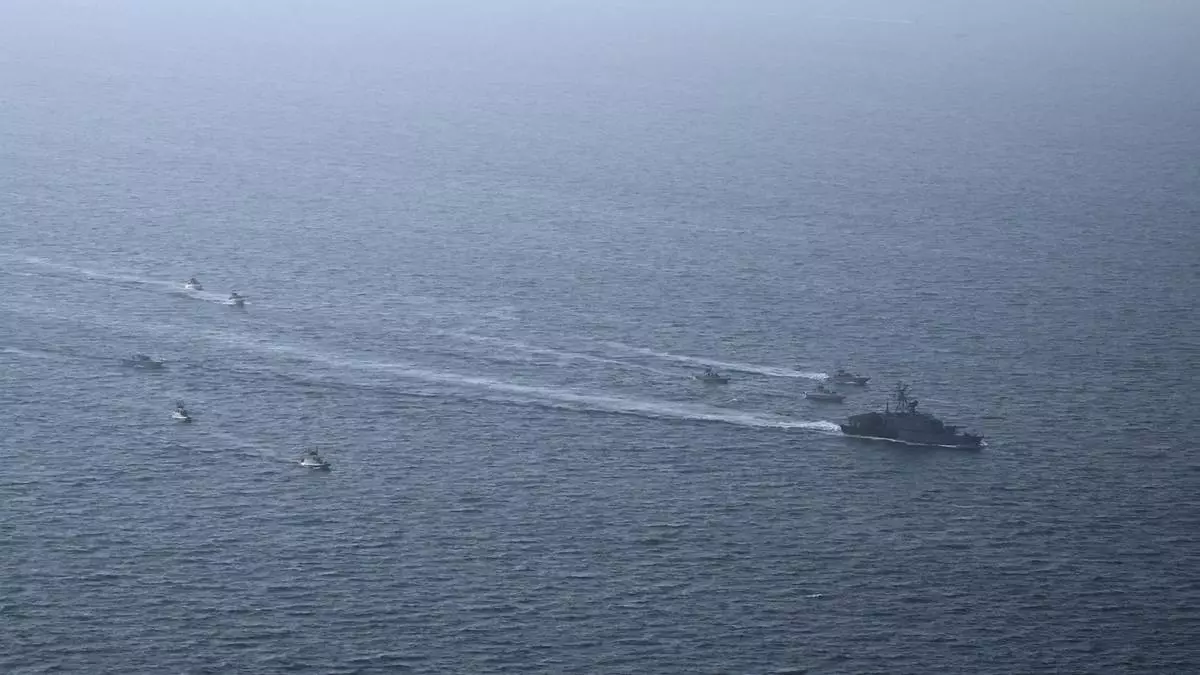
In this image provided by Sepahnews of the Iranian Revolutionary Guard on Feb. 16, 2026, shows the Iranian Revolutionary Guard's drill in the Persian Gulf on Monday, Feb. 16, 2026. (Sepahnews via AP)
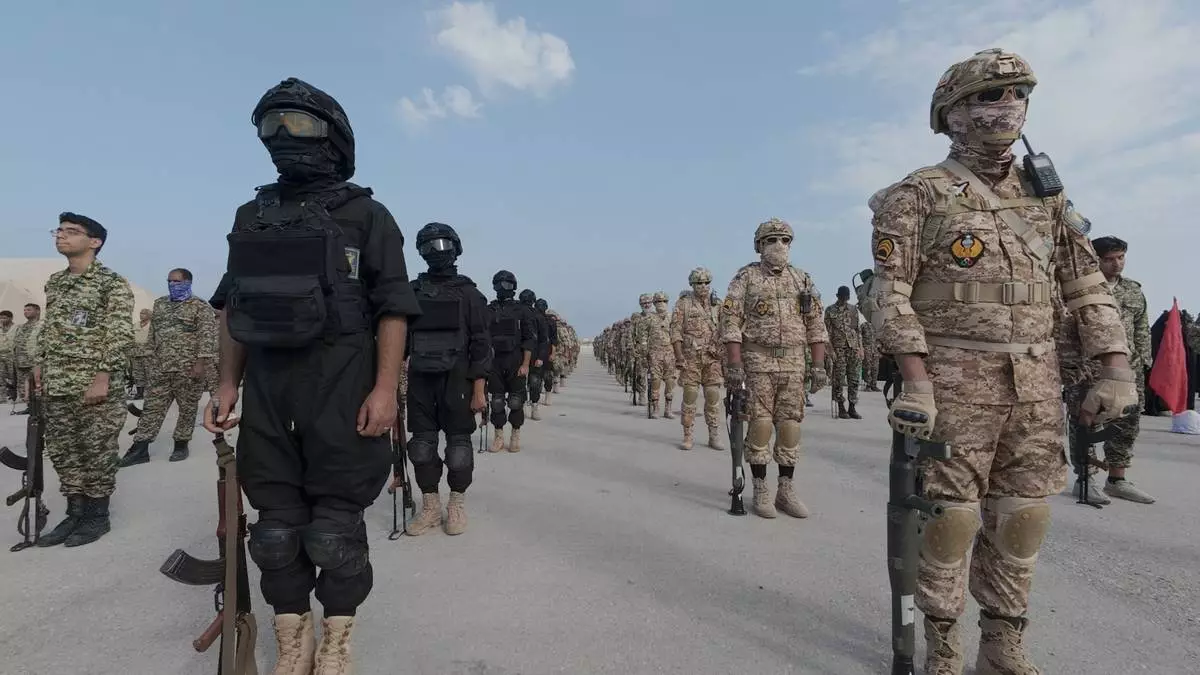
In this image provided by Sepahnews of the Iranian Revolutionary Guard on Feb. 16, 2026, shows troops standing at attention during the guard's drill in the Persian Gulf on Monday, Feb. 16, 2026. (Sepahnews via AP)
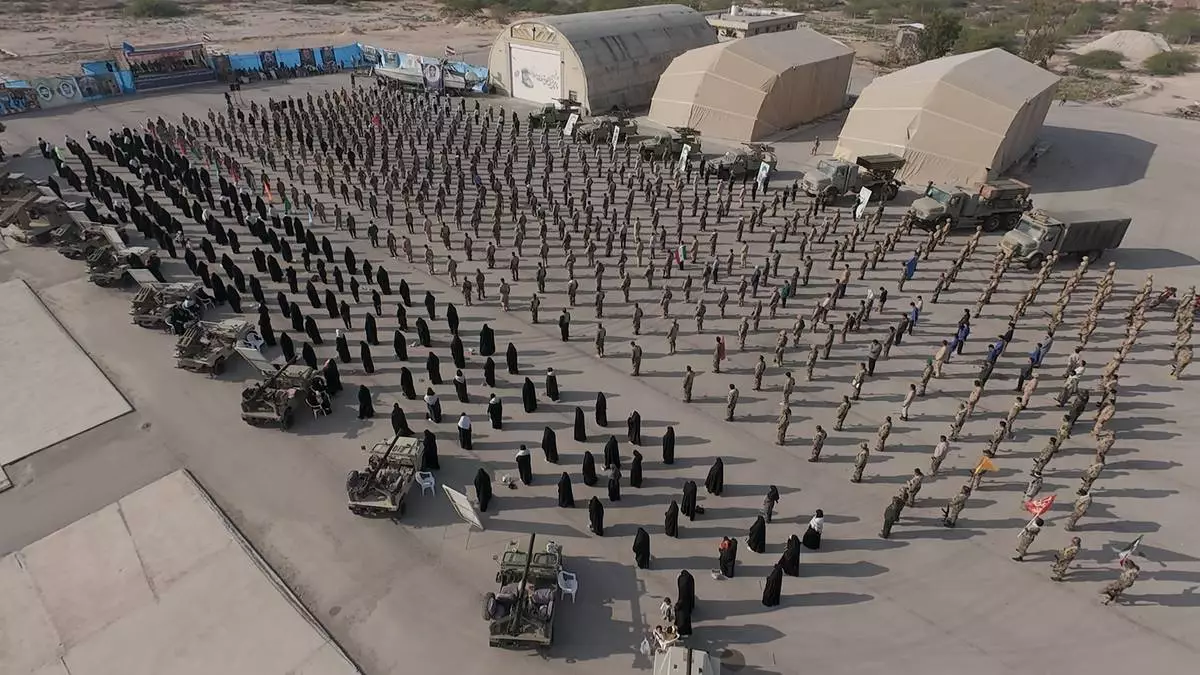
In this image provided by Sepahnews of the Iranian Revolutionary Guard on Feb. 16, 2026, shows troops standing at attention during the guard's drill in the Persian Gulf on Monday, Feb. 16, 2026. (Sepahnews via AP)