Skip to Content Facebook Feature Image

Exhibit honors Japanese American who fought for US in WWII while their families were locked up

News

Exhibit honors Japanese American who fought for US in WWII while their families were locked up
News

News

Exhibit honors Japanese American who fought for US in WWII while their families were locked up

2026-03-03 13:05 Last Updated At:13:55

SAN FRANCISCO (AP) — After the bombing of Pearl Harbor, second-generation Japanese American soldiers signed up to fight for the United States in World War II even as their families were locked up in government-run internment camps and declared “ alien enemies ” of the state.

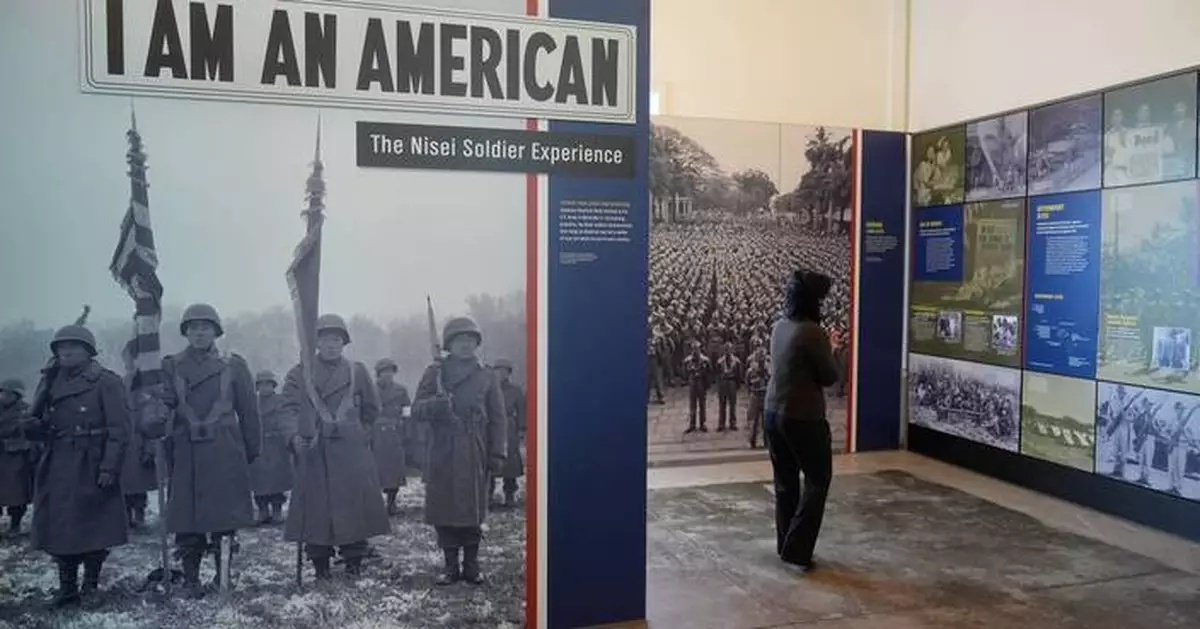
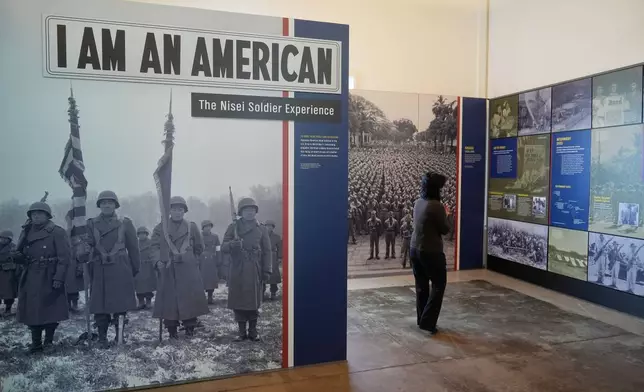
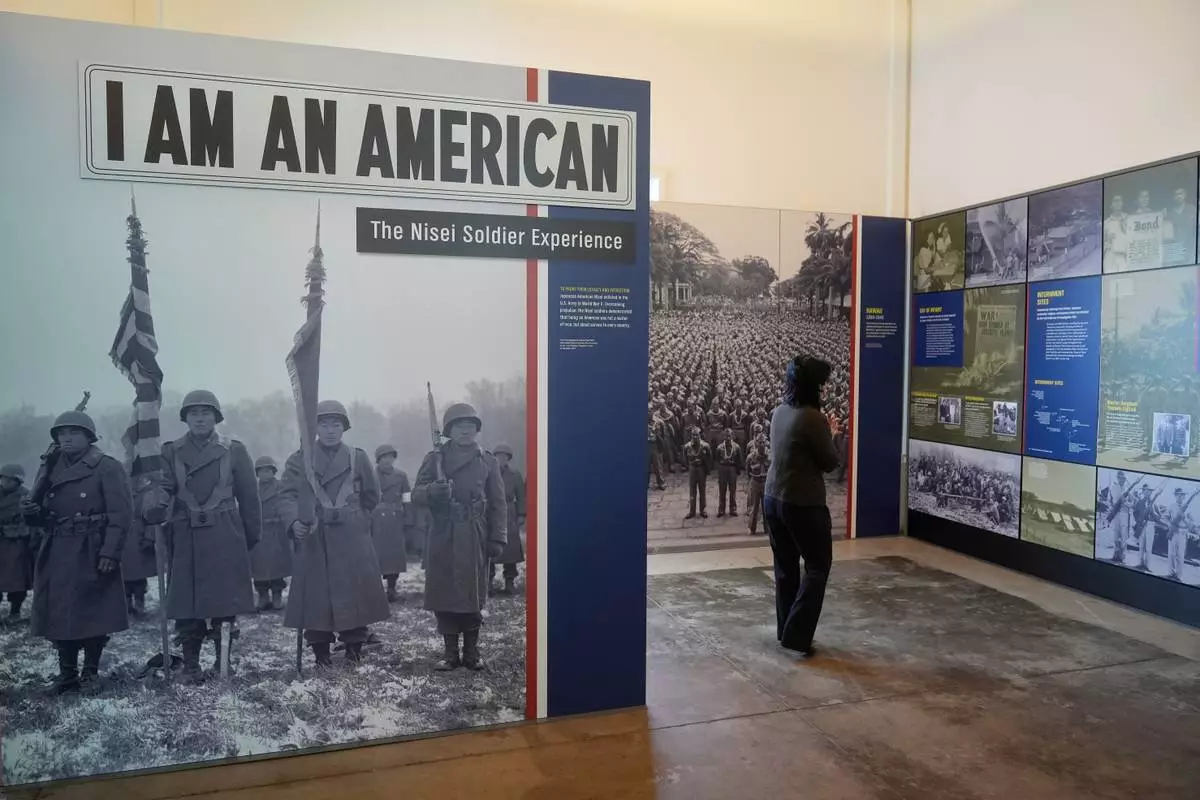
Decades after they returned home from the war to face more racism and discrimination, the soldiers now are being honored in a new traveling exhibit kicking off in San Francisco called “I am an American: The Nisei Soldier Experience". The title of the show comes from a large sign posted to a Japanese American storefront in Oakland, California, the day after Pearl Harbor.

More Images
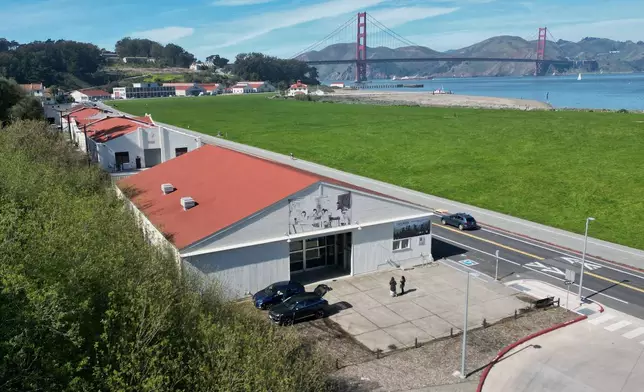
People walk outside of the Military Intelligence Service Historic Learning Center, which is displaying the "I am an American: The Nisei Soldier Experience" exhibit, in San Francisco, Thursday, Feb. 26, 2026. (AP Photo/Terry Chea)
People walk outside of the Military Intelligence Service Historic Learning Center, which is displaying the "I am an American: The Nisei Soldier Experience" exhibit, in San Francisco, Thursday, Feb. 26, 2026. (AP Photo/Terry Chea)

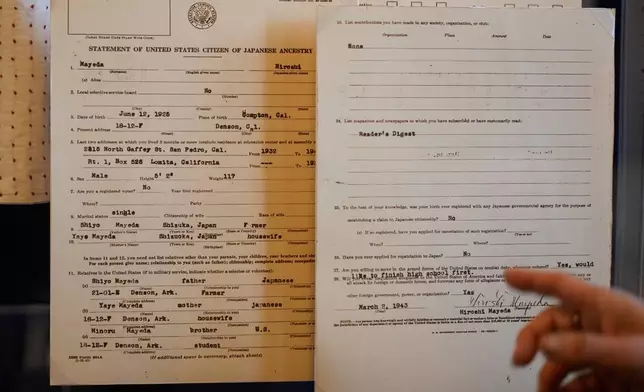
Rosalyn Tonai, Executive Director at the National Japanese American Historical Society, gestures toward a Hiroshi Mayeda's Statement of United States Citizen of Japanese Ancestry displayed in the "I am an American: The Nisei Soldier Experience" exhibit at the Military Intelligence Service Historic Learning Center in San Francisco, Wednesday, Feb. 25, 2026. (AP Photo/Jeff Chiu)
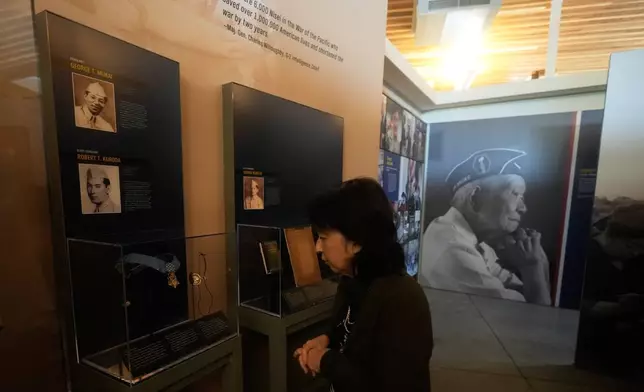
Rosalyn Tonai, Executive Director at the National Japanese American Historical Society, gestures toward a Hiroshi Mayeda's Statement of United States Citizen of Japanese Ancestry displayed in the "I am an American: The Nisei Soldier Experience" exhibit at the Military Intelligence Service Historic Learning Center in San Francisco, Wednesday, Feb. 25, 2026. (AP Photo/Jeff Chiu)
Rosalyn Tonai, Executive Director at the National Japanese American Historical Society, looks toward Staff Sgt. Robert Kuroda's class ring and Medal of Honor and Sgt. George Mukai's compass displayed in the "I am an American: The Nisei Soldier Experience" exhibit during an interview at the Military Intelligence Service Historic Learning Center in San Francisco, Wednesday, Feb. 25, 2026. (AP Photo/Jeff Chiu)
Rosalyn Tonai, Executive Director at the National Japanese American Historical Society, looks toward Staff Sgt. Robert Kuroda's class ring and Medal of Honor and Sgt. George Mukai's compass displayed in the "I am an American: The Nisei Soldier Experience" exhibit during an interview at the Military Intelligence Service Historic Learning Center in San Francisco, Wednesday, Feb. 25, 2026. (AP Photo/Jeff Chiu)

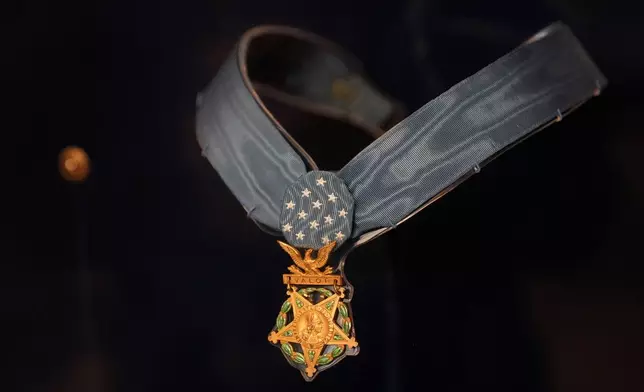
The Medal of Honor awarded to Pfc. Sadao Munemori is displayed in the "I am an American: The Nisei Soldier Experience" exhibit at the Military Intelligence Service Historic Learning Center in San Francisco, Wednesday, Feb. 25, 2026. (AP Photo/Jeff Chiu)

The Medal of Honor awarded to Pfc. Sadao Munemori is displayed in the "I am an American: The Nisei Soldier Experience" exhibit at the Military Intelligence Service Historic Learning Center in San Francisco, Wednesday, Feb. 25, 2026. (AP Photo/Jeff Chiu)

Rosalyn Tonai, Executive Director at the National Japanese American Historical Society, walks through the "I am an American: The Nisei Soldier Experience" exhibit during an interview at the Military Intelligence Service Historic Learning Center in San Francisco, Wednesday, Feb. 25, 2026. (AP Photo/Jeff Chiu)

Rosalyn Tonai, Executive Director at the National Japanese American Historical Society, walks through the "I am an American: The Nisei Soldier Experience" exhibit during an interview at the Military Intelligence Service Historic Learning Center in San Francisco, Wednesday, Feb. 25, 2026. (AP Photo/Jeff Chiu)

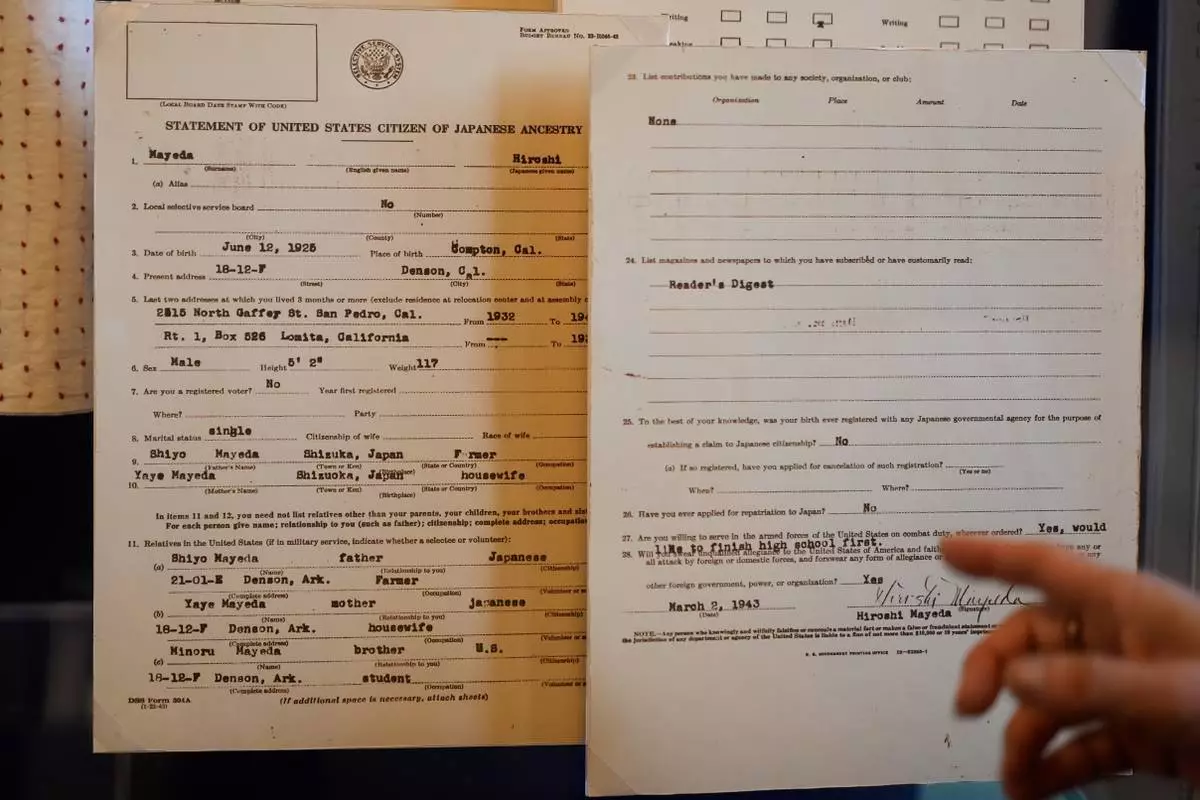
The 1,500-square-foot (140 square-meter) exhibit features family photos, mementos and short bios of the Nisei men shared by their relatives to ensure that stories of past bravery endure for younger generations, especially as questions of nationality still persist.

On display is a travel bag that belonged to Sgt. Gary Uchida, marked by drawings he made of his native Hawaii and places he went while in the Army.

There is a U.S. Army identification card on which Oregon-born George S. Hara wrote under nationality: American.

Rihachi Mayewaki made a note holder from lumber scraps while imprisoned at Jerome camp in Arkansas. It features an American bald eagle and a blue star banner with three stars, one for each son: Ben, who helped collect, evaluate and interpret enemy intelligence; Charles, who trained as a rifleman with the famed 442nd Regimental Combat Team; and Hachiro, who trained as a linguist and worked as a translator.

At the bottom of the holder is written “nintai,” the Japanese word for endurance.

“The father was incredibly proud he had three sons serving in the American army,” Christine Sato-Yamazaki, executive director of the National Veterans Network and co-curator of the exhibit, said last month at a ribbon-cutting ceremony for the exhibit.

About 33,000 Japanese Americans fought in World War II, despite the U.S. government shipping an estimated 120,000 people of Japanese ancestry to desolate camps. Thousands were elderly or children too young to know the meaning of treason. Two-thirds were U.S. citizens. Their homes and businesses were seized while they were imprisoned, often in overcrowded, wooden bunk houses in bleak locations with harsh conditions.

The United States didn’t offer a formal apology until 1988.

“These soldiers wanted to prove they were loyal patriotic Americans, part of the greatest generation at that time and they were American — just like anybody else,” said Sato-Yamazaki, whose grandparents did not talk about their time in camp or at war. The garrison cap worn by her grandfather, Tech. Sgt. Dave Kawagoye, is featured in the exhibit. It contains the words “Go for Broke,” the motto of the famed 442nd.

Japanese Americans joined the 442nd Regimental Combat Team or 100th Infantry Battalion, both highly awarded yet segregated units. They also served as linguists in the Military Intelligence Service. Some 800 Nisei soldiers were killed in action.

The five-year exhibit runs in San Francisco’s Presidio through August before heading off to 10 other cities, including Honolulu, Los Angeles, and Portland, Oregon. It is presented by the National Veterans Network, National Museum of the United States Army and the Army Historical Foundation.

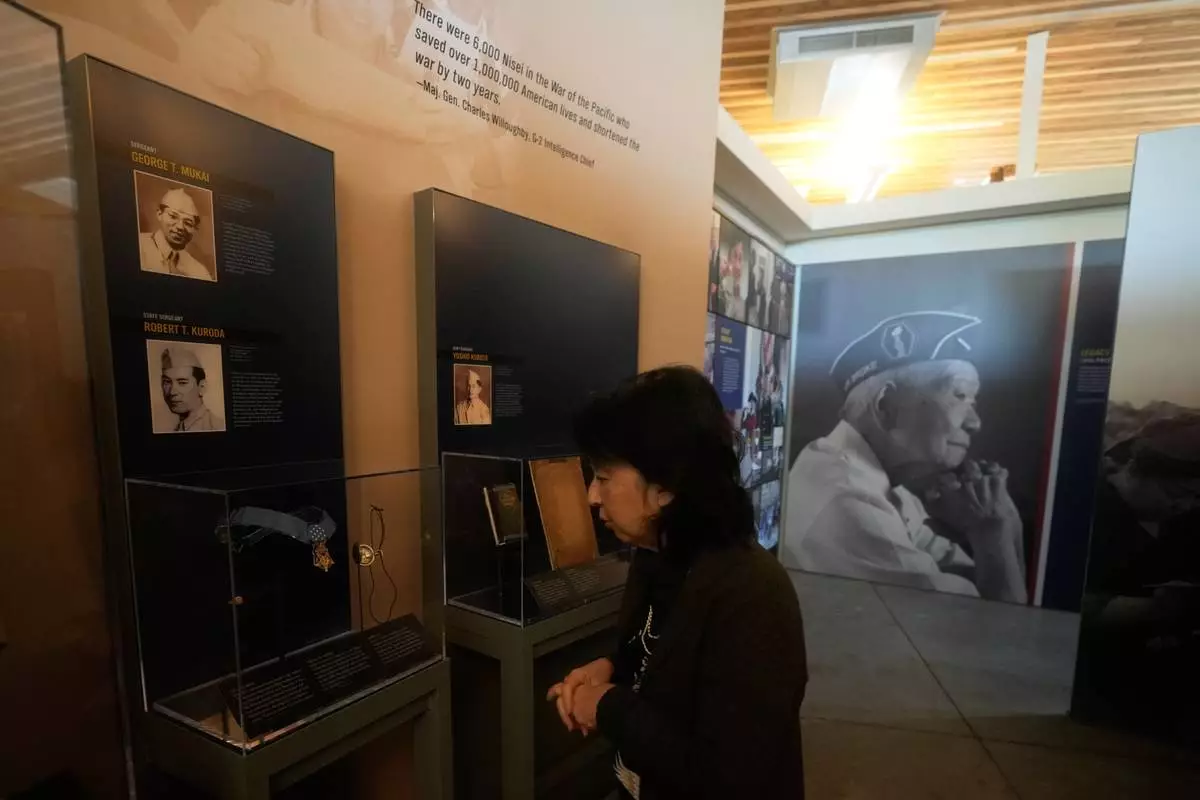
Among those featured in the exhibit is Staff Sgt. Robert Kuroda, who was unable to get work as a second-generation Japanese American in Hawaii solely because of his ancestry. So he signed up to fight in World War II, reasoning that if he fought for his country employers could no longer deny him a job.

On Oct. 20, 1944, Kuroda advanced through heavy enemy gunfire to take out two enemy machine gun nests after helping liberate the French town of Bruyères from Nazi occupation. He continued his assault until sniper fire killed him. He was 21.

Kuroda was posthumously awarded the Distinguished Service Cross, which was later upgraded to the Medal of Honor. The medal citation noted that his “courageous actions and indomitable fighting spirit ensured the destruction of enemy resistance.”

On display in the exhibit are Kuroda's Medal of Honor and high school class ring, which was prized in his family as he was the first of nine siblings to graduate.

The ring was missing until 2021 when a metal detector hobbyist named Sébastien Roure found it buried in a forest near Bruyères. Roure worked tirelessly to return the Farrington High School class ring to the Kurodas and now, the two families visit, using an app and high school French and English to communicate.

Before the exhibit, both the ring and medal had been displayed in a glass case at a cousin’s auto body shop near Honolulu.

“The family just felt if we could, in our own ways, help others, the country, know the sacrifices of the previous generation and what they did for our lives, then, even better,” said Kevin Kuroda, a nephew who traveled from Hawaii for the exhibit’s opening.
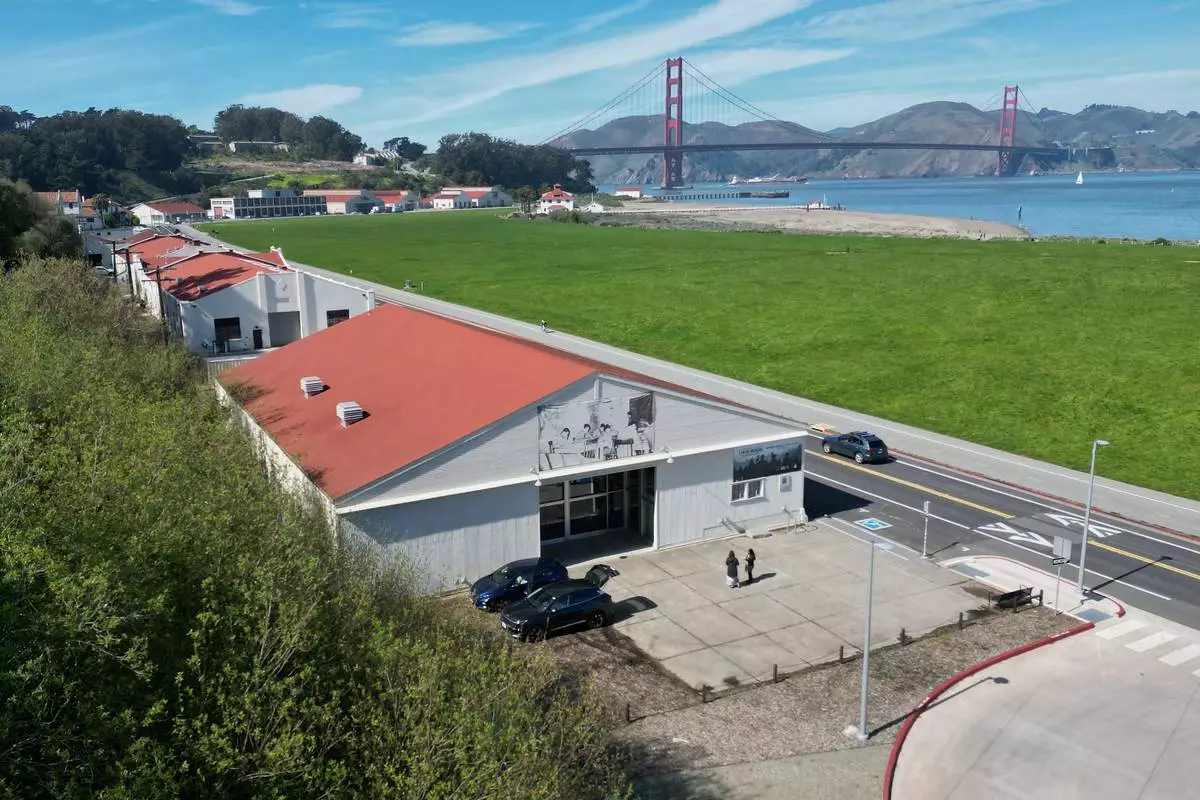
People walk outside of the Military Intelligence Service Historic Learning Center, which is displaying the "I am an American: The Nisei Soldier Experience" exhibit, in San Francisco, Thursday, Feb. 26, 2026. (AP Photo/Terry Chea)
People walk outside of the Military Intelligence Service Historic Learning Center, which is displaying the "I am an American: The Nisei Soldier Experience" exhibit, in San Francisco, Thursday, Feb. 26, 2026. (AP Photo/Terry Chea)

Rosalyn Tonai, Executive Director at the National Japanese American Historical Society, gestures toward a Hiroshi Mayeda's Statement of United States Citizen of Japanese Ancestry displayed in the "I am an American: The Nisei Soldier Experience" exhibit at the Military Intelligence Service Historic Learning Center in San Francisco, Wednesday, Feb. 25, 2026. (AP Photo/Jeff Chiu)
Rosalyn Tonai, Executive Director at the National Japanese American Historical Society, gestures toward a Hiroshi Mayeda's Statement of United States Citizen of Japanese Ancestry displayed in the "I am an American: The Nisei Soldier Experience" exhibit at the Military Intelligence Service Historic Learning Center in San Francisco, Wednesday, Feb. 25, 2026. (AP Photo/Jeff Chiu)
Rosalyn Tonai, Executive Director at the National Japanese American Historical Society, looks toward Staff Sgt. Robert Kuroda's class ring and Medal of Honor and Sgt. George Mukai's compass displayed in the "I am an American: The Nisei Soldier Experience" exhibit during an interview at the Military Intelligence Service Historic Learning Center in San Francisco, Wednesday, Feb. 25, 2026. (AP Photo/Jeff Chiu)
Rosalyn Tonai, Executive Director at the National Japanese American Historical Society, looks toward Staff Sgt. Robert Kuroda's class ring and Medal of Honor and Sgt. George Mukai's compass displayed in the "I am an American: The Nisei Soldier Experience" exhibit during an interview at the Military Intelligence Service Historic Learning Center in San Francisco, Wednesday, Feb. 25, 2026. (AP Photo/Jeff Chiu)


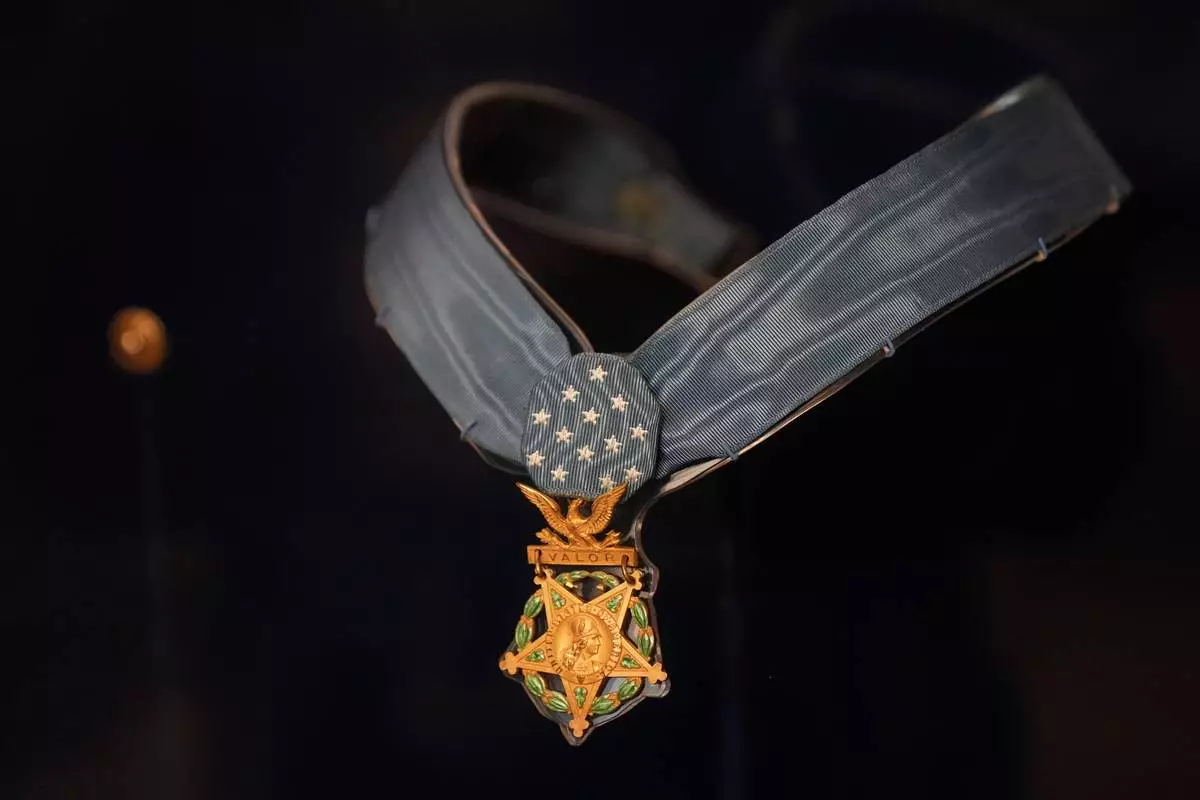
The Medal of Honor awarded to Pfc. Sadao Munemori is displayed in the "I am an American: The Nisei Soldier Experience" exhibit at the Military Intelligence Service Historic Learning Center in San Francisco, Wednesday, Feb. 25, 2026. (AP Photo/Jeff Chiu)

The Medal of Honor awarded to Pfc. Sadao Munemori is displayed in the "I am an American: The Nisei Soldier Experience" exhibit at the Military Intelligence Service Historic Learning Center in San Francisco, Wednesday, Feb. 25, 2026. (AP Photo/Jeff Chiu)
Rosalyn Tonai, Executive Director at the National Japanese American Historical Society, walks through the "I am an American: The Nisei Soldier Experience" exhibit during an interview at the Military Intelligence Service Historic Learning Center in San Francisco, Wednesday, Feb. 25, 2026. (AP Photo/Jeff Chiu)

Rosalyn Tonai, Executive Director at the National Japanese American Historical Society, walks through the "I am an American: The Nisei Soldier Experience" exhibit during an interview at the Military Intelligence Service Historic Learning Center in San Francisco, Wednesday, Feb. 25, 2026. (AP Photo/Jeff Chiu)
As the war in the Middle East intensifies, U.S. President Donald Trump said that the U.S. has “the capability to go far longer" than its projected four-to-five-week time frame for its military operations against Iran.

Across Tehran, the sound of explosions rang out through the night and into the early morning hours Tuesday, as the U.S. and Israel have continued to pound Iran since killing its Supreme Leader Ayatollah Ali Khamenei on Saturday.

Tehran and its allies have hit back against Israel, neighboring Gulf states, and targets critical to the world’s production of oil and natural gas.

The intensity of the attacks and the lack of any apparent exit plan set the stage for a prolonged conflict with far-reaching consequences. Israel and the U.S. have given conflicting answers about what exactly the war’s objectives are or what the endgame might be.

Israeli Prime Minister Benjamin Netanyahu late Monday defended the decision to go to war, contending in an interview on Fox News Channel’s "Hannity" that Iran was rebuilding “new sites, new places” that would make “their ballistic missile program and their atomic bomb program immune within months,” without providing evidence.

Satellite photos analyzed by The Associated Press showed limited activity at two nuclear sites in Iran before the war, with analysts saying it was likely Tehran was trying to assess damage from American strikes in June and possibly salvage what remained there.

Here is the latest:

The U.S. State Department on Tuesday ordered the evacuation of non-emergency personnel and family in Bahrain and Jordan.

The State Department announcement online said the decision came “due to safety risks.” The department has urged Americans across the Mideast to leave over the ongoing war with Iran.

The U.S. Embassy in Saudi Arabia acknowledged coming under attack from Iranian drones Tuesday and urged Americans to avoid the diplomatic post for the time being.

The Saudi Defense Ministry earlier Tuesday said the embassy was attacked by two drones.

Across Iran’s capital, the sound of explosions rang out throughout the night into the early morning hours.

Witnesses described hearing aircraft overhead as well.

It wasn’t immediately clear what had been hit.

Iranian state television early Tuesday read a statement from the country’s paramilitary Revolutionary Guard, saying that it launched a missile and drone attack targeting an air base in Bahrain.

Israeli airstrikes hit the Lebanese capital Tuesday morning.

The Israeli military said it was targeting “Hezbollah command centers and weapons storage facilities in Beirut.”

Hezbollah also said it launched drones targeting an Israeli air base.

The Israeli military said it downed two drones.

Tokyo has told Japanese shipowners to have their ships stay away from the Persian Gulf to ensure the safety of their crew members.

Chief Cabinet Secretary Minoru Kihara told reporters Tuesday that the Transport Ministry has notified the Japanese Shipowners’ Association to do the utmost to protect crews on board the ships in the region.

Kihara said those already in the Gulf are urged to lie at anchor where it is safe to do so.

On Monday, Japan’s Foreign Minister Toshimitsu Motegi met with Iranian ambassador to Japan Peiman Seadat and conveyed Japan’s consistent stance that Iran must stop attacks on neighboring countries and other actions destabilizing the region.

Motegi also noted the importance of ensuring safety in the Strait of Hormuz, which is key to Japan’s energy security.

Iran’s top diplomat early Tuesday sought to turn the tables on the United States, describing it as entering “a war of choice on behalf of Israel.”

After Trump urged Iranians to take over their government, Foreign Minister Abbas Araghchi made the same call to Americans.

“Shedding of both American and Iranian blood is thus on Israel Firsters,” Araghchi wrote on X. “American people deserve better and should take back their country.”

This partially redacted image from video provided by U.S. Central Command shows a complex of structures in Iran being struck by missiles fired by U.S. forces on Sunday, March 1, 2026. (U.S. Central Command via AP)

This partially redacted image from video provided by U.S. Central Command shows a complex of structures in Iran being struck by missiles fired by U.S. forces on Sunday, March 1, 2026. (U.S. Central Command via AP)

President Donald Trump walks past Defense Secretary Pete Hegseth as he exist the East Room of the White House following the Medal of Honor ceremony, Monday, March 2, 2026, in Washington. (AP Photo/Mark Schiefelbein)

President Donald Trump walks past Defense Secretary Pete Hegseth as he exist the East Room of the White House following the Medal of Honor ceremony, Monday, March 2, 2026, in Washington. (AP Photo/Mark Schiefelbein)

Rescue workers carry a dead body in a plastic bag from a building that was hit by Israeli strike, in Jnah neighborhood, south of Beirut, Lebanon, Monday, March 2, 2026. (AP Photo/Hussein Malla)

Rescue workers carry a dead body in a plastic bag from a building that was hit by Israeli strike, in Jnah neighborhood, south of Beirut, Lebanon, Monday, March 2, 2026. (AP Photo/Hussein Malla)

A poster of the late Supreme Leader Ayatollah Ali Khamenei, who was killed during the ongoing joint U.S.-Israeli military campaign, and the late Iranian Revolutionary founder Ayatollah Khomeini, right, lays on a motorcycle amid debris left by a strike in Tehran, Iran, Monday, March 2, 2026. (AP Photo/Vahid Salemi)

A poster of the late Supreme Leader Ayatollah Ali Khamenei, who was killed during the ongoing joint U.S.-Israeli military campaign, and the late Iranian Revolutionary founder Ayatollah Khomeini, right, lays on a motorcycle amid debris left by a strike in Tehran, Iran, Monday, March 2, 2026. (AP Photo/Vahid Salemi)

Plumes of smoke from two simultaneous strikes rise over Tehran, Iran, Monday, March 2, 2026. (AP Photo/Mohsen Ganji)

Plumes of smoke from two simultaneous strikes rise over Tehran, Iran, Monday, March 2, 2026. (AP Photo/Mohsen Ganji)

Recommended Articles