DH urges public to take part in Colorectal Cancer Screening Programme and adopt healthy lifestyle in support of Colorectal Cancer Awareness Month
March is Colorectal Cancer Awareness Month. The Centre for Health Protection (CHP) of the Department of Health today (March 3) reminded members of the public that adopting a healthy lifestyle and undergoing screeningregularly can effectively prevent colorectal cancer.
"Colorectal cancer is the third most common cancer and the second most common cause of cancer death in Hong Kong. In 2023, there were 5 467 newly diagnosed colorectal cancer cases, accounting for 14.4 per cent of all new cancer cases. In the same year, colorectal cancer led to 2 266 deaths. The Government attaches great importance to cancer prevention and control work, including launching the Colorectal Cancer Screening Programme (CRCSP) as a pilot in 2016 and fully implementing the CRCSP in 2020. Analysis showed that over half of colorectal cancer cases diagnosed through the CRCSP belonged to earlier stages (Stage II or below), while only less than 40 per cent of colorectal cancer cases diagnosed belonged to earlier stages in the general population (excluding cases from the CRCSP). This demonstrates that the CRCSP can help patients detect colorectal cancer and receive treatment early and improve treatment effectiveness and survival rates," said the Controller of the CHP, Dr Edwin Tsui.
The International Agency for Research on Cancer of the World Health Organization has recognised March as Colorectal Cancer Awareness Month every year to highlight the importance of screening for colorectal cancer, as well as to promote healthy lifestyle habits to reduce a person's risk of developing colorectal cancer.The CHP has long been promoting the same message to members of the public through different channels - the primary prevention of cancer is to adopt a healthy lifestyle, while screening is a tool for secondary prevention to detect and treat precancerous lesions or early-stage cancers before symptoms appear, thereby increasing the cure rate.
CRCSP
---------
Using a public-private partnership model, the CRCSP subsidises asymptomatic Hong Kong residents aged between 50 and 75 to undergo screening tests every two years in the private sector. Participants in the CRCSP should first attend a medical consultation provided by an enrolled primary care doctor (PCD) and receive a Faecal Immunochemical Test (FIT) screening arranged by the PCD. If the FIT result is positive, the participant will be referred to an enrolled colonoscopy specialist to receive a colonoscopy examination subsidised by the Government.
"I call on all eligible persons to join the CRCSP starting at age 50. If the screening result is normal, rescreening should be performed every two years until age 75. The CRCSP is heavily subsidised by the Government, with a network of participating doctors throughout the territory. As of the end of last year, over 1 200primary care doctors (PCD) had enrolled in the CRCSP, offering consultations and arranging FITs at about 2 300 locations. More than 90 per cent of these service locations will not charge any additional payment. Approximately 260 colonoscopy specialists have joined the CRCSP to provide colonoscopy examination at about 800 service locations, of which over 70 per cent will not charge any additional payment for colonoscopy and polyp removal," Dr Tsui said.
"By the end of last year, over 580 000 eligible persons had enrolled in the CRCSP. Around 15 per cent of participants (over 88 000 persons) had positive FIT screening results. Among them, over half (over 46 000 persons) were diagnosed to have colorectal adenomas after colonoscopy examination, and more than 4 per cent (over 3 800 persons) were diagnosed with colorectal cancer. Analysis showed that more than 50 per cent of the colorectal cancer cases detected under the CRCSP were in the early stages, demonstrating the effectiveness of screening," he added.
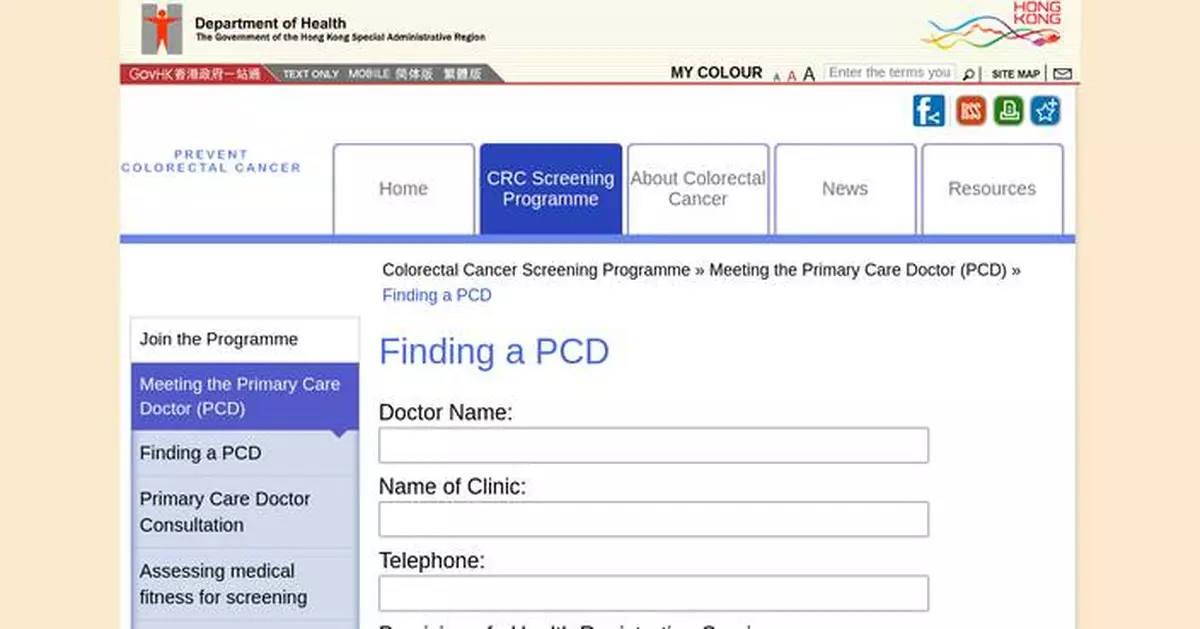
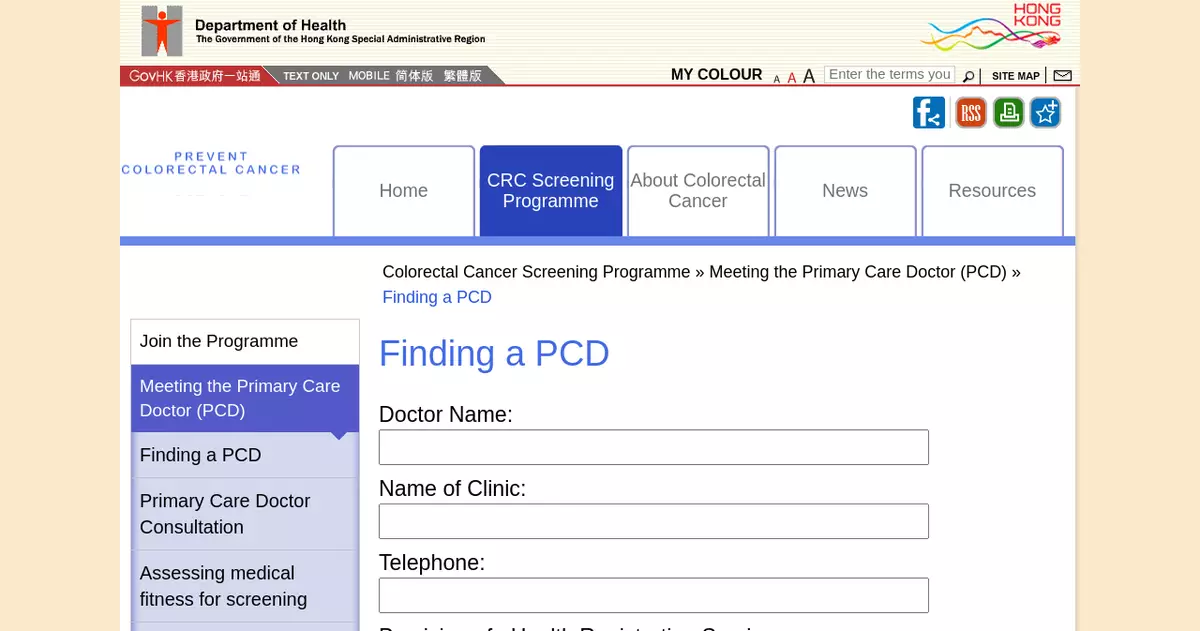
Eligible persons may visit www.colonscreen.gov.hk/en/public/programme/finding_a_pcd.phpto find a PCD to join the CRCSP. Participants are also encouraged to enrol alongside eligible family members or friends. For more information on the CRCSP, please visit the DH's thematic website www.colonscreen.gov.hk/en/ or call the dedicated hotline (3565 6288) during office hours.
Adopting healthy lifestyle
----------------------------
"Obesity is the third leading risk factor for cancer globally and is linked to an increased risk of at least 13 types of cancer, including colorectal cancer. In addition, the latest Health Behaviour Survey revealed that unhealthy but modifiable practices are common among the Hong Kong population. For example, 14.8 per cent of the adult population performed an insufficient level of physical activity, 97.0 per cent of the public had an inadequate intake of fruits and vegetables, and 2.7 per cent of the population (aged 15 or above) engaged in binge drinking at least monthly (i.e. consumed at least five cans of beer, five glasses of wine or five glasses of spirits on a single occasion). These practices are important risk factors for developing cancer. To prevent colorectal cancer, members of the public are encouraged to adopt healthy lifestyles and practices, including exercising regularly, eating two servings of fruits and three servings of vegetables daily, maintaining a healthy body weight, and avoiding smoking and alcohol," Dr Tsui said.
Life Course Preventive Care Plan
----------------------------------------
At the same time, the Primary Healthcare Commission is actively promoting the Life Course Preventive Care Plan via District Health Centres (DHCs), DHC Expresses and family doctors. Based on the core principles of prevention-oriented and whole-person care, a personalised preventive care plan will be formulated to address the health needs of citizens across different life stages with reference to the latest evidence. Family doctors and primary healthcare professionals will collaborate to provide health advice and education on chronic disease and cancer screening, as well as healthy lifestyles according to personal factors, including recommendations on colorectal cancer screening for those aged 50 or above.
Source: AI-found images