WASHINGTON (AP) — So, who won?
That’s a question The Associated Press has answered many thousands of times in U.S. elections held since shortly after the news organization was founded nearly 180 years ago.
Declaring a winner involves a careful and thorough analysis of the latest available vote tallies and a variety of other election data. The ultimate goal is to determine whether there is any circumstance in which the trailing candidate can catch up to the candidate who is leading the race. If not, then the leading candidate has won.
Here’s a look at the AP’s role and its process for determining the outcome of elections, also known as calling a race:
The United States does not have a nationwide body that collects and releases election results. Elections are administered locally, by thousands of offices, following standards set by the states. In many cases, the states themselves do not even offer up-to-date tracking of election results.
The AP fills this gap by compiling vote results and declaring winners in elections, providing critical information in the period between Election Day and the official certification of results, which typically takes weeks.
The AP’s vote count brings together information that otherwise might not be available online for days or weeks after an election or is scattered across hundreds of local websites. Without national standards or consistent expectations across states, it also ensures the data is in a standard format, uses standard terms and undergoes rigorous quality control.
The AP hires vote count reporters who work with local election officials to collect results directly from counties or precincts where votes are first counted. These reporters submit them, by phone or electronically, as soon as the results are available. If any of the results are available from state or county websites, the AP will gather the results from there, too.
In many cases, counties will update vote totals as they count ballots throughout the night. The AP is continually updating its count as these results are released. In a general election, the AP will make as many as 21,000 vote updates per hour.
As votes are coming in, the AP will analyze races to determine the winners.
One key piece that the AP considers is how many ballots are uncounted and from what areas. In cases in which official or exact tallies of the outstanding vote are unavailable, the AP estimates the turnout in every race based on several factors and uses that estimate to track how much of the vote has been counted and how much remains.
The AP also tries to determine how ballots counted so far were cast and the types of vote, such as mail ballots or ballots cast in person on Election Day, that remain.
That is because the method that voters choose can be correlated to the party they voted for. Since voting by mail became highly politicized in the 2020 election, Democrats have been more likely to vote by mail, while Republicans have been more likely to vote in person on Election Day.
In many states, it is possible to know which votes will be counted first, based on past elections or plans announced by election officials. In others, votes are clearly marked by type when released.
This helps to determine if an early lead is expected to shrink or grow. For example, if a state first counts votes cast in person on Election Day, followed by mail-in votes, that suggests that an early Republican lead may narrow as more mail ballots are tabulated. But if mail ballots are counted first, an early Republican lead could be the first sign of a comfortable victory.
In almost all cases, races can be called well before all votes have been counted. The AP’s team of election journalists and analysts will call a race as soon as a clear winner can be determined.
In competitive races, AP analysts may need to wait until additional votes are tallied or to confirm specific information about how many ballots are left to count.
Competitive races in which votes are actively being tabulated — for example, in states that count a large number of votes after election night — might be considered “too early to call.” A race may be “too close to call” if a race is so close that there is no clear winner even once all ballots except for provisional and late-arriving absentee ballots have been counted.
The AP’s race calls are not predictions and are not based on speculation. They are declarations based on an analysis of vote results and other election data that one candidate has emerged as the winner and that no other candidate in the race will be able to overtake the winner once all the votes have been counted.
Follow along as the AP tabulates votes and calls races. Check out results pages and notes from the AP Decision Team.

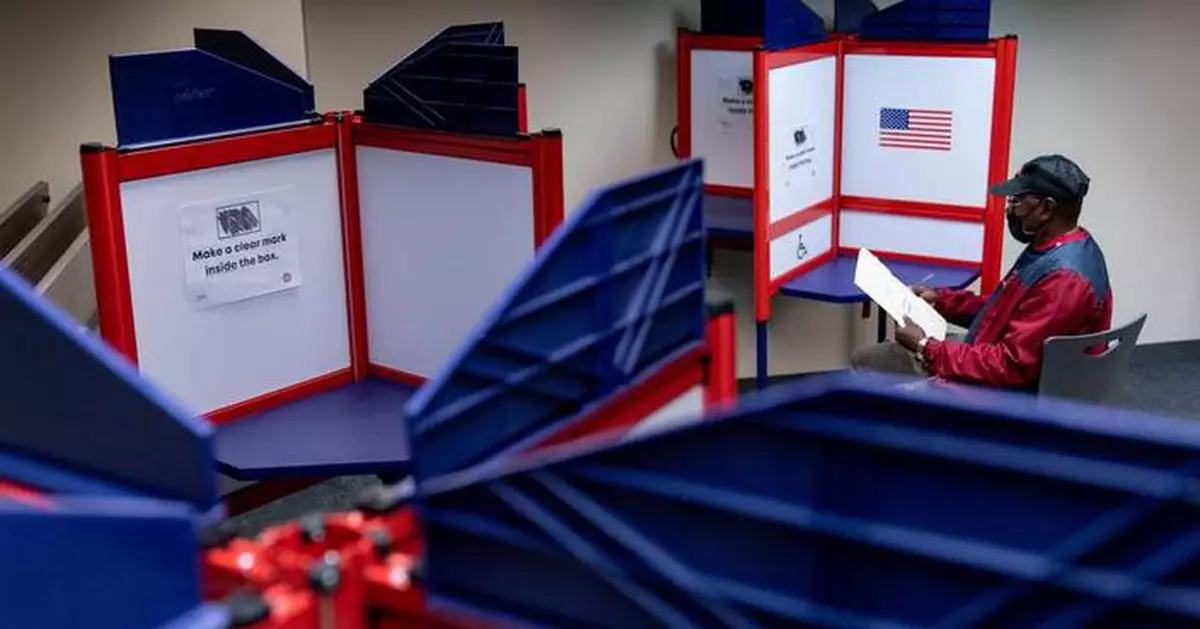
FILE - Cornelius Whiting fills out his ballot at an early voting location in Alexandria, Va., Sept. 26, 2022. (AP Photo/Andrew Harnik, File)
As the war in the Middle East intensifies, U.S. President Donald Trump said the U.S. has “the capability to go far longer" than its projected four-to-five-week time frame for its military operations against Iran.
Across Tehran, the sound of explosions rang out through the night and into the early hours Tuesday, as the U.S. and Israel have continued to pound Iran since killing its Supreme Leader Ayatollah Ali Khamenei on Saturday.
Tehran and its allies have hit back against Israel, neighboring Gulf states, and targets critical to the world’s production of oil and natural gas.
The intensity of the attacks and the lack of any apparent exit plan set the stage for a prolonged conflict with far-reaching consequences. Israel and the U.S. have given conflicting answers about what exactly the war’s objectives are or what the endgame might be.
Israeli Prime Minister Benjamin Netanyahu late Monday defended the decision to go to war, contending in an interview on Fox News Channel’s "Hannity" that Iran was rebuilding “new sites, new places” that would make “their ballistic missile program and their atomic bomb program immune within months,” without providing evidence.
Satellite photos analyzed by The Associated Press showed limited activity at two nuclear sites in Iran before the war, with analysts saying it was likely Tehran was trying to assess damage from American strikes in June and possibly salvage what remained there.
Here is the latest:
The U.N. peacekeeping force in southern Lebanon, known as UNIFIL, says its peacekeepers saw Israeli forces crossing into Lebanon in several areas Tuesday morning “before returning south of the Blue Line,” referring to the border between the two countries.
It said Israeli forces were seen crossing in areas near the villages of Markaba, Odaisseh, Kfar Kila and Ramia.
“Over the past two days, as well as dozens of rockets and missiles fired into Israel claimed by Hizbullah, UNIFIL has recorded several airstrikes and hundreds of incidents of firing across the Blue Line and 84 air violations,” the statement said.
The Israeli military said earlier that its troops were positioned at several points near the border as it continues strikes against Hezbollah.
A drone struck Oman’s largest port of Salalah on Tuesday, authorities said.
The government media office also said two drones were shot down in the southwestern province of Dhofar.
The attacks left no casualties or damage in both Salalah and Dhofar, it said.
Thousands of Syrians have crossed from Lebanon into Syria to flee Israeli strikes over the past two days as Israel and the Iran-allied Lebanese militant group Hezbollah escalated their attacks against each other.
The U.N. refugee agency, UNHCR, said in a statement that around 3,900 to 4,400 people would typically cross from Lebanon into Syria during Ramadan. On Monday, after Hezbollah launched missiles toward Israel and Israel retaliated with bombarding Lebanon, a total of 10,629 people crossed, the vast majority of them Syrian.
Azzam Sweiri, a Syrian farm worker who had been working in southern Lebanon, crossed back into Syria Tuesday.
“The streets were packed with cars and people” as he fled, he said. “It took us 10 or 12 hours just to make it 30 or 40 kilometers.”
Ukrainian President Volodymyr Zelenskyy said Tuesday that he has offered to help the United Arab Emirates protect itself against Iranian aerial attacks.
Ukraine has built significant expertise in countering Iranian-designed Shahed drones that Russia has launched almost daily at Ukrainian targets since Moscow’s invasion more than four years ago.
Zelenskyy said on X that he spoke by phone with the United Arab Emirates president, Sheikh Mohamed bin Zayed Al Nahyan, and “discussed how we can help” protect lives in the UAE.
On Sunday, British Prime Minister Keir Starmer said that Ukrainian and British experts will work together to help Middle East countries shoot down Iranian drones.
The U.N. human rights chief is calling for a “prompt, impartial and thorough investigation” into what Iran says was an airstrike that hit a girls’ school in the southern city of Minab.
Volker Türk said he is “deeply shocked” by the fallout of the hostilities on civilians and civilian infrastructure in the conflict.
Alluding to the reported strike on the girls school, rights office spokeswoman Ravina Shamdasani said “the onus is on the forces that carried out the attack to investigate it.”
She called for those forces to make the findings public and ensure accountability and redress for victims.
The rights office said it was making no assessment who might be responsible.
An Israeli military spokesperson said Sunday he is not aware of any Israeli or American strikes in the area.
A Qatari official says Iranian attacks in the gas-rich country “will not go unanswered” as the Iran war expands in the Middle East.
Majed Al Ansari, a spokesman of the Qatari foreign ministry, said the Iranian attacks not only targeted military facilities but struck across all of Qatar’s territory.
“Such attacks will not go unanswered,” he said in a briefing.
He said there were attempted attacks on the Hamad International airport, adding that more than 8,000 people have been stranded as the country’s airspace remains closed.
Turkish Foreign Minister Hakan Fidan renewed his call for an end to escalating violence and a return to diplomacy.
“Our fundamental request and demand is clear: the mutual attacks must stop immediately and diplomacy must resume,” Fidan said, according to a transcript of his remarks to journalists late Monday.
The minister said Turkey consistently emphasizes this message during talks with other leaders.
Commenting on Iran’s attacks on Gulf states’ facilities, Fidan said Iran hopes these countries will pressure the United States to stop the war, while adding he believes that outcome “is not likely.”
The Italian government said Tuesday it is working “non-stop” to assist Italian citizens stranded in the Middle East.
Italy scheduled two flights including one from Muscat, Oman, to Rome’s Fiumicino airport Tuesday to carry around 300 people and another from Abu Dhabi to Milan to carry about 200 people, mostly young students.
Another two flights are set to depart from Abu Dhabi to Milan and Rome in the early afternoon Tuesday, while an additional flight from Muscat has been scheduled for Wednesday.
Romanian tourists arrived in Bucharest early Tuesday after traveling from Israel to Cairo to escape the conflict.
Hundreds of Romanian Orthodox Church pilgrims were stranded in Israel while visiting Bethlehem on a trip led by Romanian priests when the war broke out. The group was forced to cut their trip short to return to Romania.
Romanian pilgrim Mariana Muicaru said she was terrified as rockets flew across the sky in Israel.
“We called our children at 3 a.m. to ask forgiveness because we might die and to tell them we love them and to let them know that it’s over for us,” she told The Associated Press.
The Kremlin said Tuesday that Russian President Vladimir Putin will convey the Gulf leaders’ concern over the Iranian strikes on their territory to Iran.
Kremlin spokesman Dmitry Peskov told reporters that Putin will “make every effort to facilitate at least minor easing of tension.”
He noted that after Monday’s calls with the leaders of the United Arab Emirates, Qatar, Bahrain and Saudi Arabia, Putin will convey their “deep concern about the strikes on their infrastructure” to Tehran.
A senior Hezbollah official says that after more than a year of abiding by the ceasefire as Israel’s strikes continued on Lebanon, the group’s patience has ended, leaving it with no option “but to return to resistance” and fight an open war with Israel.
Mohamoud Komati said Tuesday that Hezbollah exercised patience since a ceasefire ended the Israel-Hezbollah war in November 2024, hoping the government’s diplomatic efforts would yield positive results in ending Israeli strikes.
In the comments released by Hezbollah’s media office, Komati blasted the Lebanese government for calling Hezbollah’s actions illegal and demanded it hand over its weapons, saying it did not act to stop Israel’s airstrikes that continued on almost daily basis for nearly 15 months.
“The Zionist enemy wanted an open war, which it has not stopped since the ceasefire agreement,” Komati said. “So let it be an open war.”
Saudi Arabia has condemned in the strongest terms Iran’s drone strike that hit the U.S. embassy in the Saudi capital, Riyadh.
“The brutal Iranian behavior … will push the region into further escalation,” the Saudi Foreign Ministry said in a statement, which reiterated the nation’s right to protect Saudi territories and interests, including “the option of responding to the aggression.”
The Saudi Defense Ministry said the U.S. embassy came under attack from two drones early Tuesday.
Footage aired by the Saudi-owned satellite news channel Al Arabiya showed fire damage on one part of the roof of U.S. Embassy in Riyadh after the drone attack.
Sirens sounded in Bahrain on Tuesday afternoon as a new Iranian attack was expected.
China, a major importer of oil and natural gas from the Mideast, has called on all sides to stop the fighting and ensure ships can pass safely through the Strait of Hormuz.
Iran has attacked several ships in the the narrow strait through which a fifth of all oil traded passes, sending oil and gas prices soaring.
“China urges all parties to immediately cease military operations, avoid escalating tensions, safeguard the safety of shipping lanes in the Strait of Hormuz and prevent greater impacts on the global economy,” Chinese Foreign Ministry spokesperson Mao Ning said in Beijing.
The Israeli military said Tuesday it has struck Iran’s presidential office and the building of the country’s Supreme National Security Council.
It said the airstrikes happened overnight.
“In addition, the gathering site of the regime’s most senior forum responsible for security decision-making was targeted, as well as the institution for training Iranian military officers and additional key regime infrastructure,” it added.
Iran did not immediately acknowledge the strikes.
The United Nations’ nuclear watchdog said Tuesday that Iran’s Natanz nuclear enrichment site sustained “some recent damage” during a U.S.-Israeli airstrike campaign, though it said there was “no radiological consequence expected” from it.
The International Atomic Energy Agency said the damage was focused on “entrance buildings” to the underground portion of the atomic site.
Natanz earlier came under attack by the U.S. in the 12-day Iran-Israel war in June.
The IAEA said it saw “no additional impact” detected at Natanz’s fuel enrichment plant, which is buried underground.
Nuclear material is still believed to be buried at the plant alongside damaged and destroyed centrifuges. However, the IAEA has not been allowed to visit any of the attacked sites by Iran since that war.
Airstrikes by the United States and Israel have killed at least 787 people in Iran since the start of the war, the Iranian Red Crescent Society said Tuesday.
The organization offered the toll in a message on X.
Israel’s military said Iran launched missiles at the country and it was working to intercept them.
The Israeli military struck a building in a southern suburb of Beirut housing Hebzollah’s TV and radio station, causing heavy damage.
The strike after midnight Monday came after a warning by the Israeli military to evacuate the building. Hezbollah’s Al-Manar TV was interrupted for about an hour before the station resumed its programs.
During the 2006 Israel-Hezbollah war, Al-Manar TV and al-Nour Radio station were both struck but continued broadcasts from secret locations.
Cypriot officials say France will dispatch a warship to Cyprus to help bolster the country’s anti-drone defenses after a Rashed drone struck a British military base on the east Mediterranean island.
France also will send additional land-based, anti-drone and anti-missile systems to the country, officials confirmed Tuesday.
Germany also responded positively to a request to send a warship, according to three officials who spoke on condition of anonymity because they were not permitted to provide details publicly.
The equipment will arrive in Cyprus as soon as possible, they said
The French military did not respond immediately to a request for information from The Associated Press.
The drone struck the British base, RAF Akrotiri, shortly after midnight Monday and caused only minor material damage to an aircraft hangar. Another two drones were intercepted by British warplanes around midday Monday after they were scrambled from the air base, officials said.
Greece has sent four F-16 fighter jets to Cyprus while two of its state-of-the-art frigates are on their way.
A fire broke out in an oil industrial facility Fujairah, one of the seven emirates of the United Arab Emirates, as forces intercepted a drone attack, authorities said.
No casualties were reported.
The government media office in Fujairah said the drone was intercepted and that shrapnel landed in the Fujairah Oil Industry Zone.
The office said the fire was put down and operations resumed.
At least five people were killed or wounded in airstrikes in Iran’s western city of Hamadan, the state-run IRNA news agency reported.
Strikes also were reported across other cities, including Isfahan and Shiraz.
Lebanon’s state-run National News Agency said the Lebanese army is evacuating some of its positions along the border with Israel.
The agency said the troops are redeploying to other posts.
The report comes after Israel’s military said it is conducting operations inside Lebanon along the border with Israel.
Israel’s army said Tuesday that Iran’s firepower has been weakened.
Army spokesman Lt. Col. Nadav Shoshani said Israeli and U.S. attacks on Iran have “limited significantly” Iran’s ability to fire.
Shoshani said Israel has been going after Iran’s missile launchers and have taken out dozens of them.
Iran has fired hundreds of missiles but it’s hard to tally the total amount with Iran also striking other countries, he said.
The pace of missiles being launched at Israel has slowed since the first two days of the war.
Shoshani said the slowdown also could be partly attributed to Iran understanding the war could go on for longer than they had thought and they are trying to pace themselves.
Iran has started the process of returning Iranian pilgrims from the shrine cities of Mecca and Medina, state media said Tuesday.
Alireza Enayati, Iran’s ambassador to Saudi Arabia, said the process of returning 9,000 Iranians currently in the cities of Mecca and Medina began Monday.
In a report carried by the Iranian judiciary’s Mizan news agency, Enayati said the departure is taking place in the same manner as during the 12-day war between Israel and Iran in 2025. Iranian pilgrims will leave Saudi Arabia through Saudi–Iraqi border crossings and return to Iran from Iraq.
The announcement came during the Muslim holy month of Ramadan and a widening that has seen Iran target sites in Saudi Arabia.
The U.S. ambassador in Israel told Americans there that the best way to leave is through Egypt’s Sinai Peninsula.
Mike Huckabee said in a social media post early Tuesday that the embassy was receiving lots of evacuations requests as embassy staff “are sheltering in place.”
“There are VERY LIMITED options,” he wrote. “Not sure when Ben Gurion Airport in Tel Aviv will reopen.”
He advised Americans to take buses to Egypt’s resorts of Sharm el-Sheikh and Taba in southern Sinai, describing that route as “best.”
The U.S. State Department evacuations of non-emergency personnel and family reached six nations on Tuesday with the inclusion of the United Arab Emirates.
The UAE, home to Dubai and Abu Dhabi and long considered a safe corner of the Middle East, has been dragged into the Iran war with interceptions and attacks.
The other countries include Bahrain, Iraq, Jordan. Kuwait and Qatar.
The U.S. Embassy in Abu Dhabi also warned there could be militant attacks in the UAE as well.
“Terrorists may attack with little or no warning and may target tourist locations, transportation hubs, shopping areas, government facilities, places of worship, and in particular locations associated with the Jewish and Israeli communities,” it added.
A camp for Iranian Kurdish opposition in the semiautonomous region of Kurdistan in northern Iraq was attacked Tuesday morning, an official said.
A missile and drone hit the Azadi camp in Irbil and slightly injured one person, according to Kareem Parwizi, a senior official with the Kurdistan Democratic Party of Iran.
Oman said a drone hit a fuel tank at its port in Duqm on Tuesday.
The state-run Oman News Agency said no one was hurt in the attack.
Duqm has been a key resupply route for the USS Abraham Lincoln aircraft carrier, which is operating in the Arabian Sea.
The Israeli military says one of its divisions is operating inside southern Lebnaon and took positions on several strategic points close to the border.
The Arabic language spokesperson of the Israeli military posted on X that the troops’ move inside Lebanon is part of its efforts to bolster the forward defense system and create an addition layer of security.
The military said that at the same time the air force is conducting strikes against Hezbollah infrastructure in the area to thwart threats and prevent infiltration attempts into Israel.
The Israeli operations inside Lebanon came after a long night of airstrikes on southern Lebanon and Beirut’s southern suburbs.
The Israeli military says soldiers are “operating in southern Lebanon’ as it continues strikes against Hezbollah.
In a statement, it said the troops are positioned at several points near the border in what it described as a “forward defense posture” as it battles Hezbollah militants.
It says the deployment is part of a broader effort to increase security for residents in northern Israel near the border with Lebanon. It has also beefed up troops and air defenses in the area.
The army says there are no plans to evacuate Israeli residents of border areas.
The U.S. State Department added Kuwait and Qatar to the evacuation list from its Mideast diplomatic outposts.
The U.S. Embassy in Kuwait said in a social media post Tuesday that it is closing “until further notice” due to the war.
Iran on Tuesday held a mass funeral ceremony for 165 people killed in what it described as an attack on a girls’ school in the southern city of Minab.
Iranian state television showed thousands of people filling a public square. Men waved the Islamic Republic flag while largely standing apart from women draped in black chadors.
From the stage, a women who said she was the mother of “Atena” held up a printed image of portraits that she called “a document of American crimes.” She added, “They died in the way of God.”
The crowd erupted into chants of “Death to America,” “Death to Israel” and “No surrender.”
Amazon said Monday that two of its data centers in United Arab Emirates were hit by drones, while a drone strike near one of its facilities in Bahrain “caused physical impacts to our infrastructure.”
The tech giant said on its website that the strikes have caused structural damage and gotten in the way of power getting to infrastructure. The company did not say who was responsible for the strikes.
“We are working to restore full service availability as quickly as possible, though we expect recovery to be prolonged given the nature of the physical damage involved,” Amazon said.
Iran is continuing to threaten shipping in the Strait of Hormuz, the narrow mouth of the Perisan Gulf through which a fifth of all oil traded passes.
Brig. Gen. Ebrahim Jabbari, an adviser to the paramilitary Revolutionary Guard, issued the threat on Iranian state television on Monday.
“The Strait of Hormuz is closed. Anyone who wants to pass, our devotee heroes in the IRGC navy and the army will set those ships on fire,” he said. “Don’t come to this region.”
The Israeli military said Tuesday it was conducting “simultaneous targeted strikes against military targets in Tehran and Beirut,” without elaborating.
The U.S. State Department on Tuesday ordered the evacuation of non-emergency personnel and family in Bahrain and Jordan.
The State Department announcement online said the decision came “due to safety risks.” The department has urged Americans across the Mideast to leave over the ongoing war with Iran.
The U.S. Embassy in Saudi Arabia acknowledged coming under attack from Iranian drones Tuesday and urged Americans to avoid the diplomatic post for the time being.
The Saudi Defense Ministry earlier Tuesday said the embassy was attacked by two drones.
Iranian state television early Tuesday read a statement from the country’s paramilitary Revolutionary Guard, saying that it launched a missile and drone attack targeting an air base in Bahrain.
Israeli airstrikes hit the Lebanese capital Tuesday morning.
The Israeli military said it was targeting “Hezbollah command centers and weapons storage facilities in Beirut.”
Hezbollah also said it launched drones targeting an Israeli air base.
The Israeli military said it downed two drones.
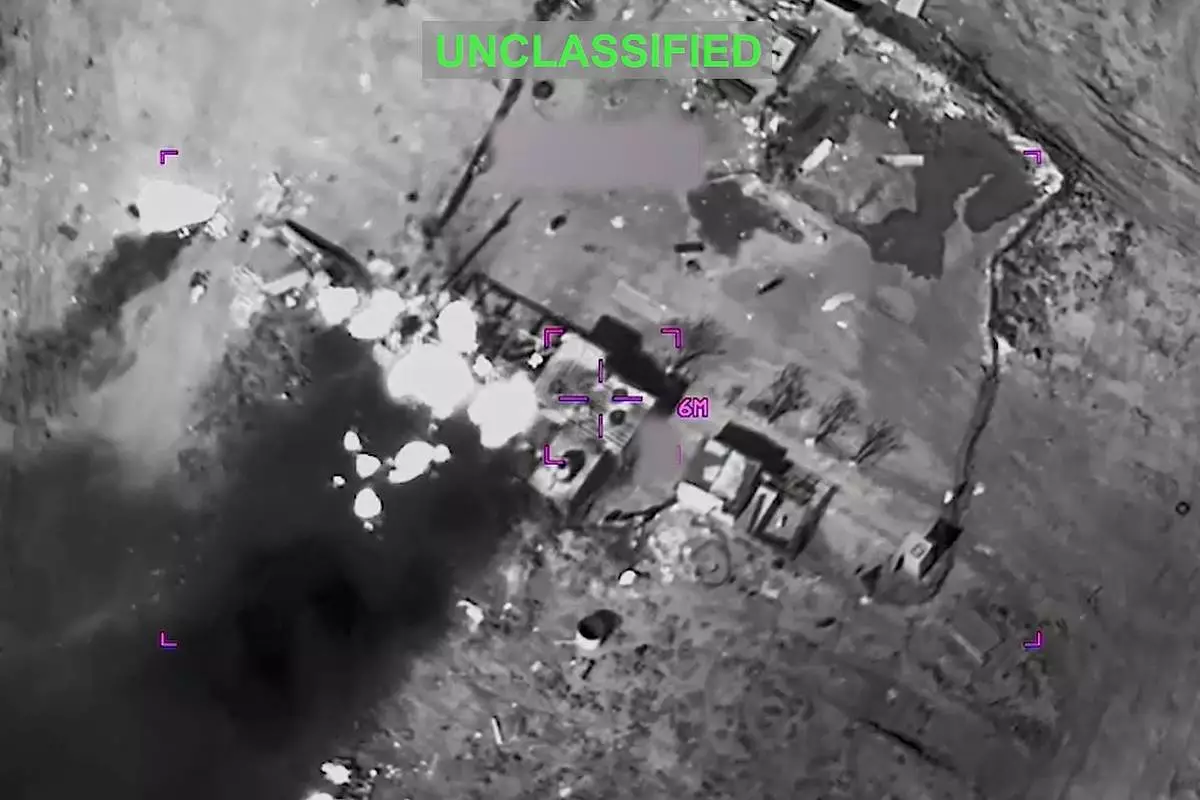
This partially redacted image from video provided by U.S. Central Command shows a complex of structures in Iran being struck by missiles fired by U.S. forces on Sunday, March 1, 2026. (U.S. Central Command via AP)

President Donald Trump walks past Defense Secretary Pete Hegseth as he exist the East Room of the White House following the Medal of Honor ceremony, Monday, March 2, 2026, in Washington. (AP Photo/Mark Schiefelbein)
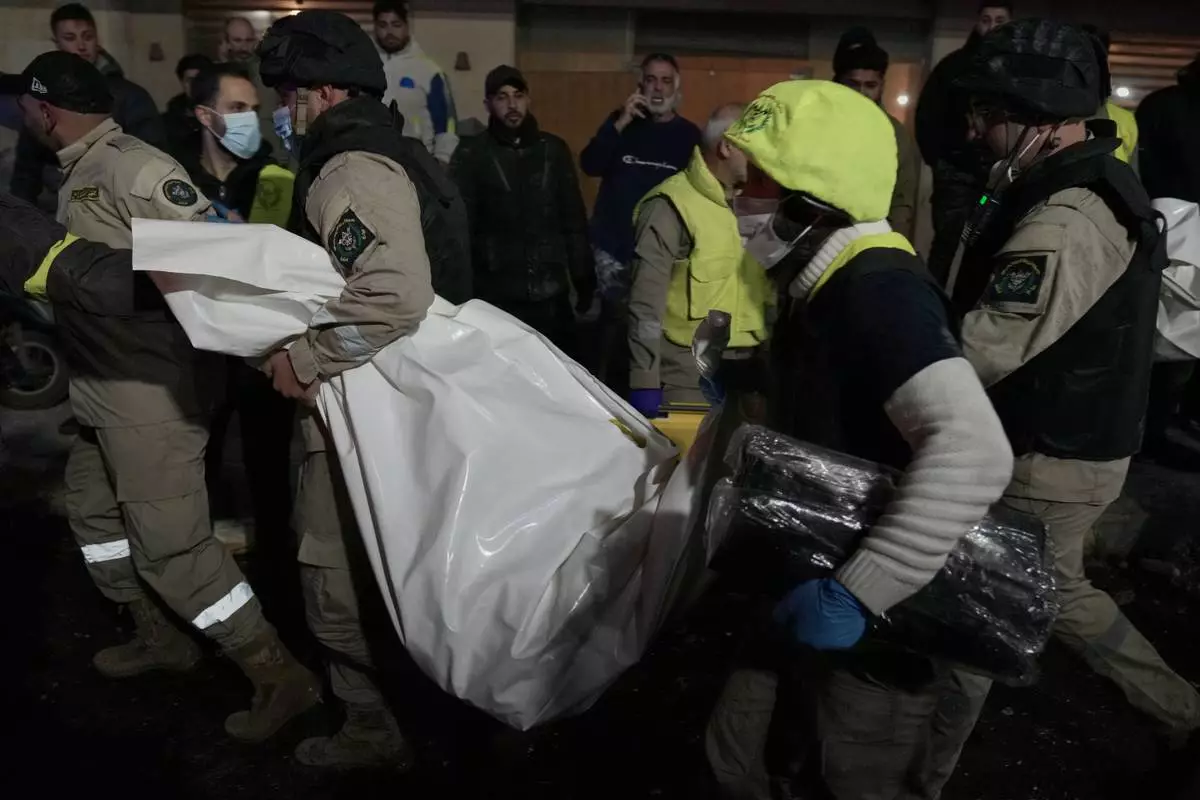
Rescue workers carry a dead body in a plastic bag from a building that was hit by Israeli strike, in Jnah neighborhood, south of Beirut, Lebanon, Monday, March 2, 2026. (AP Photo/Hussein Malla)
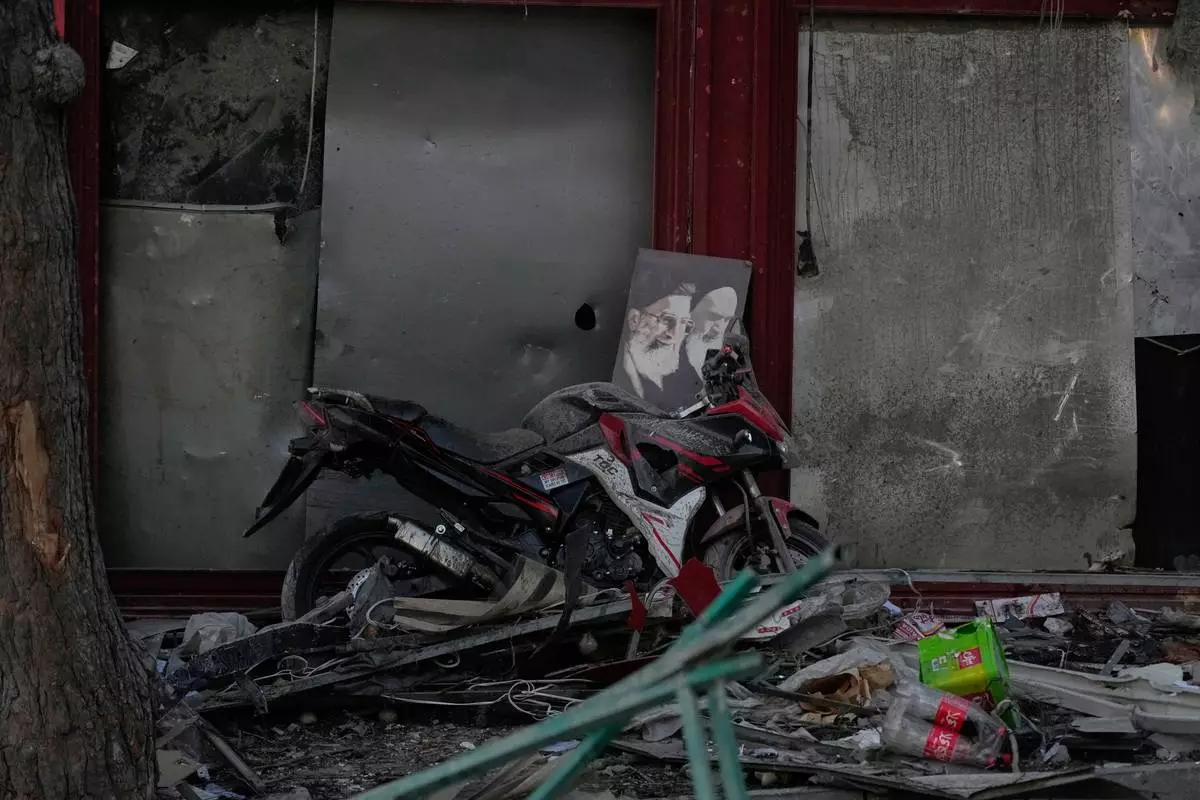
A poster of the late Supreme Leader Ayatollah Ali Khamenei, who was killed during the ongoing joint U.S.-Israeli military campaign, and the late Iranian Revolutionary founder Ayatollah Khomeini, right, lays on a motorcycle amid debris left by a strike in Tehran, Iran, Monday, March 2, 2026. (AP Photo/Vahid Salemi)
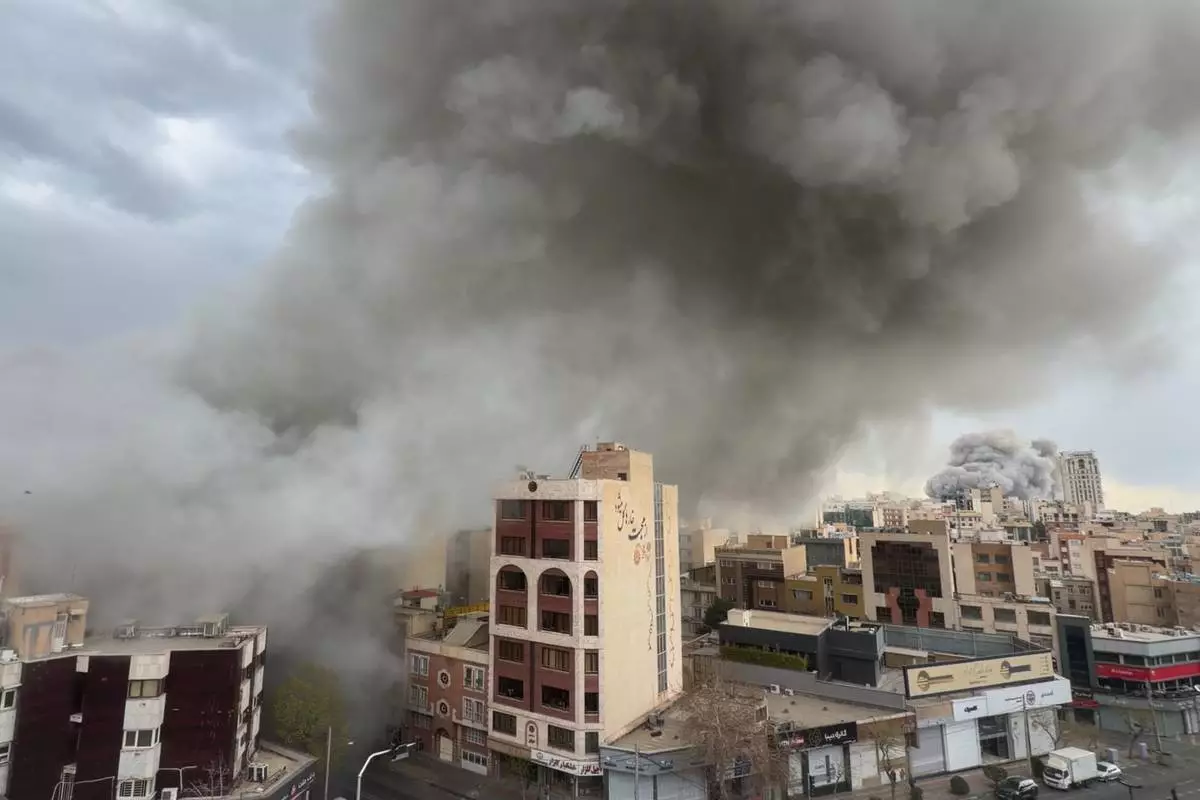
Plumes of smoke from two simultaneous strikes rise over Tehran, Iran, Monday, March 2, 2026. (AP Photo/Mohsen Ganji)