NEW YORK (AP) — A federal judge has blocked President Donald Trump's administration's efforts to halt New York’s first-in-the-nation congestion fee meant to reduce traffic and pump revenue into the region’s aging transit system.
U.S. District Judge Lewis Liman on Tuesday ruled that the U.S. Department of Transportation lacked the authority to unilaterally rescind approval of the $9 toll, which former Democratic President Joe Biden initially green-lit.
Instead, he sided with the Metropolitan Transportation Authority, which had argued that the department’s reversal was “unlawful” because the agency had not adequately explained its reasoning.
“The Secretary’s actions were arbitrary and capricious, an abuse of discretion, and not in accordance with law,” Liman wrote in his 149-page ruling, referring to Trump's Transportation Secretary Sean Duffy.
The judge noted that New York's legislature passed the toll, which its governor signed into law and received the necessary federal approvals before launching.
“The democratic process worked,” Liman wrote, even as he left the door open for future attempts by Trump and other opponents to kill the program, which took effect on Jan. 5, 2025.
Gov. Kathy Hochul said the decision vindicates a “once-in-a-lifetime success story” that's “yielded huge benefits” in its first year of operation, including reducing gridlock and unlocking critical funding for mass transit.
“The judge’s decision is clear: Donald Trump’s unlawful attempts to trample on the self-governance of his home state have failed spectacularly," the Democrat said in a statement. “Congestion pricing is legal, it works, and it is here to stay.”
The U.S. DOT said it’s reviewing its legal options, including appealing.
“Once again, working-class Americans are being sidelined under Governor Kathy Hochul’s policies, which impose a massive tax on every New Yorker,” the agency said in a statement.
New York’s congestion toll is imposed on most vehicles driving into Manhattan south of Central Park.
The toll varies depending on vehicle type and time of day, and is added to tolls drivers already pay to cross bridges and tunnels into Manhattan, but generally costs about $9.
Congestion pricing schemes aimed at reducing traffic pollution and encouraging public transit use have long existed in other global cities, including London, Stockholm, Milan and Singapore, but not in the U.S.
But Trump, whose namesake Trump Tower and other properties are within the congestion zone, has strongly opposed the idea. During his presidential campaign, he vowed to kill New York's plan as soon as he took office.
Then last February, Duffy rescinded the toll's federal approval, calling the fee “a slap in the face to working-class Americans and small business owners." He threatened to withhold federal funding for projects in New York if the toll weren't discontinued.
But Liman temporarily blocked the administration from following through on those threats until he issued a final decision. The Manhattan judge previously dismissed a series of lawsuits brought by local opponents, including New Jersey’s governor, unionized teachers in New York City, a trucking industry group and local suburban leaders.
Hochul had been a vocal supporter of the toll but paused its planned rollout in 2024, a move widely seen as an attempt to help suburban Democrats in congressional races where the toll was divisive. She then reinstated the fee after the election, but lowered it from $15 to $9.
As the program marked its first anniversary in January, Hochul, who is up for reelection, joined the MTA in touting the toll's benefits.
According to a recent MTA report, the toll has led to some 27 million fewer vehicles coming into the heart of Manhattan, resulting in 22% less air pollution and 23% faster commute times for those opting to drive and pay the fee.
The toll has also generated more than $550 million in revenue for the region’s creaky and cash-strapped transit system — exceeding projections, the MTA has said.
Sales tax revenues, office leases and foot traffic in the congestion zone have all increased since the toll took effect, disproving concerns it would hurt the local economy, according to the agency.
“Traffic is down, business is up, and we’re making crucial investments in a transit system that moves millions of people a day,” Janno Lieber, the MTA's CEO, said Tuesday. "New York is winning.”
Follow Philip Marcelo at https://x.com/philmarcelo
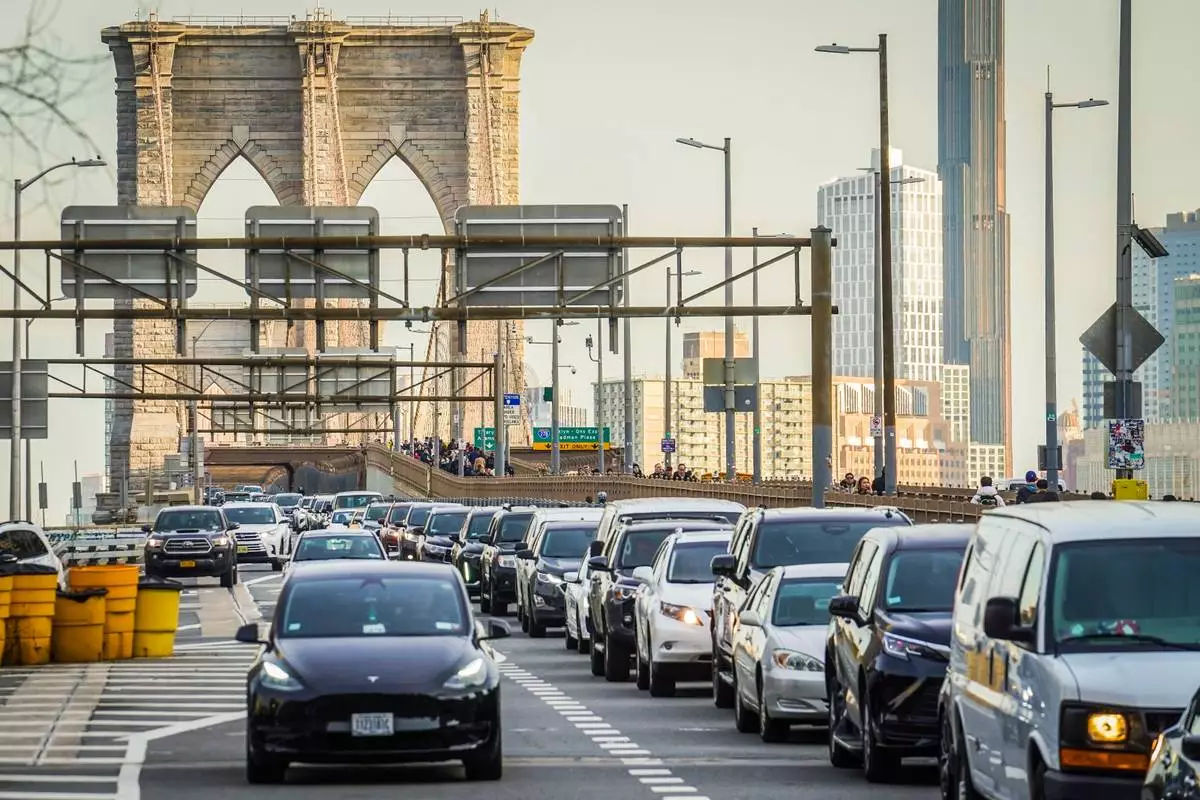
FILE - Traffic enters lower Manhattan after crossing the Brooklyn Bridge, Feb. 8, 2024, in New York. (AP Photo/Bebeto Matthews, File)