Skip to Content Facebook Feature Image

A property tax revolt spreads across states, but election-year cuts hit opposition

News

A property tax revolt spreads across states, but election-year cuts hit opposition
News

News

A property tax revolt spreads across states, but election-year cuts hit opposition

2026-03-04 08:52 Last Updated At:09:01

ATLANTA (AP) — More and more states are examining plans to cut property taxes during what's an election year for governors and legislators in most states. But some states' tax-cutting zeal is hitting political resistance to slashing local government and public school funding.

National experts say it's a property tax revolt — comparing it to earlier backlashes, including the one that led to California’s Proposition 13, a 1978 initiative that limited property tax rates and how much local governments could increase property valuations on homes for tax purposes. Like then, rising home values have driven higher property tax bills.

“The overwhelming trend across the states is relief for residential property owners," said Manish Bhatt of the Tax Foundation, a Washington, D.C., group that studies taxes.

New proposals have been debated in recent weeks to cut taxes in Iowa, Kansas, Michigan, Missouri, Oklahoma, South Dakota and Wisconsin. In some of those states, the debate is likely to play out for months.

While political pressure from angry homeowners is likely to keep some legislatures on track to cut property taxes, efforts to eliminate property taxes on a homeowner's primary residence face a difficult path.

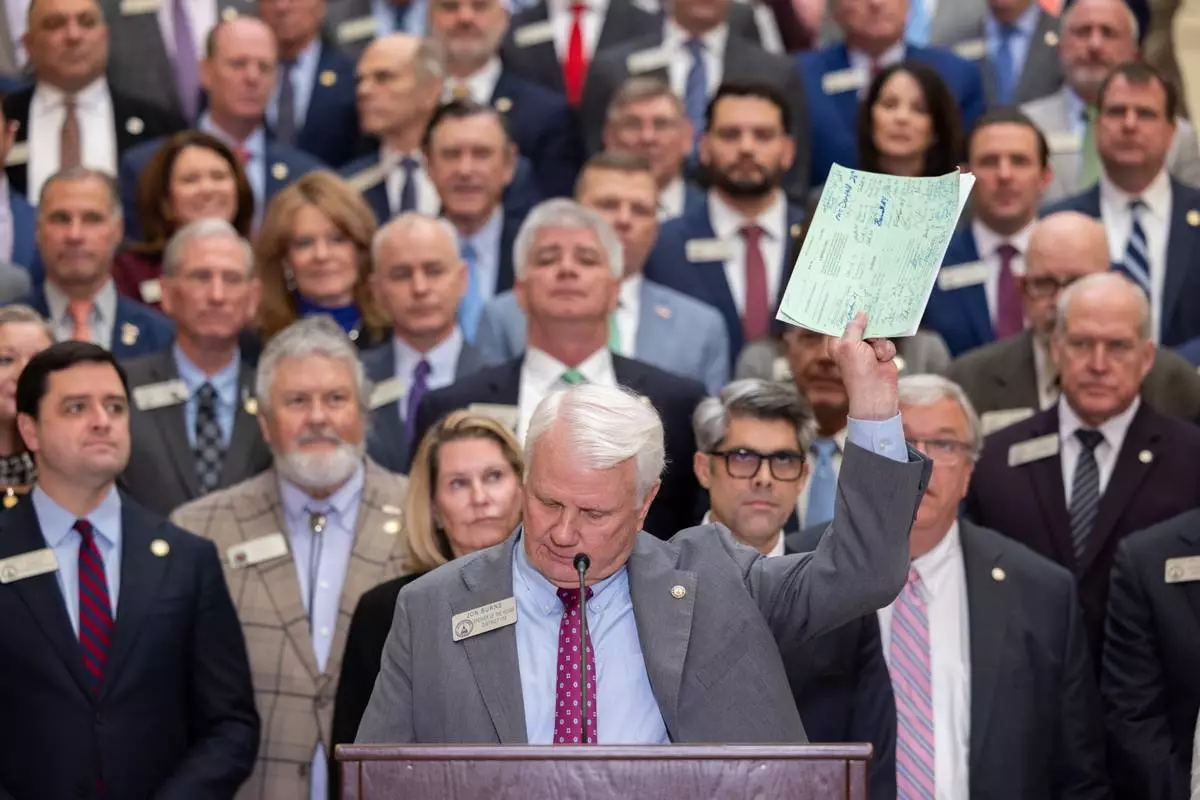
In Georgia on Tuesday, a state constitutional amendment that could have cut property taxes for homeowners by 75% or more failed when all but one Democrat voted against it. Because such amendments in Georgia require a two-thirds vote by legislators, the plan backed by Republican state House Speaker Jon Burns needed at least 21 Democratic votes.

The Georgia bill could be revived, but House Republicans said they would also begin looking at more limited ways to provide property tax relief that wouldn't require a constitutional amendment.

In Florida, House lawmakers passed a proposed state constitutional amendment to phase out property taxes for nonschool purposes over 10 years. The proposal, which would cost an estimated $13 billion in forgone revenue, awaits Senate action. But a key state senator has signaled that his chamber is unlikely to agree, instead saying senators favor something less generous and more tailored to the needs of individual counties. Lawmakers have said it may take a special session to reach a deal.

Thomas Brosy, a senior research associate at the Urban-Brookings Tax Policy Center, said eliminating property taxes is “very unlikely to happen.”

“Completely slashing them is really unrealistic, since it really is the largest source of on revenues for most local governments in the United States,” Brosy said.

Even the plan rejected Tuesday in Georgia was a step back from the original plan to phase out homeowner property taxes by 2032. Tuesday's version would have cut, but not necessarily eliminated, property taxes on a primary residence, while encouraging local governments and schools to instead rely on sales taxes to fund operations. It would also have raised taxes on sales of computers to data centers to offset some revenue losses.

State House Ways and Means Committee Chairman Shaw Blackmon said the measure would have provided “dramatic savings for homeowners.”

“We’ve all received emails from constituents worried their skyrocketing property tax will force them from their homes," he said in a debate on Tuesday.

But state House Democratic Minority Leader Carolyn Hugley called the bill an election-year “exercise in cold, hard politics.” She and other Democrats said that in many cases, local governments wouldn't be legally able to raise sales taxes enough to offset the billions in property taxes that would be lost.

“The math’s just not math-ing. It just does not add up," Hugley said. "And this is not a responsible thing to do.”

Other states are looking at shifting from property taxes to sales taxes as well. South Dakota Gov. Larry Rhoden proposes letting counties impose a half-percent sales tax and devoting the proceeds to property tax credits for homeowners. Last week, Rhoden, a Republican, launched a website estimating how much homeowners would save annually on property taxes, ranging from $428 to $1,227. However, it doesn’t count how much people would pay from increased sales taxes.

In Michigan, Republican state House Speaker Matt Hall last week proposed raising taxes on currently untaxed services and using the money to erase the state's share of property taxes, the state real estate transfer tax and Michigan's personal property tax. Any agreement may not come until lawmakers finalize the state budget in the fall.

One issue with a shift to sales taxes is that it may shift the tax burden from richer to poorer people, Brosy with the Urban-Brookings Tax Policy Center said.

“They try to get it to the next best thing or the next available thing, which is the sales tax, which in itself is a lot more regressive and tends to fall a lot more on lower-income families compared to the property tax,” he said.

Another issue with shifting to sales taxes is that some local governments have few sources of retail sales to tax.

“Not all locations have the same opportunities to replace that revenue," Bhatt of the Tax Foundation said. "And that often is missed in the discussions.”
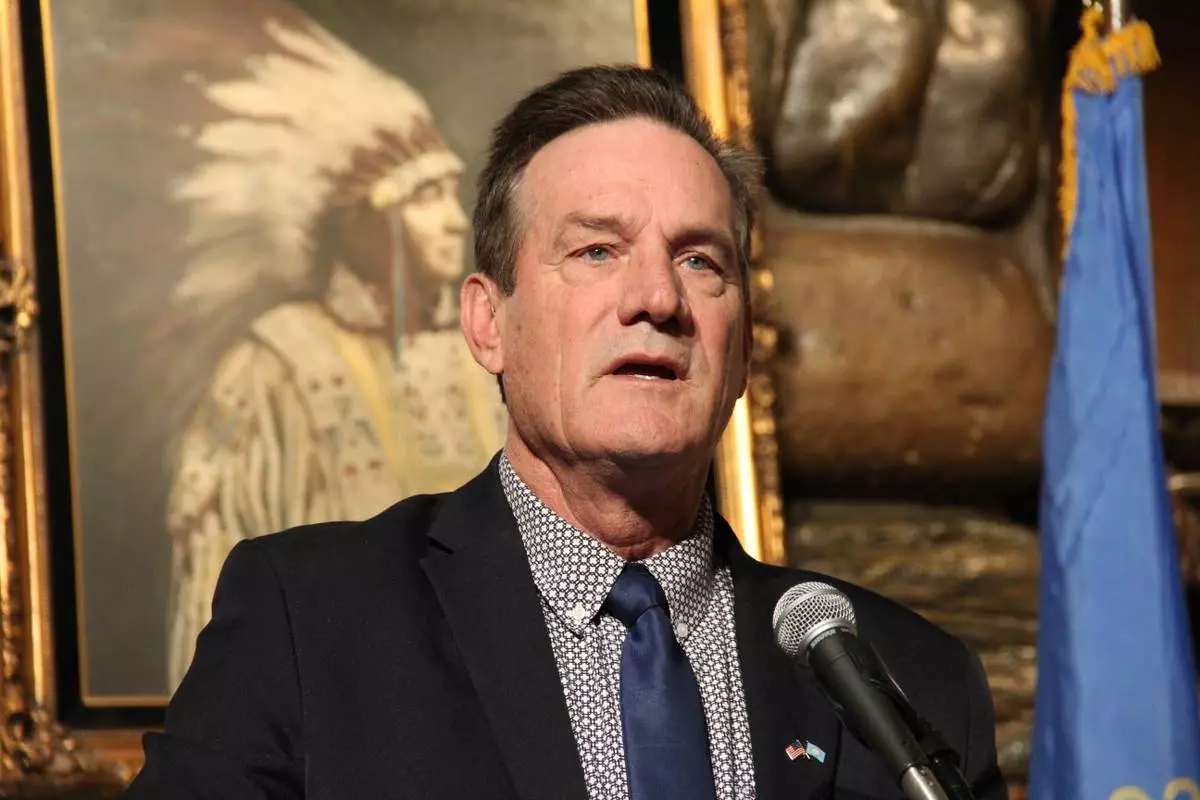
FILE - Gov. Larry Rhoden speaks with attendees of his announcement event at the Hotel Alex Johnson, Nov. 18, 2025, in Rapid City, S.D. (Shalom Baer Gee/Rapid City Journal via AP, File)
FILE - Gov. Larry Rhoden speaks with attendees of his announcement event at the Hotel Alex Johnson, Nov. 18, 2025, in Rapid City, S.D. (Shalom Baer Gee/Rapid City Journal via AP, File)

FILE - House Speaker Jon Burns holds up proposed property tax relief legislation during a news conference at the Capitol, in Atlanta, Jan. 28, 2026. (Arvin Temkar/Atlanta Journal-Constitution via AP, File)
FILE - House Speaker Jon Burns holds up proposed property tax relief legislation during a news conference at the Capitol, in Atlanta, Jan. 28, 2026. (Arvin Temkar/Atlanta Journal-Constitution via AP, File)

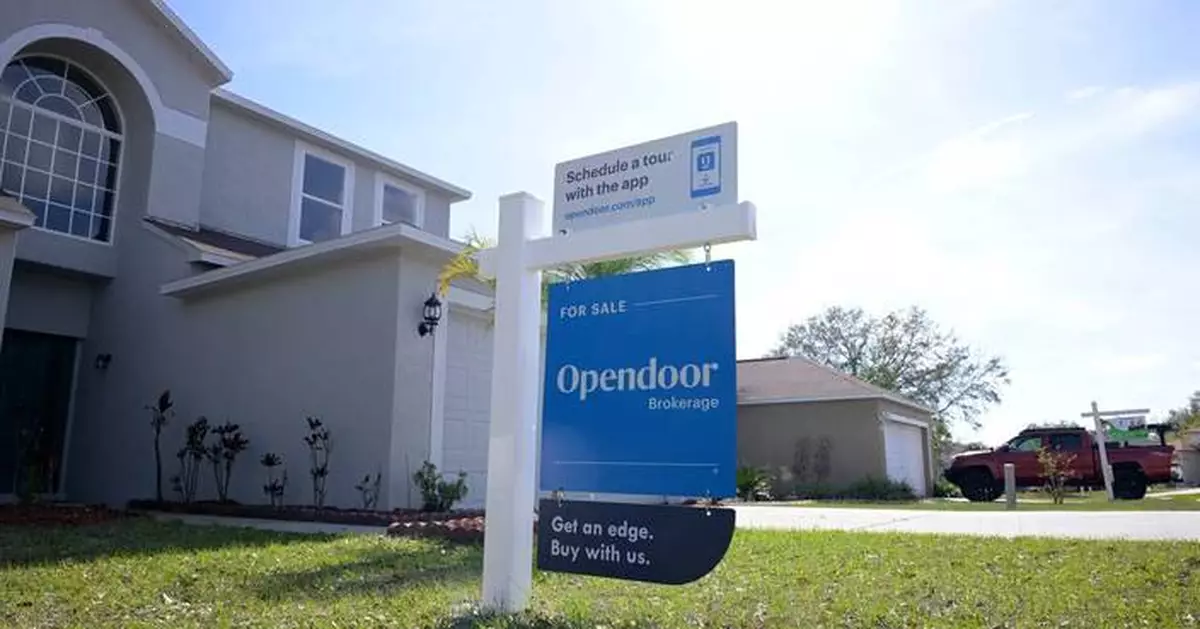
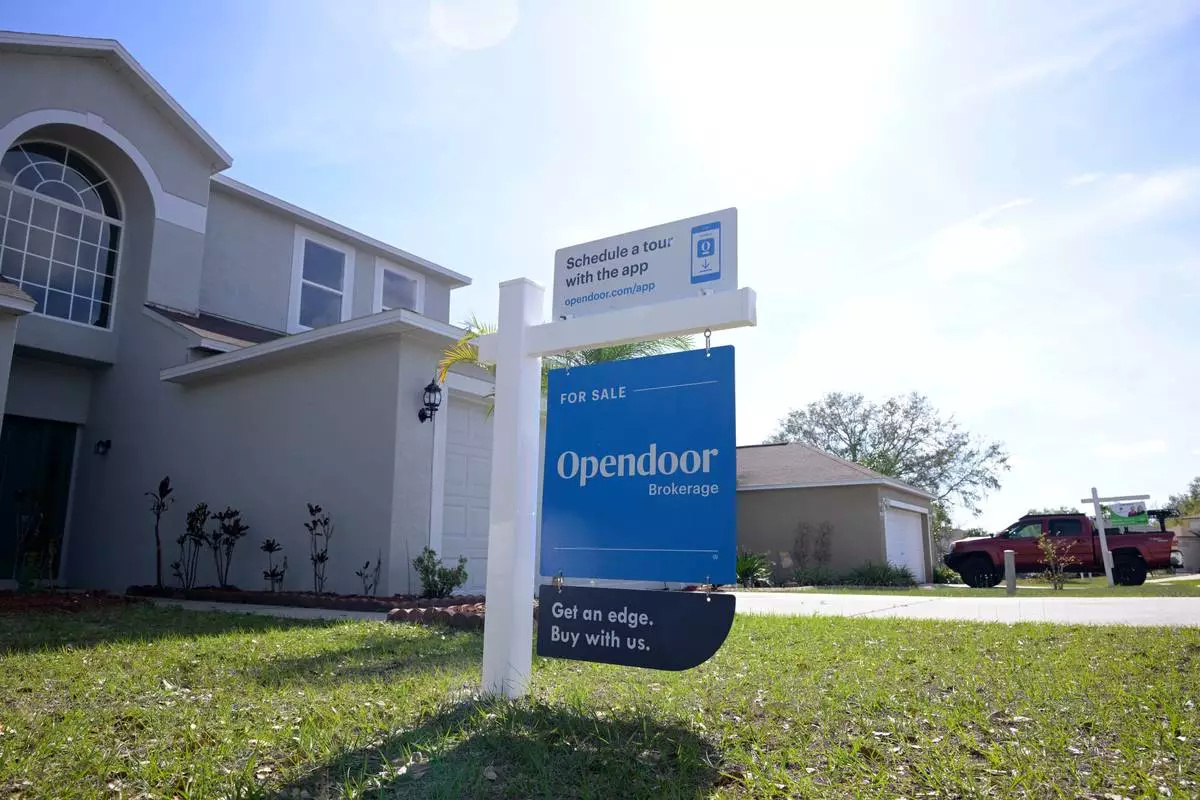
FILE - Real estate signs are posted outside homes for sale, Feb. 21, 2023, in Valrico, Fla. (AP Photo/Phelan M. Ebenhack, File)
FILE - Real estate signs are posted outside homes for sale, Feb. 21, 2023, in Valrico, Fla. (AP Photo/Phelan M. Ebenhack, File)
Voters in two major Texas counties were turned away at polling locations and directed to different precincts Tuesday, after a recent change in how the primary is conducted created confusion and frustration.

In Dallas County, a judge ordered polls to remain open for two hours past the scheduled 7 p.m. closing time, citing “voter confusion so severe” that it caused the website of the county election office to crash. The judge was acting on a petition filed by the local Democratic Party.

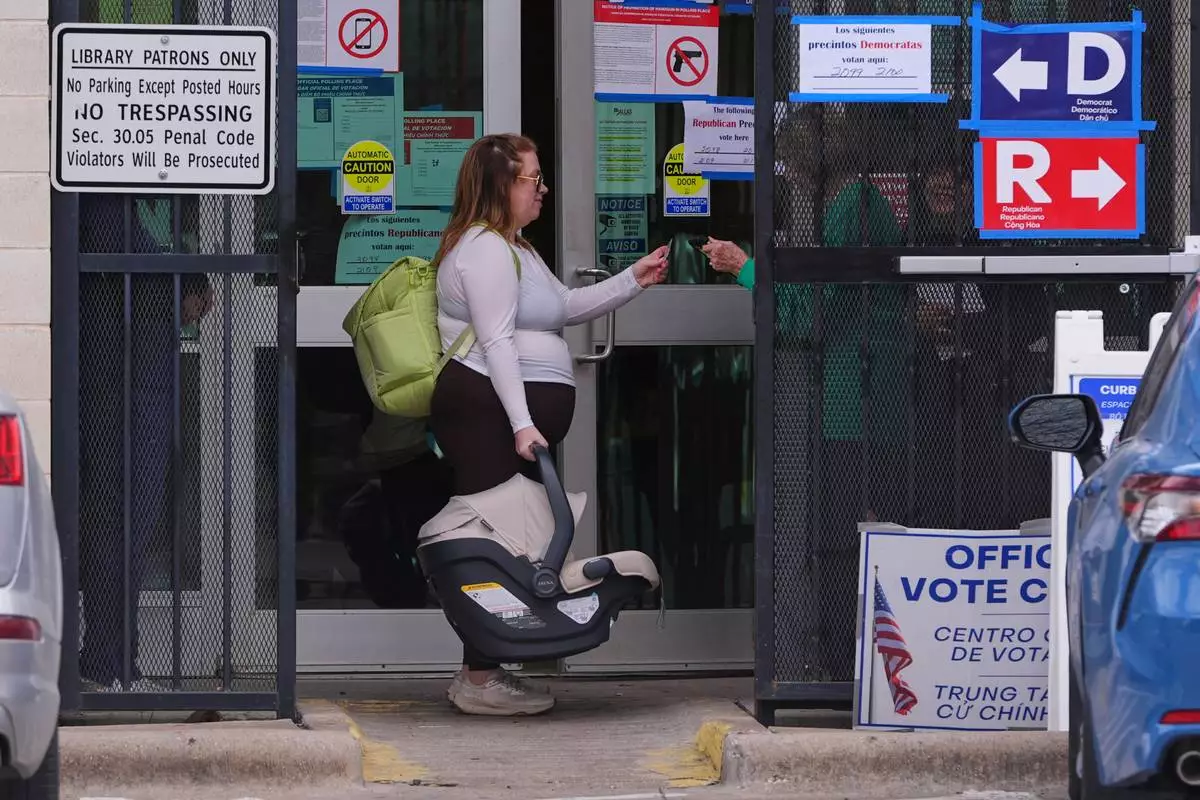
In Dallas and Williamson counties, voters had been allowed to cast their ballot anywhere in their county for years. But for this primary, the local Republican parties opted against countywide voting. State law says both major parties have to agree to the countywide system for it to be in effect.

That meant that on Tuesday all voters in the two counties could cast ballots only at their assigned precinct.

The campaigns of the two Democrats running in the party primary for U.S. Senate denounced the effect of the change on voters and called for the poll hours to be extended.

“Both Dallas and Williamson county voters have grown accustomed to countywide voting, including on election day,” U.S. Rep. Jasmine Crockett 's campaign said. “This effort to suppress the vote, to confuse and inconvenience voters, is having the intended effect as people are being turned away from the polls.”

The campaign of James Talarico, a state lawmaker, said it was “deeply concerned” about the reports of voters showing up at polling locations and being sent elsewhere.

Adding to the confusion was the fact that voting locations also might be specific to someone’s party affiliation, said Nic Solorzano, a spokesperson for the Dallas County Elections Department.

“We’re seeing a lot of people that are going to their vote centers that they usually go to ... and not realizing they can’t do that anymore. They have to go to their precinct-based location,” he said.

It was not immediately clear whether the judge’s ruling applied to all voting precincts or just the ones for Democrats.

Texas was one of three states kicking off the 2026 midterm elections Tuesday, along with North Carolina and Arkansas. Voting otherwise went fairly smoothly, except for a problem with electronic poll books in one rural North Carolina county that prompted the state elections board to delay the release of statewide results by an hour.

Tomas Sanchez, a student at Dallas College, was among those who showed up at a voting location on campus to cast his ballot in Texas' Democratic primary. But he was under a “mistaken impression” and told that he needed to vote at his assigned precinct, a location about 6 miles (about 10 kilometers) away and closer to his neighborhood.

“This is something that we were really concerned about, honestly,” Solorzano said. He added that after nearly seven years of voters being able to cast their ballots anywhere in the county, “then we kind of had to retool our entire operation to go back to precinct-based voting for Election Day.”

The county elections department has been putting up signs, running ads and sending text messages and mailers to make people aware of the change. On Election Day former poll workers were stationed outside voting locations with tablets to help people find the correct place to cast their ballot.

While Solorzano said his department was not keeping track of how many people were been turned away, local Democrats said the number was significant.

Brenda Allen, executive director of the Dallas Democratic Party, said her offices were swamped by hundreds of calls from voters of both parties trying to find their precincts. She noted that congressional districts in the county also were remapped in Texas’ mid-decade redistricting and that new precinct lines were only finalized in December, leaving little time to inform voters.

“Lots of reports of people being turned away, hundreds of people unable to vote. Both parties are affected by this,” Allen said. “It’s not great.”

In Williamson County, which includes suburbs north of Austin, the state capital, the local Democratic Party headquarters was slammed by calls, executive director Madison Dickinson said.

“We’re having significant problems with the precinct-level voting,” she said, adding that, like in Dallas, even Republicans were confused by the change and were calling the Democratic Party for help.

Republicans were less vocal about the changes online, although the Dallas County Republican Party posted a link showing voters where to find their assigned polling places. The Williamson County Republican Party did not respond to a request for comment.

Associated Press writer John Hanna contributed.

Primary voter Allie Davis carries her seven-week-old son Declan as a Dallas County Election Navigator checks her ID before entering a voting center in Dallas, Tuesday, March 3, 2026. (AP Photo/LM Otero)

Primary voter Allie Davis carries her seven-week-old son Declan as a Dallas County Election Navigator checks her ID before entering a voting center in Dallas, Tuesday, March 3, 2026. (AP Photo/LM Otero)

Recommended Articles