Skip to Content Facebook Feature Image

Drone show director turns night skies into living canvas of light, technology

China

China

China

Drone show director turns night skies into living canvas of light, technology

2026-03-04 03:13 Last Updated At:14:53

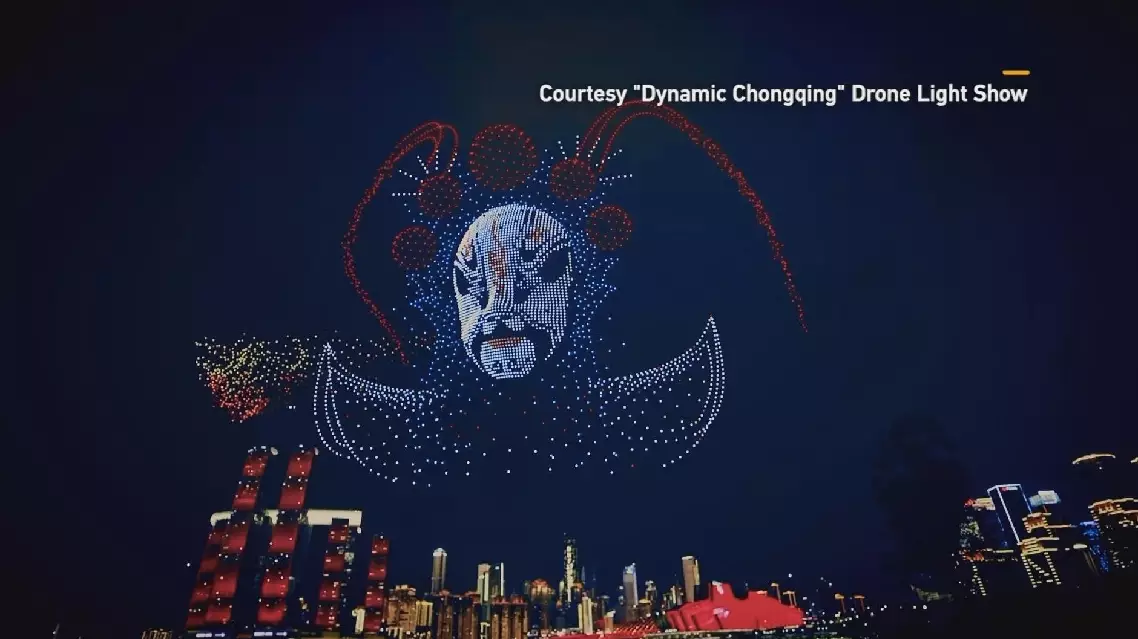
A drone show director has helped transform the already sparkling night skies of the southwestern Chinese metropolis of Chongqing into a living canvas of light and technology, delivering a breathtaking overhead spectacle which has become a must-see attraction for visitors.

While Chongqing has already become a tourism hotspot for its sprawling modern cityscape, colorful skylines and spicy hotpot dishes, the introduction of regular drone shows above the city has added a whole other dimension to its appeal after darkness falls.

The city has become increasingly ambitious in its quest to hit new heights with its dazzling drone formations. Last summer, Chongqing even set a Guinness World Record, when a fleet of nearly 12,000 drones were flown in perfect unison to create a stunning aerial image over the city.

Among those playing their part in this popular technological showcase is former television news reporter, Li Junlin, who now serves as director of the "Dynamic Chongqing" Drone Light Show, a now iconic attraction that has quickly become synonymous with the city's innovative spirit.

Li's journey from covering local news on the ground to making news in the night sky reflects a broader trend across China, where cutting-edge drone technology is merging with artistic vision to create spectacular public experiences.

China is home to some of the world's best commercial drones, and cities across the country are experimenting with them in more creative ways. Chongqing, a mountainous metropolis which has already gained fame for its futuristic-looking skyline, offers the perfect backdrop for high-tech shows to flourish, Li emphasized.

Last year, China's Ministry of Human Resources and Social Security introduced a list of newly-recognized occupations, including 'drone swarm flight planner', a role that Li enthusiastically took up as she left her media career behind.

Her experience with visual storytelling on TV came in handy. To her, each drone in the sky is not just a machine, but like a pixel on a vast, dynamic screen.

"When we produced TV programs, we used wide, medium, and close-up shots. Those techniques can also be applied to drone storytelling. For example, in a sequence of ten visuals, each can build on the emotion of the previous one," said Li.

Turning artistic concepts into aerial reality requires robust technical support, and it's a responsibility that falls to Yao Lijun, project manager at the Shenzhen DAMODA Intelligent Control Technology Company, who explained the advanced technology which is powering these drone devices.

"We call it 'AP', or 'autopilot'. The program collects data from each drone and sends the information to the computer. The computer determines whether the drone is ready for takeoff. We then upload the program from the computer to the drones. Once they reach their designated point, they know exactly where to go and at what altitude," said Yao.

The drones are designed to carry-out high-precision maneuvers, and Li said they've gone through several upgrades in recent months which further improves their potential to create even more impressive visual displays.

"I entered the industry around July or August last year, and the upgrades have been happening fast. We used to remove each battery and charge them one by one. Now it's like a hive system. One power unit can charge six drones at the same time," said Li.

Across Chongqing and beyond, technology is transforming not just city skylines, but the very fabric of an economy driven by innovation, creativity, and talent.
Drone show director turns night skies into living canvas of light, technology
Drone show director turns night skies into living canvas of light, technology
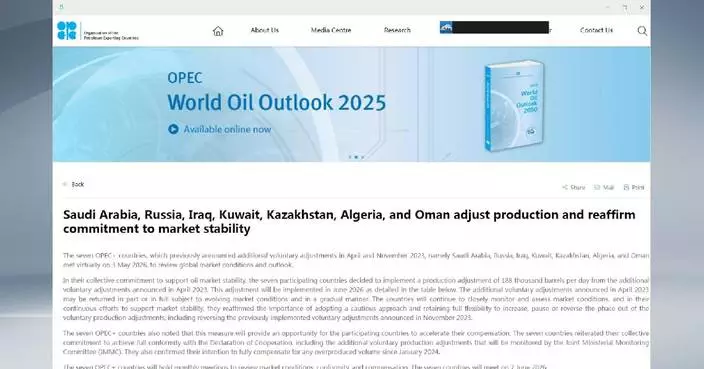
The United Arab Emirates' (UAE) exit from the Organization of the Petroleum Exporting Countries (OPEC) and the broader OPEC+ is unlikely to jolt oil markets in the short term, but sets the stage for lower prices once the Iran conflict ends and Gulf exports resume, experts said.

Effective Friday, the UAE formally withdrew from OPEC in a move poised to reshape global oil markets. The decision came amid heightened geopolitical tensions driven by the ongoing Iran conflict.

The UAE Energy Minister Suhail Al Mazrouei said the timing was chosen to cause the least market disruption. But analysts say the exit reflects the UAE's long-simmering frustrations over production quotas that no longer align with its capacity.

"It gives the UAE flexibility to move from a quota within OPEC of 3.3 million barrels a day to 5 million barrels a day in 2027. It won't radically change the pricing. It will make more energy available. So, it will take some of the price pressures off," said John Defterios, senior advisor for APCO Worldwide, a global advisory firm, and also senior fellow at the Center for Energy and Materials of the World Economic Forum.

While immediate market impact remains muted amid wartime volatility, experts anticipate meaningful shifts once regional stability returns.

"It has no impact right now, because obviously oil prices right now depend on the state of the war and whether exports can start freely through the Gulf and so on. But assume, once the war is over and a normal transit resumes, I would expect the UAE will move quickly to increase production and try to refill some of that storage that was drained. And that should mean, in general, lower prices for oil importers, for oil consumers. In the longer term, yes, I think also probably it means lower prices," said Robin Mills, CEO of Qamar Energy, a Dubai-based independent consultancy company.

The UAE's departure highlights structural tensions within OPEC+. As a low-cost producer with billions invested in upstream expansion, Abu Dhabi increasingly chafed against collective quotas.

However, other members, including Iraq and Kazakhstan, also sought higher production allowances.

"This pressure has been building up for some time. But Saudi Arabia was also in a difficult position. If it agreed to grant higher production levels to the UAE, then it would have to grant them to Iraq as well. Kazakhstan wanted more [allowance as well]. Everybody wants special treatment," said Mills.

Strategically, the move aligns with the UAE's broader vision to diversify its economy.

"They made this announcement ahead of a very important forum, Make It In the Emirates, which displays what the UAE is doing in terms of diversification outside of oil and gas. So, they want that revenue from oil and gas -- the extra 50 billion dollars a year to go into greater diversification. It's advanced manufacturing, it's artificial intelligence, it's the next wave of financial services, and it is trade," said Defterios.

The exit also signals a broader recalibration of legacy energy institutions in a world confronting new climate imperatives, geopolitical fragmentation, and energy transition pressures.

"I do think it shows definitely a world in which there's a new energy reality, there's a new climate reality, there's a new geopolitical reality. And these legacy institutions have to adapt. And if they don't, then of course, their members will either leave or at least won't take them seriously," said Mills.

UAE's OPEC exit long expected, may ease oil prices after Iran war ends: experts

UAE's OPEC exit long expected, may ease oil prices after Iran war ends: experts

Recommended Articles