Skip to Content Facebook Feature Image

China's national legislature to examine draft outline of 15th Five-Year Plan: spokesman

China

China's national legislature to examine draft outline of 15th Five-Year Plan: spokesman
China

China

China's national legislature to examine draft outline of 15th Five-Year Plan: spokesman

2026-03-04 13:28 Last Updated At:16:17

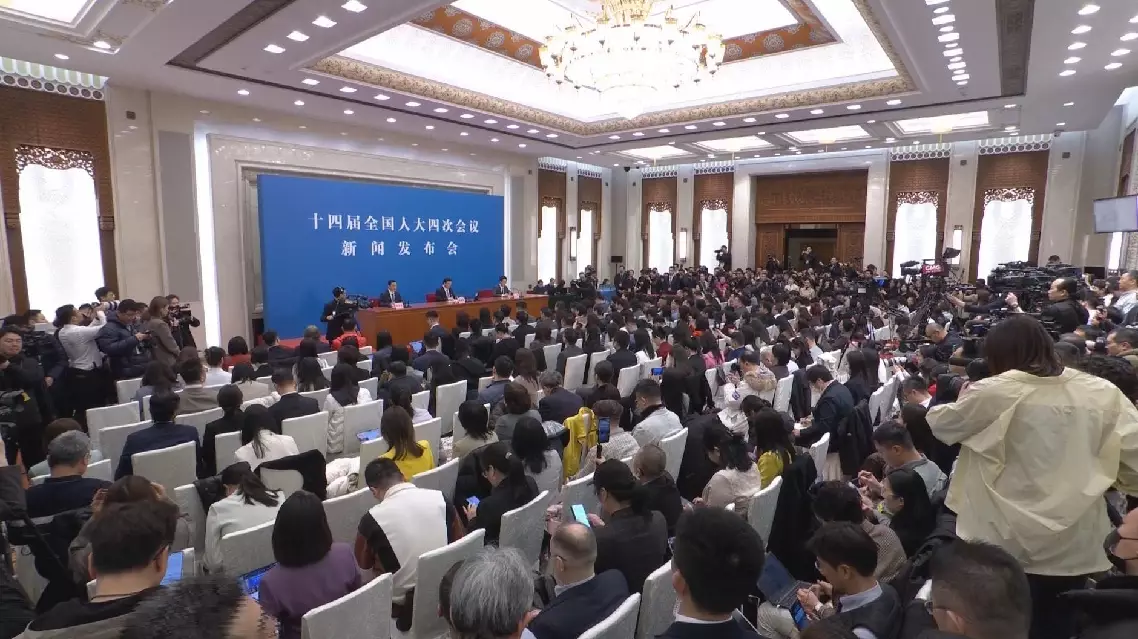
The upcoming fourth session of the 14th National People's Congress (NPC) will examine and approve the draft outline of China's 15th Five-Year Plan (2026-2030), a spokesman for the upcoming NPC session said on Wednesday, as he stressed how the country's five-year plans function as strategic frameworks for economic and social development.

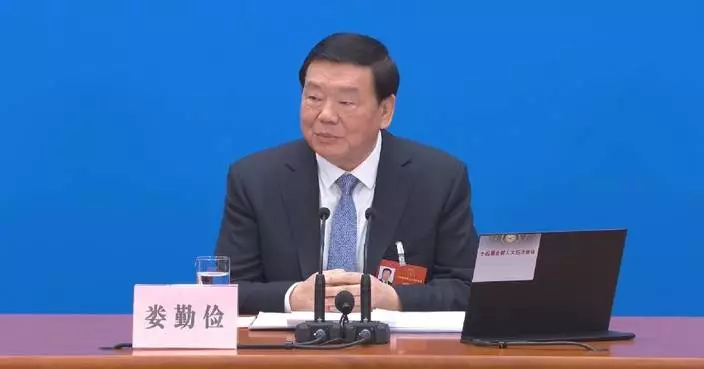
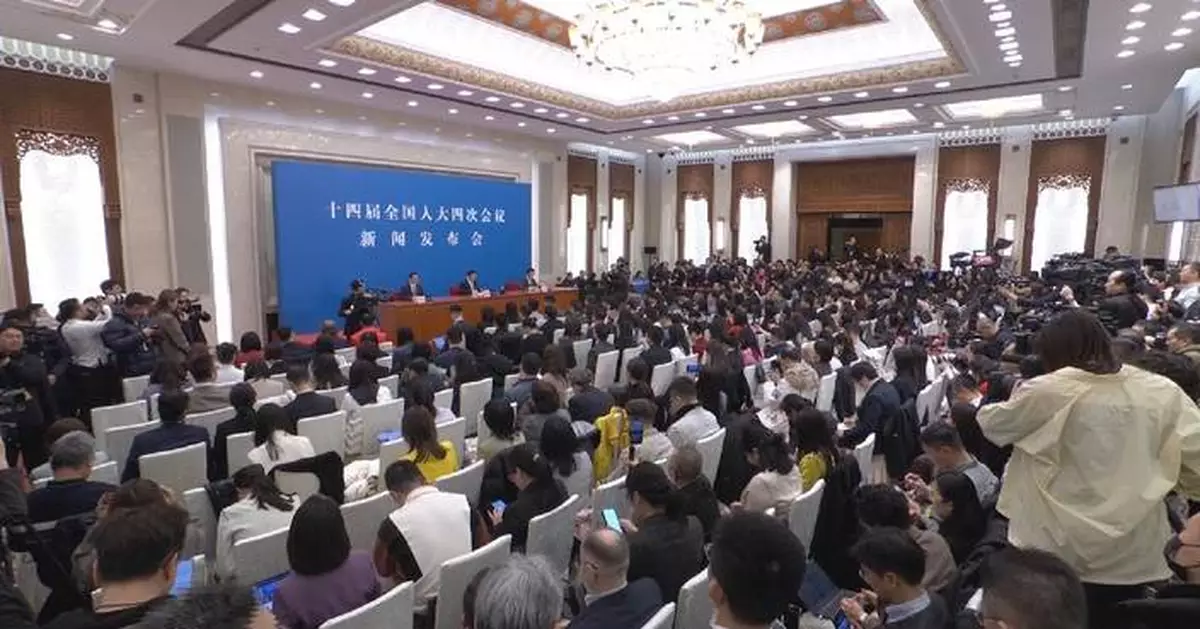
Lou Qinjian, the spokesman, was speaking at a press conference held in Beijing one day before the start of the annual gathering of the NPC, China's national legislature.

"Formulating and implementing five-year plans is an important experience of the Communist Party of China (CPC) on national governance. Since the first five-year plan in the 1950s, China has formulated and implemented 14 five-year plans consecutively, leading to the twin miracles of rapid economic growth and long-term social stability. This demonstrated the advantages of China's system, including upholding the leadership of the CPC, pooling all resources to accomplish major tasks, promoting interplay between an efficient market and a well-functioning government, and persevering and delivering on the master plan. Last year, the 14th Five-Year Plan was successfully completed, China's economic aggregate exceeded 140 trillion yuan (about 19.6 trillion U.S. dollars), contributing around 30 percent of global economic growth," he said.

"The 15th Five-Year Plan period will be a critical stage during which China will work to reinforce the foundations for and push ahead on all fronts towards basically realizing socialist modernization. The fourth plenary session of the 20th CPC Central Committee adopted the recommendations for formulating the plan, providing a strategic deployment for China's development in the next five years. The draft outline of the plan, upon extensive public consultation, will be submitted to the NPC session for review and approval, and released for implementation thereafter. Through statutory procedures, the Party's propositions thus becomes the will of the state and the collective action of the people," said Lou.

With decades of exploration and practice, China has established institutional arrangements of formulating and executing these five-year plans, Lou said. The work falls under the centralized, unified leadership of the CPC Central Committee, which puts forward the recommendations for formulating the plans. The State Council drafts the outline of the plan, which is submitted to the NPC for review and approval. The NPC then publishes the outline for a national wide implementation, the spokesman told the press.

The upcoming NPC session will deliberate on a draft law on national development planning, which codifies these mature practices and will allow national development plans to better serve as a strategic guide, he said.

The localities and government departments will make various plans at their own levels in accordance with the outline of the 15th Five-Year Plan, so that the whole country will work as one to ensure the objectives and tasks set out in the plan are fulfilled. The NPC and its standing committee will exercise supervision over the plan's execution in accordance with law, Lou said.
China's national legislature to examine draft outline of 15th Five-Year Plan: spokesman

China's national legislature to examine draft outline of 15th Five-Year Plan: spokesman

China's Large High Altitude Air Shower Observatory (LHAASO), a high-altitude cosmic ray observatory in Sichuan Province, is pushing the boundaries of astrophysics by bringing humanity closer to answering the century-long question of the origins of ultra-high-energy cosmic rays.

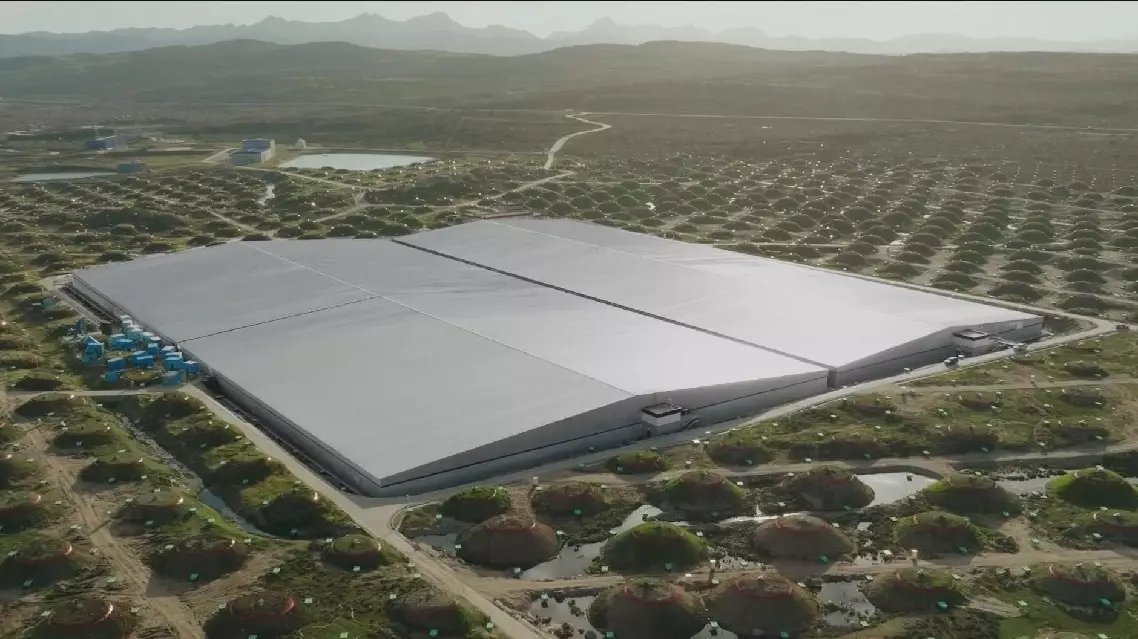
Completed in 2021, LHAASO sprawls across an area the size of 190 football fields. It is the world’s highest-altitude, largest-scale, and most sensitive observatory for detecting cosmic ray particles as they enter Earth’s atmosphere.

The project traces back two decades, when physicist Cao Zhen envisioned China taking a decisive role in this frontier of science.

"Each particle has the energy much higher than what we can produce on Earth. We don't know where it was produced. This is the fascinating question that has bothered people for 100 years already. First of all, (we) go to the high altitude -- the higher [you go], the less the influence from the atmosphere. And then we decided to build such a large-scale experiment: the larger, you get more cosmic rays," said Cao Zhen, chief scientist at LHAASO and a researcher at the Institute of High Energy Physics under the Chinese Academy of Sciences (CAS).

LHAASO functions as a giant set of "eyes" -- detectors that track cosmic ray particles invisible to the human eye. At its core lies a warehouse the size of 2.5 National Aquatic Centers, housing the world's most sensitive gamma-ray telescope.

Surrounding it are raised mounds -- muon detectors engineered to absorb photons and electrons while allowing only highly penetrating muons to pass through. Scattered among them, 18 blue, container-shaped telescopes complete the vast array.

Despite the thin atmosphere at an altitude of over 4,400 meters, China completed the construction of LHAASO in under five years, showcasing a remarkable feat of human endurance.

"Some of our detectors work perfectly fine in the lab, but they might malfunction when installed here because of the high-altitude environment. During the day, with the sun, the humidity is only about 20 to 30 percent, but at night it rises rapidly, reaching 100 percent. In addition, the detectors are also affected by temperature, wind, and extreme weather," said Wang Yudong, a researcher at the Institute of High Energy Physics.

The effort quickly began to yield results. In 2020, even before the observatory was fully completed, scientists using LHAASO's partial array identified 12 ultra-high-energy gamma-ray sources. Two years later, in October 2022, the facility captured an extraordinary event: a millennial gamma-ray burst, a dazzling "cosmic firework" triggered by the collapse of a massive star some two billion years ago.

LHAASO is but one of 77 mega-science infrastructures now operating across China. Over the past five years, these facilities have propelled the country to the forefront of high-impact publications and patent applications, unraveling cosmic mysteries, advancing core technologies, and driving industrial progress along the way.

China's LHAASO edges closer to solving cosmic ray mystery

China's LHAASO edges closer to solving cosmic ray mystery

Recommended Articles