The allegation sounded like the stuff of spy movies: A Pakistani businessman trying to hire hit men, even handing them $5,000 in cash, to kill a U.S. politician on behalf of Iran 's powerful paramilitary Revolutionary Guard.
It was true, and potential targets of the 2024 scheme included now-President Donald Trump, then-President Joe Biden and former presidential candidate and ex-U.N. Ambassador Nikki Haley, the man told jurors at his attempted terrorism trial in New York on Wednesday. But he insisted his actions were driven by fear for loved ones in Iran, and he figured he'd be apprehended before anything came of the scheme.
“My family was under threat, and I had to do this,” the defendant, Asif Merchant, testified through an Urdu interpreter. “I was not wanting to do this so willingly.”
Merchant said he had anticipated getting arrested before anyone was killed, intended to cooperate with the U.S. government and had hoped that would help him get a green card.
U.S. authorities were, indeed, on to him — the supposed hit men he paid were actually undercover FBI agents — and he was arrested on July 12, 2024, a day before an unrelated attempt on Trump's life in Butler, Pennsylvania. Merchant did sit for voluntary FBI interviews, but he ultimately ended up with a trial, not a cooperation deal.
“You traveled to the United States for the purpose of hiring Mafia members to kill a politician, correct?” Assistant U.S. Attorney Nina Gupta asked during her turn questioning Merchant Wednesday in a Brooklyn federal court.
“That’s right,” Merchant replied, his demeanor as matter-of-fact as his testimony was unusual.
The trial is unfolding amid the less than week-old Iran war, which killed Iranian Supreme Leader Ayatollah Ali Khamenei in a strike that Trump summed up as "I got him before he got me.” Jurors are instructed to ignore news pertaining to the case.
The Iranian government has denied plotting to kill Trump or other U.S. officials.
Merchant, 47, had a roughly 20-year banking career in Pakistan before getting involved in an array of businesses: clothing, car sales, banana exports, insulation imports. He openly has two families, one in Pakistan and the other in Iran — where, he said, he was introduced around the end of 2022 to a Revolutionary Guard intelligence operative. They initially spoke about getting involved in a hawala, an informal money transfer system, Merchant said.
Merchant testified that his periodic visits to the U.S. for his garment business piqued the interest of his Revolutionary Guard contact, who trained him on countersurveillance techniques.
The U.S. deems the Revolutionary Guard a “foreign terrorist organization.” Formally called the Islamic Revolutionary Guard Corps, the force has been prominent in Iran under Khamenei.
Merchant said the handler told him to seek U.S. residents interested in working for Iran. Then came another assignment: Look for a criminal to arrange protests, steal things, do some money laundering, “and maybe have somebody murdered,” Merchant recalled.
“He did not tell me exactly who it is, but he told me — he named three people: Donald Trump, Joe Biden and Nikki Haley,” he added.
After U.S. immigration agents pulled Merchant aside at the Houston airport in April 2024, searched his possessions and asked about his travels to Iran, he concluded that he was under surveillance. But still he researched Trump rally locations, sketched out a plot for a shooting at a political rally, lined up the supposed hit men and scrambled together $5,000 from a cousin to pay them a “token of appreciation.”
He even reported back to his Revolutionary Guard contact, sending observations — fake, Merchant said — tucked into a book that he shipped to Iran through a series of intermediaries.
Merchant said he “had no other option” than to play along because the handler had indicated that he knew who Merchant’s Iranian relatives were and where they lived.
In a court filing this week, prosecutors noted that Merchant didn't seek out law enforcement to help with his purported predicament before he was arrested. He testified that he couldn't turn to authorities because his handler had people watching him.
Prosecutors also said that in his FBI interviews, Merchant “neglected to mention any facts that could have supported” an argument that he acted under duress.
Merchant told jurors Wednesday that he didn't think agents would believe his story, because their questions suggested “they think that I'm some type of super-spy.”
“And are you a super-spy?" defense lawyer Avraham Moskowitz asked.
“No,” Merchant said. “Absolutely not.”

FILE - This image provided by the Justice Department, contained in the complaint supporting the arrest warrant, shows Asif Merchant. (Justice Department via AP, File)
WASHINGTON (AP) — Senate Republicans voted down an effort Wednesday to halt President Donald Trump’s war against Iran, demonstrating early support for a conflict that has rapidly spread across the Middle East with no clear U.S. exit strategy.
The legislation, known as a war powers resolution, failed on a 47-53 vote tally. The vote fell mostly along party lines, though Republican Sen. Rand Paul of Kentucky voted in favor and Democratic Sen. John Fetterman of Pennsylvania voted against.
The war powers resolution gave lawmakers an opportunity to demand congressional approval before any further attacks are carried out. The vote forced them to take a stand on a war shaping the fate of U.S. military members, countless other lives and the future of the region.
Underscoring the gravity of the moment, Democratic senators filled the Senate chamber and sat at their desks as the voting got underway. Typically, senators step into the chamber to cast their vote, then leave.
“Today every senator — every single one — will pick a side," Senate Democratic Leader Chuck Schumer said before the vote. “Do you stand with the American people who are exhausted with forever wars in the Middle East or stand with Donald Trump and Pete Hegseth as they bumble us headfirst into another war?”
Sen. John Barrasso, second in Senate Republican leadership, said during the debate that GOP senators were sending a message that Democrats are wrong for forcing a vote on the war powers resolution.
“Democrats would rather obstruct Donald Trump than obliterate Iran’s national nuclear program,” he added.
After launching a surprise attack against Iran on Saturday, Trump has scrambled to win support for a conflict that Americans of all political persuasions were already wary of entering. Trump administration officials have been a frequent presence on Capitol Hill this week as they try to reassure lawmakers that they have the situation under control.
Defense Secretary Pete Hegseth said Wednesday that the war could extend eight weeks, a longer time frame than has previously been floated by the Trump administration. He also acknowledged that Iran is still able to carry out missile attacks even as the U.S. tries to control the country's airspace.
U.S. service members “remain in harm’s way, and we must be clear-eyed that the risk is still high,” Gen. Dan Caine, chairman of the Joint Chiefs of Staff, said at the same press conference.
Six U.S. military members were killed over the weekend in a drone strike in Kuwait.
Republican Sen. Joni Ernst of Iowa acknowledged the human costs of the war in her floor speech. Two of the soldiers killed Sunday were from Iowa and a National Guard unit from her state was also attacked in Syria in December, resulting in the deaths of two other soldiers.
“But now is our opportunity to bring an end to the decades of chaos,” said Ernst, who herself served as an officer in the Iowa National Guard for two decades.
“The sooner the better,” she added.
Trump has also not ruled out deploying U.S. ground troops. He has said he is hoping to end the bombing campaign within a few weeks, but his goals for the war have shifted from regime change to stopping Iran from developing nuclear capabilities to crippling its navy and missile programs.
“We should be careful about opening a door into chaos in the Middle East when we cannot see the other side of it,” Democratic Sen. Chris Coons of Delaware said in a solemn floor speech after the vote concluded.
He said he was praying for “grace to find a path forward together where more do not needlessly join those who have already fallen in this new war in the Middle East.”
The votes in Congress this week represented potentially consequential markers of just where lawmakers stand on the war as they look ahead to midterm elections and the consequences of the conflict.
“Nobody gets to hide and give the president an easy pass or an end-run around the Constitution,” said Sen. Tim Kaine, the Virginia Democrat leading the war powers resolution.
Republican leaders have successfully, though narrowly, defeated a series of war powers resolutions pertaining to several other conflicts that Trump has entered or threatened to enter. This one, however, was different.
Unlike Trump's military campaigns against alleged drug boats or even Venezuelan leader Nicolás Maduro, the attack on Iran represents an open-ended conflict that is already ricocheting across the region. Several senators who have voted for previous war powers resolutions noted that they opposed this one because it applied to a conflict that is already raging.
“Passing this resolution now would send the wrong message to Iran and to our troops,” said GOP Sen. Susan Collins of Maine. "At this juncture, providing unequivocal support to our service members is critically important, as is ongoing consultation by the administration with Congress.”
On the other side of the Capitol, an intense debate over the war unfolded before a vote Thursday. The House first debated a resolution presented by GOP leadership affirming that Iran is the world’s largest state sponsor of terrorism.
Rep. Brian Mast, the GOP chairman of the House Foreign Affairs Committee, publicly thanked Trump for taking action against Iran, saying the president is using his own constitutional authority to defend the U.S. against the “imminent threat” of Iran.
Mast, an Army veteran who worked as a bomb disposal expert in Afghanistan, said the Democratic resolution was effectively asking “that the president do nothing.”
Rep. Gregory Meeks, the top Democrat on the Foreign Affairs panel, said before the debate that the hardest votes he has taken in Congress have been to decide whether to send U.S. troops to war. “Our young men and women’s lives are on the line,” he said, his voice showing emotion as he emerged from a closed-door briefing late Tuesday with Trump officials.
At a news conference Wednesday, several Democratic members who are also veterans of the Iraq and Afghanistan wars spoke about the heavy costs of those conflicts.
One of them was Rep. Jason Crow, D-Colo. “I learned when I was fighting in Iraq and Afghanistan, that when elites in Washington bang the war drums, pound their chest, talk about the costs of war and act tough, they're not talking about them doing it, they're not talking about their kids,” Crow said. “They're talking about working class kids like us.”
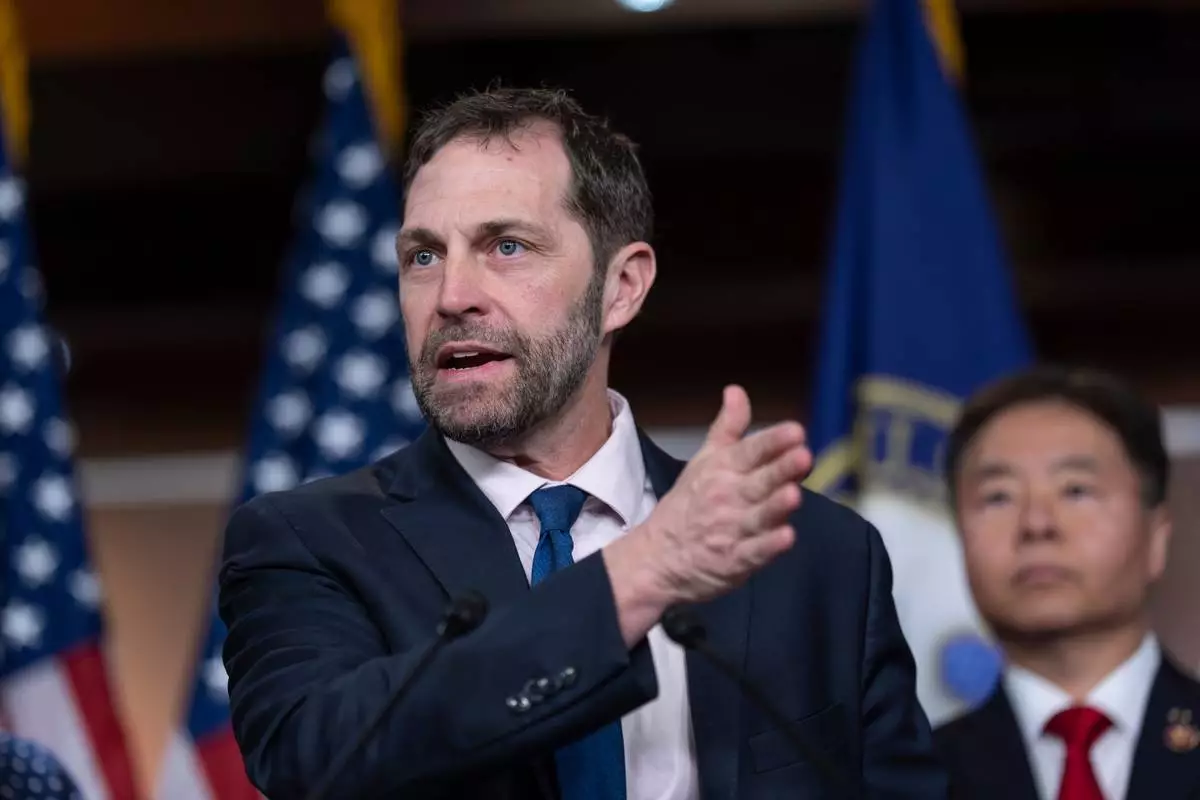
Rep. Jason Crow, D-Colo., a combat veteran, joins the House Democratic leadership in demanding a congressional approval for embarking on a war with Iran, during a news conference at the Capitol in Washington, Wednesday, March 4, 2026. (AP Photo/J. Scott Applewhite)
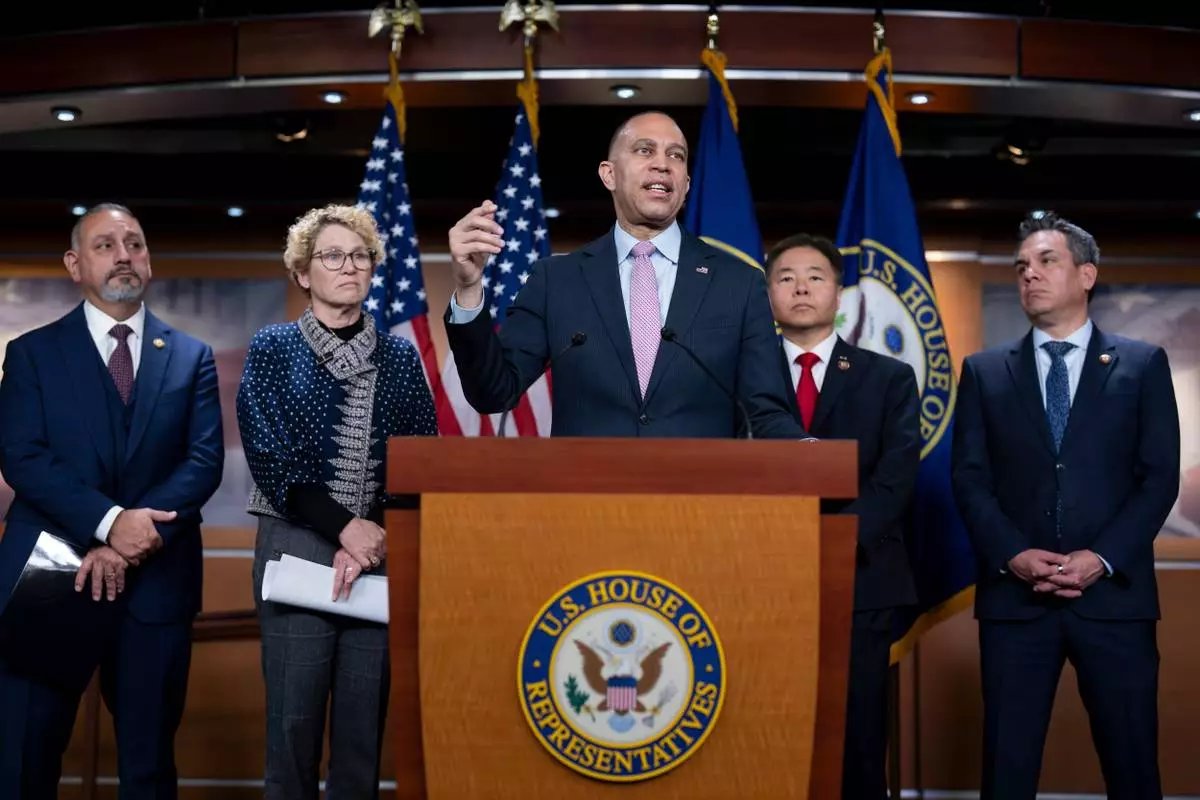
House Minority Leader Hakeem Jeffries, D-N.Y., and other Democrats, from left, Rep. Gil Cisneros, D-Calif., Rep. Chrissy Houlahan, D-Pa., Rep. Ted Lieu, D-Calif., and Rep. Pete Aguilar, D-Calif., demand congressional approval for embarking on a war with Iran, during a news conference at the Capitol in Washington, Wednesday, March 4, 2026. (AP Photo/J. Scott Applewhite)
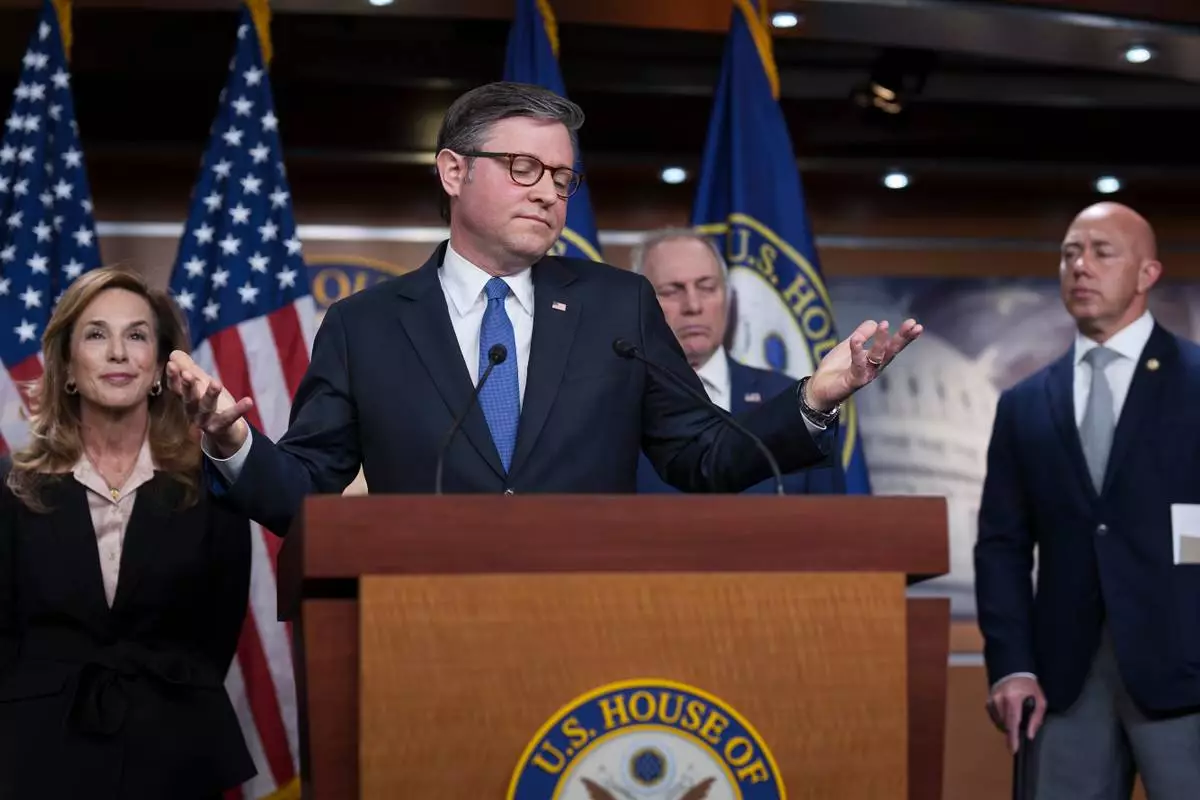
Speaker of the House Mike Johnson, R-La., gestures as he and the GOP leadership talk about the war against Iran, during a news conference at the Capitol in Washington, Wednesday, March 4, 2026. (AP Photo/J. Scott Applewhite)
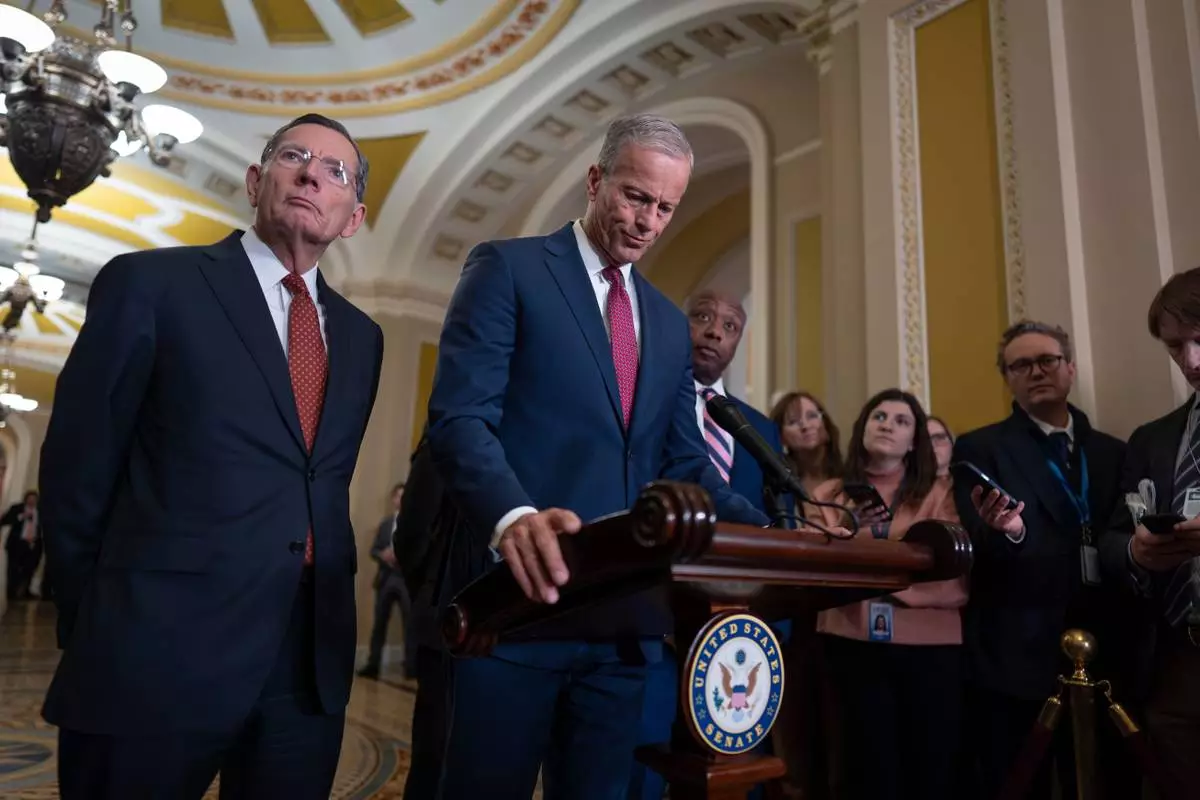
Senate Majority Leader John Thune, R-S.D., center, joined at left by Sen. John Barrasso, R-Wyo., the GOP whip, speaks to reporters at the Capitol in Washington, Tuesday, March 3, 2026. (AP Photo/J. Scott Applewhite)
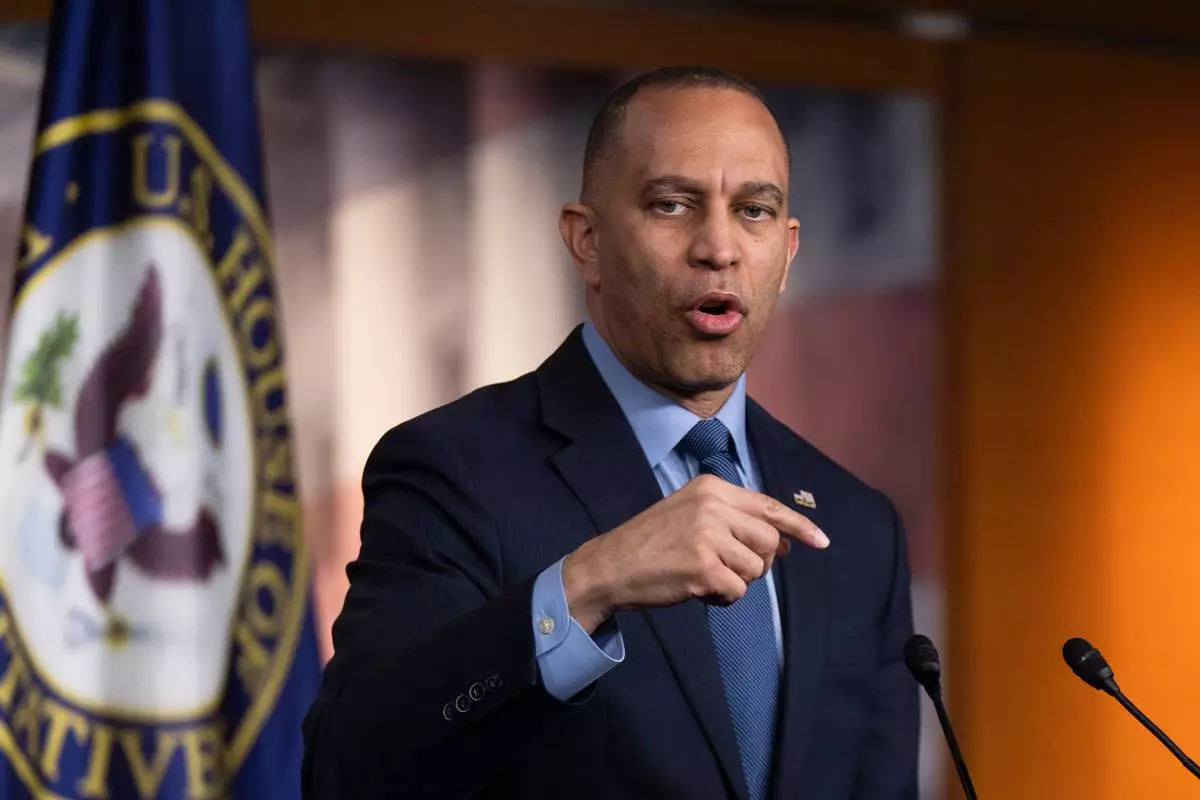
House Minority Leader Hakeem Jeffries, D-N.Y., speaks to reporters during a news conference on Capitol Hill in Washington, Tuesday, March 3, 2026. (AP Photo/Manuel Balce Ceneta)

Defense Secretary Pete Hegseth arrives for a briefing for lawmakers on Iran at a secure room in the basement of the Capitol in Washington, Tuesday, March 3, 2026. (AP Photo/J. Scott Applewhite)
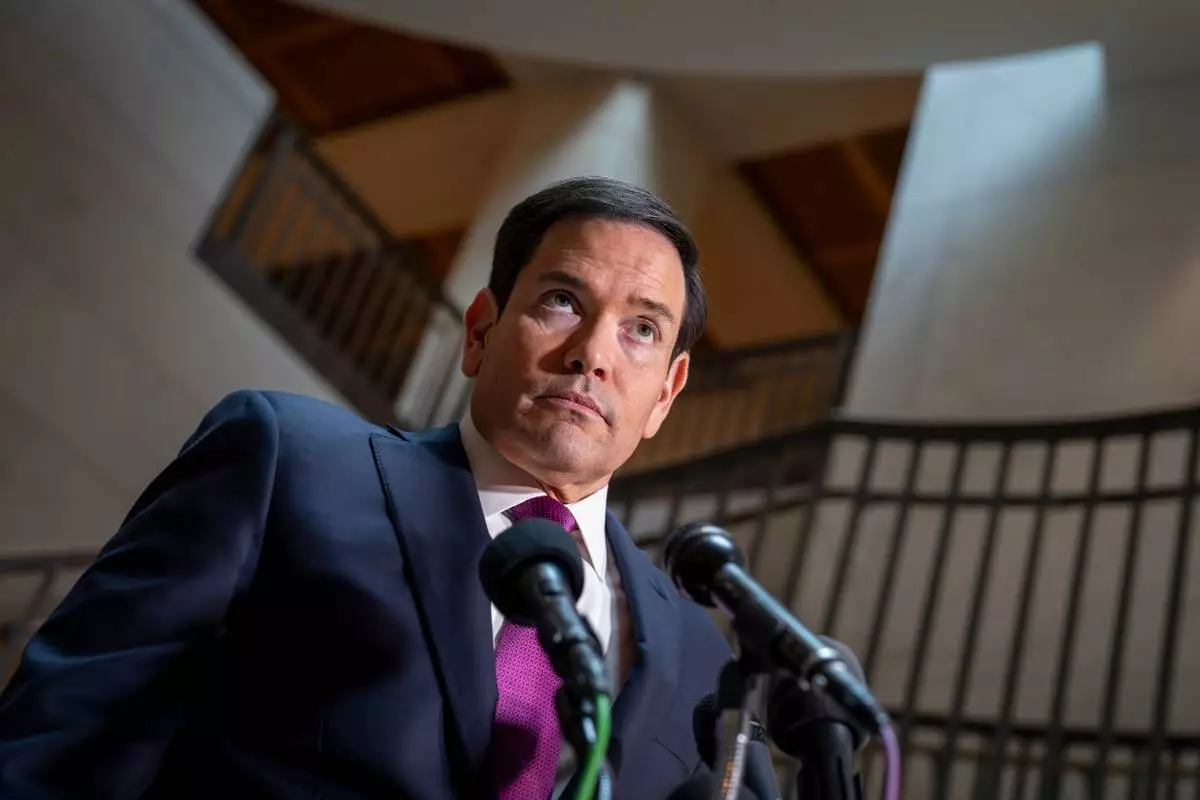
Secretary of State Marco Rubio speaks to reporters as he arrives for an intelligence briefing with top lawmakers on Iran, at the Capitol in Washington, Monday, Mar. 2, 2026. (AP Photo/J. Scott Applewhite)
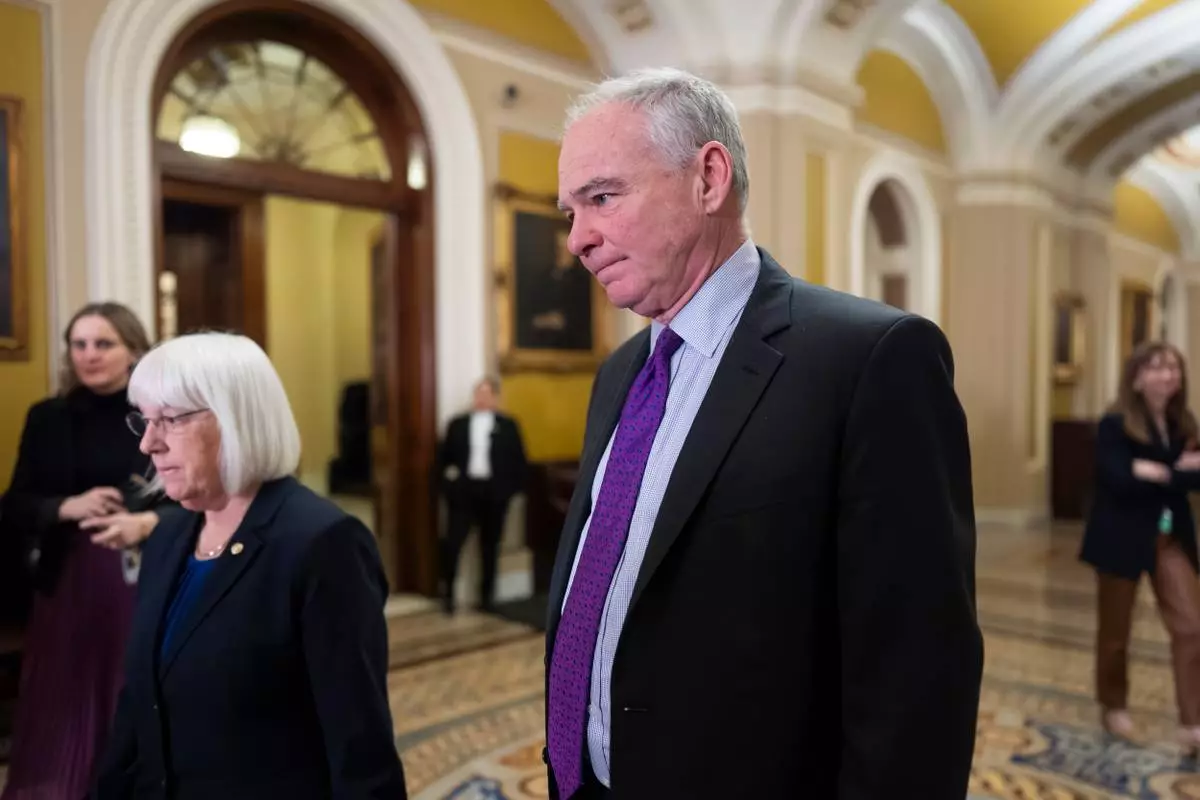
Sen. Tim Kaine, D-Va., center, and Sen. Patty Murray, D-Wash., left, arrive to speak with reporters at the Capitol in Washington, Tuesday, March 3, 2026. Kaine is leading an effort to advance a swift vote on a war powers resolution that would restrain President Donald Trump's military attack on Iran. (AP Photo/J. Scott Applewhite)
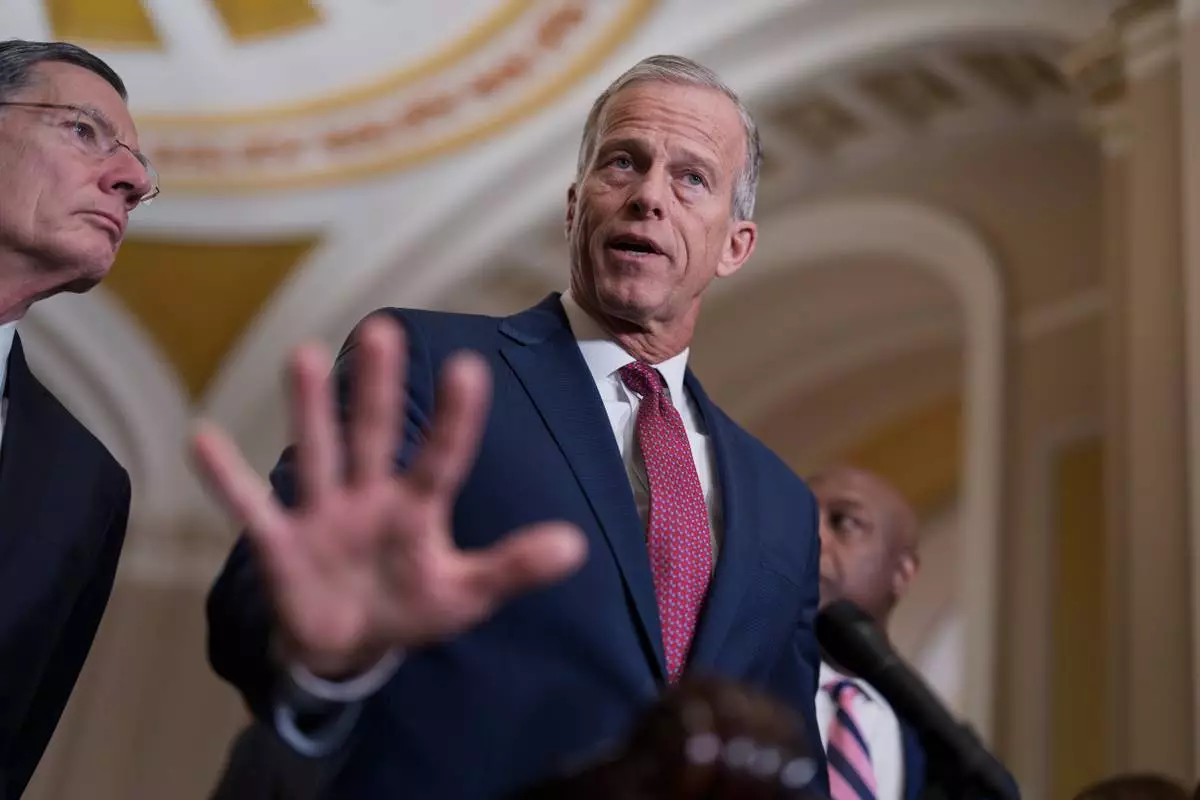
Senate Majority Leader John Thune, R-S.D., center, joined at left by Sen. John Barrasso, R-Wyo., the GOP whip, speaks to reporters at the Capitol in Washington, Tuesday, March 3, 2026. (AP Photo/J. Scott Applewhite)
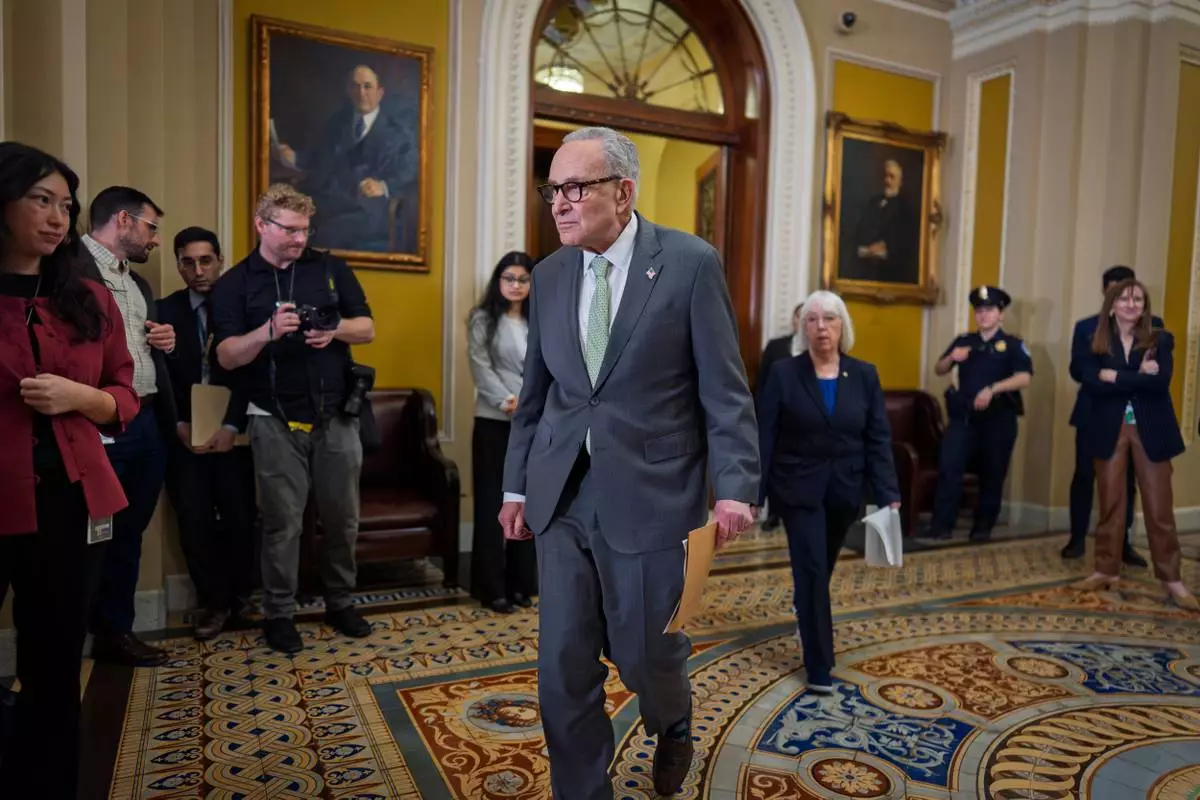
Senate Minority Leader Chuck Schumer, D-N.Y., arrives to speak with reporters at the Capitol in Washington, Tuesday, March 3, 2026. (AP Photo/J. Scott Applewhite)