Cadillac might just be the best-prepared new team in Formula 1 history.
The General Motors-backed team racked up the virtual miles in detailed race simulations last year and was reliable in preseason testing with its new car, named for Mario Andretti, even if it's likely to be fighting with struggling Aston Martin not to be last.
The rubber hits the road for real as the 11th team at the Australian Grand Prix on Sunday.
From a one-season wonder to a notorious disgrace, here is a look at some other debut seasons from F1 history for Cadillac to aspire to, or avoid:
Everyone starts somewhere. In the first world championship season, Ferrari was an emerging manufacturer in the shadow of Italian giants Alfa Romeo and Maserati. Alberto Ascari's second-place finish at the Monaco Grand Prix made a statement that Ferrari was serious. José Froilán González brought Ferrari its first win a year later and Ascari became the team's first champion in 1952. Ferrari is the only team to participate in every F1 season.
When F1 had so many teams that pre-qualifying was needed to trim the field, you needed something special to stand out. Team boss Eddie Jordan, who died last year at the age of 76, was a cult figure in F1 for his strong opinions and loud shirts, and handed future seven-time champion Michael Schumacher a debut after his regular driver was arrested. Schumacher qualified seventh, putting himself and Jordan on the map. The popular Irish team stayed on the grid, winning four races, until a 2005 sale.
F1 had slow teams like Life, which never got past pre-qualifying. It had short-lived teams like Mastercard Lola, which lasted one qualifying session. Andrea Moda still stands out. Its car, a years-old design, broke down regularly — once before leaving the pit lane — and was hopelessly slow. The team missed a race because its engines didn't arrive and another when its trucks were stuck in traffic, was accused by one driver of knowingly fitting damaged steering to his car and was eventually excluded from F1 mid-season.
F1's ultimate Cinderella story began when Honda wanted to shut down its team to save money as the global economy plummeted. Team principal Ross Brawn persuaded Honda to accept a management buyout for one pound. In a plain white car with almost no sponsors but with a game-changing “double diffuser” innovation that left other teams scrambling to copy it, Jenson Button won Brawn's first race in Australia. He held off Red Bull's Sebastian Vettel to take the championship in the team's first and only season. Brawn then sold his team to Mercedes and it has won eight more constructors' titles since.
American teams have a patchy history in F1. The last to win a race was Penske in 1976, while USF1 never even made the grid before running out of cash in 2010. That made it all the more surprising when the next U.S. entry, Haas, didn't just survive in F1, it celebrated sixth- and fifth-place finishes in its first two races with Romain Grosjean at the wheel. While Cadillac is building a new headquarters in Indiana, Haas bases much of its key operations in Europe, with close ties to Ferrari and a new partnership with Toyota.
AP auto racing: https://apnews.com/hub/auto-racing

FILE - New F1 Haas team drivers Esteban Gutierrez of Mexico, left, and Romain Grosjean of France pose during the official presentation of the new Ferrari-powered VF16 car at the Catalunya racetrack in Montmelo, just outside of Barcelona, Spain, Monday, Feb. 22, 2016. (AP Photo/Siu Wu, File)

FILE - In this July 6, 1952 file photo Alberto Ascari of Italy in action in a Ferrari at the French Grand Prix in Rouen. (AP Photo, File)

FILE - Brawn GP Formula One driver Jenson Button of Britain, right, BMW Sauber Formula One driver Nick Heidfeld of Germany celebrate during the award ceremony of the Malaysia Formula One Grand Prix at the Sepang racetrack in Kuala Lumpur, Sunday, April 5, 2009. (AP Photo/Eugene Hoshiko, File)
WASHINGTON (AP) — The U.S. Senate is headed toward a vote Wednesday on President Donald Trump's decision to embark on a war against Iran, an extraordinary test in Congress for a conflict that has rapidly spread across the Middle East with no clear U.S. exit strategy.
The legislation, known as a war powers resolution, gives lawmakers an opportunity to demand congressional approval before any further attacks are carried out. The Senate resolution and a similar bill being voted on in the House later this week face unlikely paths through the Republican-controlled Congress and would almost certainly be vetoed by Trump even if they were to pass.
Nonetheless, the votes marked a weighty moment for lawmakers. Their decisions on the five-day-old war — which Trump entered without congressional approval — could determine the fates of U.S. military members, countless other lives and the future of the region.
“Wars without clear objectives do not remain small. They get bigger, bloodier, longer and more expensive,” said Senate Democratic Leader Chuck Schumer at a news conference Tuesday. “This is not a necessary war. It’s a war of choice.”
After launching a surprise attack against Iran on Saturday, Trump has scrambled to win support for a conflict that Americans of all political persuasions were already wary of entering. Trump administration officials have been a frequent presence on Capitol Hill this week as they try to reassure lawmakers that they have the situation under control.
“We are not going to put American troops in harm’s way,” Secretary of State Marco Rubio told reporters in a raucous news conference at the Capitol on Tuesday.
But six U.S. military members were killed over the weekend in a drone strike in Kuwait.
Trump has also not ruled out deploying U.S. ground troops. He has said he is hoping to end the bombing campaign within a few weeks, but his goals for the war have shifted from regime change to stopping Iran from developing nuclear capabilities to crippling its navy and missile programs.
“I think they are achieving great success with what they've done so far,” Senate Majority Leader John Thune said Tuesday, adding that what happens next in the country will be “largely up to the Iranian people.”
Almost all Republican senators were readying to vote Wednesday against the war powers resolution to halt military action, but a number still expressed hesitation at the idea of troop deployments.
“I don’t think the American people want to see troops on the ground,” said Sen. Bill Cassidy, R-La., as he exited a classified briefing Tuesday. He added that Trump administration officials “left open that possibility,” but it wasn't an option they were emphasizing.
Republican Sen. Todd Young, who told reporters earlier this week he was undecided on the legislation, released a statement Wednesday morning saying that now that the U.S. has entered the war, the danger "will only grow if we limit the president's military options at this critical moment."
He called for lawmakers to conduct oversight and evaluate any requests from the administration for more wartime funding or authorities.
The votes in Congress this week represented potentially consequential markers of just where lawmakers stand on the war as they look ahead to midterm elections and the consequences of the conflict.
“Nobody gets to hide and give the president an easy pass or an end-run around the Constitution,” said Sen. Tim Kaine, the Virginia Democrat leading the war powers resolution. “Everybody's got to declare whether they're for this war or against it.”
Republican leaders have successfully, though narrowly, defeated a series of war powers resolutions pertaining to several other conflicts that Trump has entered or threatened to enter. This one, however, is different.
Unlike Trump's military campaigns against alleged drug boats or even Venezuelan leader Nicolás Maduro, the attack on Iran represents an open-ended conflict that is already ricocheting across the region. For Republicans who are used to operating in a political party dominated by Trump and his promises of keeping the U.S. out of foreign entanglements, the moment represented a bit of whiplash.
“War is ugly, it always has been ugly, but we're taking out a regime that has been trying to attack us for quite some time,” said Sen. Markwayne Mullin, an Oklahoma Republican.
Meanwhile, Sen. Lindsey Graham, a South Carolina Republican who has long pushed Trump to engage overseas, argued that the widening conflict represented an opportunity for Arab and European countries to join in the fight against Iran and the militant groups it supports.
“I don’t mind people being on record as to whether or not they think this is a good idea,” he told reporters, but also argued that too much power over the military was ceded to Congress in the War Powers Act, which mandates that presidents must withdraw troops from a conflict within 90 days if there is no congressional authorization.
On the other side of the Capitol, House leaders were also readying for an intense debate over the war followed by a vote Thursday.
"I do believe we have the votes to defeat it, I certainly hope we do,” House Speaker Mike Johnson said after an all-member briefing on Tuesday night.
Meanwhile, House Democratic leader Hakeem Jeffries said he expected a strong showing from Democrats in favor of the war powers resolution.
As lawmakers emerged from a closed-door briefing Tuesday night, Rep. Gregory Meeks, the top Democrat on the House Foreign Affairs Committee, implored the Trump administration to “come to Congress” and speak directly to the American people about the rationale for the war.
His voice filled with emotion as he said, "Our young men and women's lives are on the line."
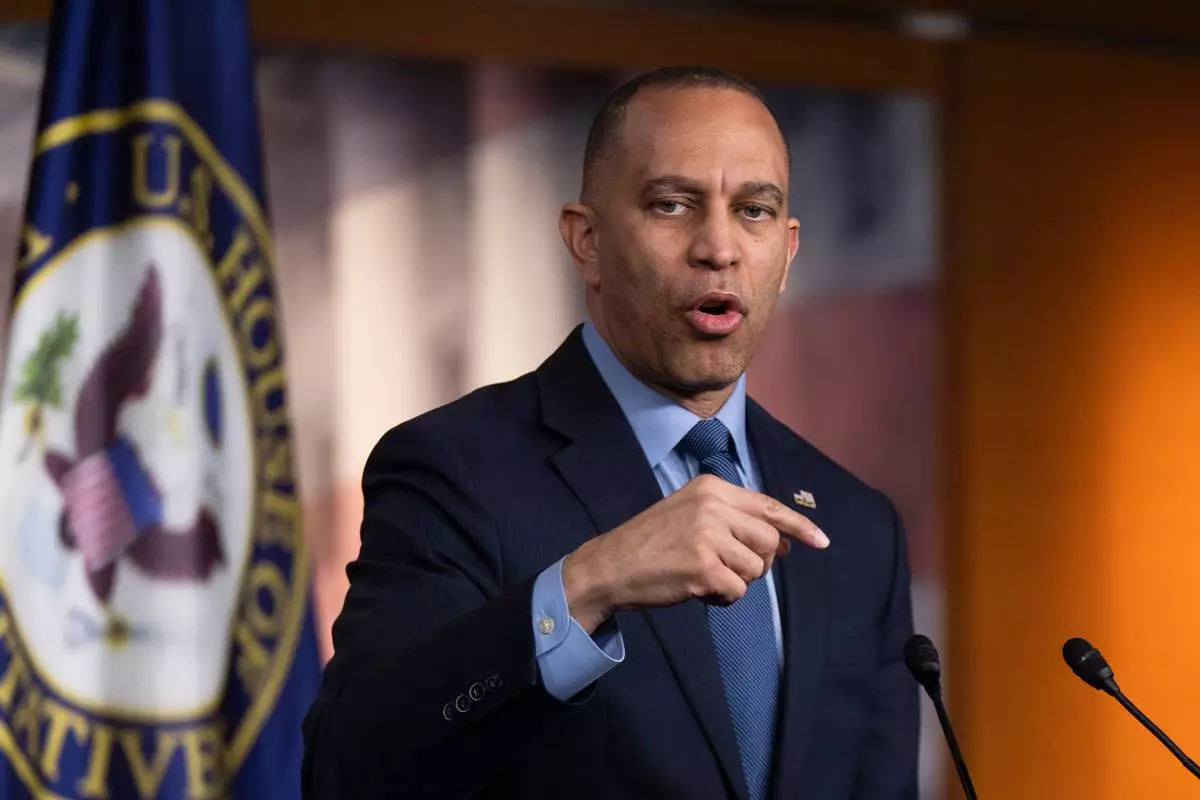
House Minority Leader Hakeem Jeffries, D-N.Y., speaks to reporters during a news conference on Capitol Hill in Washington, Tuesday, March 3, 2026. (AP Photo/Manuel Balce Ceneta)

Defense Secretary Pete Hegseth arrives for a briefing for lawmakers on Iran at a secure room in the basement of the Capitol in Washington, Tuesday, March 3, 2026. (AP Photo/J. Scott Applewhite)
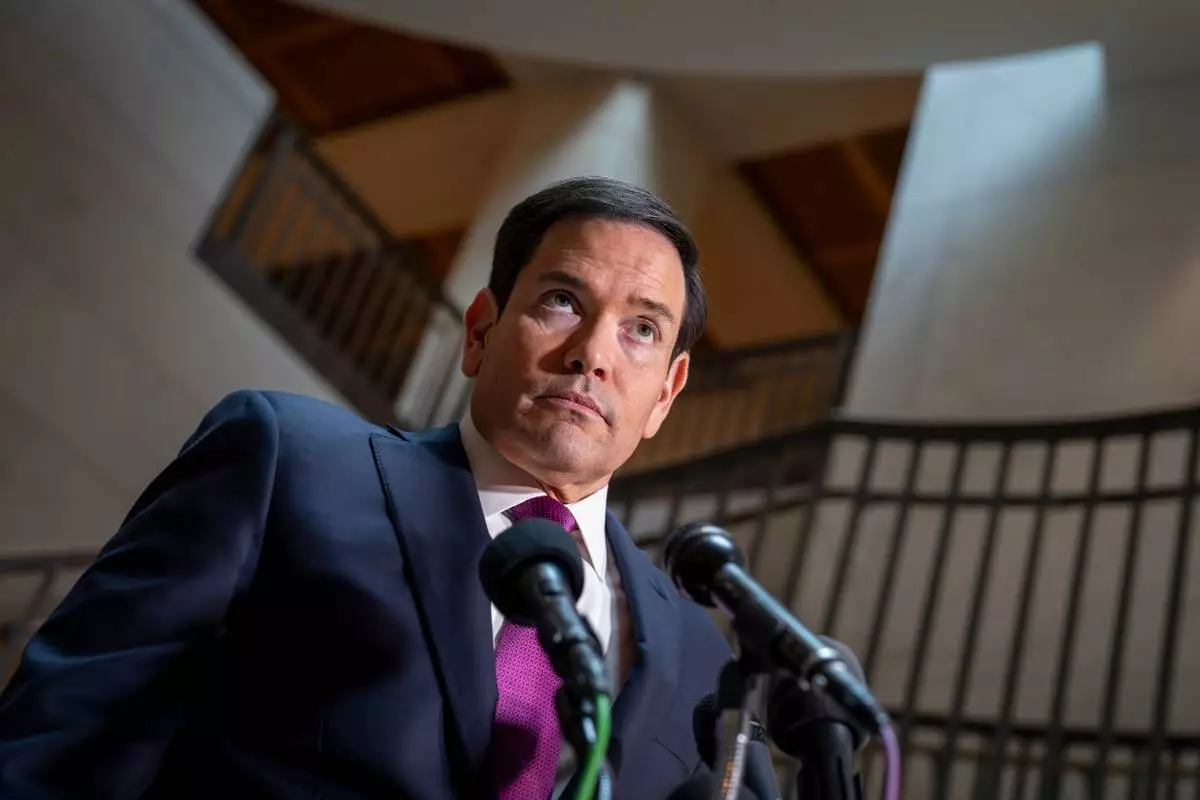
Secretary of State Marco Rubio speaks to reporters as he arrives for an intelligence briefing with top lawmakers on Iran, at the Capitol in Washington, Monday, Mar. 2, 2026. (AP Photo/J. Scott Applewhite)
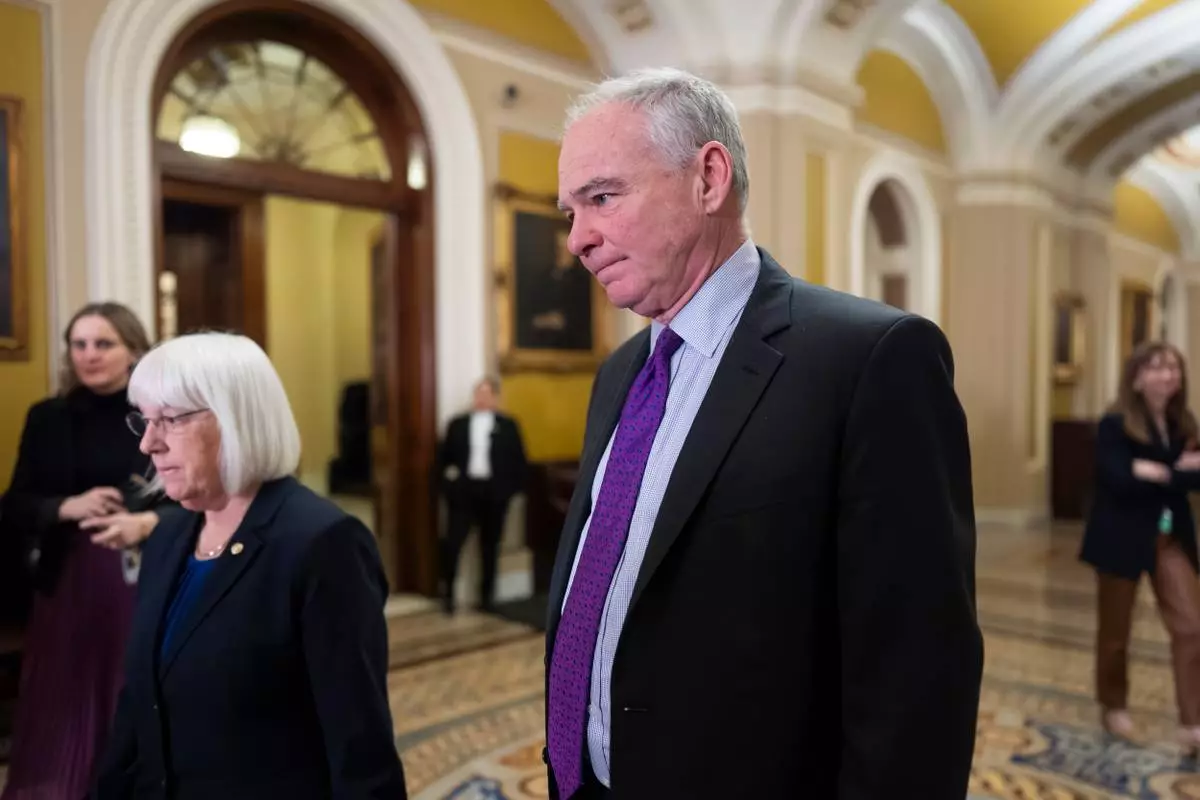
Sen. Tim Kaine, D-Va., center, and Sen. Patty Murray, D-Wash., left, arrive to speak with reporters at the Capitol in Washington, Tuesday, March 3, 2026. Kaine is leading an effort to advance a swift vote on a war powers resolution that would restrain President Donald Trump's military attack on Iran. (AP Photo/J. Scott Applewhite)
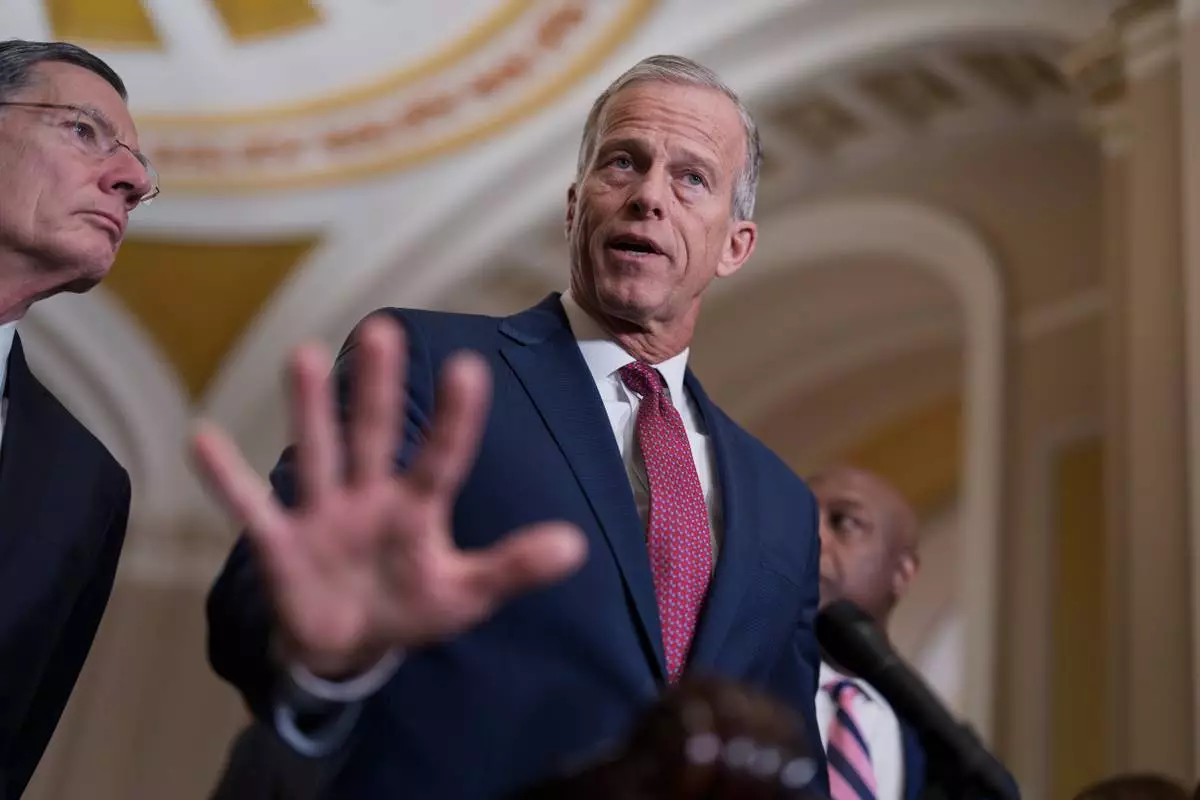
Senate Majority Leader John Thune, R-S.D., center, joined at left by Sen. John Barrasso, R-Wyo., the GOP whip, speaks to reporters at the Capitol in Washington, Tuesday, March 3, 2026. (AP Photo/J. Scott Applewhite)
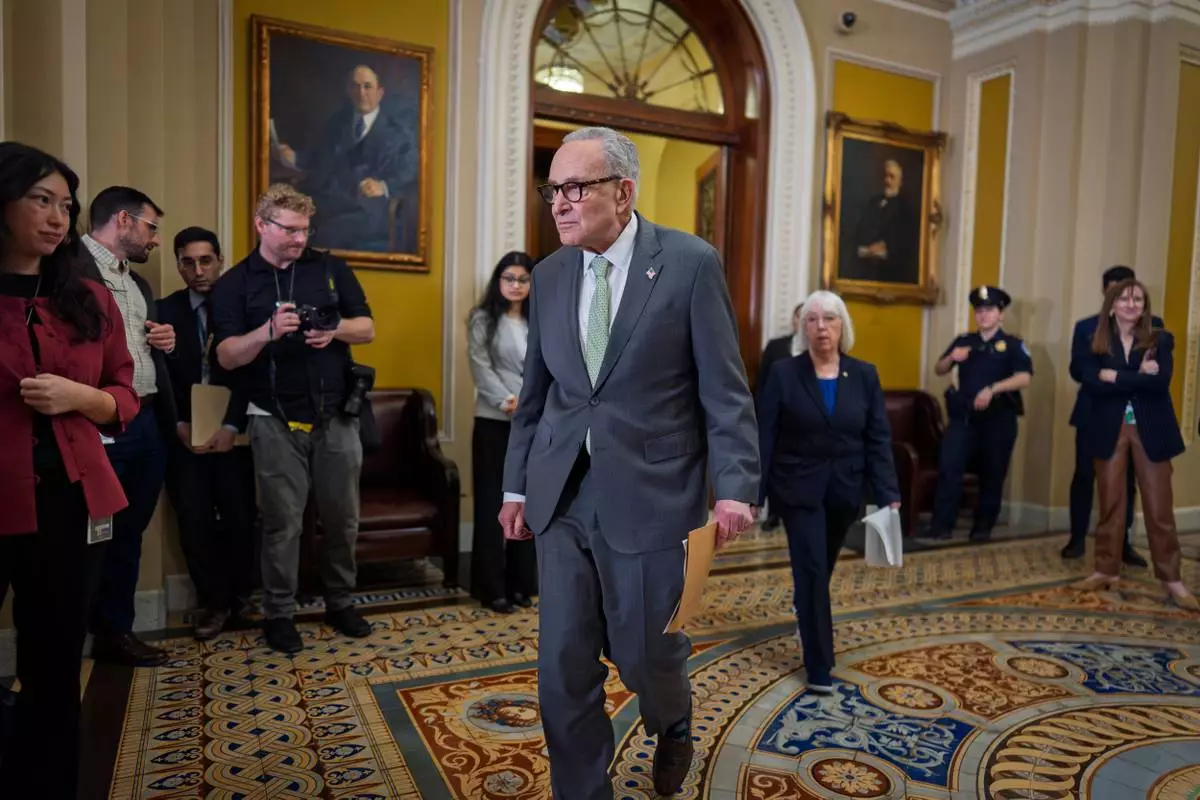
Senate Minority Leader Chuck Schumer, D-N.Y., arrives to speak with reporters at the Capitol in Washington, Tuesday, March 3, 2026. (AP Photo/J. Scott Applewhite)