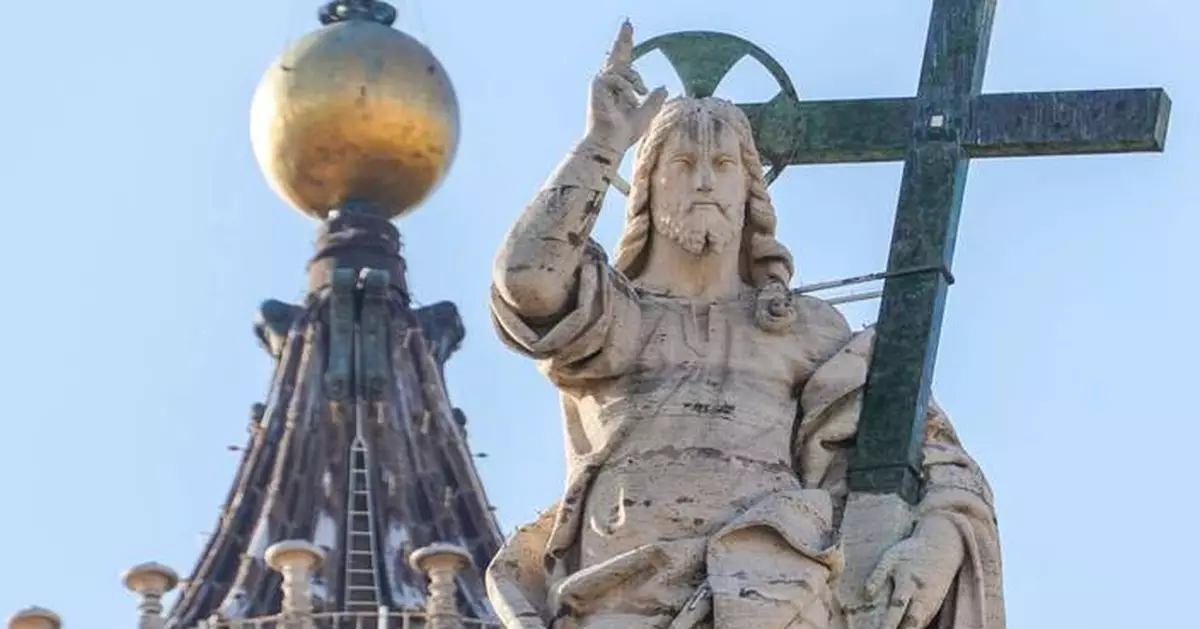
On its own, the phrase “Christ is king” sums up a core tenet of the Christian faith, that Jesus is the divine ruler of the universe. Catholics and many Protestants celebrate a Christ the King Sunday each year.
But the ancient proclamation can morph into something political, controversial or even sinister, depending on who says it and how it’s said.
In recent years, “Christ is king” and similar phrases have been chanted at political rallies, posted on social media and proclaimed in speeches by voices on the right.
At times the phrase is used to support the notion of America as a Christian nation or as one that owes its allegiance specifically to the Christian God. Some current Cabinet officials and recent members of Congress have used the phrase in speeches and on social media.
But other times, political activists have paired “Christ is king” with anti-Zionist statements or negative Jewish stereotypes.
The phrase has gained popularity among far-right figures and their followers. Conservative influencer Candace Owens, who shares antisemitic conspiracies, sells branded “Christ is King” coffee mugs and T-shirts.
The controversy connects to a larger schism on the right, with some conservatives pushing back against an increasingly vocal faction whose denunciations of Israel, critics say, often combine with blatant antisemitism. Some of the latter group insist they’re not antisemitic, just anti-Zionist. That itself is a sharp break from what was once a near-consensus of pro-Israel sentiment among Republicans.
But there are times when the use of the phrase “Christ is king” is unquestionably hostile toward Jews, said a 2025 report by the Rutgers University-affiliated Network Contagion Research Institute.
Analyzing social media postings between 2021 and 2024, the institute reported a dramatic increase of the phrase “Christ is king,” often used as a hate meme targeting Jews. The report lamented this deviation from its historical use as a hopeful, sacred affirmation with biblical roots.
“The weaponization or hijacking of 'Christ is King’ represents a disturbing inversion of its original intent. Rather than sacralizing shared values, extremists have exploited this religious expression to justify hatred,” the report said.
A recent meeting of the Religious Liberty Commission, a group President Donald Trump created and appointed, put the phrase and related controversies in the spotlight.
At a Feb. 9 hearing focused on antisemitism, a witness, Seth Dillon, spoke of often hearing people use the phrase “Christ is king” followed immediately by a highly contemptuous slur toward Jews.
“This should offend every Christian,” said Dillon, the CEO of the conservative satirical site The Babylon Bee.
Commission member Carrie Prejean Boller repeatedly grilled witnesses about whether opposing Zionism could be construed as anti-Jewish. She said that as a Catholic she opposes Zionism but that this is not antisemitic. She asked Dillon if he thought “saying ‘Christ is king’ is antisemitic.”
Dillon said no and that, as a Christian, he regularly declares that “Christ is my king” — but context matters.
He testified that the phrase has been co-opted by Groypers, alluding to the followers of far-right influencer Nick Fuentes, who has spread antisemitic views.
It's “using the Lord’s name in an abusive manner,” Dillon said.
Fuentes’ supporters chanted “Christ is king” at the Million MAGA March, a November 2020 rally denying the Republican Trump’s defeat to Democrat Joe Biden in that year’s presidential election.
Texas Lt. Gov. Dan Patrick, a Republican who chairs the Religious Liberty Commission, announced Prejean Boller's removal from the panel after the meeting. He asserted that she tried to “hijack” the hearing for her own agenda.
Following the commission meeting, Prejean Boller has posted prolifically on X, denouncing “Zionist supremacists” and repeatedly using the phrase “Christ is King.” She also has denounced the war launched by the U.S. and Israel against Iran.
A recent Catholic convert, she said she opposes a popular evangelical view that modern-day Israel exists in fulfillment of biblical prophecy.
The commission hearing was hardly the first forum to air controversy over “Christ is king.”
The Network Contagion Research Institute’s 2025 report noted that while many “Christ is king” references on social media are strictly religious, the phrase has been “systematically co-opted by extremist figures.”
The report said Fuentes and other extremists use the phrase as a “white supremacist mantra publicizing their antisemitic beliefs.”
Fuentes has said the Holocaust was exaggerated, and he has denounced “organized Jewry in America.” He has claimed to be in battle with “satanic, globalist elites,” an antisemitic trope.
The religious phrase “Christ is king” is not inherently political, said Brian Kaylor, president and editor-in-chief of Word&Way, a progressive site covering faith and politics.
But that fact provides a “deniability” to those politicizing it, he said.
“We’re at a dangerous point with the phrase ‘Christ is king’ because of the heavy activity and use of it on the far right in very fascist, antisemitic ways,” said Kaylor, a Baptist minister and author of several books on religion and politics. “We’re at the danger of that phrase losing its meaning to where this new antisemitic use is the dominant definition.”
The phrase has also gained popularity in political settings with some on the Catholic and evangelical right who are strongly pro-Israel and have repeatedly denounced antisemitism, such as Defense Secretary Pete Hegseth and Secretary of State Marco Rubio.
Kaylor said the phrase is often used as “a declaration of Christian nationalism ” asserting that “the nation should be brought under the dictates of Christ.”
The controversy has highlighted both religious and political fissures.
The Vatican has diplomatic relations with Israel and has also recognized a state of Palestine. Pope Leo XIV has called for a two-state solution while denouncing antisemitism. During the Israel-Hamas war, popes Francis and Leo denounced the Oct. 7, 2023, attacks by Hamas and Israel’s massive military response, with Leo demanding a halt to Israel’s “collective punishment” of Gaza’s population.
Other Catholics on the Religious Liberty Commission noted that Jesus and his followers were Jews and that a seminal 1965 Vatican document rejects antisemitism and the blaming of all Jews, including those alive today, for Jesus’ crucifixion.
Patrick, the commission chairman, said the dispute with Prejean Boller reflects “a real problem with a very small group in our Republican Party.” Antisemitism needs to be repudiated or “this is going to destroy our party,” he said on “The Mark Levin Show,” a podcast.
But Prejean Boller has galvanized supporters from a staunchly conservative group called Catholics for Catholics, a lay-led, self-described “militant organization dedicated to the evangelization of this great country.”
It plans to honor Prejean Boller at a March 19 event with a Catholic Champion Award in Washington featuring speakers such as Owens.
Prejean Boller has reposted announcements of the event on X, including one post that shared a Spanish-language statement that translates to “We will not rest until we convert the USA into a Catholic nation.” The post concluded in English with “Christ is King!”
Associated Press religion coverage receives support through the AP’s collaboration with The Conversation US, with funding from Lilly Endowment Inc. The AP is solely responsible for this content.
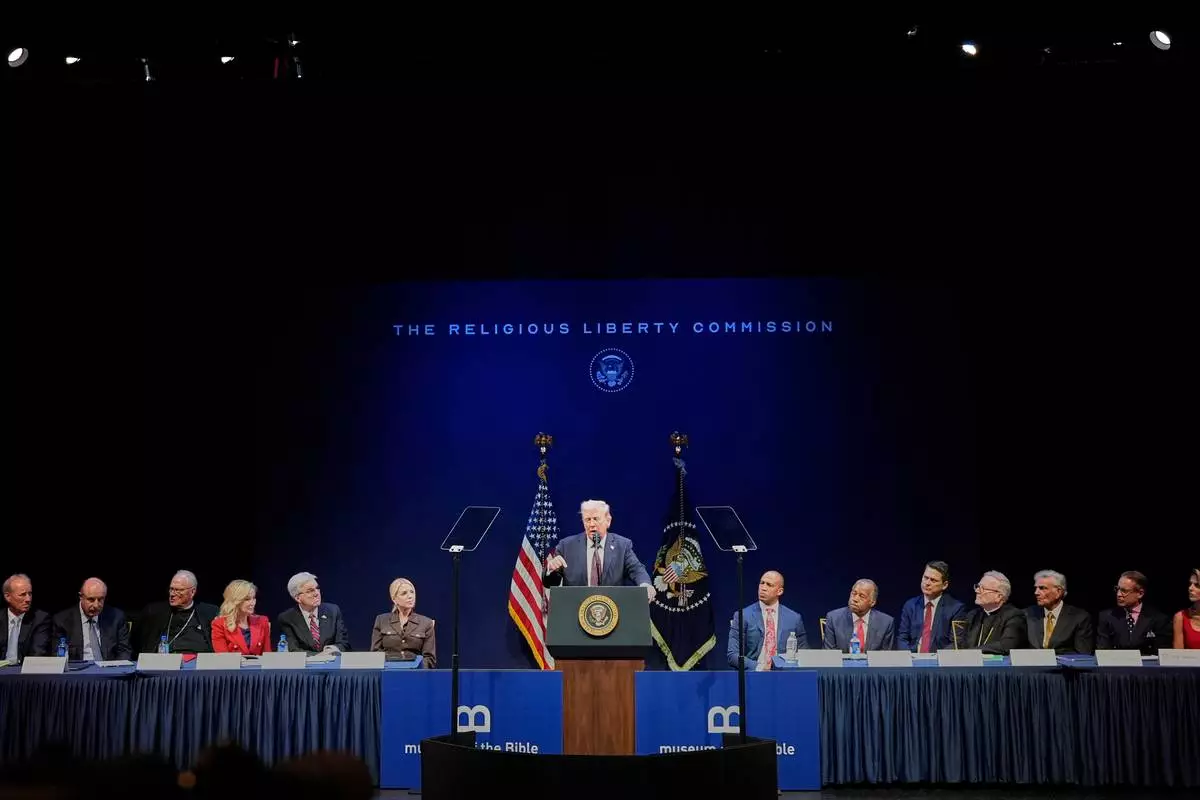
FILE - President Donald Trump speaks at a hearing of the Religious Liberty Commission at the Museum of the Bible, Sept. 8, 2025, in Washington. (AP Photo/Alex Brandon, File)
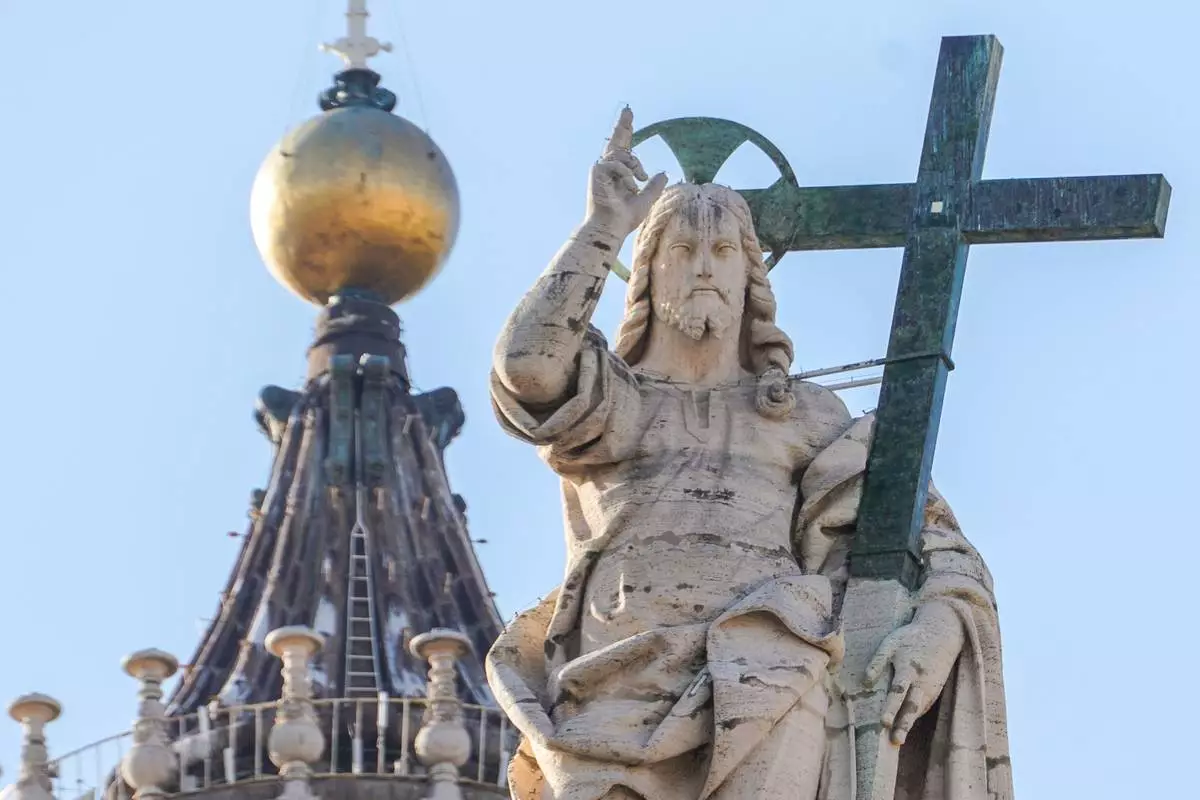
FILE - A statue of Jesus Christ on the facade of St. Peter's Basilica at the Vatican, Nov. 10, 2020. (AP Photo/Andrew Medichini, File)