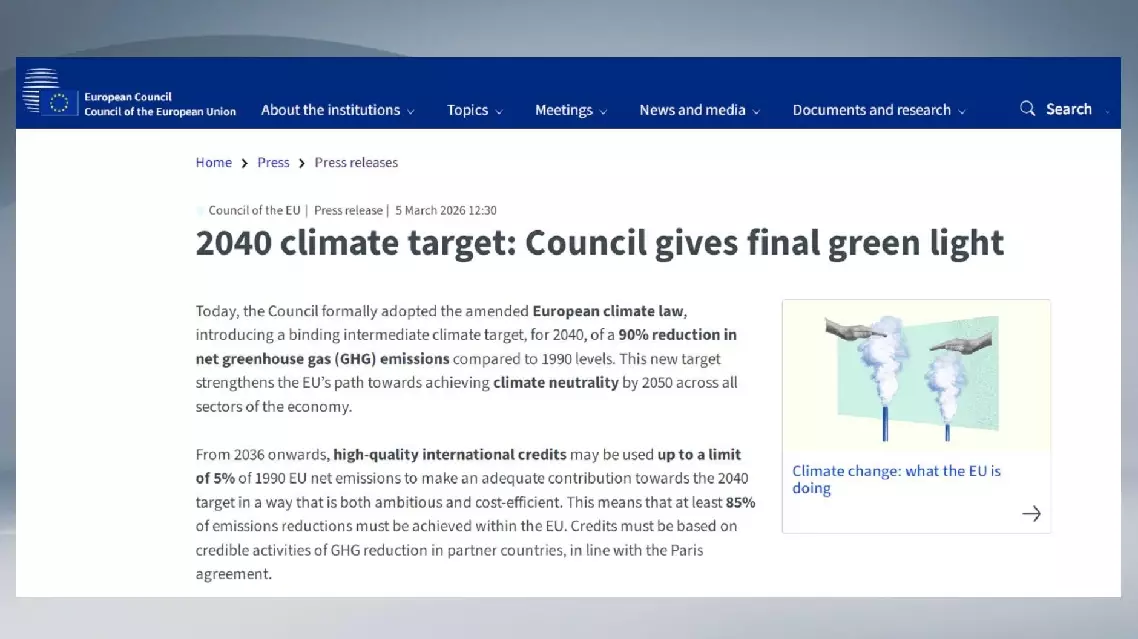
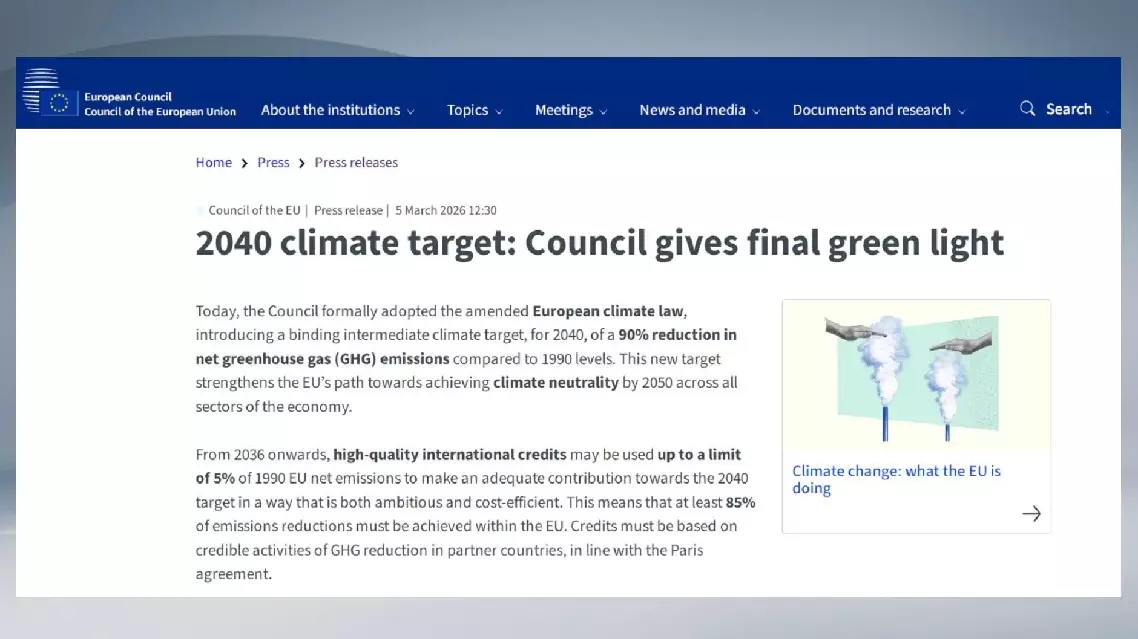
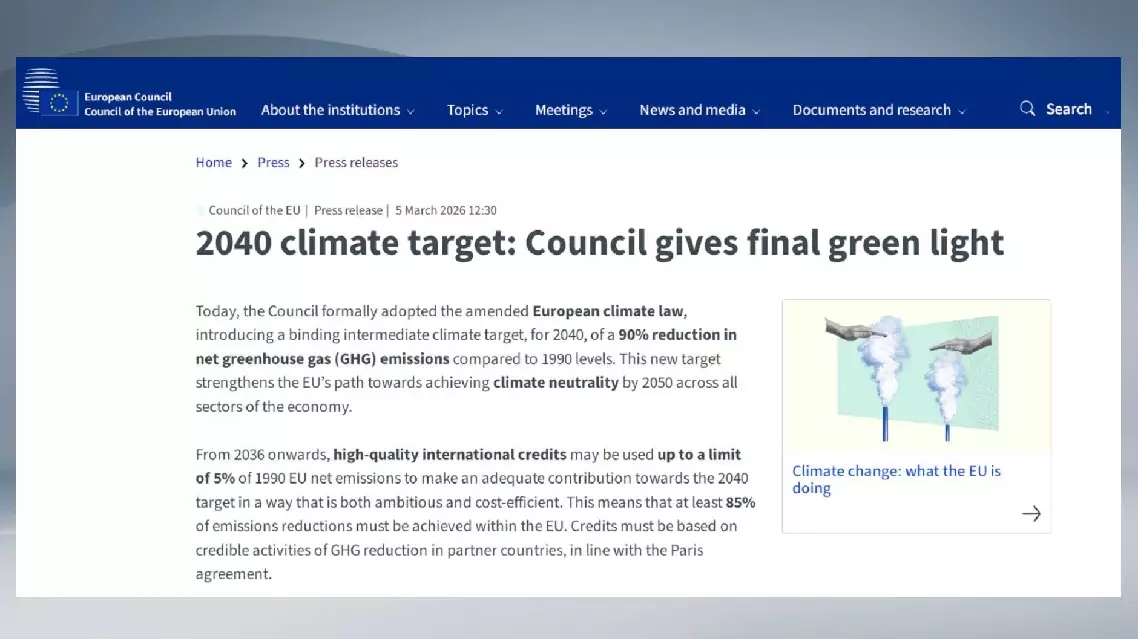
European Union (EU) countries gave final approval on Thursday to an amendment of the European Climate Law, setting a binding intermediate target to cut the bloc's net greenhouse gas emissions by 90 percent by 2040 compared with 1990 levels, reinforcing the EU's path toward climate neutrality by 2050.
Under the amended law, from 2036 EU member states will be allowed to count "high-quality international credits" towards meeting the 2040 target, capped at 5 percent of the EU's 1990 net emissions. This means at least 85 percent of the emissions reductions must be achieved within the bloc, the Council of the EU said in a statement.
The credits must be based on credible greenhouse gas reduction activities in partner countries and be aligned with the Paris Agreement, the statement added.
The amended law also delays the launch of the EU's emissions trading system covering road transport, buildings and other sectors, shifting its start date from 2027 to 2028.
The adoption of the amendment marks the final step in the legislative process. The amended regulation will enter into force 20 days after its publication in the Official Journal of the EU and will apply directly across all EU member states.
The European Climate Law was first adopted in 2021, setting a legally binding target of climate neutrality by 2050 and a 2030 goal to cut net emissions by at least 55 percent from 1990 levels.
EU countries approves 2040 target to cut net emissions by 90 pct
EU countries approves 2040 target to cut net emissions by 90 pct
EU countries approves 2040 target to cut net emissions by 90 pct
China's development has never been a "threat" to anyone but the source of growth advancing common development of all countries, Foreign Ministry spokesman Lin Jian said at a regular press conference in Beijing on Friday.
Some Western media and think tanks are peddling so-called "China Shock 2.0," saying that "China is achieving fast development in high-tech sectors such as renewable energy and AI and relies on foreign markets to absorb its overcapacity, thus reducing the market share of developed countries and sending more serious shock waves to the global economy compared with the era of traditional manufacture industry," while there are foreign commentators saying that the "China Shock 2.0" argument ignores the genuine innovation occurring within the Chinese industrial ecosystem and that Chinese export is the exact booster of the global economy that is needed in the turbulent period and more indispensable than ever.
Commenting on that, Lin said: "From the world's factory to the world's market and innovation powerhouse, China's development is achieved through strong performance driven by innovation and brings tangible cooperation opportunities and space to the world. High-quality Chinese products represented by the 'old three' of textiles, furniture and home appliances have stabilized the global industrial and supply chain, lowered the living cost of global consumers and eased the inflationary pressure worldwide. China's green production capacity represented by the 'new three' of electric vehicles, batteries and solar panels has bridged the gap between supply and demand in global green development and bolstered the global energy transition and low-carbon development. Moreover, China's high-tech products represented by the 'new new three' of robots, AI and innovative drugs have broken high-tech barriers and monopoly and enabled people in more countries to access affordable new technologies," said the spokesman.
"Openness and cooperation bring about progress and win-win result. China's development has never been a 'threat' to anyone but the source of growth advancing common development of all countries. What really creates 'shocks' to the world has never been the innovation of Chinese companies and efficiency of Chinese industrial capacity, but protectionist moves of setting up barriers, decoupling and severing industrial and supply chains. China will stay committed to high-standard opening up, defend the multilateral trading system and provide more certainty and new impetus to the world economy with its own steady development," said Lin.
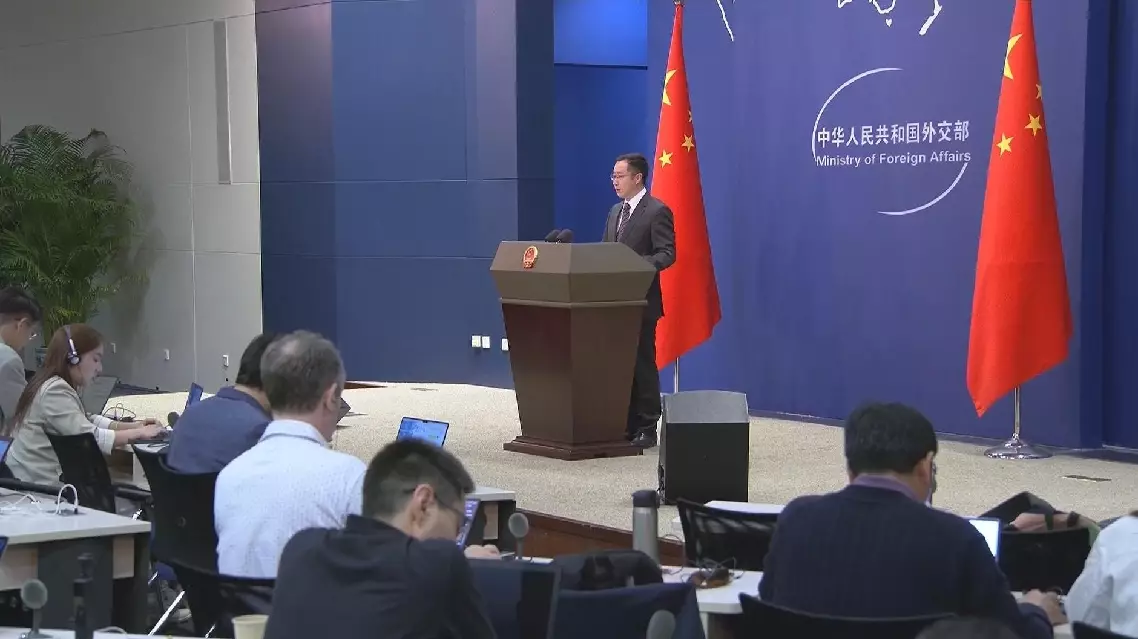
China's development never a threat: FM spokesman