
Skip to Content Facebook Feature Image

Pentagon says it is labeling AI company Anthropic a supply chain risk 'effective immediately'

News

Pentagon says it is labeling AI company Anthropic a supply chain risk 'effective immediately'
News

News

Pentagon says it is labeling AI company Anthropic a supply chain risk 'effective immediately'

2026-03-06 09:31 Last Updated At:09:40

The Trump administration is following through with its threat to designate artificial intelligence company Anthropic as a supply chain risk in an unprecedented move that could force other government contractors to stop using the AI chatbot Claude.

The Pentagon said in a statement Thursday that it has “officially informed Anthropic leadership the company and its products are deemed a supply chain risk, effective immediately.”

The decision appeared to shut down the opportunity for further negotiation with Anthropic, nearly a week after President Donald Trump and Defense Secretary Pete Hegseth accused the company of endangering national security.

Trump and Hegseth announced a series of threatened punishments last Friday, on the eve of the Iran war, after Anthropic CEO Dario Amodei refused to back down over concerns the company’s products could be used for mass surveillance of Americans or autonomous weapons.

Amodei said in a statement Thursday that “we do not believe this action is legally sound, and we see no choice but to challenge it in court.”

The Pentagon statement said, "this has been about one fundamental principle: the military being able to use technology for all lawful purposes. The military will not allow a vendor to insert itself into the chain of command by restricting the lawful use of a critical capability and put our warfighters at risk.“

Amodei countered that the narrow exceptions Anthropic sought to limit surveillance and autonomous weapons “relate to high-level usage areas, and not operational decision-making.”

He said “productive conversations” continued this week with the Pentagon over whether it could keep using Claude or establish a “smooth transition” if no agreement was reached. Trump gave the military six months to phase out Claude, which is already widely embedded in military and national security platforms. Amodei said it’s a priority to make sure warfighters won’t be “deprived of important tools in the middle of major combat operations.”

Some military contractors were already cutting ties with Anthropic, a rising star in the tech industry that sells Claude to a variety of businesses and government agencies. Lockheed Martin said it will “follow the President’s and the Department of War’s direction” and look to other providers of large language models.

“We expect minimal impacts as Lockheed Martin is not dependent on any single LLM vendor for any portion of our work,” the company said.

It's not yet clear if the designation aims to block Anthropic's use by all federal government contractors or just those that partner with the military. Amodei said a notification Anthropic received from the Defense Department on Wednesday shows it only applies to Claude's use by customers as a “direct part of” their military contracts.

The Pentagon's decision to apply a rule designed to address supply threats posed by foreign adversaries was quickly met with criticism from both opponents and some supporters of Trump's Republican administration. Federal codes have defined supply chain risk as a “risk that an adversary may sabotage, maliciously introduce unwanted function, or otherwise subvert” a system in order to disrupt, degrade or spy on it.

U.S. Sen. Kirsten Gillibrand, a New York Democrat and member of the Senate Armed Services Committee and Senate Intelligence Committee, called it “a dangerous misuse of a tool meant to address adversary-controlled technology.”

“This reckless action is shortsighted, self-destructive, and a gift to our adversaries,” she said in a written statement Thursday.

Neil Chilson, a Republican former chief technologist for the Federal Trade Commission who now leads AI policy at the Abundance Institute, said the decision looks like “massive overreach that would hurt both the U.S. AI sector and the military’s ability to acquire the best technology for the U.S. warfighter.”

Earlier in the day, a group of former defense and national security officials sent a letter to U.S. lawmakers expressing “serious concern” about the designation.

“The use of this authority against a domestic American company is a profound departure from its intended purpose and sets a dangerous precedent,” said the letter from former officials and policy experts, including former CIA director Michael Hayden and retired Air Force, Army and Navy leaders.

They added that such a designation is meant to “protect the United States from infiltration by foreign adversaries — from companies beholden to Beijing or Moscow, not from American innovators operating transparently under the rule of law. Applying this tool to penalize a U.S. firm for declining to remove safeguards against mass domestic surveillance and fully autonomous weapons is a category error with consequences that extend far beyond this dispute.”

While losing its big partnerships with defense contractors, Anthropic experienced a surge of consumer downloads over the past week due to people siding with its moral stance. Anthropic has boasted of more than a million people signing up for Claude each day this week, lifting it past OpenAI's ChatGPT and Google's Gemini as the top AI app in more than 20 countries in Apple's app store.

The dispute with the Pentagon has also further deepened Anthropic's bitter rivalry with OpenAI that started when ex-OpenAI leaders, including Amodei, started Anthropic in 2021.

Hours after the Pentagon punished Anthropic last Friday, OpenAI announced a deal to effectively replace Anthropic with ChatGPT in classified military environments.

OpenAI said it sought similar protections against domestic surveillance and fully autonomous weapons but later had to amend its agreements, leading CEO Sam Altman to later say he shouldn't have rushed a deal that “looked opportunistic and sloppy.”

Amodei also expressed regret about his own part in that “difficult day for the company,” saying Thursday he wanted to “directly apologize” for an internal note he sent to Anthropic staff that attacked OpenAI's behavior and suggested Anthropic was being punished for not giving ”dictator-like praise" to Trump.
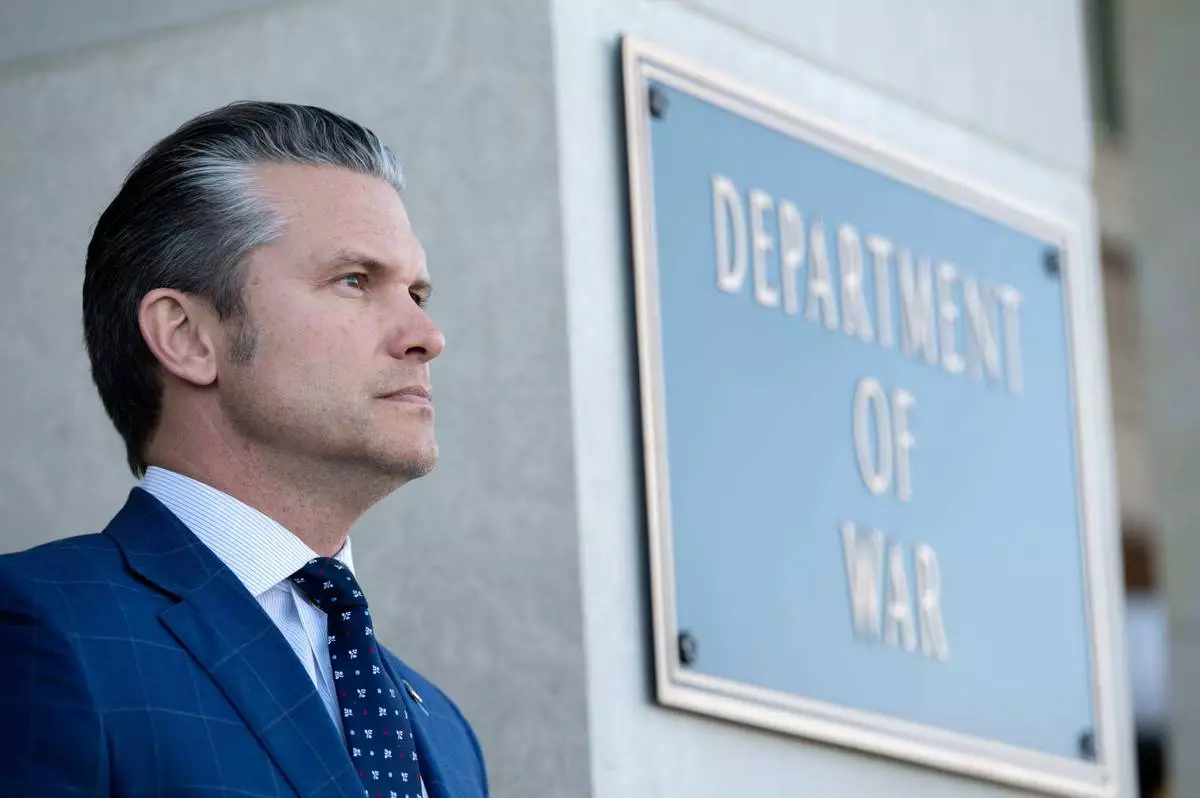
FILE - Defense Secretary Pete Hegseth stands outside the Pentagon during a welcome ceremony for the Japanese defense minister at the Pentagon in Washington, Jan. 15, 2026. (AP Photo/Kevin Wolf, File)

FILE - Defense Secretary Pete Hegseth stands outside the Pentagon during a welcome ceremony for the Japanese defense minister at the Pentagon in Washington, Jan. 15, 2026. (AP Photo/Kevin Wolf, File)

Pages from the Anthropic website and the company's logo are displayed on a computer screen in New York on Thursday, Feb. 26, 2026. (AP Photo/Patrick Sison)


Pages from the Anthropic website and the company's logo are displayed on a computer screen in New York on Thursday, Feb. 26, 2026. (AP Photo/Patrick Sison)

WASHINGTON (AP) — President Donald Trump's proposed White House ballroom is “ugly,” “grossly out of scale” and a “gold gilded edifice to one man's ego,” according to members of the public who oppose the project and got a chance to speak their minds Thursday to a federal panel that's reviewing it.

Others characterized the project as an “invitation for corruption” because Trump said he'll pay for it with money donated by rich people and corporations, some of which do business with the federal government. And a few people suggested to the National Capital Planning Commission that the Republican president build the ballroom underground if he wants one so badly.

The public's overwhelmingly negative assessment appeared to be a minor bump in the road for Trump's plan for a new 90,000-square-foot (8,360-square-meter) addition, including a ballroom, on the east side of the White House. Trump had the East Wing demolished in October.

The commissioners on the panel — one of two that play a role in advancing the project — showed little sign that their approval process could be delayed. A final vote was set for April 2.

A separate federal panel, the U.S. Commission of Fine Arts, has already signed off on the project while the National Trust for Historic Preservation lost its federal court bid to force the White House to temporarily halt the construction.

A total of 31 people offered their views at the commission’s meeting Thursday, but only one panel member spoke up during the session, which went on for more than two hours — and those inquiries went to a duo that beamed into the online session from Caracas, Venezuela, to discuss an alternative to the ballroom. They did not praise or condemn Trump’s plan.

“It's ugly. It's just ugly. It's too much,” said Kye Rowan, who described herself as an “ordinary citizen” with no architectural background.

Other speakers asked the commission to properly deliberate before making a decision, or openly wondered if the commissioners would treat their comments seriously.

“I urge you to send this back to the drawing board,” said Diane Marlin, who recently retired as mayor of Urbana, Illinois. “Take the time to get this right.”

Concerns also were raised about Trump's plan to pay the estimated $400 million construction cost with money donated by wealthy people and corporations, many of whom have business before the government. Will Scharf, a top White House aide named by Trump to chair the commission, noted that such concerns were beyond the panel's scope.

Abigail Bellows, senior policy director for anti-corruption and accountability at Common Cause, a nonpartisan grassroots group, called the arrangement a “golden invitation for corruption.”

The lone voice in support of the project invoked Trump's background in construction, saying the public should be “thankful and blessed” that he decided to build the ballroom.

“I think this is great that our president is giving us a gift, this incredible ballroom that is much needed, especially for his security and allowing him to have a place that he can have people come together and have it safe,” said Tara Brown.

Jon Golinger, an attorney who represented Public Citizen, a nonprofit consumer advocacy organization, used his testimony to challenge the credentials of Scharf and two other White House officials Trump appointed to the commission last year. Presidents get to name three of the 12 commission members.

Golinger said only people with city or regional planning experience should serve and he asserted that Trump put Scharf, White House deputy chief of staff James Blair and Stuart Levenbach, the government's chief statistician, on the panel to “rubber stamp” his pet projects.

He called on all three to recuse themselves from voting on the ballroom and to resign from the commission.

Scharf responded by directly telling Golinger, “you're just completely wrong.” Scharf, an attorney, cited his experience in real estate law and his past work for the Missouri governor. He said he was involved in a rewrite of the state's historic preservation tax credit program and served on state boards dealing with housing and development.

“So to say that I lack the credentials to serve on this commission is, frankly, insulting,” Scharf said.

Rebecca Miller, executive director of the DC Preservation League, criticized Trump's proposal as “disproportionately large and impersonal” and said he can use the Mellon Auditorium, which is owned by the federal government on Constitution Avenue a few blocks away from the White House. The auditorium has a meeting room that can seat 2,500 people, according to a government website. Trump delivered remarks there at an event in January.

More than 100 people had signed up to comment at Thursday's meeting, which Scharf said was being conducted online to ease that process. But about two-thirds of the people didn't show up. Scharf initially had said he expected the public comment session to extend into Friday.

The panel also received written comments submitted by more than 35,000 people, according to the commission, with the majority opposed to Trump's plans.

The National Trust for Historic Preservation, a private, nonprofit group, asked a federal judge to temporarily halt construction until the White House submitted the plans both to federal panels and to Congress for approval, and allowed the public to comment.

U.S. District Judge Richard Leon rejected the request last week, and the trust has said it plans to file an amended lawsuit.

Work continues on the construction of the ballroom at the White House, Tuesday, Feb. 24, 2026, in Washington, where the East Wing once stood. (AP Photo/Jose Luis Magana)

Work continues on the construction of the ballroom at the White House, Tuesday, Feb. 24, 2026, in Washington, where the East Wing once stood. (AP Photo/Jose Luis Magana)

The White House is viewed from the Old Eisenhower Executive Office Building on the White House campus Wednesday, Feb. 25, 2026, in Washington. (AP Photo/Tom Brenner)

The White House is viewed from the Old Eisenhower Executive Office Building on the White House campus Wednesday, Feb. 25, 2026, in Washington. (AP Photo/Tom Brenner)

The White House and the West Wing is seen Tuesday, Feb. 24, 2026, in Washington. (AP Photo/Jose Luis Magana)

The White House and the West Wing is seen Tuesday, Feb. 24, 2026, in Washington. (AP Photo/Jose Luis Magana)

The White House, including the West Wing and construction of the new ballroom, is seen from the Old Eisenhower Executive Office Building on the White House campus Wednesday, Feb. 25, 2026, in Washington. (AP Photo/Tom Brenner)

The White House, including the West Wing and construction of the new ballroom, is seen from the Old Eisenhower Executive Office Building on the White House campus Wednesday, Feb. 25, 2026, in Washington. (AP Photo/Tom Brenner)

Recommended Articles