Danica Patrick said Thursday it was her decision to not return to Sky Sports as an analyst for the upcoming Formula 1 season that began this weekend with the Australian Grand Prix.
Patrick joined the broadcast team in 2021 following her retirement from racing, which included stints in both IndyCar and NASCAR. Her departure from the Sky broadcast team was confirmed Wednesday when the network announced a lineup of Martin Brundle, Jenson Button, Nico Rosberg, Jacques Villeneuve, Naomi Schiff, Bernie Collins, Karun Chandhok, Jamie Chadwick and Anthony Davidson.
Patrick told The Associated Press on Thursday she initiated the departure at the end of last season.
“I called after the season last year and just said it was time for me to move on,” she told AP. “I felt like I had taken in a great experience in F1 and was ready to have more time for other projects and interests.
“I am building a new company. I am also new to a couple of boards with big plans, and very busy punishing myself by learning new sports like tennis, golf, and skiing.”
Patrick during the last U.S. election cycle became an outspoken conservative and supporter of President Donald Trump, which led many to speculate her entrance into politics played a role in her departure from the F1 broadcast team. F1 is a globetrotting series that races on five continents.
She said she enjoyed her time in F1 and found the work demanding but rewarding. Patrick has also been part of the broadcast team for the Indianapolis 500 the last several years.
“I had an amazing time with the Sky Sports team. They were the reason I did it for so long. It was a lot of work — more than being a driver in many ways during a race weekend — especially in terms of time commitment at the track,” she said. “However, as a group, we made it fun. I also learned a lot about F1 and the drivers and became a much bigger fan, so that was fun too.
“The sport of F1 is very entertaining. My favorite part is the team principals. They understand the assignment of good television while obviously being incredible at running race teams.”
Patrick began racing as a child and briefly pursued a career in Europe before moving back to the U.S. for single-seater racing in the IndyCar Series. She made her debut in 2005 at age 23 and spent seven full seasons in that series, notably finishing third in the 2009 Indianapolis 500.
Her one career IndyCar victory came in 2008 in Japan.
Patrick moved to NASCAR in 2012 and went winless in 191 starts. She made 2017 her final full season as a racer and in 2018 concluded her driving career by racing in the Daytona 500 and the Indianapolis 500 as a farewell.
She set many marks on the track as the first woman to lead laps in the Indianapolis 500, the highest-finishing Indy 500 female driver and the first woman to win the pole for the Daytona 500, which she did in 2013.
AP auto racing: https://apnews.com/hub/auto-racing
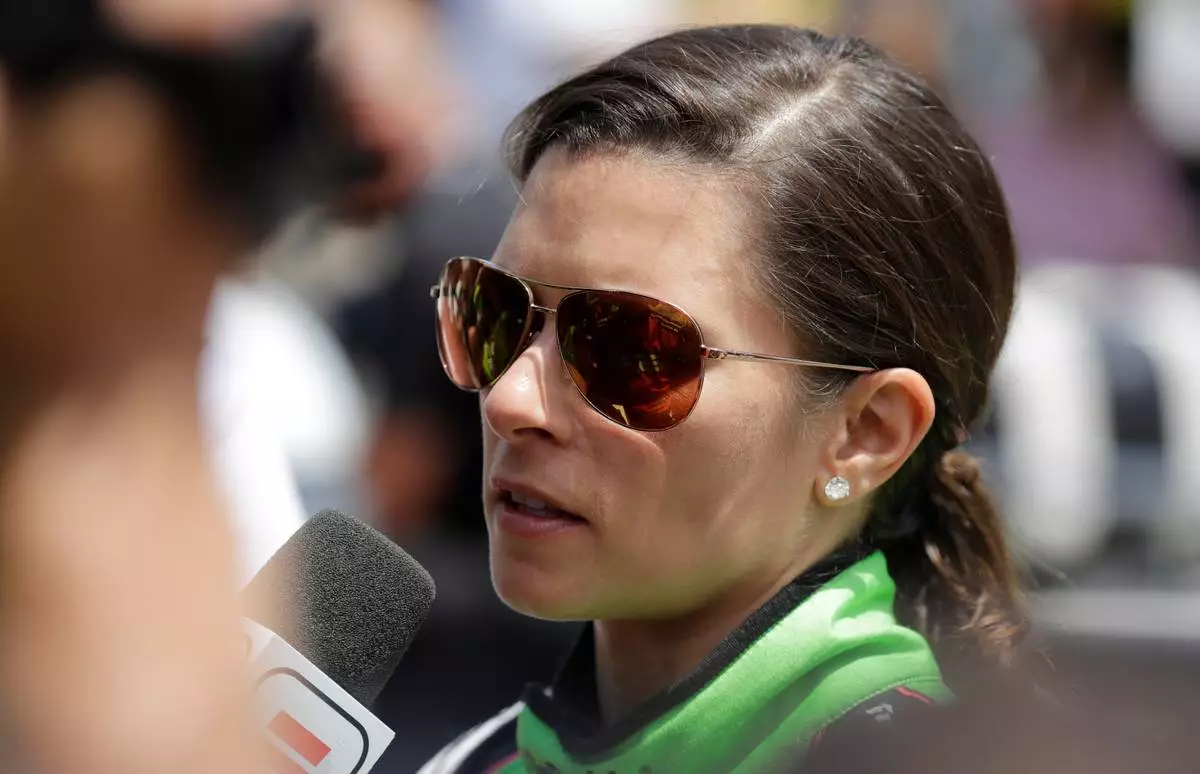
FILE - Danica Patrick is interviewed following her release from the infield hospital May 27, 2018, after being checked following a crash in the Indianapolis 500 auto race at Indianapolis Motor Speedway in Indianapolis. (AP Photo/Darron Cummings, File)

FILE - Danica Patrick sits on the set of ESPN's College Game Day program as a guest picker in Soldier Field before an NCAA college football game between Wisconsin and Notre Dame, Sept. 25, 2021, in Chicago. (AP Photo/Charles Rex Arbogast, File)
The Trump administration is following through with its threat to designate artificial intelligence company Anthropic as a supply chain risk in an unprecedented move that could force other government contractors to stop using the AI chatbot Claude.
The Pentagon said in a statement Thursday that it has “officially informed Anthropic leadership the company and its products are deemed a supply chain risk, effective immediately.”
The decision appeared to shut down the opportunity for further negotiation with Anthropic, nearly a week after President Donald Trump and Defense Secretary Pete Hegseth accused the company of endangering national security.
Trump and Hegseth announced a series of threatened punishments last Friday, on the eve of the Iran war, after Anthropic CEO Dario Amodei refused to back down over concerns the company’s products could be used for mass surveillance of Americans or autonomous weapons.
The San Francisco-based company didn't immediately respond to a request for comment Thursday. It has previously vowed to sue if the Pentagon pursued what the company described as a “legally unsound” action “never before publicly applied to an American company.”
The Pentagon statement said "this has been about one fundamental principle: the military being able to use technology for all lawful purposes. The military will not allow a vendor to insert itself into the chain of command by restricting the lawful use of a critical capability and put our warfighters at risk.“
Some military contractors were already cutting ties with Anthropic, a rising star in the tech industry that sells Claude to a variety of businesses and government agencies. Lockheed Martin said it will “follow the President’s and the Department of War’s direction” and look to other providers of large language models.
“We expect minimal impacts as Lockheed Martin is not dependent on any single LLM vendor for any portion of our work,” the company said. It's not yet clear if the designation aims to block Anthropic's use by all federal government contractors or just those that partner with the military.
The Pentagon's decision to apply a rule designed to address supply threats posed by foreign adversaries was quickly met with criticism from both opponents and some supporters of Trump's Republican administration. Federal codes have defined supply chain risk as a “risk that an adversary may sabotage, maliciously introduce unwanted function, or otherwise subvert” a system in order to disrupt, degrade or spy on it.
U.S. Sen. Kirsten Gillibrand, a New York Democrat and member of the Senate Armed Services Committee and Senate Intelligence Committee, called it “a dangerous misuse of a tool meant to address adversary-controlled technology.”
“This reckless action is shortsighted, self-destructive, and a gift to our adversaries,” she said in a written statement Thursday.
Neil Chilson, a Republican former chief technologist for the Federal Trade Commission who now leads AI policy at the Abundance Institute, said the decision looks like “massive overreach that would hurt both the U.S. AI sector and the military’s ability to acquire the best technology for the U.S. warfighter.”
Earlier in the day, a group of former defense and national security officials sent a letter to U.S. lawmakers expressing “serious concern” about the designation.
“The use of this authority against a domestic American company is a profound departure from its intended purpose and sets a dangerous precedent,” said the letter from former officials and policy experts, including former CIA director Michael Hayden and retired Air Force, Army and Navy leaders.
They added that such a designation is meant to “protect the United States from infiltration by foreign adversaries — from companies beholden to Beijing or Moscow, not from American innovators operating transparently under the rule of law. Applying this tool to penalize a U.S. firm for declining to remove safeguards against mass domestic surveillance and fully autonomous weapons is a category error with consequences that extend far beyond this dispute.”
While losing its big partnerships with defense contractors, Anthropic experienced a surge of consumer downloads over the past week due to people siding with its moral stance. Anthropic has boasted of more than a million people signing up for Claude each day this week, lifting it past OpenAI's ChatGPT and Google's Gemini as the top AI app in more than 20 countries in Apple's app store.
The dispute with the Pentagon has also further deepened Anthropic's bitter rivalry with OpenAI, which announced a Friday deal with the Pentagon to effectively replace Anthropic with ChatGPT in classified military environments.
OpenAI said it sought similar protections against domestic surveillance and fully autonomous weapons but later had to amend its agreements, leading CEO Sam Altman to say he shouldn't have rushed a deal that “looked opportunistic and sloppy.”
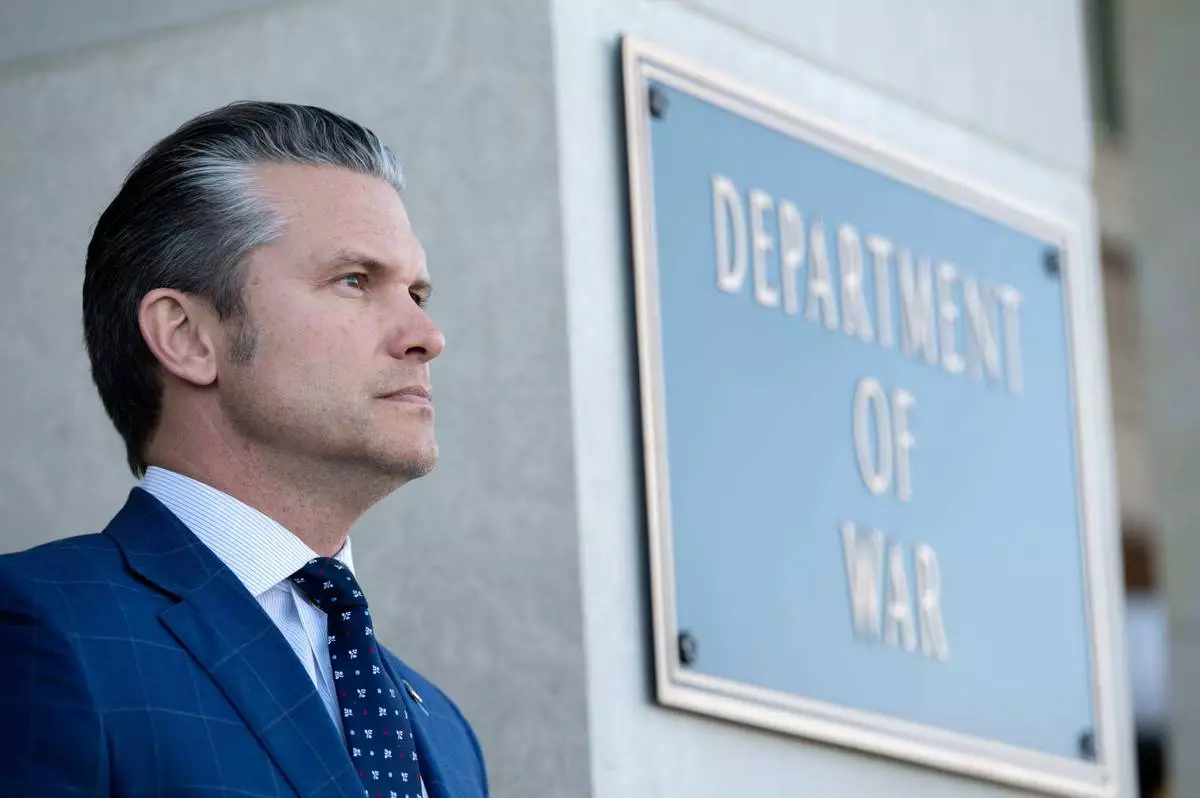
FILE - Defense Secretary Pete Hegseth stands outside the Pentagon during a welcome ceremony for the Japanese defense minister at the Pentagon in Washington, Jan. 15, 2026. (AP Photo/Kevin Wolf, File)
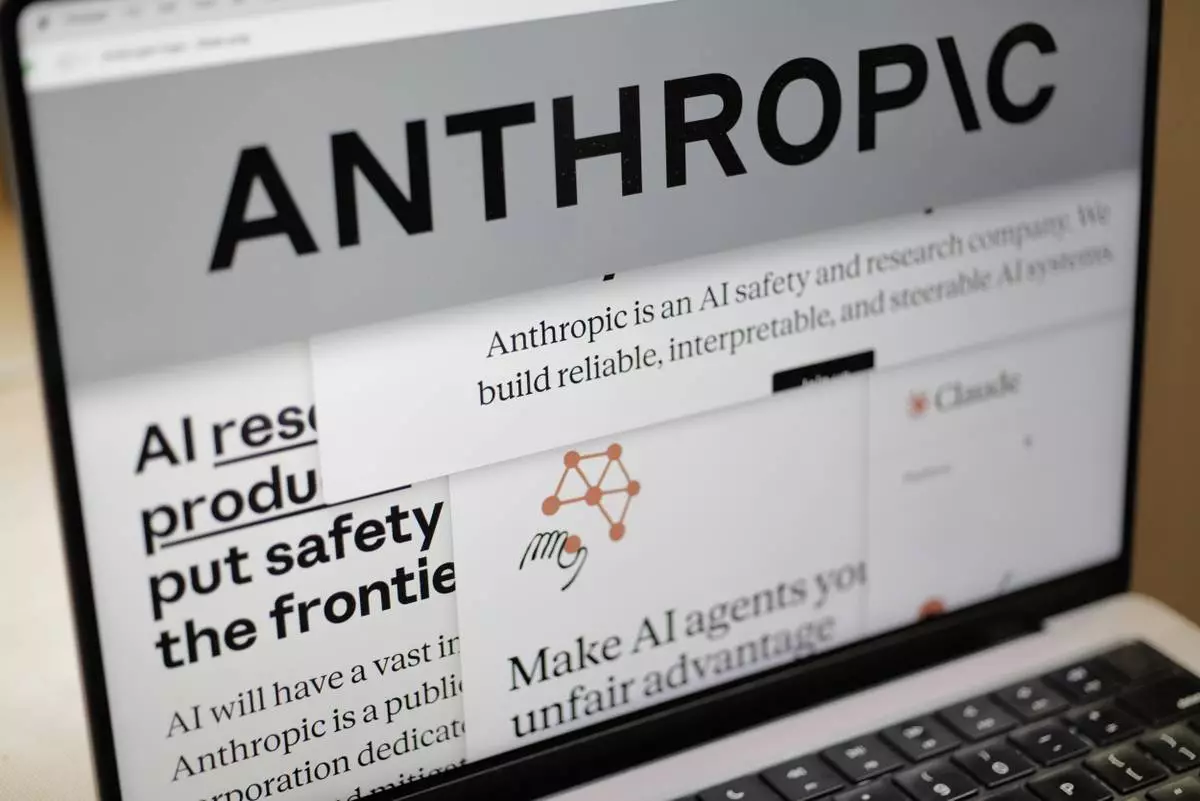
Pages from the Anthropic website and the company's logo are displayed on a computer screen in New York on Thursday, Feb. 26, 2026. (AP Photo/Patrick Sison)