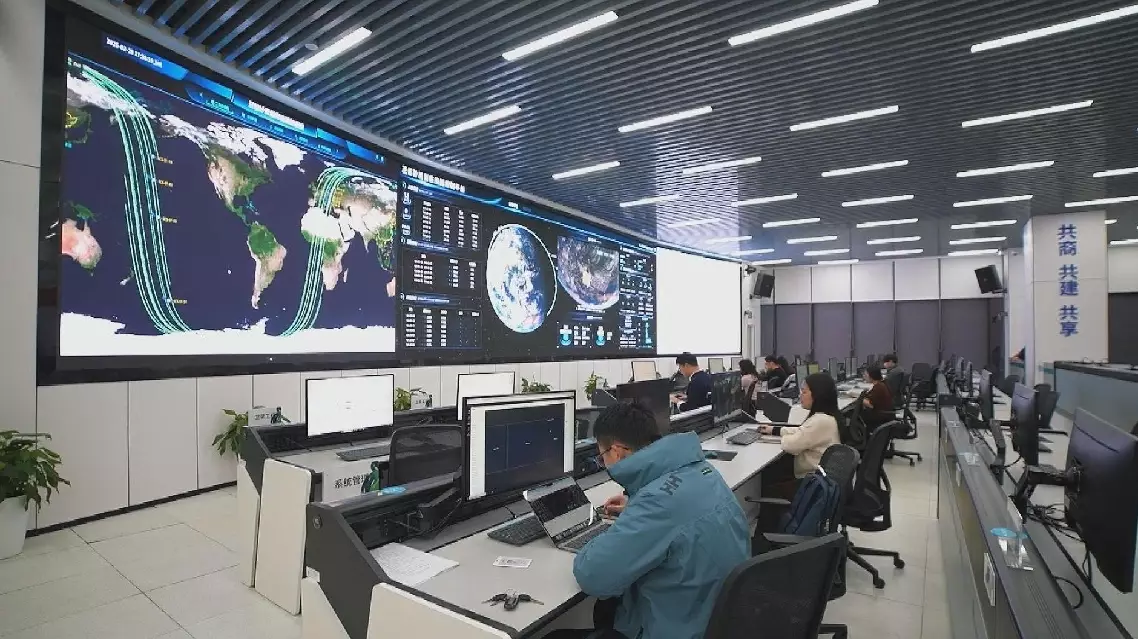
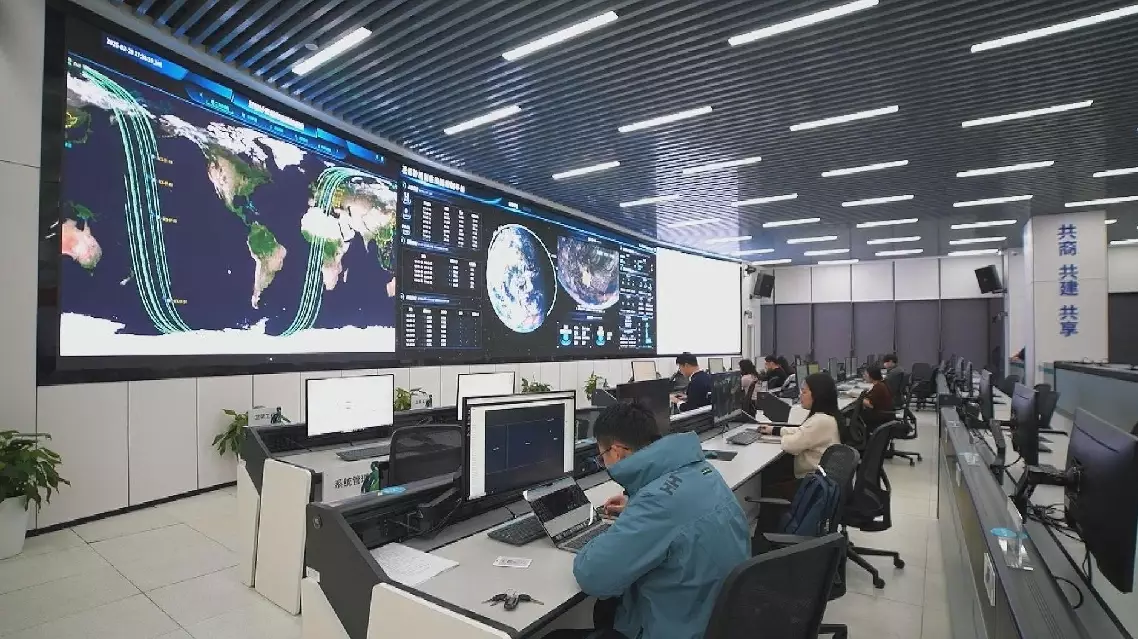
China has taken a major step toward building an AI-powered space infrastructure, with a satellite constellation deploying 10 AI models in orbit and establishing inter-satellite networking, poised to advance the application in industry and improving livelihoods, according to a Chinese lab.
The deployment demonstrates AI applications in deep space exploration, smart city development and natural resource surveys, according to the Zhejiang Lab based in Hangzhou City of east China's Zhejiang Province, which has developed the constellation with global partners.
At the opening meeting of the fourth annual session of the 14th National People's Congress (NPC) -- China's top legislature -- on March 5, Chinese Premier Li Qiang delivered a government work report that unveiled China's key achievements in 2025, the country's major new achievements over the 14th Five-Year Plan period (2021-2025) for national socioeconomic development, the main targets for development this year, and the major development targets for the next five years (2026-2030).
China will foster emerging pillar industries including aviation and aerospace, and will expedite the development of a satellite internet, according to the report.
The ongoing fourth annual session of the 14th NPC is one of the annual political "two sessions" held in the Chinese capital, with the other one being the fourth annual session of the 14th National Committee of the CPPCC -- China's top political advisory body.
China placed 12 satellites, the first group of the space computing constellation called "Three-Body Computing Constellation," into orbit in May 2025.
After nearly several months of in-orbit testing, the constellation has demonstrated core capabilities including networking, computing, model deployment and scientific payload verification.
"By coordinating and interconnecting satellites through models, the capabilities of the remote sensing satellites have been greatly enhanced," said Wang Jian, director of the Zhejiang Lab and also a CPPCC National Committee member.
Unlike traditional remote sensing satellites that simply capture images and transmit them back to the Earth, Wang described the new constellation as a "space analyst" -- a satellite system equipped with a "superbrain" to analyze and recognize data directly in orbit, which only sends the final conclusions back to ground stations.
Remote sensing satellites generate vast amounts of data, but limited onboard computing power has hampered real-time application.
Wang illustrated this with an example: during morning rush hour in a city, satellites have the capacity to observe traffic conditions from space, identifying congested roads and vehicle density. But transmitting all that detailed data back to the Earth often takes so long that the insights become outdated, missing the peak traffic times.
The solution, Wang emphasized, lies in expanding space-based computing.
"Our goal is to complete the tasks in space if they should be fulfilled there. Now, AI models can count cars to analyze traffic in orbit, providing timely data. The value of the satellite is brought into play in this way and things that we couldn't do before can now be done," Wang said.
Looking ahead, the "Three-Body Computing Constellation" plans to launch 50 satellites this year, aiming to build a network of 1,000 computing satellites by 2032, forming a space computing power constellation serving AI.
"Sending computing power into space will generate value that we cannot imagine today. We should share our computing resources on satellites globally, so as to bring out the creativity and ultimately benefiting the entire society and the common people," Wang said.
The fourth session of the 14th NPC and the fourth session of the 14th National Committee of the CPPCC kicked off in Beijing on March 5 and March 4, respectively.
The two sessions are regularly held each year to review the government work in the last year and finalize the country's priorities for the year ahead.
China advances AI computing power with satellite network to support industry, livelihoods
China advances AI computing power with satellite network to support industry, livelihoods
Iran's official news agency IRNA on Wednesday evening published the full text of a recently finalized memorandum of understanding (MoU) between Tehran and Washington on ending the war.
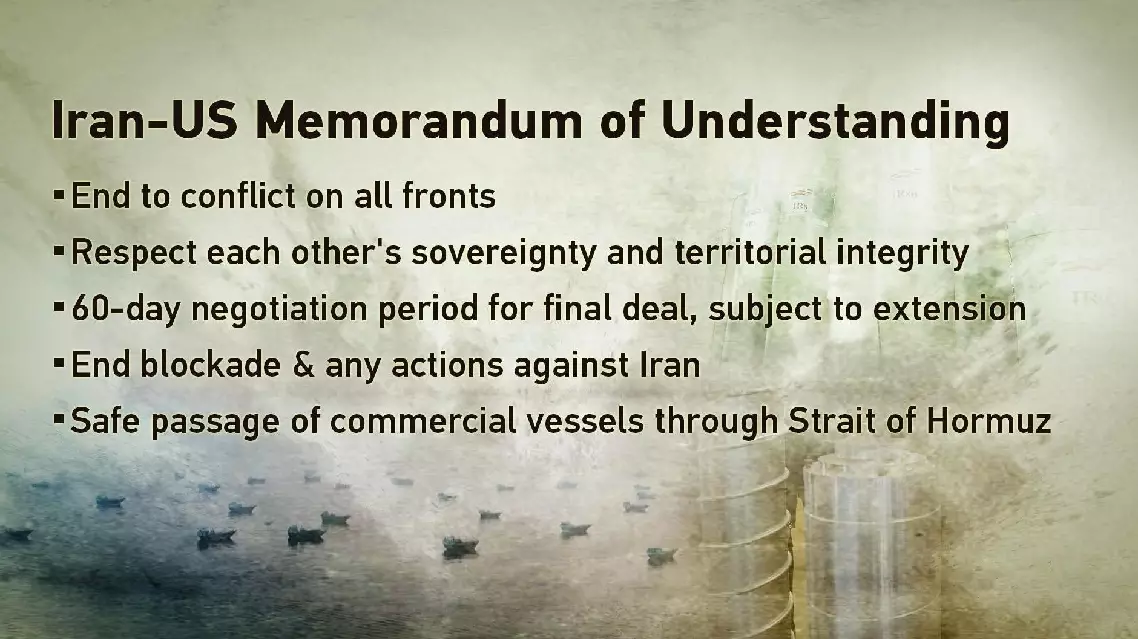
According to the released text, by signing the MoU, Iran and the United States, along with their allies, will jointly agree to end the war and military operations on all fronts, including Lebanon, immediately and permanently, and undertake from now on not to initiate any war or military operation against each other, refrain from the threat or use of force against each other and guarantee Lebanon's territorial integrity and national sovereignty.
Iran and the United States commit to respecting each other's sovereignty and territorial integrity and refraining from interfering in each other's internal affairs, IRNA said, quoting the MoU.
It said Iran and the United States also commit to holding negotiations and reaching a final agreement within a maximum period of 60 days, extendable by mutual consent.
According to IRNA, immediately upon the MoU's signing, the United States will begin to lift its anti-Iran naval blockade and stop any harassment or obstruction against the country, and will fully end the blockade within 30 days.
It said during this period, traffic by vessels will return to the pre-war level to be restored by Iran, and the United States also undertakes to withdraw its military forces from areas around Iran within 30 days after the final agreement.
The report said by signing the MoU, Iran will make arrangements to the best of its ability to provide safe passage for commercial ships free of charge, only for a period of 60 days, from the Persian Gulf to the Gulf of Oman and vice versa, adding that commercial ships' passage will commence immediately and will be established within 30 days given the need for removing technical and military obstacles and demining by Iran.
Besides, Iran will hold discussions with Oman on the future management and maritime services in the Strait of Hormuz in accordance with applicable international law and the sovereign rights of the waterway's coastal states, and will also exchange views with other Gulf littoral states, IRNA said.
It said that the United States commits, along with its regional partners, to developing a definitive and mutually agreed-upon plan for Iran's reconstruction and economic development by providing at least 300 billion U.S. dollars, and the plan's executive mechanism will be finalized as part of the final agreement within 60 days.
IRNA said it is stipulated in the MoU that the United States will provide all necessary approvals, waivers, and permissions for relevant financial transactions.
In addition, the report added, the United States commits to lifting all types of sanctions against Iran, including the resolutions of the UN Security Council and the Board of Governors of the International Atomic Energy Agency (IAEA), and all unilateral U.S. sanctions, both the primary and secondary ones, on a timetable to be agreed as part of the final agreement.
According to IRNA, Iran and the United States recognize the fundamental importance of the issue of lifting sanctions and express their intention to immediately address these issues in negotiations to reach a mutual agreement.
By signing the MoU, the report said, Iran reaffirms its commitment not to develop or purchase nuclear weapons, and Tehran and Washington have agreed to resolve the issue pertaining to Tehran's stockpile of enriched uranium through a mutually agreed mechanism and in accordance with the timetable set out in the peace deal at least by means of on-site dilution under the IAEA's supervision.
The two sides also agree to discuss the issue of enrichment and other mutually agreed matters related to Iran's nuclear needs on the basis of a framework to be agreed in the final agreement.
According to the MoU, Iran and the United States agree to maintain the status quo until the final agreement is reached; Tehran will maintain the status quo of its nuclear program, and Washington will not impose any new sanctions or deploy additional military forces to the region.
IRNA said under the MoU, the United States undertakes that immediately upon the signing of the deal and until the termination of sanctions, U.S. Department of the Treasury will issue waivers for the export of Iranian crude oil, petroleum products, and derivatives, and all associated services, including banking transactions, insurance, and transportation.
It added that Washington also commits to fully making available any restricted or frozen Iranian funds and assets upon the MoU's implementation, stressing that the two sides will mutually agree on the procedures to release the funds during the upcoming negotiations, and the United States undertakes to issue all necessary licenses and authorizations accordingly.
It has been stipulated in the MoU that an executive mechanism will be established to monitor the successful implementation of the deal and future compliance with the final deal.
According to IRNA, following the MoU signing, Iran and the United States will start negotiations on the final deal, which will be endorsed by a binding UN Security Council resolution.
Iran, the United States, and Pakistan early Monday announced the finalization of the MoU on ending the war following weeks of negotiations.
Iran's Foreign Ministry spokesman Esmaeil Baghaei said early Thursday in an interview with state-run IRIB TV that Iranian President Masoud Pezeshkian and his U.S. counterpart, Donald Trump, had digitally signed the MoU.
On Feb. 28, Israel and the United States launched joint attacks on Tehran and other Iranian cities. Iran responded with waves of missile and drone attacks targeting Israel and U.S. bases and assets in the region, and tightened its grip on the Strait of Hormuz, barring safe passage of vessels belonging to or affiliated with Israel and the United States.
Iran's official news agency releases full text of U.S.-Iran MoU