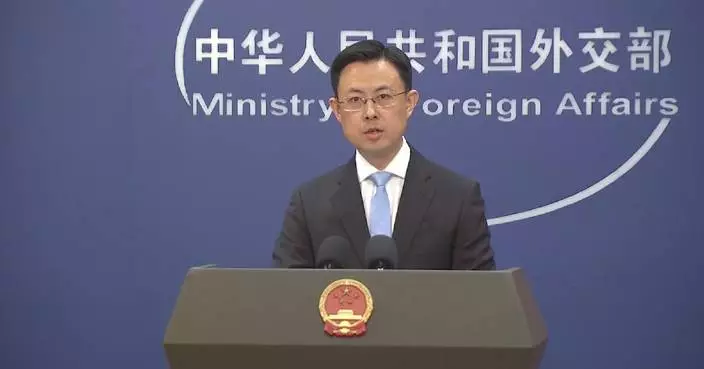
President Xi Jinping's Special Representative Zhang Guoqing will attend the second Nuclear Energy Summit scheduled from March 9 to 12 in France, said Foreign Ministry spokesman Guo Jiakun on Monday.
"President Xi Jinping's Special Representative, Member of the Political Bureau of the Communist Party of China Central Committee and Vice Premier of the State Council Zhang Guoqing will be in France from March 9 to 12 for the second Nuclear Energy Summit upon invitation," said Guo at a regular briefing in Beijing.
"The Nuclear Energy Summit is the world's highest-level multilateral meeting exclusively focused on the topic of nuclear energy. The gathering aims at enhancing political consensus, advancing multilateral coordination, and enabling nuclear energy to play a bigger role in tackling global climate change, strengthening countries' energy security and resilience and realizing UN Sustainable Development Goals. Held against the backdrop of global climate change and green and low-carbon transition, the second Nuclear Energy Summit will focus on such key topics as nuclear energy development strategies, financing models and innovation pathways. Leaders of participating countries will deliver keynote addresses and the Summit will issue a joint statement," said Guo. "China is a global leader in nuclear energy, and an important advocate, participant and contributor in international nuclear energy cooperation. While ensuring its own nuclear security, China actively fulfills its international obligations on nuclear security and vigorously advances international cooperation on nuclear energy. Through the Summit, China looks forward to stepping up communication and exchanges with various parties, building consensus for cooperation, working for more just and equitable global nuclear energy governance, and making nuclear energy development more inclusive and beneficial for all and nuclear energy cooperation more open and orderly," he said.
Xi's special representative to attend second nuclear energy summit
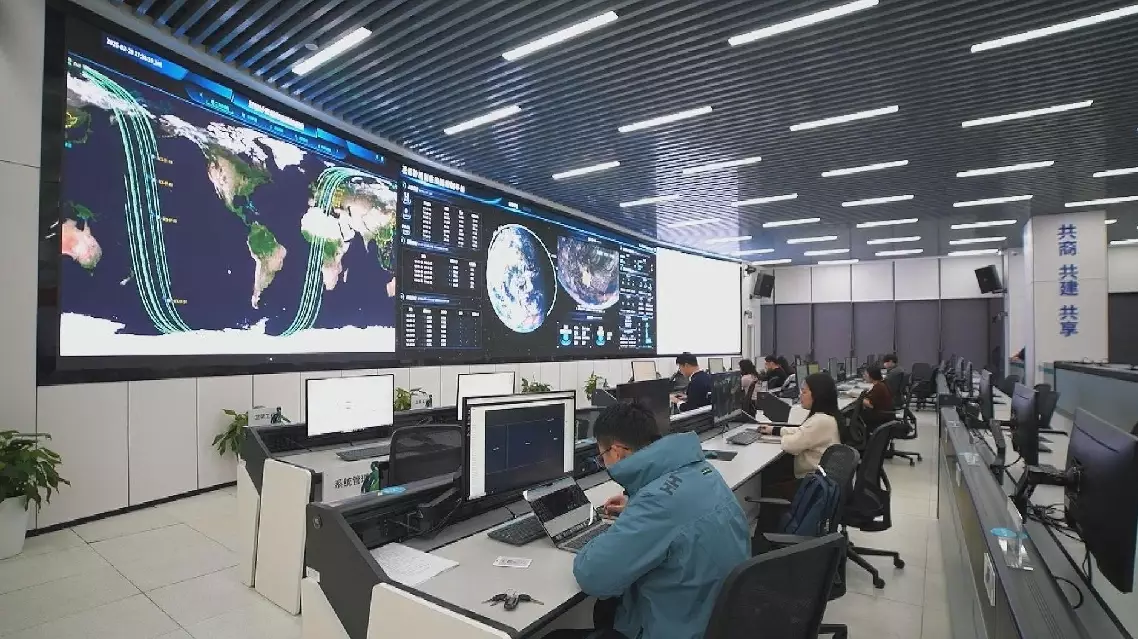
China has taken a major step toward building an AI-powered space infrastructure, with a satellite constellation deploying 10 AI models in orbit and establishing inter-satellite networking, poised to advance the application in industry and improving livelihoods, according to a Chinese lab.
The deployment demonstrates AI applications in deep space exploration, smart city development and natural resource surveys, according to the Zhejiang Lab based in Hangzhou City of east China's Zhejiang Province, which has developed the constellation with global partners.
At the opening meeting of the fourth annual session of the 14th National People's Congress (NPC) -- China's top legislature -- on March 5, Chinese Premier Li Qiang delivered a government work report that unveiled China's key achievements in 2025, the country's major new achievements over the 14th Five-Year Plan period (2021-2025) for national socioeconomic development, the main targets for development this year, and the major development targets for the next five years (2026-2030).
China will foster emerging pillar industries including aviation and aerospace, and will expedite the development of a satellite internet, according to the report.
The ongoing fourth annual session of the 14th NPC is one of the annual political "two sessions" held in the Chinese capital, with the other one being the fourth annual session of the 14th National Committee of the CPPCC -- China's top political advisory body.
China placed 12 satellites, the first group of the space computing constellation called "Three-Body Computing Constellation," into orbit in May 2025.
After nearly several months of in-orbit testing, the constellation has demonstrated core capabilities including networking, computing, model deployment and scientific payload verification.
"By coordinating and interconnecting satellites through models, the capabilities of the remote sensing satellites have been greatly enhanced," said Wang Jian, director of the Zhejiang Lab and also a CPPCC National Committee member.
Unlike traditional remote sensing satellites that simply capture images and transmit them back to the Earth, Wang described the new constellation as a "space analyst" -- a satellite system equipped with a "superbrain" to analyze and recognize data directly in orbit, which only sends the final conclusions back to ground stations.
Remote sensing satellites generate vast amounts of data, but limited onboard computing power has hampered real-time application.
Wang illustrated this with an example: during morning rush hour in a city, satellites have the capacity to observe traffic conditions from space, identifying congested roads and vehicle density. But transmitting all that detailed data back to the Earth often takes so long that the insights become outdated, missing the peak traffic times.
The solution, Wang emphasized, lies in expanding space-based computing.
"Our goal is to complete the tasks in space if they should be fulfilled there. Now, AI models can count cars to analyze traffic in orbit, providing timely data. The value of the satellite is brought into play in this way and things that we couldn't do before can now be done." 7. Various of screen showing "Three-Body Computing Constellation," Wang said.
Looking ahead, the "Three-Body Computing Constellation" plans to launch 50 satellites this year, aiming to build a network of 1,000 computing satellites by 2032, forming a space computing power constellation serving AI.
"Sending computing power into space will generate value that we cannot imagine today. We should share our computing resources on satellites globally, so as to bring out the creativity and ultimately benefiting the entire society and the common people," Wang said.
The fourth session of the 14th NPC and the fourth session of the 14th National Committee of the CPPCC kicked off in Beijing on March 5 and March 4, respectively.
The two sessions are regularly held each year to review the government work in the last year and finalize the country's priorities for the year ahead.
China advances AI computing power with satellite network to support industry, livelihoods