Gaming, one of China’s fastest-growing industries, is thriving in Chengdu, the capital of southwestern Sichuan Province, fueled by the persistence, ambition, and creativity of young developers, who are also embracing Artificial Intelligence (AI) to take the industry to the next level.
When "AI Limit" launched last March, it climbed Steam's charts, earned a 92 percent positive rating, and ranked among China's top six best-selling domestically made titles in 2025. In an industry that rewards speed, game producer Yang Bin chose patience. He spent nine years on a single game.
"When I decided to do this back in 2015-2016, I told myself: even if I had to do it alone, I'd keep going. By early 2023, we were basically running out of money. During that time, there were long stretches when no one got paid," said Yang, producer of the game AI Limit.
Yang said that even during the tough period, they didn't feel unbearable, because they were still working on something they really cared about.
In this industry, success is never guaranteed. But Yang shows what persistence can achieve. In Gaoxin District of Chengdu, that persistence is now being met with policy support. A program introduced in 2024 offers up to five million yuan (around 725,000 USD) in annual subsidies per game company. And Yang's team is preparing to apply.
Fei Zhengyong is an independent game developer. He earned his master's degree at the University of the Chinese Academy of Sciences, quit his job as an engineer, and has been building his own game solo for a year and a half.
He's been relying on savings from his last job to keep the game alive. At this stage, he is basically learning while developing the game.
"You only really learn by actually trying to make something. Even if the game fails, I still gain that experience, and I know I'll come out more mature than before," he said.
In Chengdu, lower living costs, a steady inflow of young talent, and a growing industry network may simply give that choice more room to grow.
Meanwhile, AI is introducing new possibilities to the industry. At the University of Electronic Science and Technology of China (UESTC), Professor Xie Ning and his team are working at the intersection of gaming, AI, and education.
"What we mostly do now is to work with students on game-related tech, combining it with AI, and using that to solve different kinds of problems," said Xie, a professor at the School of Computer Science and Technology, UESTC.
As China enters the first year of its 15th Five-Year Plan, AI has moved to the center of national development, and the gaming industry is gaining new significance in the rise of AI.
Today, games are no longer just products. They are becoming a key training base for AI.
"What we hope to do is to take the research from universities and push it into broader real-world use. It's basically what China has been talking about, turning scientific achievements into something that actually lands in the real world. In fact, this now also includes smart city management, digital twin factories, and immersive operations systems, all of which grew out of game tech. Now they're being used to power smart manufacturing, city management, and other industries," said Xie.
Professor Xie said more universities are now treating gaming as a legitimate academic discipline, moving beyond the old idea that games are merely a distraction.
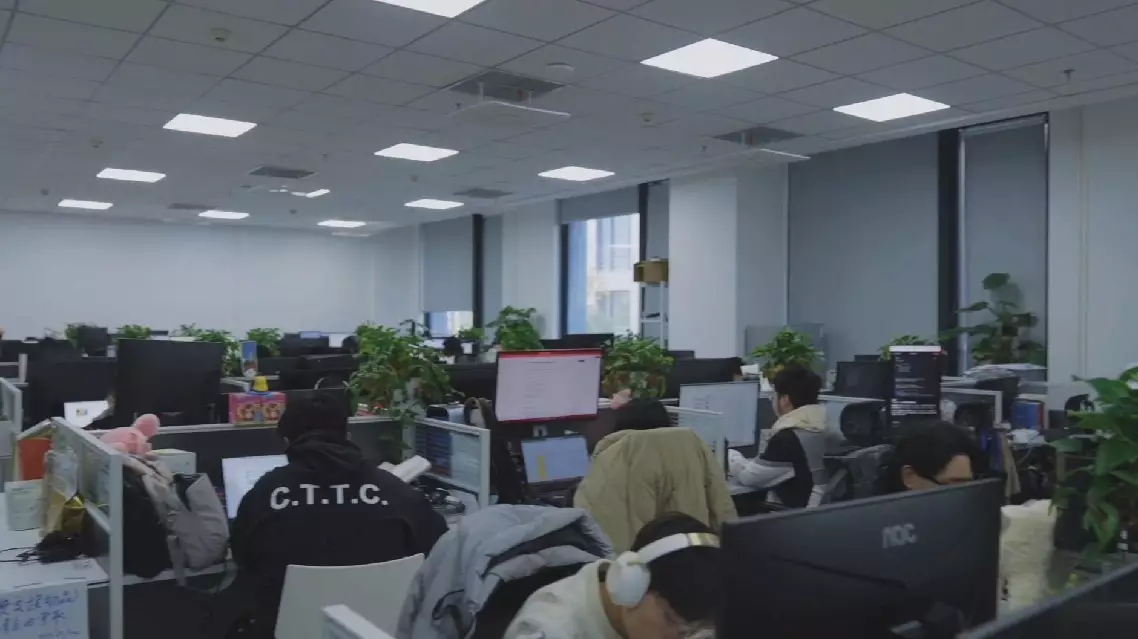
Young developers in Chengdu shaping future of China's gaming industry with talent, persistence