Galaxy General Robotics is redefining embodied artificial intelligence (AI) with a world-first "virtual-real integration" approach, aiming to define the future of generalist robots, according to founder Wang He.
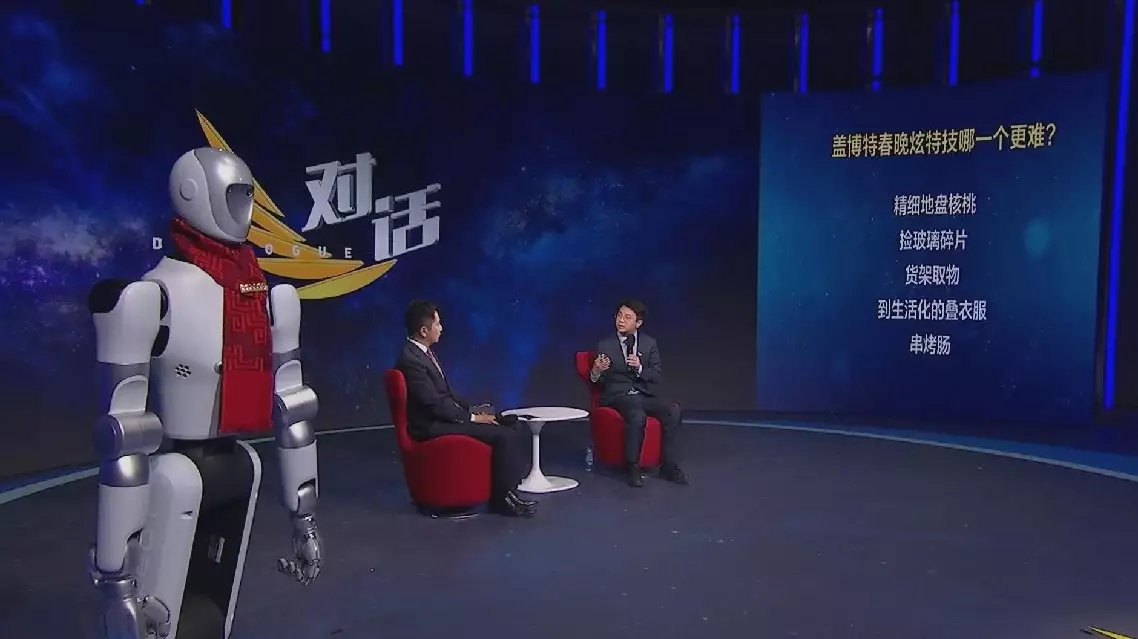
At the 2026 China Media Group (CMG) Spring Festival Gala, the humanoid robot "Xiao Gai" captivated audiences with its interactive performance, showcasing the latest advances in embodied AI. Wang, also a researcher at the Peking University, discussed the core technologies behind "Xiao Gai" and the future of the embodied AI industry, in a recent interview with the the CMG.
Wang identified "walnut spinning" as the most challenging skill for the robot, explaining that the difficulty lies not in the hardware, but in the coordination required for precise in-hand manipulation.
"The in-hand manipulation capability of Galaxy General's dexterous hand is indeed the strongest in the world. The greatest difficulty does not lie in the hardware itself. The real challenge is how to coordinate all five fingers to perform such fine in-hand manipulation. This model is actually the hardest part," Wang said.
"Behind this is actually the 'cerebellum' part of our Galaxy Brain (AstraBrains), which achieves fine in-hand control through reinforcement learning. The goal of this reinforcement learning is to make the walnut rotate in the direction you specify, and at the speed you want. After this reinforcement learning is completed in the simulator, we then move to the real world and use this strategy to obtain some real-world data. The returning real-world data help us improve the model's performance. We are the first in the world to have fully achieved this entire technical pathway, from what is virtual to what is real, and then to further improvement based on reality," he said.
To achieve robust generalization, Wang emphasized the importance of data.
"When I talk about generalization, it means that the model has processed a massive, astronomical amount of data. If all these data came entirely from the real world, the cost would be extremely high, and at the current technological stage, some things are simply impossible. If we tried to replicate the time spent learning walnut spinning in the simulation in the real world, it might take 100 years, or even several centuries. But in the simulation world, thousands of hands learn simultaneously. Through parallel simulation and reinforcement learning, after training, we deploy it to the real world, which greatly reduces the cost of data collection and learning time," he said.
"That's why we can say that by combining 99 percent synthetic data with 1 percent real-world data, we can take the best of both worlds. Synthetic data excels in sheer volume, while real data excels in perfectly and seamlessly connecting with the real world. Galaxy General makes the best use of both types of data, which allows us to continuously produce a wide variety of skills and lead the development of embodied intelligence," said the founder.
Galaxy General Robotics redefines embodied AI with 'virtual-real integration': founder