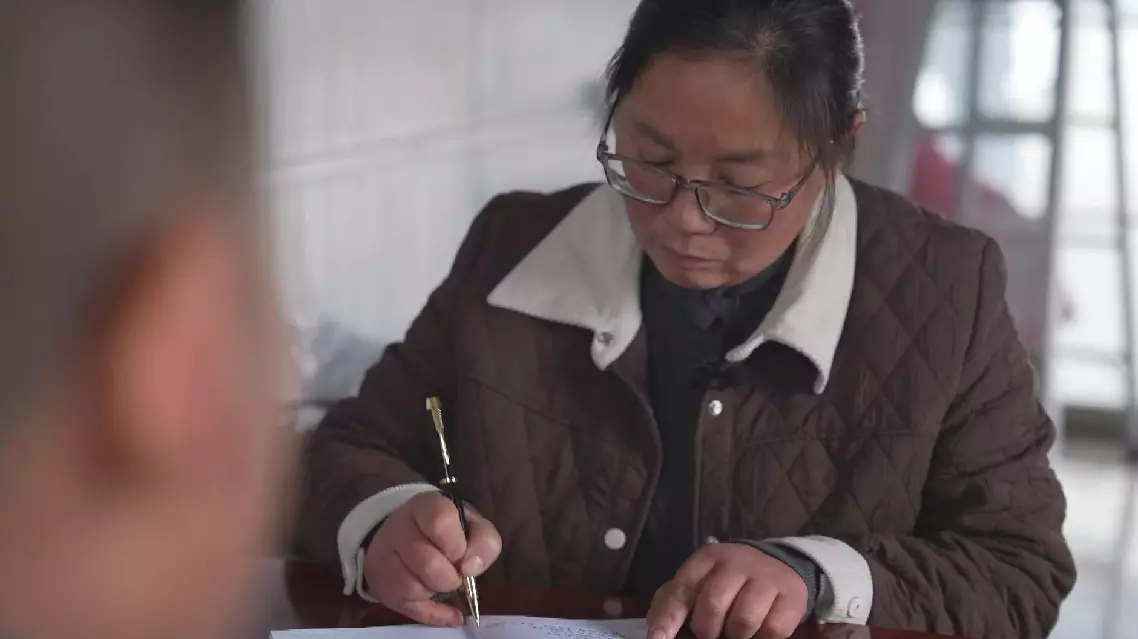
A deputy to the 14th National People's Congress (NPC) has called for enhanced efforts in talent cultivation and financial support for agricultural mechanization to help achieve the high-quality development of China's modern agriculture.
Since returning to her rural hometown in 2014 to start a business as a "new farmer" -- a term that has come to refer to educated people who take on the task of modernizing farming practices -- Yu Qingqing has witnessed firsthand the transformation of agriculture in China from fragmented traditional farming to large-scale, industrialized, and technology-driven family farms.
In recent years, she has consistently focused on the cultivation of agricultural talent and the promotion of agricultural machinery.
"In 2024 and 2025, my efforts have centered on the cultivation of practical rural talent. Talent is the key to rural revitalization. It's not just about injecting us young people and highly educated 'new farmers' with vitality; it's also about cultivating experts and skilled personnel within our rural communities who truly understand agriculture and work on the front lines of production. We need to enable everyone to genuinely regard the countryside as their home, to put down roots, and to play their part," she said.
In Yu's hometown, Zongyang County in east China's Anhui Province, a total of 3,862 farmers were trained in modern agricultural skills throughout 2025 with training programs organized by the local agricultural and rural affairs authorities. A total of 38,000 farmers were trained throughout the province.
By collaborating with universities including Huazhong Agricultural University, Shanghai Jiao Tong University, and Anhui Agricultural University, the county has selected 46 leaders, equipping them to spearhead technological innovation and practical advancements in local agriculture.
"The training sessions typically last eight to nine days, with over 60 percent of the time dedicated to hands-on practice in the fields. This ensures that the theoretical knowledge learned can be truly transformed into practical skills," said Zhou Sanxi, head of the Zongyang County branch of the Anhui Agricultural Broadcasting and Television School.
China's "No. 1 central document" for 2026, released in February, clearly outlined its plans to advance agricultural and rural modernization and to promote all-around rural revitalization.
Ensuring that farmers are equipped with and can effectively utilize advanced agricultural machinery to enhance production efficiency has thus emerged as a key priority in Yu's work.
To pinpoint practical bottlenecks in the application of agricultural machinery, she has been conducting continuous field visits, meticulously documenting the various difficulties farmers encounter when using farm equipment.
According to the Anhui provincial agricultural and rural affairs department, there are currently 143,000 large-scale grain growers in the province, with 3,400 farmers cultivating 66 hectares or more. For these large-scale growers, the demand for farm machinery is strong, but the high costs give them pause.
"To farm, I need at least three large tractors. As for drones, I need at least one or two. The financial pressure on us is immense," said He Kezhong, a local farmer who cultivates 66 hectares of wheat.
He said that although a nationwide subsidy program had already covered over 100,000 (more than 14,500 U.S. dollars) yuan of the costs, the upfront investment for three tractors and one drone was still as high as 600,000 yuan (about 86,997 U.S. dollars).
Yu Qingqing has synthesized these practical issues and brought them to Beijing. At this year's "two sessions," the annual meetings of China's top legislature and top political advisory body, she plans to submit a proposal about encouraging and supporting the cultivation of new quality productive forces in agriculture to promote the high-quality development of modern agriculture.
A key part of her proposal centers on bolstering financial support.
"Establishing special funds and issuing investment vehicles for developing new quality productive forces in agriculture could leverage social capital investment. Furthermore, promoting agricultural credit guarantees, pledge financing, and supply chain finance products, along with expanding the coverage of full-cost insurance and planting income insurance would provide these new agricultural entities with more diverse access to financial support. This would, in turn, give them greater confidence to adopt new technologies and equipment, ultimately driving the advancement of modern agriculture," she said.
NPC deputy urges greater support for agricultural mechanization