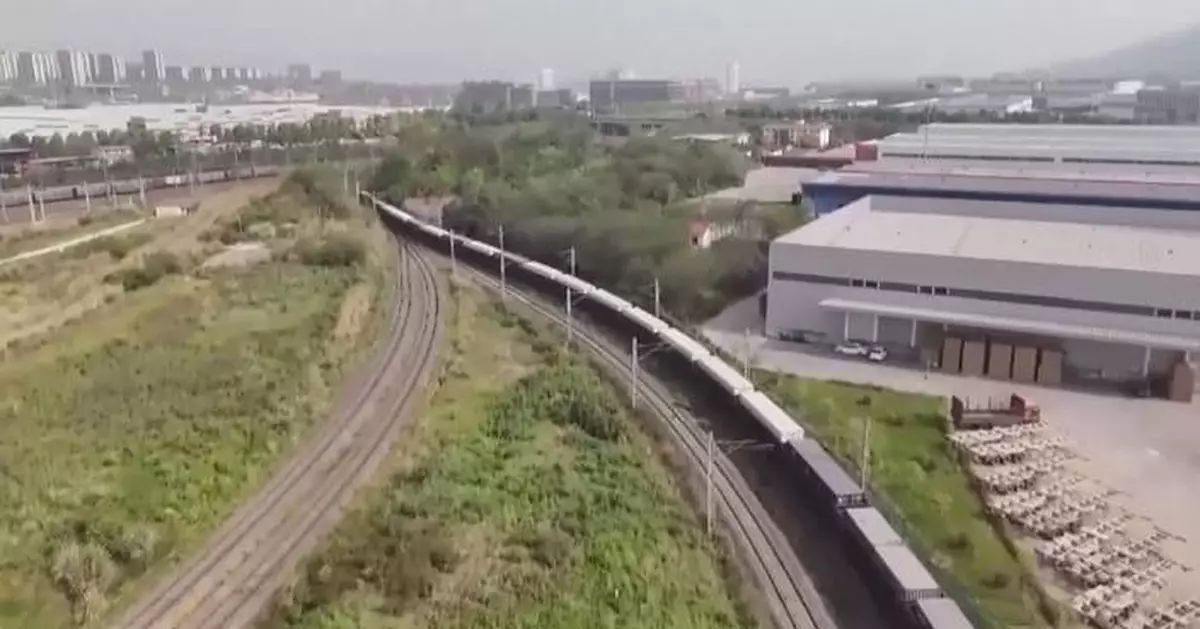
China's New International Land-Sea Trade Corridor has emerged as a crucial channel bolstering trade and industrial growth, making a remarkable contribution to the country's better-than-expectation trade performance in the first two months of 2026.
Serving as a vital logistics artery connecting China with global marketplaces including Association of Southeast Asian Nations (ASEAN) and Central Asia, the corridor offers three modes of transportation: rail-sea intermodal transport, international railway services and cross-border road transport. Chongqing Municipality in southwest China serves as a key logistics hub within this network.
Data released by China's General Administration of Customs shows that in the January-February period, cross-border road freight registered a cargo value surpassing 2 billion yuan (about 290 million U.S. dollars), up more than 80 percent year on year.
The corridor now connects over 580 ports in more than 120 countries and regions worldwide.
China's foreign trade grew 18.3 percent year on year in the first two months of 2026, data from the General Administration of Customs showed on Tuesday.
Exports rose 19.2 percent from the same period last year, while imports went up 17.1 percent, according to the data.
The development of the corridor marks a strategic move to advance regional coordinated development and expand high-level opening-up.
At the Nanpeng Bonded Logistics Center in Chongqing, trucks ready for departure exemplify the corridor's role in global trade. This isn't just a simple logistics route, it's a crucial strategic artery within China's strategies for the large-scale development of the western region.
Since the first truck set out in 2016, the corridor has seen explosive growth from over 100 departures a year then to tens of thousands today.
The cargo variety has also expanded from basic machinery to more sophisticated goods, including auto parts, electronics, raw materials, daily necessities and fresh fruits, totaling over 500 types. These goods are now seemlessly moving across borders, supporting both domestic and foreign trade.
In particular, enterprises no longer need separate warehouses and logistics teams for internal and external trade, reducing costs significantly. Now, goods for both domestic and international markets can be stored and managed in the same warehouses, freeing up resources that can be reinvested into core business areas and boosting overall logistics efficiency.
Meanwhile, innovations continue in international rail transport. In early 2026, a shipment of more than 80 tons of bananas from Laos arrived in Chongqing via the China-Laos Railway under a new model of destination inspection for the first time.
This move is a game-changer. Previously, imported fruits had to undergo lengthy border inspections, leading to multiple customs procedures and intermediate loading and unloading that increased the risk of spoilage. Now, all inspection and quarantine procedures are completed in Chongqing after the fruits left Laos, significantly reducing handling steps, lowering costs, and ensuring fresher, higher-quality fruit for Chinese consumers.
New Int'l Land-Sea Trade Corridor boosts opening-up, yields impressive results