WEST DES MOINES, Iowa--(BUSINESS WIRE)--Mar 10, 2026--
Sammons Financial Group announced today that it has appointed Sergi Turabelidze as Senior Vice President and Chief Investment Officer, effective March 2, 2026.
This press release features multimedia. View the full release here: https://www.businesswire.com/news/home/20260310423558/en/
Reporting to Chairman and Chief Executive Officer Esfand Dinshaw, Turabelidze is responsible for all aspects of Sammons Financial Group’s $135 billion portfolio, including investment strategy, asset allocation, and performance management. In this role, he will advance the company’s investment strategy to support continued enterprise growth and long-term business objectives. As part of Sammons Financial Group’s Senior Staff – the executive leadership team – he assumes an important role in shaping corporate strategy.
"Sergi is a collaborative and versatile asset management leader with extensive experience directing liability-driven investment strategies and building high-performing investment teams,” Dinshaw said. “As we look to the future, we are committed to continuing to invest in our internal investment management group under Sergi's leadership. I welcome him to our team and look forward to working closely with him."
“I am excited to join the talented team at Sammons Financial Group,” Turabelidze said. "By further investing in our internal capabilities and leveraging our open architecture asset management platform, we will continue to partner with best-in-class asset managers globally to deliver exceptional value for our clients."
Turabelidze joins Sammons Financial Group from Sixth Street Partners, a leading alternative asset manager, where he was Managing Director and a senior leader of the Insurance team. Prior to Sixth Street, he served as Chief Investment Officer and a member of the founding executive leadership team at Soteria Re, a Bermuda-based reinsurance company sponsored by Fidelity Investments. Turabelidze previously was the Head of Investment Strategy for St. Louis-based RGA, where he was responsible for asset-liability management, asset allocation, and the development of innovative investment capabilities. He also served in senior roles at Goldman Sachs and NISA Investment Advisors.
Turabelidze earned a Bachelor of Science in Business Administration from Washington University in St. Louis.
About Sammons® Financial Group, Inc.
The companies of Sammons Financial Group® help families and businesses by empowering futures and changing lives. Sammons Financial Group is employee-owned with member companies that are among the most enduring and stable in the financial services industry. Sammons Financial Group is Midwest-based, with offices in Iowa, Illinois, Minnesota, North Dakota, Ohio, Pennsylvania, South Dakota, and Virginia.

Sergi Turabelidze, Senior Vice President and Chief Investment Officer at Sammons Financial Group
DEATH VALLEY, Calif. (AP) — Death Valley, known as the driest place in North America, is teeming with life with a once-in-a-decade blossoming of wildflowers known as a superbloom, transforming a normally brown desert landscape into carpets of gold.
Wildflowers bloom across parts of southern California and Nevada at different degrees usually every year. In some years, superblooms are so vibrant they can be seen from space. But it's rare for Death Valley National Park, the hottest place on Earth, to burst with color.
“This landscape that sometimes people think of as desolate or devoid of life is coming alive right now with this really beautiful palette of colors,” said park ranger Matthew Lamar.
This year’s bloom is the best the park has seen since 2016 thanks to steady rainfall and warm temperatures in the last six months, Lamar said.
Death Valley received nearly a year’s worth of rain since October and experienced the wettest November on record, according to the National Park Service, with 1.76 inches (4.47 centimeters) of rain, allowing long-dormant seeds buried in the soil to burst through the surface.
Known as the “desert sunflower,” the desert gold flower blankets areas of the valley, with purple phacelia, brown-eyed primrose and the pink desert five-spot sprinkled throughout.
Just north of the Furnace Creek Visitor Center, Las Vegas resident Jackie Gilbert appreciated the contrast between the field of gold flowers with the mountains behind it and the blue sky above. She said the flowers' resilience is amazing.
“It’s a good reminder that even in the face of all this adversity, that they can still thrive,” said Gilbert, who visited specifically to see the superbloom.
Ecologists say the superbloom disproves a misconception about deserts: that there’s no life. Even in years without vibrant blooms, a lot of life happens in Death Valley, said Loralee Larios, plant ecologist at the University of California, Riverside.
“The plants and the animals have developed really amazing strategies to be able to persist, and especially in a system like Death Valley that’s really sort of characterized by extremes,” Larios said.
Tiffany Pereira, ecologist and associate research scientist at the Desert Research Institute, said desert plants have adapted to go decades without water, waiting for the perfect conditions for its seeds to germinate and spring to life.
Time is of the essence to see these ephemeral, or short-lived, wildflowers.
The fields of flowers on the park's lower elevations are expected to remain until mid-to-late March, depending on the weather. Higher elevations will blossom with color April through June, according to the National Park Service.
Visitors can check a poster outside of the visitor center for the best spots to view the flowers. In early March, fields of wildflowers are blooming just north of the visitor center, as well as south along Badwater Road. Ashford Mill, an hour’s drive from the visitor center, is also bursting with color, according to Lamar.
Ecologists and the park rangers caution visitors to stick to designated trails and avoid trampling on the flowers. Picking the flowers is prohibited, and touching the purple phacelia could cause skin irritation. Any flower plucked from the ground means fewer seeds planted for future generations to enjoy, Pereira said.
Visitors should also watch their step for the sphinx moth caterpillars, which are scattered across the desert floor in search of the brown-eyed primrose to eat before it buries itself into the soil and transforms into a moth.
“I think it’s a great time to come to Death Valley and have that unique experience because who knows when the next one will happen?” Lamar said.
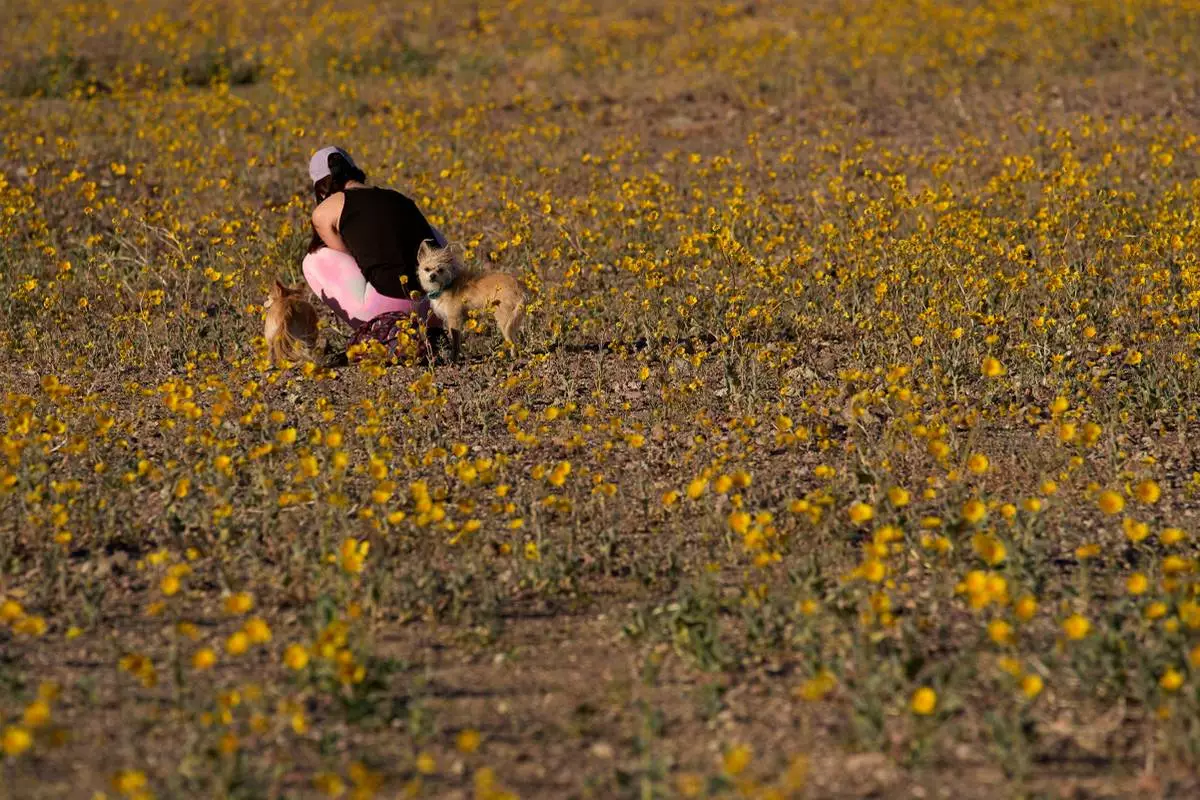
A person looks closely in a field of wildflowers during a superbloom, Saturday, March 7, 2026, in Death Valley National Park, Calif. (AP Photo/John Locher)
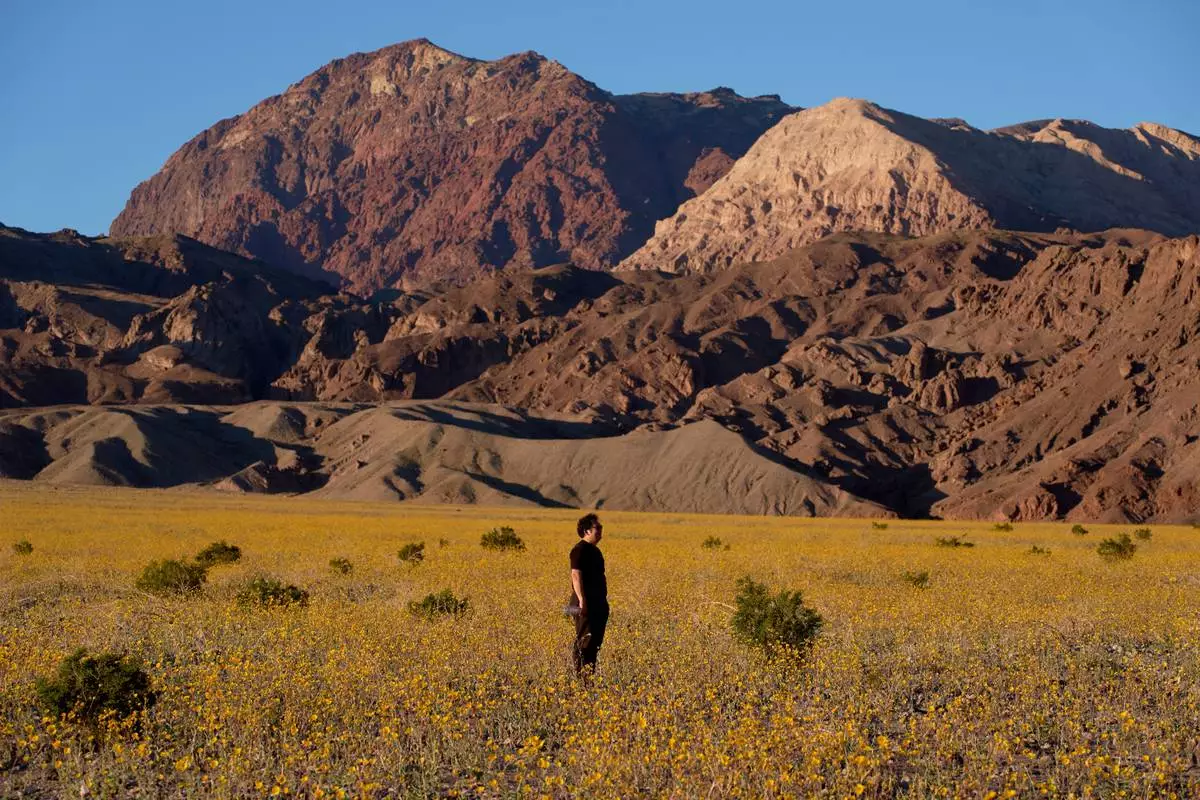
A person stands in a field of wildflowers during a superbloom Saturday, March 7, 2026, in Death Valley National Park, Calif. (AP Photo/John Locher)
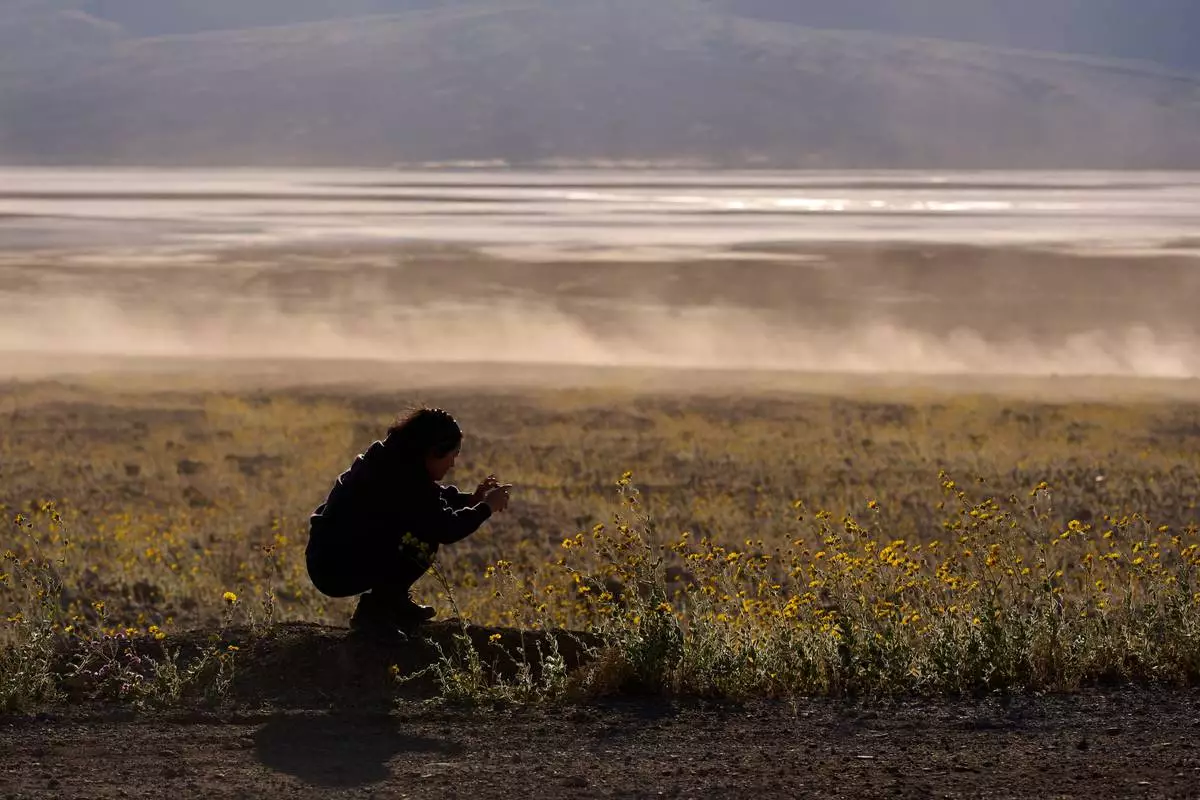
A person takes pictures of wildflowers during a superbloom, Saturday, March 7, 2026, in Death Valley National Park, Calif. (AP Photo/John Locher)
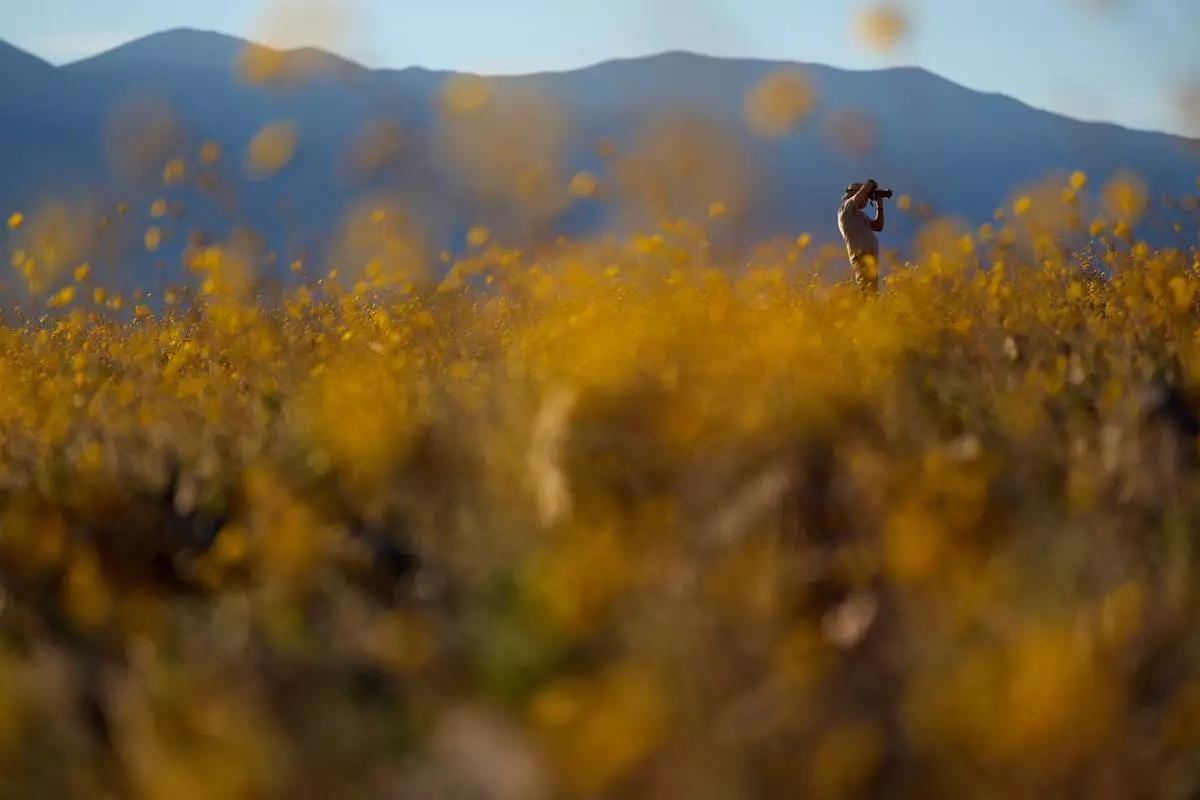
A person takes pictures of wildflowers during a superbloom, Saturday, March 7, 2026, in Death Valley National Park, Calif. (AP Photo/John Locher)
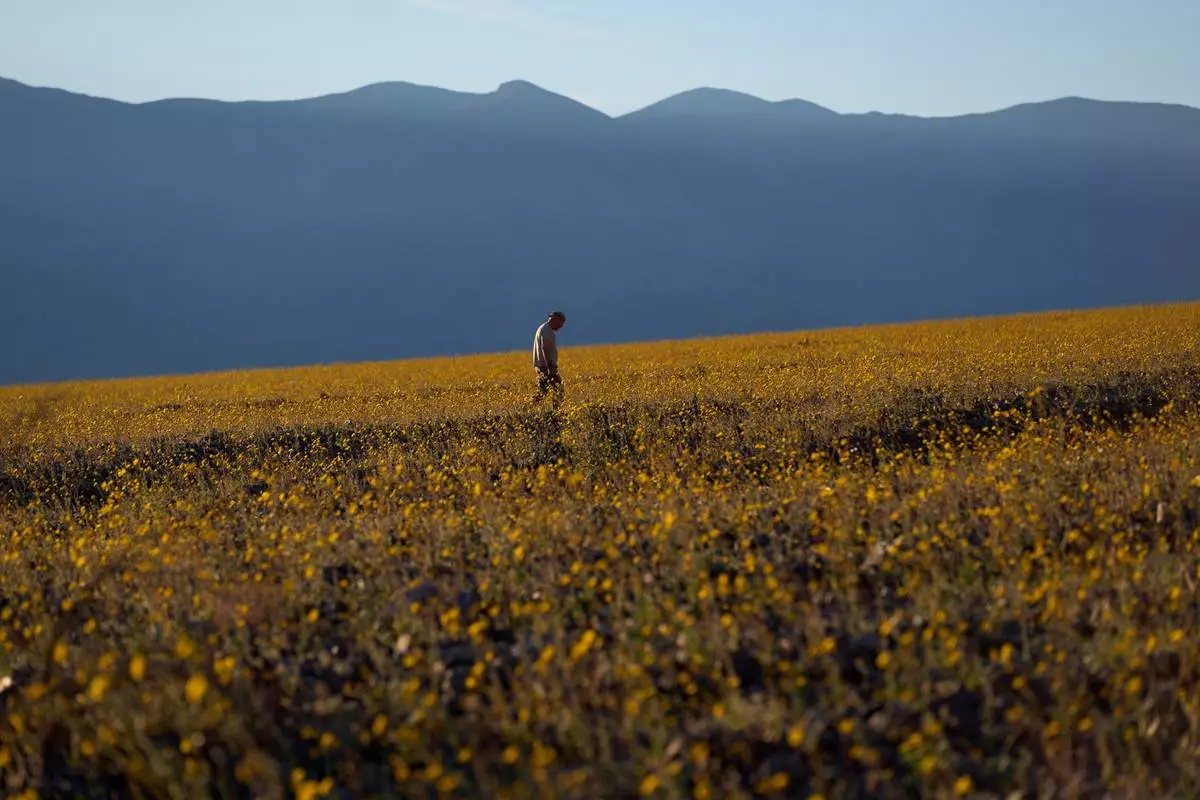
A person walks in a field of wildflowers during a superbloom, Saturday, March 7, 2026, in Death Valley National Park, Calif. (AP Photo/John Locher)