Skip to Content Facebook Feature Image

Uruguay's Ambassador calls China's five-year plan "basic input" to understand future world development

China

China

China

Uruguay's Ambassador calls China's five-year plan "basic input" to understand future world development

2026-03-11 20:43 Last Updated At:03-12 12:15

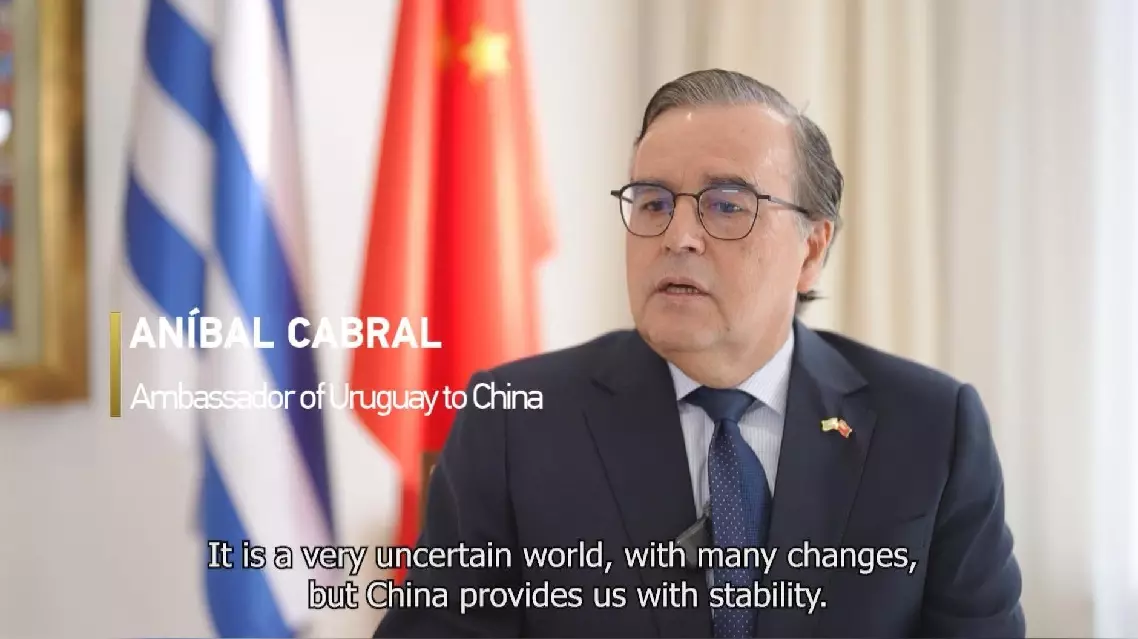
Uruguay's Ambassador to China Anibal Cabral said China's five-year plan should be examined closely as a "basic input" to understand how the world will develop when talking about the significance of China's "two sessions" in a recent interview with China Central Television.

The "two sessions," or the annual gatherings of the National People's Congress (NPC) and the Chinese People's Political Consultative Conference (CPPCC), are currently being held in Beijing. The draft outline of the 15th Five-Year Plan (2026-2030) for China's national economic and social development was submitted to the fourth session of the 14th NPC for review on March 5.

Cabral said Uruguay is paying close attention to the new five-year plan, highlighting the growing ties between the two countries. He shared his views about China's development blueprint and its global importance.

"China has been Uruguay's main trading partner for the past 14 years, both for exports and imports. Of course, since it is a planned economy with five-year plans, we are always very interested in studying them. In fact, many staff members at the Ministry of Economy asked me to obtain a copy of the five-year plan so they could study it. What can we see in the five-year plan? The modernization of China, the rejuvenation of its population, and its development. It includes some of the highest planned growth rates today -- around 5 percent. But above all, it also emphasizes the consolidation of its domestic market and internal economy. The growth of income among the Chinese population is very important, as it creates a consumer base for the entire world and a very advantageous market. We should also highlight the developments China has achieved in green economy," he said.

Cabral also stressed China's positive role in promoting global stability, suggesting that China's five-year plans are good references to studying future development trends.

"It is a very uncertain world, with many changes, but China provides us with stability. With China, Uruguay shares very important principles in the international arena, especially the promotion of multilateralism, respect for international rules, and compliance with the regulations of the World Trade Organization -- topics on which Uruguay and China share a vision. This vision is part of a broader goal of a more multipolar, more democratic world with stronger global governance. I believe that nowadays, because of China's importance, most economists, politicians and international analysts are studying the Chinese five-year plan and examining it closely as a basic input to understand how the world will develop in the next five years," said the ambassador.
Uruguay's Ambassador calls China's five-year plan "basic input" to understand future world development

Uruguay's Ambassador calls China's five-year plan "basic input" to understand future world development
The United States' war with Iran has already been "terminated" ahead of a 60-day deadline by law due to the current ceasefire, U.S. media reported on Thursday, citing a senior Trump administration official.

Under the War Powers Resolution, U.S. President Donald Trump had until Friday to seek congressional authorization to continue the conflict or bring it to an end, with the option to extend the deadline by an additional 30 days.

"The hostilities that began on Saturday, Feb. 28 have terminated" between the United States and Iran for purposes of that law, the official, who spoke on condition of anonymity, was quoted as saying.

Washington and Tehran have not exchanged fire since a ceasefire began on April 7 and was later extended.

Earlier on Thursday, Defense Secretary Pete Hegseth argued at a congressional hearing that he believes the ceasefire "pauses or stops" the 60-day clock for congressional authorization of war.

"I do not believe the statute would support that," Democratic Senator Tim Kaine responded, "I think the 60 days runs (out) maybe tomorrow, and that's going to pose a really important legal question for the administration there."

"That deadline is not a suggestion; it is a requirement," said Republican Senator Susan Collins, who voted Thursday for a measure to end U.S. military action in Iran without congressional approval.

The White House notified Congress of the military campaign against Iran on March 2, making Friday the 60-day milestone for the president to start winding down the war unless he gets congressional authorization.

Iranian President Masoud Pezeshkian said on Thursday that any U.S. attempt to impose a naval blockade and maritime restrictions against Iran is "doomed to failure."

Pezeshkian made the remarks in a statement to mark Persian Gulf National Day, which falls on April 30. He said the "enemies" have changed their approach and shifted their pressure to the economic and maritime arenas, using a naval blockade on the Strait of Hormuz and restrictions on maritime trade as a new tool against the Iranian government and people, according to the statement published on his office's website.

The United States imposed its blockade on the Strait of Hormuz after post-ceasefire negotiations with Iran in Pakistan's capital Islamabad on April 11 and 12 failed to lead to an agreement.

The ceasefire between Iran, the United States and Israel took effect on April 8 following 40 days of fighting, which started on Feb. 28 when the United States and Israel launched joint attacks on Tehran and other Iranian cities, killing Iran's then-Supreme Leader Ali Khamenei, senior commanders, and civilians.

Iran responded with waves of missile and drone strikes targeting Israel and U.S. assets in the Middle East, and tightened its grip on the Strait of Hormuz, barring passage to vessels belonging to or affiliated with Israel and the United States.

Trump team says Iran war 'terminated' as ceasefire sparks clash over War Powers deadline

Trump team says Iran war 'terminated' as ceasefire sparks clash over War Powers deadline

Recommended Articles