Higher oil prices triggered by the ongoing U.S.-Israeli attacks on Iran, coupled with a sharp decline in the value of its currency, are changing South Africa's economic trajectory, putting the country's fragile economic outlook under fresh threat.
Brent crude oil prices are up at least 20 percent since U.S.-Israeli air strikes began on February 28, while the South African rand has weakened by over 4 percent in the last week.
"Price rise comes through into your inflation number because we now have a new inflation target of 3 percent with a 1-percent leeway either side. We probably will breach that 1-percent leeway and that would cause the reserve bank to possibly be forced to raise interest rates even though that's not the right thing to do when you have a supply shock, but it might have to do it because it's establishing a new inflation target," said Viv Govender, a portfolio manager at Rand Swiss.
"South Africa being the net importer of oil and fuel, we know that most of our refineries have closed down. We don't have enough capacity in terms of refining. Even if we did we still need oil to be shipped through the Strait of Hormuz which is almost non-functional. So that's going to have a negative impact. We're going to have to import this oil at a higher price and also import fuel at a very high price," explained Maudi Lentsoane, an independent economist.
Rising oil prices have already started to filter into South Africa’s economy.
"Fuel prices affect every individual. For those commuting with public transport and personal transport, having to fork out an extra cent is quite steep based on the question of inflation that we are encountering in the country," said Olebogeng Lephoi, a resident.
Fuel price hikes feed directly into transport, food and logistics costs, placing renewed pressure on households already struggling with elevated living costs.
For businesses, especially in agriculture, mining and freight, an energy price spike could erode margins and delay investment decisions.
"We are not that far above zero. We have 1.5 to 2 percent growth targets for the next year. I think every 10-dollar oil price increase results in a 0.3-dollar reduction in GDP growth. That really puts us into negative economic growth, so we could be in a recession and this won't just affect us, it will be Europe, it will be the whole world as well," said Govender.

Soaring oil prices put South Africa's economy under pressure
A special movie-themed flight campaign lifted off with Xiamen Airlines on Tuesday, blending film culture with tourism promotion to deliver a unique in-flight experience for passengers ahead of China's upcoming May Day holiday.
The campaign took off aboard a plane operated by Xiamen Airlines, which are based in east China's Fujian Province, bringing the magic of the big screen to the small screens on passengers' seats.
The aircraft's cabin has been adorned with film-themed posters and exclusive decorations, with brochures introducing the featured film content placed in seat pockets.
During the flight, the crew also hosted an interactive question-and-answer session, where they promoted some of the top films scheduled for release during the five-day May Day holiday which begins on Friday.
They also shared insights into the featured films, including the cultural and tourism resources of their shooting locations, giving passengers inside cinematic info and essential travel tips during their trip.
The immersive themed experience resonated well with passengers on the flight, who say they are now eager to check out some of the latest film releases.
"There are eight films recommended here, and I'm going to watch them when I get back. I'm keen to see Cold War 1994, because I'm a big fan of Aaron Kwok and the other cast members. I have been following the film all along," said Wang Jianghai, a passenger on the flight, as he expressed his interest in the upcoming crime thriller set in Hong Kong.
The flight attendants involved say they enjoyed having their role extend beyond the standard service duties during this particular plane ride, as they led passengers on this cinematic voyage.
"Today, we are more than just flight attendants. We are more like guides for this movie-themed journey. At 10,000 meters in the air, we get to plant a seed in our passengers' hearts that will make them want to take a trip or go watch that film. We want this to be the start of a beautiful memory for them," said Zhu Yanyan, the flight's chief attendant.
The launch of the themed flight comes as China braces for a surge in travel and cultural consumption during the May Day holiday. By integrating cinematic content with air travel scenarios, the campaign seeks to build a seamless link between the film and cultural tourism sectors, unlocking new growth momentum for both industries.
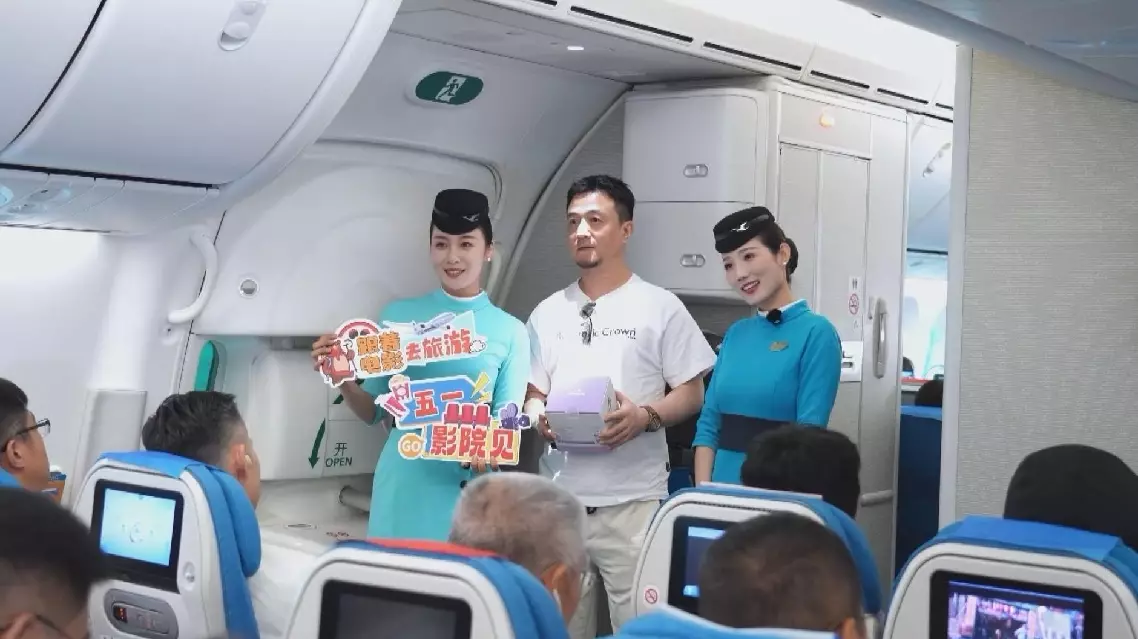
Movie-themed flight takes off in Fujian, integrating film culture with tourism