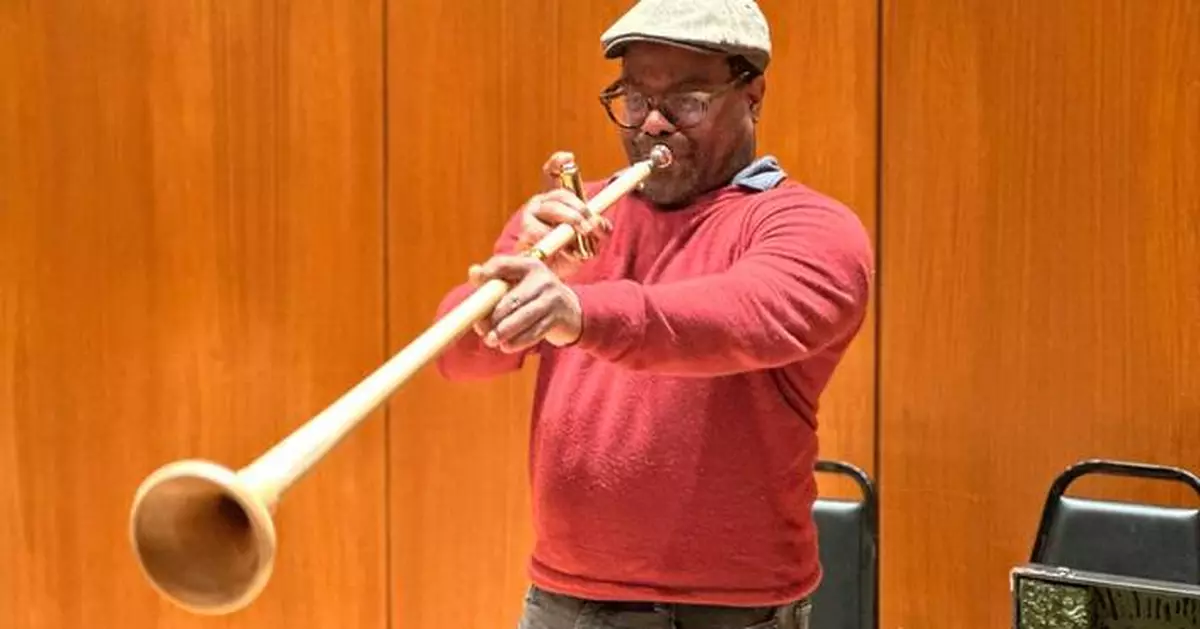
NEW YORK (AP) — About 4 1/2 hours after the first notes of Wagner's “Tristan und Isolde,” a startling sound emerges from the wings, one many in the audience likely have never heard before.
A nearly 4-foot wooden horn known as a holztrompete, specially constructed to the composer's somewhat ambiguous specifications, signals the arrival of the ship carrying Isolde and King Marke to Brittany, inspiring a mortally wounded Tristan to hang on to life for a few more moments.
“Joyous,” said Billy R. Hunter Jr., the Metropolitan Opera's principal trumpet, who plays the wooden horn from stage left.
Yuval Sharon's compelling new production starring Lise Davidsen that opened Monday to mostly rave reviews features a specially constructed horn nearly Hunter's height — it measures a minimum 46.5 inches and lengthens slightly if the tuning slide is turned.
“You listen to the sound of the holztrompete and the imitation, it’s a clear difference,” said bass-baritone Ryan Speedo Green, who sings Marke alongside Davidsen’s Isolde and Michael Spyres’ Tristan. “It blows my mind to think that Wagner created it himself. How many humans have created an instrument? It really sounds like victory.”
While the Wagner Tuba was invented in the 1850s by the composer for his Ring Cycle to bridge the sounds of horn and trombones, the holztrompete's details are more nebulous.
Wagner wrote the notes for an English horn but included a footnote to his score saying it should have “the effect of a very powerful natural instrument, such as the alphorn.” As pointed out in research by Daniël Vernooij, Wagner added in a June 15, 1861, letter to violinist and conductor Heinrich Esser that he wanted it to be “at least three feet long, made of wood, almost trumpet-like, slightly curved downwards so that the bell is open to the side.”
While a wood trumpet was used at the opera’s premiere, Wagner’s Bayreuth Festival in Germany switched in 1891 to a newly created woodwind called the Heckel-clarina, which resembled a soprano saxophone. Conductor Hans Richter replaced that at Bayreuth in 1902 with a tárogató, a woodwind common to Hungarian folk music. The tárogató was used by the Met when James Levine conducted “Tristan” from 1981 through 2008.
Mitch Weiss, a Met clarinet for 38 years, took over the tárogató in the 1980s from Roger Hiller.
“One day he said, `I’m sick and tired of playing this. You play it.′ And he handed me the tárogató,” recalled Weiss, now 93.
And then, Weiss had to audition for Levine alongside principal trumpet Mel Broiles.
“We each had to play the solo,” Weiss said. “I played it on a tárogató and the first trumpet played it on a low horn. And Jimmy said: `Tárogató plays it.'”
“The Hungarians used it as a battle cry instrument because it was very loud,” said Dean LeBlanc, a Met orchestra clarinet and bass clarinet who played the tárogató in the 2016 production conducted by Simon Rattle.
When Daniel Barenboim led the opera at the Met later in 2008, he brought his own holztrompete.
“He pulled out this thing. I’m like: What in the world?” Hunter recalled. He said Barenboim told him, “'This is what we use at Bayreuth.'”
Barenboim took the horn with him after the run. Thomas Lausmann, hired in 2019 as the Met’s director of music administration, ordered a new one to be manufactured by Thein Brass in Bremen, Germany, which built its initial version for the Hamburg State Opera.
“They recreated an instrument that they believed would come very, very close to the instrument Wagner would have had in his time,” Lausmann said.
Hunter said the bells of the Barenboim and current Met version are slightly different. Martin Wagemann, principal trumpet of the Deutsch Oper Berlin, has played the Holztrompete at Bayreuth since 2018. He uses different versions at each hall.
“The Deutsche Oper trumpet sounds slightly darker and woodier, but it is softer and therefore harder to articulate,” Wagemann wrote in an email. “The Bayreuth instrument has slightly better intonation and a brighter sound, which allows for clearer articulation — something you need in the Bayreuth acoustic.”
Hunter compared the holztrompete to a bugle. Its one valve lowers the notes down a step — a trumpet has three valves.
“On a regular trumpet, there’s slides you can adjust with pitch but with this, there is no adjustment,” Hunter said.
Preparing for the mostly sold-out run through April 4, Hunter practiced for a month in the living room of his Upper West Side apartment, with an audience of his wife — who is a pianist — and their children.
“If the kids like it, then I know it’s OK,” Hunter said. “It’s like the food. If they eat the food, it means you did a good job.”
Hunter finishes the first act six stories above the stage in The Domes at the tip of the auditorium, where the banda of trumpets and trombones loudly greets Tristan's ship in Cornwall. The boat's arrival at Monday's production premiere also signaled Hunter's departure: He had about three hours until the wooden horn was needed.
“I left to put my daughters to sleep, relieve grandpa and wait for my wife to return from work,” Hunter said.
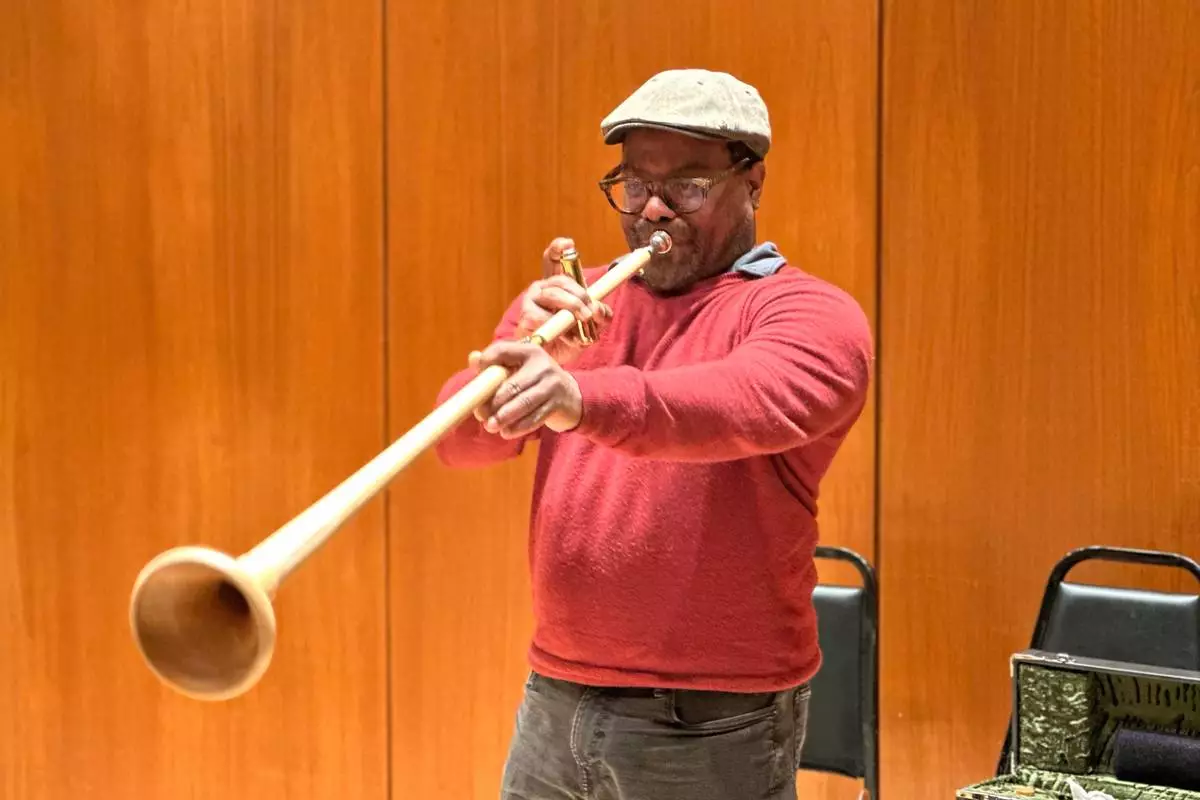
Metropolitan Opera Orchestra principal trumpet player Billy R. Hunter Jr. practices with a holztrompete, a wood horn specified by Richard Wagner for the third act of “Tristan und Isolde," at the Metropolitan Opera in New York on Feb. 28, 2026. (AP Photo/Ron Blum)
RIO DE JANEIRO (AP) — Hollywood actors might rule the silver screen — as Sunday’s Academy Awards are poised to prove — but Brazil’s path to stardom often starts under the bright lights of a TV studio rather than a sprawling movie set.
Since at least the 1960s, the telenovelas, or soap operas, produced by the country's leading broadcaster TV Globo have evolved from simple daily dramas into a multi-million-dollar industry with 13 studios, three set towns, 122 edit bays and reaching up to 60 million of Brazil's 213 million people every week.
Many Brazilian actors associated with Oscar-contending films — such as “Central Station” (1998), “I’m Still Here” (2024) and this year’s four-category nominee “The Secret Agent” — first became household names via TV Globo. Actors like Wagner Moura and Fernanda Torres gained broad national visibility through soap operas.
In contrast, Brazil only has about 3,500 movie theaters, mostly located in major cities and where U.S. blockbusters feature prominently. This creates an ecosystem where success on TV may lead to big cinema roles, which then circle back to popular soap operas, and then on to movies again.
Moura, the lead actor in “The Secret Agent," starred in the telenovela “A Lua Me Disse” (The Moon told Me) 21 years ago. Similarly, Fernanda Torres, the star of “I’m Still Here,” which won Brazil’s first best international feature Oscar, was already a beloved actor due to two major TV Globo comedic series that many in the public see as soap operas.
“Globo’s telenovelas are key for Brazil’s audiovisual production," said Amauri Soares, director of TV Globo and Globo Studios, hailing them as “a continuous platform of creation and production of content.”
"‘The Secret Agent’ has actors and staffers who worked at Globo, who will work at Globo again and the film itself has Globo investment despite being independent,” Soares said.
TV Globo broadcasts three soap operas simultaneously from early evening to prime-time. They are produced at studios in Rio de Janeiro and often run for six months from Mondays to Saturdays, involving more than 1,000 people. A telenovela finale can turn into a national viewing event, with bars, restaurants and gyms airing main episodes.
The industry requires adaptability. With some episodes written only days in advance based on audience ratings, telenovelas allow viewers to indirectly co-create the narrative. And their economic impact is powerful: a remake of the hit “Vale Tudo” (Anything Goes) reportedly generated over 200 million reais ($38 million) in advertising — fourfold the global box office of “The Secret Agent.”
Each year, TV Globo recruits up to 70 new actors from theater, film and regional productions. Soares says they hone their skills with high-end equipment and new techniques for a year. Then many leave for other productions, some just stay at the broadcaster for more soap operas, short series.
Dira Paes, a veteran actor and one of TV Globo’s frequent pundits during Oscars’ night, notes that Brazil’s soap opera and cinema industries are increasingly intertwined, as professionals can move from one to the other to create and also make more money. She was recently in another popular soap opera, “Pantanal” (Wetlands), and in “Manas,” a film praised by Julia Roberts and Sean Penn.
“Soap operas are not only about ratings, but also heart and affection. When you do it on prime-time, you experience the power of an entire nation watching you. When the public loves your character ... it is a very special popularity,” said Paes, the star of “Tres Gracas” (Three Gracas), a soap opera filmed in Rio but set in an impoverished area of Sao Paulo.
Mauricio Stycer, an author and critic of TV culture, says Brazil's inequality boosted free TV channels like Globo in a way that reduced the general public's interest in cinema. Ultimately, he argues, that led to “Brazilian cinema holding a grudge for not having the same reach of soap operas.”
Stycer added that many actors have a Hamletian dilemma whenever recruited for a soap opera.
“To be popular and have a sure income every month or to take risks in a career that involves theater and cinema? TV was always a safe haven for most actors,” he said.
While rival Brazilian TV networks have tried to challenge Globo’s soap opera supremacy, few have achieved success. But even TV Globo productions are no longer as dominant as they were up until the early 2010s. And company executives have acknowledged they face growing competition from streaming video.
Even so, “Globo is still Brazil’s biggest company for actors,” Stycer said. “Up until the year 2000, Globo alone was responsible for about 50% of TV ratings in Brazil."
Actor and director Lázaro Ramos first appeared in soap operas after he had kicked off his career in theater and cinema. He says Brazilians have learned to love both telenovelas and films with the same intensity when they succeed in portraying the country’s joyful and sometimes dark personality.
“Brazilians see themselves in telenovelas, more and more. Our acclaimed writers created many of them based on literature classics,” Ramos said. “They are an investment in a national voice through characters, language and esthetics that viewers greatly identify with."
Ramos — a lifelong friend of Moura — will attend the Academy Awards but will fly back to Brazil soon after to continue working on his new soap opera, “A Nobreza do Amor” (Love's Nobility).
For him, the ability to transition between theater, cinema and TV is what keeps Brazilian performers afloat.
“An American actor could get $10 million for a film. That’s not the Brazilian reality,” he said. “But telenovelas are not a lesser product; they are a product of the highest quality.”
Savarese reported from Sao Paulo.

Actor Bukassa Kabengele, right, takes part in the filming of the soap opera "A Nobreza do Amor" at a TV Globo set in Rio de Janeiro, Thursday, March 12, 2026. (AP Photo/Bruna Prado)

Actors Alana Cabral, behind left, Dira Paes, center, Sophie Charlotte, behind right, and Paulo Mendes, behind everyone, take part in the filming of the soap opera "Três Garças" at a TV Globo set in Rio de Janeiro, Thursday, March 12, 2026. (AP Photo/Bruna Prado)

Brazilian actor Dira Paes smiles before an interview at the TV Globo studio in Rio de Janeiro, Thursday, March 12, 2026. (AP Photo/Bruna Prado)
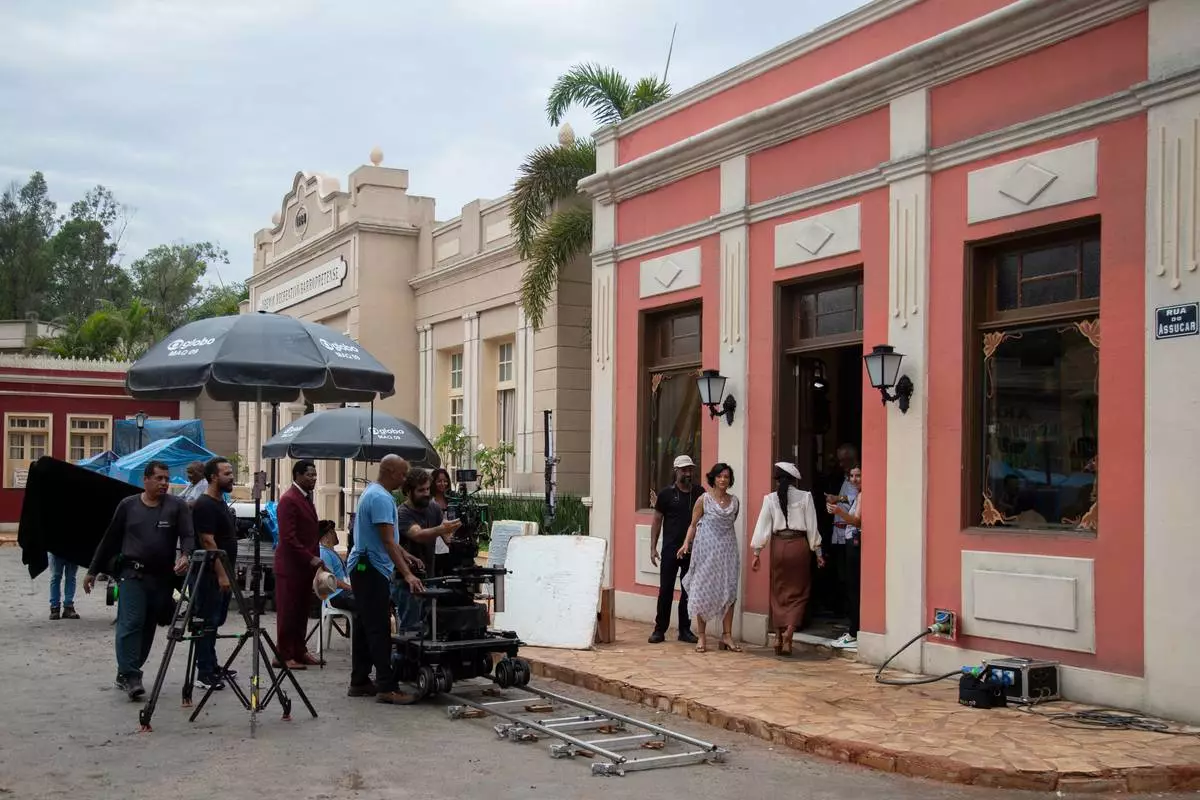
Actors film a scene of the soap opera "A Nobreza do Amor," at a TV Globo set in Rio de Janeiro, Thursday, March 12, 2026. (AP Photo/Bruna Prado)
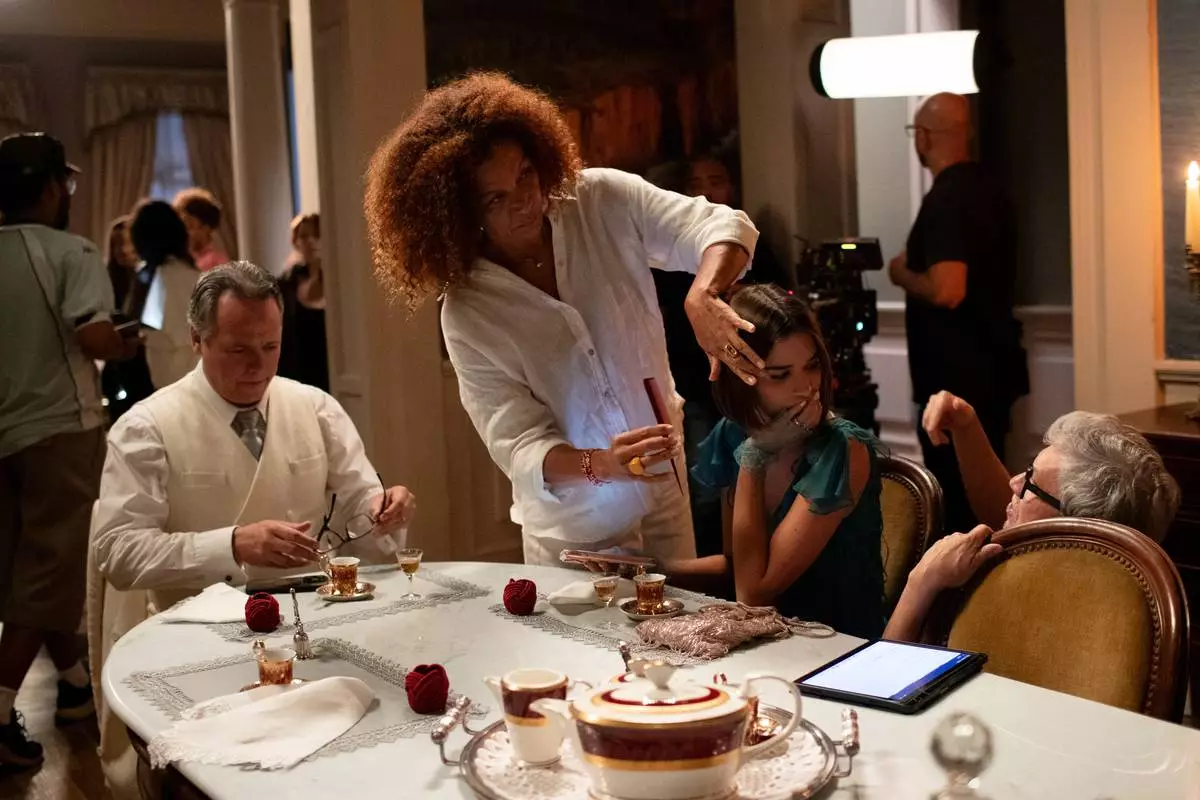
Actors Danton Mello, left, and Theresa Fonseca, second from right, prepare to film a scene of the soap opera "A Nobreza do Amor," at a TV Globo set in Rio de Janeiro, Thursday, March 12, 2026. (AP Photo/Bruna Prado)