The newly passed National Development Planning Law will better support China's development objectives by ensuring the continuity, stability, and authority of national development plans through institutional measures, according to a senior legislative affairs official in Beijing.
The law was adopted on Thursday by the National People's Congress (NPC) , the supreme organ of state power, at the closing meeting of its annual session. It will govern how the country formulates and carries out its five-year development plans, formalizing a system that has long guided the world's second-largest economy. Drawing on China's long-standing experience in national development planning, the law codifies proven practices into a legal framework and aims to reinforce the strategic guiding role of national development plans.
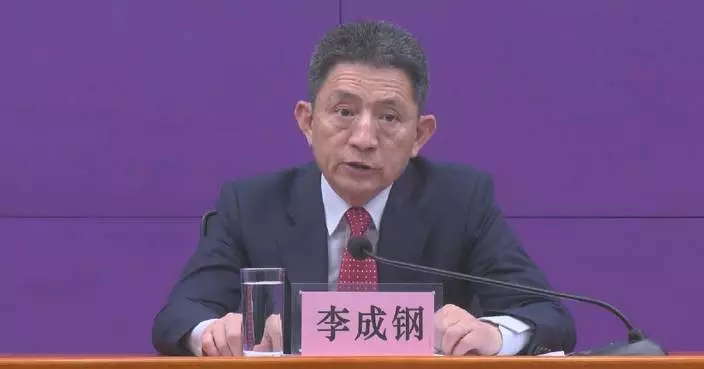
Tong Weidong, director of the State Law Department of the Legislative Affairs Commission under the Standing Committee of NPC, said the law will help legalize and standardize national development planning.
"Formulating and implementing five-year plans have long been the 'winning formula' behind China's rapid economic growth and enduring social stability. China has implemented 14 consecutive five-year plans, achieving remarkable success and accumulating valuable experience that must be carefully reviewed. This session of the NPC deliberated and approved the National Development Planning Law, elevating our long-standing and well-established practices and experience in formulating and implementing national development plans into legal provisions. Strengthening institutional achievements through legislation will promote the legalization and standardization of national development planning," he said.
He said the law will boost the continuity, stability, and authority of national development plans going forward.
"Since the start of reform and opening up, the implementation of every five-year plan has been notably effective. Many plans have even exceeded their targets ahead of schedule. The National Development Planning Law includes provisions to ensure the continuity and stability of national development planning. The law enhances continuity, stability, and authority of national development plans through institutional measures such as stronger policy coordination and resource allocation, stricter procedural requirements for plan adjustments, and greater oversight by the NPC. This provides stable expectations for investment from both domestic and foreign capital," said the official.

Newly adopted development planning law to better serve China's development goals: legislative affairs official

Chinese Foreign Minister Wang Yi said on Friday that both China and the Netherlands being committed to promoting mutually beneficial cooperation in an open and pragmatic spirit is in line with the shared interests of the two sides.
This is also conducive to the sound development of China-European Union (EU) relations as well as the security and stability of the global industrial and supply chains, he said.
Wang, also a member of the Political Bureau of the Communist Party of China Central Committee, made the remarks in a phone conversation with Dutch Foreign Minister Tom Berendson at the latter's request.
Wang congratulated Berendson on his assuming office as the Netherlands' new foreign minister and said that China and the Netherlands are important partners of cooperation to each other.
China appreciates the positive signal released by the new Dutch government of valuing its relations with China, he said, noting that China's foreign policy maintains coherence and stability, and that China is willing to work with the Netherlands to strengthen exchanges and communication, promote mutual understanding and trust, and consistently deepen their open and pragmatic partnership for comprehensive cooperation.
Wang briefed his Dutch counterpart on the outcomes of China's just concluded "two sessions," noting that China will remain committed to opening wider to the outside world and expanding institutional opening-up, bringing more opportunities to countries around the world, including the Netherlands.
China-Netherlands economic and trade cooperation enjoys mutual complementarity of advantages, mutual benefit and win-win results, Wang noted.
He expressed hope that the new government of the Netherlands will take on a new look and new challenges, adhere to independence and self-autonomy, and support the normal economic and trade exchanges between enterprises of the two countries.
It is hoped that the Dutch side would push EU institutions to understand China in an objective and rational manner, and adhere to the positioning of partnership and open cooperation between China and the EU, Wang said.
For his part, Berendson said the new government of the Netherlands speaks highly of the achievements China has made in its rapid development, and regards the relations with China as one of its most important bilateral relationships.
Berendson said his country is willing to keep high-level exchanges with China, leverage bilateral mechanisms such as the political consultation between foreign ministries and the mixed economic and trade committee, increase dialogue and exchanges at all levels, deepen the pragmatic cooperation in climate change, water resource management and other areas, and jointly defend multilateralism, consistently advancing the bilateral open and pragmatic partnership for comprehensive cooperation to new levels.
The Dutch side is willing to play a constructive role for the sound and steady development of EU-China relations, he said.
The two sides also exchanged views on issues including the Ukraine crisis.
China-Netherlands mutually beneficial cooperation in line with common interests: Chinese FM