Skip to Content Facebook Feature Image

China's NEV industry drives smarter manufacturing

China

China

China

China's NEV industry drives smarter manufacturing

2026-03-13 17:36 Last Updated At:20:27

The entire manufacturing process for new energy vehicles (NEVs) in China is becoming increasingly intelligent, with marked efficiency improvements ranging from assembly and inspection to data collection.

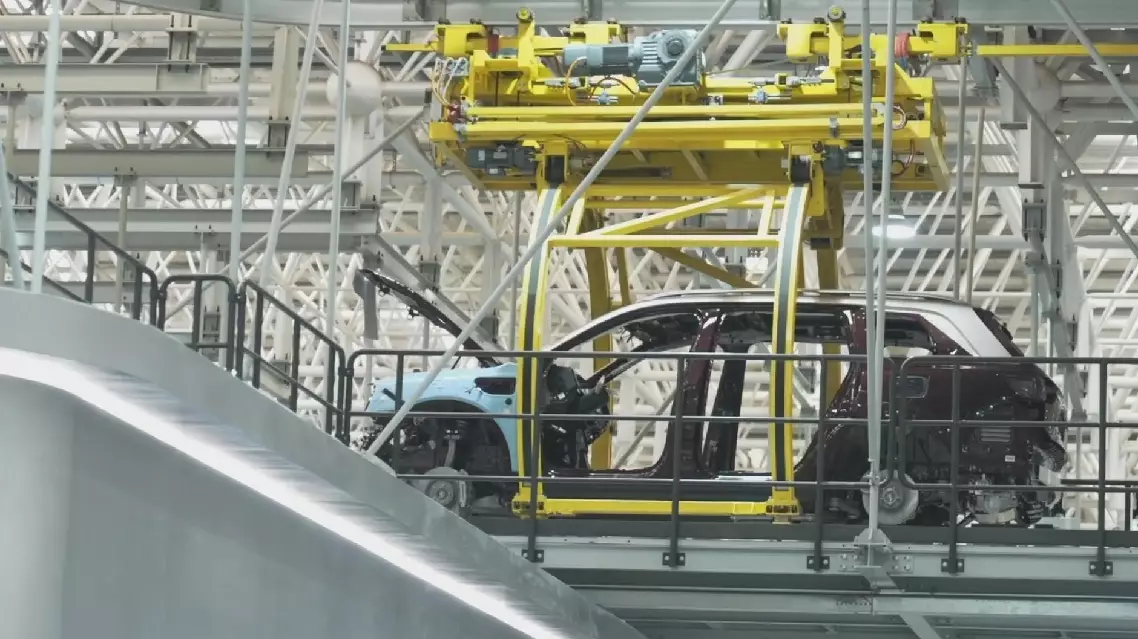
China's push for technological innovation is already taking shape on factory floors. At the Seres Super Factory in southwest China's Chongqing Municipality, a symphony of more than 3,000 robots operates in perfect coordination, with key manufacturing processes fully automated.

Workers mainly focus on verifying results during quality checks, while the most complex inspection tasks are handled by AI, which can complete analysis within one second.

"(We have our) gap and flushness examination AI station there. (Those) four robots will examine all the gaps and flushness of this vehicle, the surface (alignment). All the results will be transferred immediately to the pad here. Right now, we have more than 50 examination stations here (in this factory)," said Cao Nan, general manager of the Seres Super Factory.

Hu Jingguang, a staff member responsible for inspection, said the introduction of automated equipment has significantly improved inspection precision while reducing labor demand.

"After introducing this automated equipment, the precision has improved significantly, reaching 0.1 millimeters. Labor costs have also been reduced. Previously, manual measurement required around five workers. Now we only need two people to recheck the points identified by the robots. Overall efficiency has improved by nearly 70 to 80 percent," he said.

Helping make the entire production process smarter, more efficient and safer is the factory's data center, where AI analyzes information, predicts potential risks and supports decision-making, while humans remain in control.

"(The amount of) data in this factory is much, much more than in the traditional factories. Everything we can see in this factory -- the conveyor lines, the AGVs, the air conditioning, the lights -- all these data can be transferred by our 5G technology to our database within one second," Cao said.

Already intelligent NEVs from Chinese brands are now rolling off increasingly smarter assembly lines, a trend that is also paving the way for deeper international cooperation in the sector.

"China's NEV industry has become globalized to the point where we can co-develop technologies and products with overseas automakers. We hope that in this process, we will not only sell our products overseas, but also bring our technologies to work together, develop jointly, and pursue common development. I prefer to see it as a great balance between globalization and localization," said Zhang Xuming, secretary-general of the World New Energy Vehicle Development Organization.

The country's determination to advance technological development was evident in the government work report and the draft outline of the 15th Five-Year Plan (2026–2030), both approved by Chinese national lawmakers on Thursday.

China will build three international centers for sci-tech innovation and turn them into world-class innovation engines, according to the government work report.

The plan outline calls for strategic deployment in fields such as artificial intelligence (AI), quantum technology, biotechnology and new energy.
China's NEV industry drives smarter manufacturing

China's NEV industry drives smarter manufacturing
A new Type 055 guided-missile destroyer, the Dongguan (Hull 109), recently completed its first maritime training at the waters of the East China Sea after commissioning to the Chinese People's Liberation Army (PLA) Navy.

During this combat-oriented training exercise, the Dongguan not only completed single-vessel training subjects such as navigating through narrow waterways and damage control, but also coordinated with other warships in the formation to conduct joint operation drills, including maritime assault missions, at-sea replenishment, and multi-domain coordinated strikes.

With the improved performance of weaponry and equipment, the software and hardware of the Dongguan are vastly different from those of previous vessels. Sailors onboard the warship said that it's much more well-equipped and responsive.

"The Dongguan can now observe farther and hear more clearly. From detecting the target to launching strikes, it may take only a few seconds. However, seeing farther and wider also brings exponentially more interference factors. This requires us to practice and observe more frequently to accumulate experience, so as to enable rapid identification and efficient response," said Guo Tian, a lieutenant onboard the Gongguan.

In addition to diversified subjects with a clear combat focus, the Dongguan also faced challenges posed by harsh weather conditions during the training exercise. The crew remained at their posts throughout the process, demonstrating exceptional skills in maneuvering the vessel.

"To accelerate the combat readiness of the vessel, we participated fully in the testing and trial navigation missions from the very beginning of taking over the ship. The very first power trial navigation was independently completed by our own crew. Throughout this process, we not only learned how to operate the ship, but also understood the working principles behind its operation. This has laid a solid foundation for our combat-oriented training and equipment maintenance," said Zhang Chen, a helmsman onboard the Dongguan.

"During this maritime training exercise, we adhered to a problem-oriented approach. By creating complex settings and simulating real combat scenarios, we thoroughly tested the quality and effectiveness of the integration of trial and training during the equipment handover period, while systematically validating the combat effectiveness of the new equipment. Next, we will further optimize deployment, consolidate our foundation, strengthen coordination and cooperation, actively integrate into formation and group training, and continuously enhance the vessel’s comprehensive combat capabilities," said Shen Kai, commanding officer onboard the Dongguan.

The Type 055 destroyer is the fourth-generation destroyer independently developed and built by China. As one of the Chinese PLA Navy's most advanced surface warships, it carries advanced radar, universal vertical launch systems, and comprehensive radio frequency system, serving as the core the naval fleets for far-sea missions.

The Dongguan was commissioned to the PLA Navy together with another Type 055, the Anqing (Hull 110). With these additions, the number of China's Type 055 10,000-ton-class destroyers has risen to 10 since the first Type 055 destroyer Nanchang (Hull 101) was commissioned in 2020.

China's newly commissioned Type 055 destroyer Donggaun completes 1st maritime training

China's newly commissioned Type 055 destroyer Donggaun completes 1st maritime training

Recommended Articles