MIAMI--(BUSINESS WIRE)--Mar 13, 2026--
Picsart, the AI powered creative platform with over 130M+ monthly users, today introduces a new AI Copilot within its Picsart Flow ecosystem. This latest innovation is designed to move creators away from technical "prompt engineering" and back into the role of Creative Director, effectively democratizing high-end digital filmmaking and storytelling.
This press release features multimedia. View the full release here: https://www.businesswire.com/news/home/20260313163797/en/
The new Flow Copilot addresses the "Prompting Tax"- the technical friction and manual node setup that often disrupts the creative process. By automating the heavy lifting of technical specifications, the Flow Copilot allows one to focus entirely on the narrative. Key features of this frictionless workflow include:
Task completion time drops to one-third of the original duration, enabling creators to be three times as productive through conversational workflows. The Flow Copilot has been designed to keep people in their "creative flow" without the need to manage complex software layers.
Hovhannes Avoyan, Founder and CEO of Picsart, said: “What began as a focused experiment within our product team has evolved into a breakthrough that addresses the real-world roadblocks creators face every day. We are incredibly proud of how we are helping our users take back control of their creative vision. This Flow Copilot transforms the user from a technician into a true Creative Director, ensuring that nothing, from manual configuration to software complexity, stands in the way of world-class storytelling.”
Used by businesses and prosumers alike, Picsart Flow is an infinite canvas designed to eliminate "subscription fatigue" and the friction of switching between multiple tools for image, video, and copy editing. By centralizing Picsart’s internal toolset with preferred AI models, Flow allows creators to move projects seamlessly from ideation to scalable, automated campaigns. Key use cases include rapid prototyping on a single canvas, real-time creative team collaboration, and the ability to automate and reuse workflows to maintain brand consistency across high-volume social media, marketing, and advertising assets.
This announcement is shared alongside the news that Picsart will be among the first platforms to incorporate Seedance 2 and Recraft V4 in the coming weeks. This announcement reinforces its commitment to offering the 130M+ community the most advanced tools available, Picsart ensures users have continuous access to world-class output within a single, accessible ecosystem.
A generative AI pioneer since 2016, Picsart acquired the domain Gen.Ai prior to mass market adoption and evolved it into Picsart’s Gen AI Studio - consolidating the platform's most-used AI features with the industry's latest models in one destination.
The Copilot is currently available in beta for Picsart Flow users on web and mobile platforms. To try out the tool, visit picsart.com
Notes to Editors
About Picsart
Picsart is a recognized AI-powered platform for creative independence in a global economy increasingly driven and impacted by content. For over 14 years, Picsart has grown with and enabled the next generation of storytellers – Gen Z digital natives – to design, brand, and build at scale without limitations or barriers. With approximately 130+ million monthly active users and over 2.5 billion downloads, Picsart is well on its way to becoming the creative engine behind the $750 billion market of small businesses, entrepreneurs and brands, offering a range of innovative and intuitive tools and solutions that revolutionizes the creative, marketing and advertising processes. As creativity becomes central to identity, influence, entrepreneurship and profitability, Picsart is the platform for scalable, self-directed storytelling in a content-first economy.

Picsart, the AI powered creative platform with over 130M+ monthly users, introduces a new AI Copilot within its Picsart Flow ecosystem.
OMAHA, Neb. (AP) — Union Pacific hopes regulators will be convinced this time that its $85 billion acquisition of Norfolk Southern that it detailed for the second time Thursday will be good for the country.
The U.S. Surface Transportation Board rejected Union Pacific's initial application because regulators wanted more details about how the deal would affect the competitive balance between the five remaining major freight railroads and the impact on customers.
Union Pacific CEO Jim Vena said the new application makes an even stronger case for the benefits of the merger that he believes would shave a day or two off the delivery time for many shipments because they would no longer have to be handed off between two railroads in the middle of the country. The Omaha, Nebraska-based railroad projects that the merger could lead to shifting 2.1 million truckloads off the highway onto trains.
Vena said CSX and BNSF are already improving their operations to ensure they can compete ,and shippers will benefit from that if the deal is approved. Plus, he pointed out that since BNSF is owned by Warren Buffett's Berkshire Hathaway it has the financial resources to do whatever is needed because Berkshire is sitting on nearly $400 billion cash.
“The first few years after this, it’s gonna be like one of those old 15-round boxing fights. Prices are gonna be used, the service is going to be used, everything. And I think the customer’s going to be the winner in all this while we knock down, drag it out, to see who can win and grow their market share,” Vena said.
But the STB established a high bar for major railroad mergers like this one around the turn of the century after past rail mergers snarled freight and led to prolonged disruptions while two railroads worked to integrate their networks. Now Union Pacific has to demonstrate that this deal will enhance competition.
Vena said he's confident the railroads can avoid the integration problems of past mergers because they will take it slow while listening to a new board of customers about the impact. Plus this would be a combination of two successful railroads instead of many deals of the past where one thriving railroad took over another nearly bankrupt one in disrepair.
The deal includes a provision that if the STB requires more than $750 million in concessions Union Pacific can consider walking away, but it won't automatically doom the deal, the railroads disclosed Thursday as they submitted a copy of their merger agreement. Norfolk Southern would be entitled to a $2.5 billion breakup fee if the deal falls apart.
Currently, Norfolk Southern and CSX serve the eastern U.S. while Union Pacific and BNSF serve the west, and the two major Canadian rails compete where they can with their tracks crossing Canada and extending into the United States and Mexico.
A merged Union Pacific would likely control nearly 40% of the nation’s freight, but the railroad said that currently BNSF delivers that much of the nation's freight. So the railroads said the deal would shift which railroad dominates the market but wouldn't dramatically change the competitive balance.
But competitors BNSF and CPKC railroads joined a new coalition Wednesday to highlight concerns that the deal could hurt shippers and eventually consumers if it leads to higher rates for companies that have few options besides rail to get their raw materials and deliver their products. The coalition also includes trade groups for chemical and agricultural shippers and the unions that represent engineers and track maintenance workers.
“This did not begin with a customer asking for a UP-NS merger to happen,” BNSF CEO Katie Farmer said. “It’s driven by Wall Street on the promise of a big shareholder payout. It will eliminate competition, raise costs for consumers, and destabilize the supply chain that powers the American economy.”
But the biggest rail union and hundreds of shippers have backed the deal that would cut the number of major freight railroads across America down to five.
Union Pacific has promised that every union employee who has a job with either railroad at the time of the merger will have a job for life although the workforce could still shrink through attrition if the number of shipments slows down. But UP sounded an optimistic note Thursday and predicted that more than 1,200 new jobs will be created by the third year after the deal to handle the increased freight.
Previously, the railroads predicted 900 new jobs. But the new traffic data the railroads analyzed from all the major freight railroads convinced executives that more job growth is likely.
If the STB accepts this new application, regulators will likely spend more than a year analyzing every aspect of the deal.
.
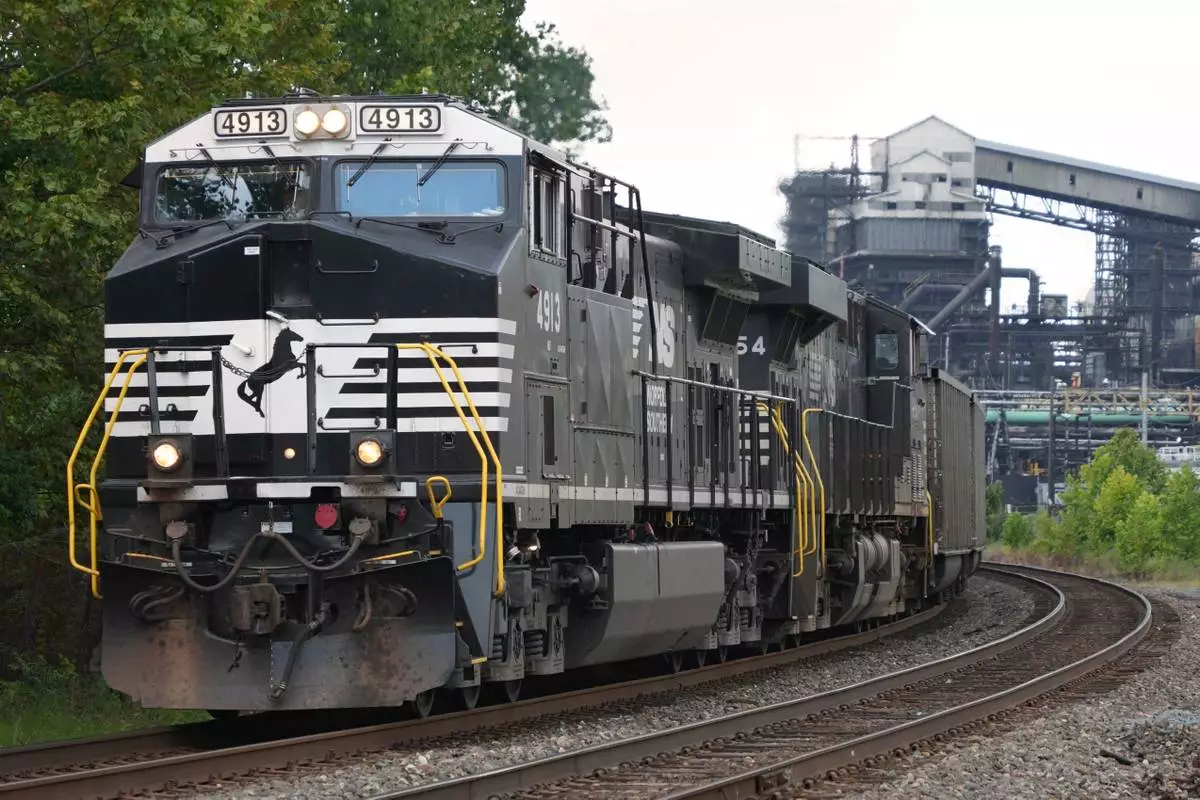
FILE - A Norfolk Southern freight train rolls past the U.S. Steel's Clairton Coke Works, in Clairton, Pa., Tuesday, Aug. 12, 2025. (AP Photo/Gene J. Puskar, File)
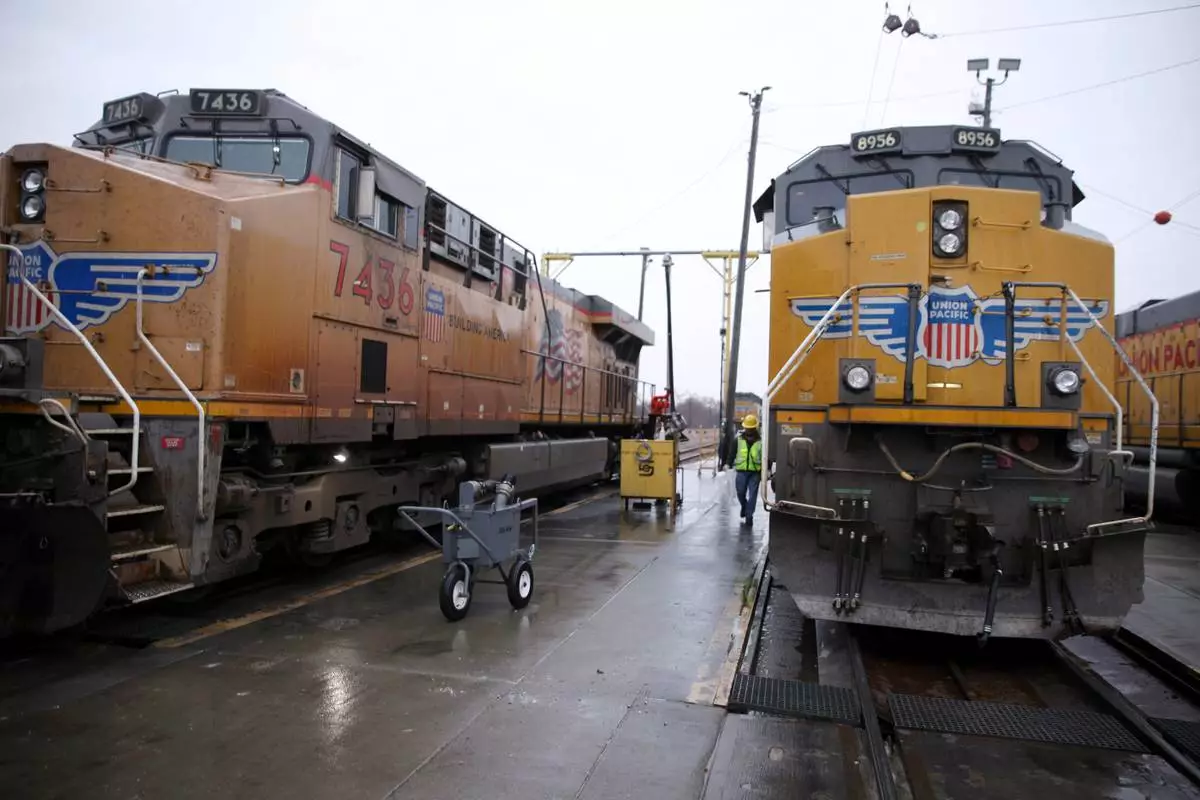
FILE - A Union Pacific worker walks between two locomotives that are being serviced in a railyard in Council Bluffs, Iowa, on Dec. 15, 2023. (AP Photo/Josh Funk, File)