NEW YORK (AP) — Lindsey Vonn is still recovering physically and emotionally from her frightening crash at the Winter Olympics. For now, the tough decisions about the future can wait.
She has undergone eight surgeries after suffering a complex left leg fracture — one that nearly led to a leg amputation — in the women’s downhill skiing race on Feb. 8. She needs at least one more to repair a torn ACL in that same knee.
Click to Gallery
FILE - United States' Lindsey Vonn arrives at the finish area during the alpine ski women's downhill training at the 2026 Winter Olympics, in Cortina d'Ampezzo, Italy, Saturday, Feb. 7, 2026. (AP Photo/Robert F. Bukaty, File)
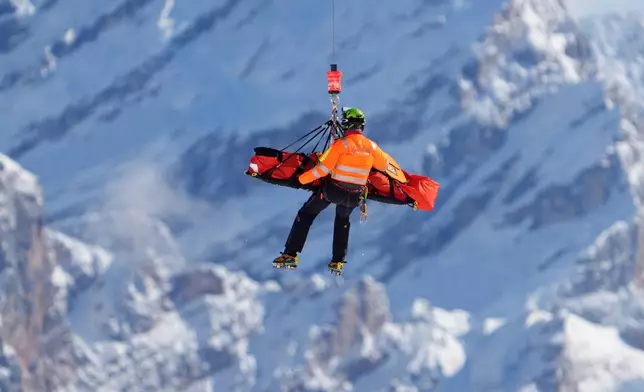
FILE - United States' Lindsey Vonn is airlifted away after a crash during an alpine ski women's downhill race at the 2026 Winter Olympics, in Cortina d'Ampezzo, Italy, Sunday, Feb. 8, 2026. (AP Photo/Jacquelyn Martin, File)
FILE - FILE - Lindsey Vonn, of the United States, poses with all the Olympic medals and Women's World Cup skiing trophies she has won in her career, on March 13, 2010, in Garmisch-Partenkirchen, Germany. (AP Photo/Giovanni Auletta, File)
FILE - United States' Lindsey Vonn crashes into a gate during an alpine ski women's downhill race, at the 2026 Winter Olympics, in Cortina d'Ampezzo, Italy, Sunday, Feb. 8, 2026. (AP Photo/Jacquelyn Martin, File)
FILE - United States' Lindsey Vonn smiles during a press conference by the U.S. ski team at the 2026 Winter Olympics, in Cortina d'Ampezzo, Italy, Tuesday, Feb. 3, 2026. (AP Photo/Fatima Shbair, File)
So if the 41-year-old races again — and she’s not ready to make that decision — a return is at least a year and a half away, Vonn told The Associated Press in an interview Wednesday.
“I just don’t want to jump to any conclusions or even speculate on what I might do,” Vonn said. “I may retire. I may never race again and that would be completely fine, but I’m not in a position emotionally to make that decision at this point.”
Vonn thinks she would have returned to retirement had she been able to complete a comeback season that rivaled one of the best of her career. She ended a six-year absence from the sport largely to race at Cortina, Italy, one of her favorite courses, and the venue for the Milan Cortina Games.
The winner of three Olympic medals, including a downhill gold in 2010, crashed just 13 seconds into the race and suffered a complex tibia fracture, shocking a star-studded crowd and ending a season in which she led the World Cup downhill standings and hadn’t finished worse than fourth in any race.
She’s returned from an assortment of injuries before — she has a titanium implant in her right knee — but this one was different. The pain was different. The eight surgeries are just one shy of the total she had for all the others combined.
“It’s a much different injury in that way, again, like the severity of the injury and understanding that I could have lost my leg and how bad things were,” Vonn said. “I can deal with a lot of pain, but this was so extreme. It’s not even been in the universe of pain with this injury as what I’ve had before.”
Vonn is making progress in and out of the gym, though not as quickly as she would like. She has moved beyond a wheelchair and now is on crutches — she is weary of both — and next week will be able to begin walking short distances.
She is able to travel again, making a trip to New York this week to discuss her support for the biopharmaceutical company Invivyd's “Antibodies for Any Body” campaign, and she has an upcoming vacation planned.
Beyond that, the future is hard to see.
Vonn said she hasn't spoken to her doctor about what a return to skiing would look like, saying they both prefer to focus on this phase of her recovery.
“Regardless, nothing would really happen until '27-28 because I still have one more surgery left to take out the metal and to replace my ACL. That still needs to happen,” Vonn said. “Once I get my ACL fixed, then that’s another six months, so I have at least I would say a year and a half ahead of me before I could really be back to 100%, even just training in the gym.”
Vonn knows there could be risks in a return, and family members don't want her to take them. It was only a day after her crash, when she was still in the hospital, that her father said her career would be over if it were up to him. Said Vonn: “He means the best. He forgot the cardinal rule with me is that if you don’t want me to do something, you shouldn’t tell me I can’t. Tell me I can’t and I’ll prove you wrong.”
Vonn has never shied from taking chances — she raced in the Olympics a little more than a week after tearing her ACL — no matter how they turned out.
“Downhill skiing is one of the most dangerous sports in the world, and that’s a risk that I’ve always taken happily, and this is the result, and I don’t regret it,” said Vonn, who noted she had done all she could to be fully prepped for the race. “I don’t want a do-over.”
But she will at some point decide if she wants to race again.
For now, Vonn said she's focused simply on getting her leg healthy. Only after that's done can she start thinking about a career that may or may not be over.
“I’m still, like I said, in survival mode that I just want to get through this phase and be able to assess where I am in my life,” said Vonn, whose 84 World Cup wins are second-most among women, trailing only teammate Mikaela Shiffrin (110). "And take count of what I’ve done and take count of what could be and make decisions in a much better place than where I am now.
“I don’t want to make a decision now because I think that would be rash and probably too emotional and I don’t want to make a mistake, you know?”
AP Sports Writer Pat Graham in Denver contributed to this report.
AP skiing: https://apnews.com/hub/alpine-skiing

FILE - United States' Lindsey Vonn arrives at the finish area during the alpine ski women's downhill training at the 2026 Winter Olympics, in Cortina d'Ampezzo, Italy, Saturday, Feb. 7, 2026. (AP Photo/Robert F. Bukaty, File)
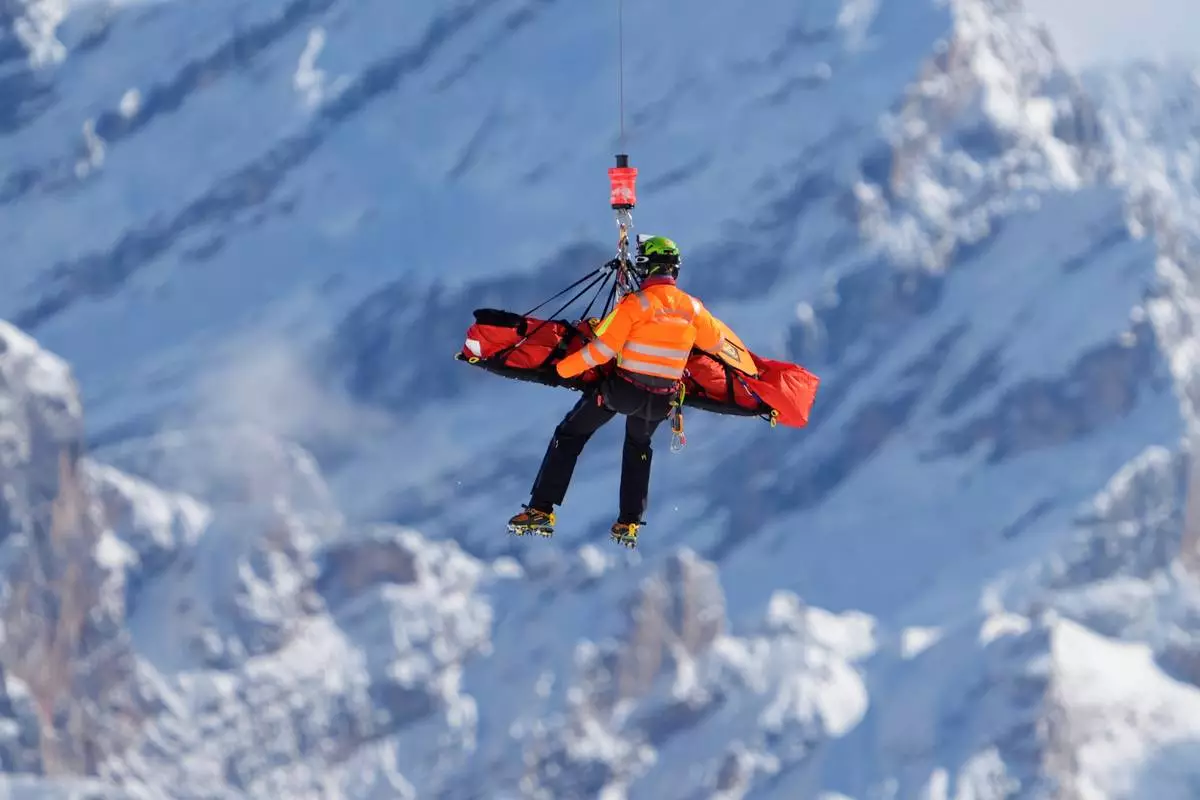
FILE - United States' Lindsey Vonn is airlifted away after a crash during an alpine ski women's downhill race at the 2026 Winter Olympics, in Cortina d'Ampezzo, Italy, Sunday, Feb. 8, 2026. (AP Photo/Jacquelyn Martin, File)

FILE - FILE - Lindsey Vonn, of the United States, poses with all the Olympic medals and Women's World Cup skiing trophies she has won in her career, on March 13, 2010, in Garmisch-Partenkirchen, Germany. (AP Photo/Giovanni Auletta, File)

FILE - United States' Lindsey Vonn crashes into a gate during an alpine ski women's downhill race, at the 2026 Winter Olympics, in Cortina d'Ampezzo, Italy, Sunday, Feb. 8, 2026. (AP Photo/Jacquelyn Martin, File)

FILE - United States' Lindsey Vonn smiles during a press conference by the U.S. ski team at the 2026 Winter Olympics, in Cortina d'Ampezzo, Italy, Tuesday, Feb. 3, 2026. (AP Photo/Fatima Shbair, File)
TEL AVIV, Israel (AP) — Hezbollah has launched a new weapon against northern Israel in the latest round of fighting: small drones controlled with fiber-optic cables the width of dental floss that avoid electronic detection.
These drones — used widely in the war in Ukraine — are small, hard to track and lethal. Drones injured at least a dozen soldiers in northern Israel on Thursday, two seriously, and the Israeli military said it had attempted to intercept multiple drones. In the past week, Hezbollah drones killed an Israeli soldier and defense contractor operating in southern Lebanon.
Many drones are susceptible to electronic jamming by air defenses. Jamming can cause a drone to crash or return to its point of origin.
Fiber-optic drones are not piloted via, for example, GPS signals or radio control. They have a thin cable that connects an operator directly to the drone, making it impossible to electronically jam.
The drones are not infallible because the wind — or other drones — can cause the cables to tangle.
But, “if you know what you’re doing, it’s absolutely deadly,” said Robert Tollast, a drone expert and researcher at the Royal United Services Institute in London, explaining how the drone can fly low and creep up on a target.
Experts say militaries must either intercept the drones, which is difficult due to their small size and short flight path, or find a way to snip the nearly invisible cable.
Hezbollah — the Iran-backed militant group in Lebanon — has mostly been using the fiber optic drones on Israeli soldiers operating in southern Lebanon or towns on the border.
Here’s a closer look at these weapons.
An Israeli military official told AP the fiber optic drones are a relatively new threat during the latest round of fighting with Hezbollah. Hezbollah seems to have turned to them because Israeli air defenses have been successful against larger and more powerful rockets, missiles and other drones, said the official, who spoke on the condition of anonymity in line with military guidelines.
Israel believes the drones are made locally and are easy to produce – requiring little more than an off-the-shelf drone, a small amount of explosives, and transparent wire that is readily available on the consumer market, he said.
He called the drones the biggest threat to troops inside Lebanon but said the Israeli military is working on technological solutions. In the meantime, Israel is taking measures on the ground to defend troops, such as adding nets and cages to military vehicles.
The fiber-optic drones are the latest part of a cat-and-mouse race as Israel’s high-tech defenses race to intercept new threats, especially ones that are less sophisticated.
Ran Kochav, a former head of the Israeli military’s air defense command, said Israel is failing in its attempts to defend against the fiber-optic drones.
“They fly very low and very fast, and they are very small, it’s very difficult to detect them, and even after they’re detected, they are really hard to track,” he said.
Kochav said Israel spent years focusing on strengthening its air defense systems to improve protection against rockets and missiles. But drones were not seen as a top priority.
He said Israel should have been following the advances in fiber-optic drones in the war in Ukraine and assumed that like Russia, other Iranian allies would eventually use them.
Throughout the war in Ukraine, Moscow and Kyiv have been engaged in a race to develop new technology.
Russia pummels Ukraine almost nightly with Shahed long-range attack drones — originally from Iran. Although Moscow has made many improvements to the drones, some can still be taken down by electronic jamming.
Fiber-optic drones were developed to get around that problem — although they do not have the same range as a drone that uses a radio link or artificial intelligence to navigate.
In some cases, fiber-optic drones have been recorded with cables extending as far as 31 miles (50 kilometers) said Tollast, the expert in London.
Russia and Ukraine are using many different types of drones “at a phenomenal scale,” he said.
The fiber-optic drones are in such wide use that footage shows front-line Ukrainian towns coated with shiny, fishing line-like strings, resembling massive spiderwebs shimmering in the sunlight.
Israel has sufficient firepower to intercept drones, but the key is early detection, Kochav said.
He explained that Israel already has suitable technology that tracks changes in light, identifies signals and communications, and can recognize the sound of drone propellers.
But he said these monitoring systems haven’t been widely deployed along the northern border.
Over the past weeks, Hezbollah has aired videos through social media platforms and its Al-Manar TV station of attacks with these new drones, especially against Israeli troops in southern Lebanon.
These attacks have captured public attention. One attack killed one Israeli soldier and wounded six others, some of them seriously, last weekend. Another attack, on Tuesday, killed an Israeli civilian contractor in southern Lebanon.
In the attack that killed the soldier, Hezbollah issued a video taken by the drone until it exploded in the middle of troops gathering near a vehicle. Another drone was fired at the same location as a military helicopter landed to evacuate the wounded but narrowly missed.
Ali Jezzini, a journalist specializing in security and military affairs who closely follows Hezbollah’s capabilities, estimated that the drones used by the group cost between $300 and $400 each. He added that they appear to be manufactured locally using 3D printing technology, in addition to readily available electronic components typically used for civilian purposes but capable of dual-use applications.
Hezbollah announced that it began using fiber-optic guided drones for the first time during the round of fighting that began March 2, after using other types of drones for years.
Israel also has a fleet of drones that carry out surveillance and attacks, though not necessarily with the fiber-optic cables, to target Hezbollah militants.
Zevik Glidai, a 78-year-old math teacher and volunteer ambulance driver, discovered coils of the translucent fiber-optic cables surrounding a drone that crashed into his backyard in the northern Israeli city of Kiryat Shmona on April 13.
His house is 2 kilometers (1.5 miles) from the Lebanon border. He was sitting at home when he heard a high-pitched shriek and a small crash. His neighbor yelled that the yard was on fire.
The two of them put out the fire with a garden hose but noticed something new: The destroyed drone was surrounded by loops and curls of a white thread.
“We are very worried about these drones because there's no way to shoot it down, because we can’t detect it,” Glidai said.
He said there was no warning siren before the drone crashed, and the bomb squad that responded called it a miracle that nearly 2 kilograms (4.4 pounds) of explosives failed to detonate.
“They told me, ‘You have a lot of luck,’” said Glidai, who noted that he's lived through several iterations of Hezbollah weapons in his 48 years in Kiryat Shmona. “They picked up all of the pieces that they could pick up, and they left me a few optical fibers as a keepsake.”
Mroue reported from Beirut; Burrows from London.
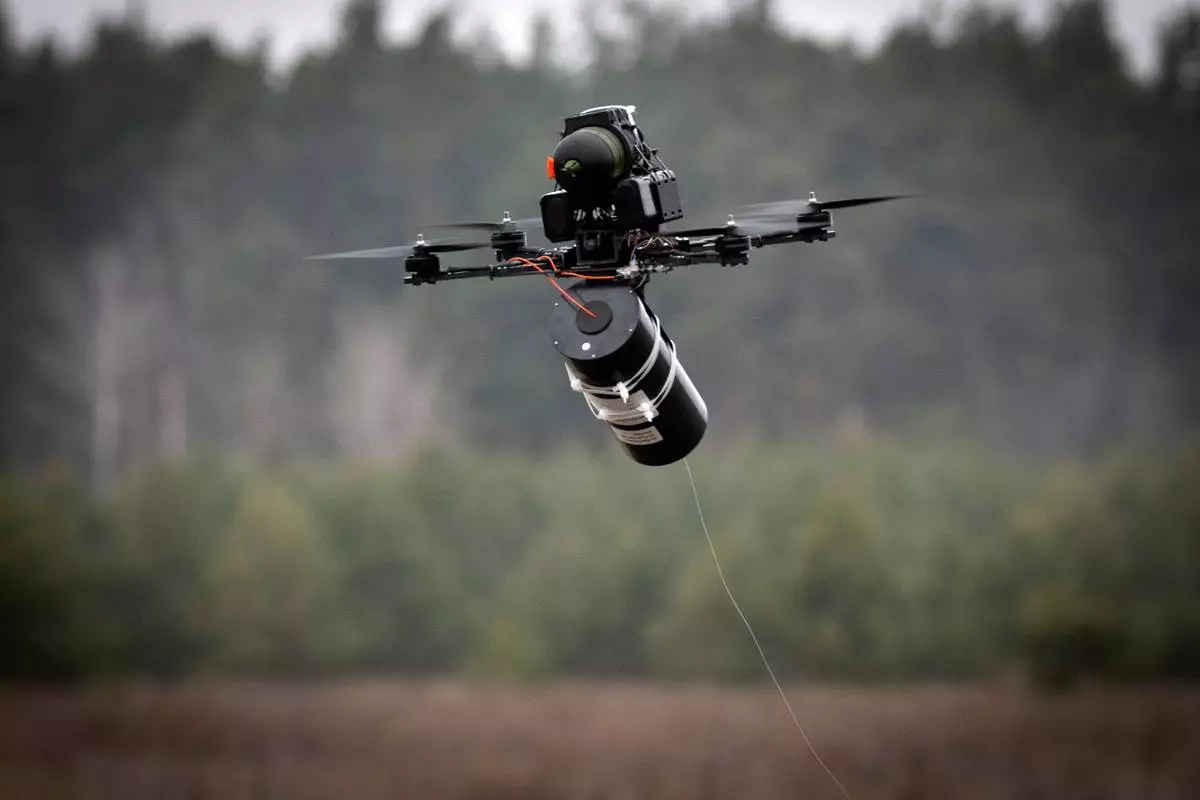
FILE - A Ukrainian made FPV fibre optic drone flies at a military market place at an undisclosed location in the Kyiv region, Ukraine, Jan. 29, 2025. (AP Photo/Efrem Lukatsky, File)