ATLANTA (AP) — Burt Jones seemed like the inevitable Republican nominee for governor in Georgia.
He is the current lieutenant governor, he has lots of family money and perhaps most important, he has President Donald Trump's endorsement.
But that certainty crumbled after health care tycoon Rick Jackson unexpectedly cannonballed into the race in February, dumping more than $30 million of his money into television ads. That already is more than any candidate has ever spent in a primary race for Georgia governor, with more than two months before the May 19 election.
The blitz has left Jones clinging to Trump’s endorsement like a life preserver while Jackson consciously evokes Trump. Jackson even descended in a glass elevator at his office building to announce his candidacy, echoing Trump's 2016 campaign start when he rode down a golden escalator in his eponymous New York skyscraper.
Jay Morgan, a former executive director of the state Republican Party, said “there’s no template” for what Jackson is doing in Georgia.
“We’re on a different playing field,” he said. “It’s like going from Little League to major leagues.”
Jackson’s emergence is yet another challenge to Trump’s influence in a critical battleground state. The president’s kingmaker record in Georgia is shaky, failing to dislodge Gov. Brian Kemp and others in 2022 and backing Herschel Walker in a Senate loss that year.
More recently, Trump nudged Clay Fuller to the front of a crowded Republican field in the special congressional election to replace Marjorie Taylor Greene. Fuller advanced to a runoff against a Democratic opponent.
Jones could be the Georgia politician most closely tied to Trump in this year's campaigns, and a loss would again show the limits to the president's sway over the party.
“The Trump endorsement is still valuable to get but can’t it be the be-all and end-all,” said University of Georgia political scientist Charles Bullock. "I guess $50 million or whatever Rick Jackson is spending will be a real test of that."
In all, it is a picture of an election turned upside down. The two other top Republican candidates — Secretary of State Brad Raffensperger and Attorney General Chris Carr — have largely stayed out of the crossfire, but are struggling for attention.
Democrats want to break a Republican winning streak that dates to 2002. Among the candidates are former Atlanta Mayor Keisha Lance Bottoms and Geoff Duncan, a onetime Republican lieutenant governor.
Trump has stood by Jones, who risked facing criminal charges when he tried to help Trump overturn his election loss in 2020.
“Burt Jones has been here and been with you and been with me right from the beginning,” Trump said Feb. 19 at an event in Rome, Georgia.
Jones is trying to counter Jackson by questioning his “Make America Great Again” bona fides, noting his history of giving to Republicans other than Trump and saying his health care staffing company assisted Planned Parenthood and gender-affirming care.
Jackson swatted back on Monday, filing a lawsuit claiming Jones was defaming him. Jones responded with a negative ad barrage the next day.
Jackson’s entry into the race was preceded by a $19 million bombardment from a mystery dark money group accusing Jones of using his office to enrich himself. There is little evidence to support the most serious claims — that Jones used his position as lieutenant governor to promote a giant data center development his family partly owns.
Jackson has repeatedly denied that he is bankrolling the ads that began in November.
On Feb. 4, Jackson launched his candidacy at the faux Italian office park he custom-built for Jackson Healthcare in suburban Alpharetta. Jackson likened himself to Trump as a businessman inspired to enter politics and said he would be “Trump’s favorite governor.”
“I saw a so-called front-runner who was as weak as can be and as lazy as the day is long,” Jackson said of Jones. “Really, he wants the title of governor, but not the job.”
A Jackson lawsuit has at least temporarily cut off a key source Jones' money — his leadership committee. That unusual Georgia fundraising vehicle lets Jones and a few other entities raise unlimited contributions. A federal judge ruled the structure illegal because Jackson’s contributions from others remain subject to Georgia’s $8,400 limit. Jones was ordered not to spend from the committee during the primary.
The court case could help Jackson maintain a financial advantage over Jones. Although Jones has ramped up his spending, political consultants said Jackson has purchased so many television spots already that he may crowd out his competitors.
Jackson is a former foster child who now calls himself a billionaire. His fortune stems from Jackson Healthcare, which recruits medical workers and leases them as well-credentialed temp workers. Among his biggest clients has been the state of Georgia. His companies have collected nearly $1 billion from state government in recent years, including providing medical workers during the pandemic.
He's been a force in Georgia politics for more than a decade as a Republican megadonor and policy advocate. In the early 2010s, he bankrolled an unsuccessful effort in Georgia and Florida to overhaul medical malpractice claims. He unsuccessfully pushed to privatize Georgia's foster care system. Later, he successfully backed efforts to increase support for foster children.
While Jackson has aired hard-edged ads pledging to cut taxes, deport immigrants and block gender-affirming care to minors, some said he is driven by Christian faith and concern for others.
“He’s a rock-solid conservative and just a terrific guy," said Eric Tanenblatt, a Republican operative who has worked for Jackson. "He's obviously a successful business person, but also someone with just a genuinely kind heart.”
Jackson made powerful Republican friends over the years.
He put former Florida Gov. Jeb Bush on his company's advisory board, and Jackson and his company gave more than $1 million to a political action committee backing Bush's failed 2016 presidential bid. That's now part of Jones' attack that Jackson is a “never Trumper." Jones also slams donations to Nikki Haley, who unsuccessfully opposed Trump in 2024, and to former Wyoming Rep. Liz Cheney's PAC.
Jackson has tried to offset that history, writing a $1 million check to Trump's MAGA Inc. PAC on Dec. 10. Jones supporters aren't buying it.
"My Chihuahua Izzy is closer to being MAGA than Rick Jackson is,” said pro-Jones Republican activist Debbie Dooley.
Even if people question Jackson's pro-Trump credentials, his entry seems to have stifled a push by Republican officials to crown Jones. Before Jackson entered the race, Georgia Republican Party Chairman Josh McKoon, and the state's two Republican National Committee members sought to waive a party rule against taking sides in primaries so the party could back Jones. But with local party groups condemning the move, the national party now says it won't wade in.
“We’re not spending any money in that race,” the RNC chairman, Joe Gruters, told WSB-AM on Feb. 19.
Being a huge self-funder doesn't guarantee election success. Republican Kelly Loeffler and her husband pumped more than $34 million into her unsuccessful Georgia Senate campaign in 2020. Of 65 candidates who spent more than $1 million of their own seeking federal office in 2024, only 10 won, according to Open Secrets, a group that tracks spending.
But for now, Jackson's money makes his message feel inescapable.
“The landscape that we were looking at 30 days ago looks radically different today," Morgan said.
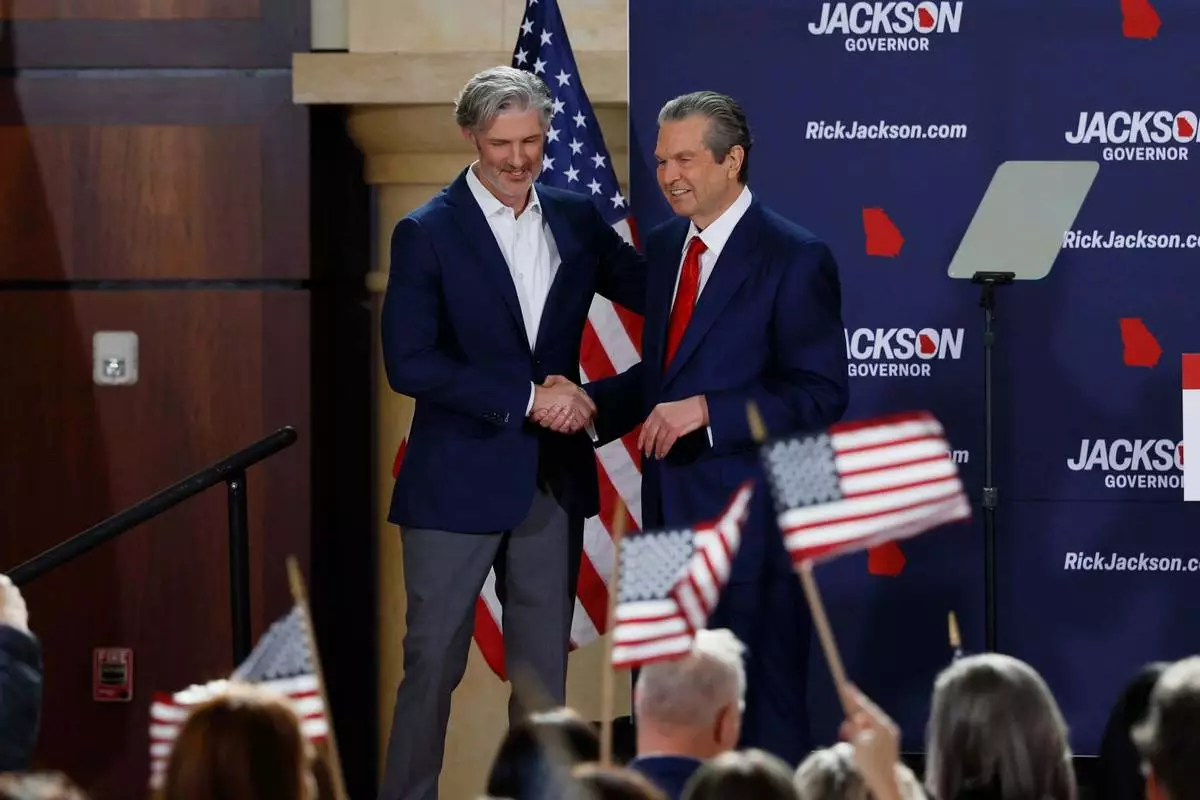
Shane Jackson shakes hands with his father, Rick Jackson, a healthcare business owner, after his campaign kickoff speech for Georgia governor at Jackson Healthcare, in Alpharetta, Ga., Wednesday, Feb. 4, 2026. (Miguel Martinez/Atlanta Journal-Constitution via AP)
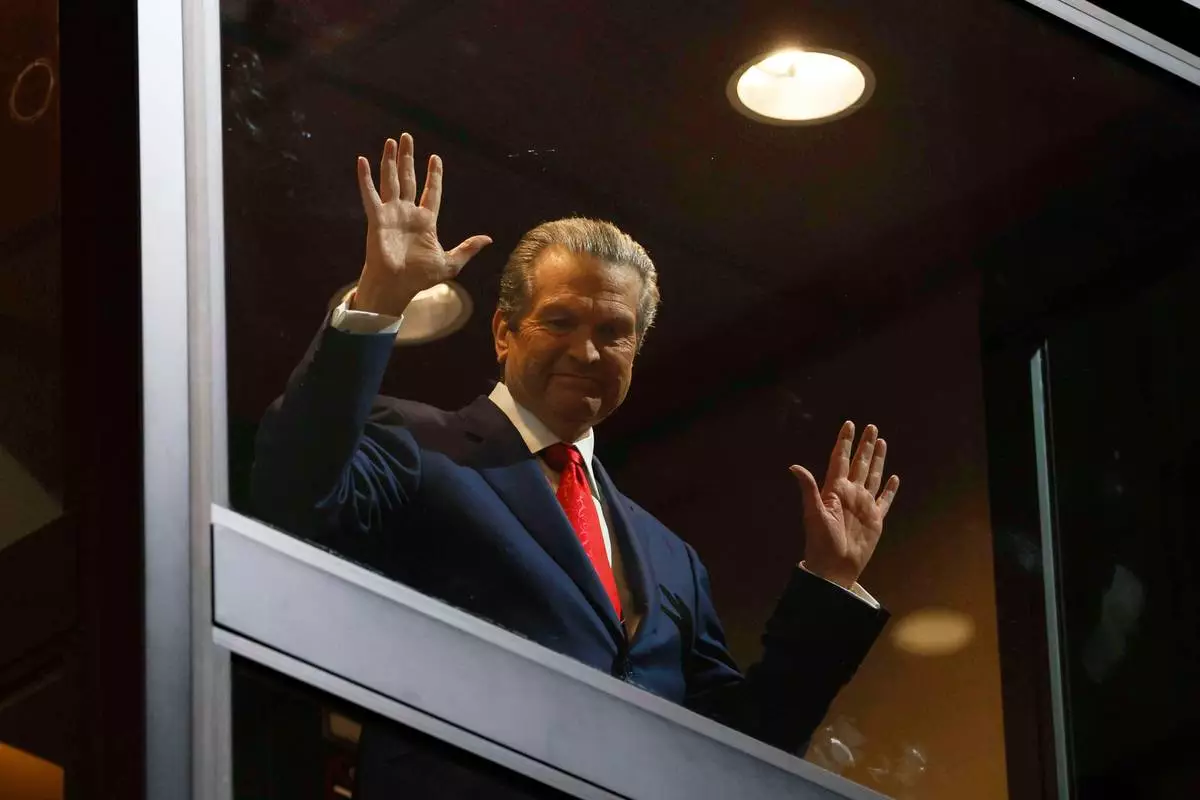
Healthcare business owner Rick Jackson waves to supporters as he comes down in an elevator for his campaign kickoff speech for Georgia governor at Jackson Healthcare, in Alpharetta, Ga., Wednesday, Feb. 4, 2026. (Miguel Martinez/Atlanta Journal-Constitution via AP)