Skip to Content Facebook Feature Image

AI enters video gaming world, enhancing gameplay and assisting in game creation

China

China

China

AI enters video gaming world, enhancing gameplay and assisting in game creation

2026-03-14 17:11 Last Updated At:03-16 13:17

The Game Developers Conference (GDC) Festival of Gaming came to a close Saturday in San Francisco after uniting all facets of the international games industry for five days of learning, networking, and inspiration.

The week-long showcase attracted around 30,000 game developers, designers and executives. One of the big topics is whether artificial intelligence (AI) in gaming has become friend or foe.

In You vs. Zombies, developed by Welsh generative AI games studio 10six Games, AI takes into account all the human designed details, from the spell types, the artwork, to the tone of voice, and then personalizes the game each run-through.

"'Joshua Tree,' that was chosen by the AI. It's picked a location to put it in. It's picked one of our 3D environments to put it in, and then it's picked one of our objectives, and then it's created dialogue, to tell a story," said Susan Cummings, CEO of 10six Games.

As a result, she said, the story created for each run will never be the same twice.

For other game makers, the technology is helping increase the efficiency of long-held practices in 3D motion rendering. MoreFun Studios, a subsidiary of Tencent Games, is using AI to capture the motion of kungfu at its most advanced level.

Game makers used to need more than 100 cameras filming models wearing motion capture sensors in a large studio. Tencent's technology now doesn't need any sensors, but instead just seven GoPro-sized cameras and a martial artist in a small space.

"We use AI to generate those different schools of kung fu, praying mantis or tiger style. In the past when we used mathematical model to generate those transition motions, you may have foot sliding and you may have weapons clipping the 3D models. Now we improve that by using AI," said Elvis Liu, head of AI at MoreFun Studios, Tencent Games.

According to Liu, this application of the technology demonstrates how AI is not a replacement for human expertise and skill, but merely a supplement.

"It's not like you can shoot a video on the street to get the movement from those pedestrians on the street. It's not like that. We need high-quality data. For that, we need to hire specialists to do those kungfu motions," he said.

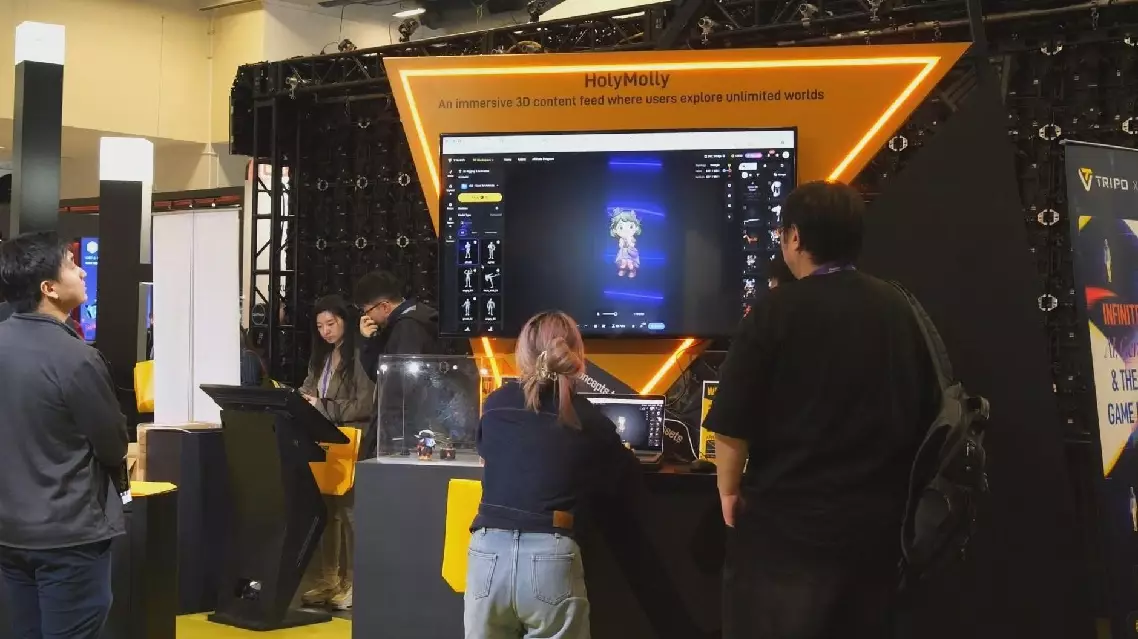
Global leading AI 3D generation platform Tripo AI has just released Tripo P1, which it says will allow game makers to create models and prototype designs nearly instantaneously.

"We are working on technology that allows everyone to generate a 3D model in five seconds by only inputting text prompts or image," said Simon Song, CEO of Tripo AI.

Technology like this allows game developers to spend less time on repetitive or low-impact tasks and explore more ideas and variations.

"Now, hundreds of people working for game companies only fulfill one person's idea. But later, everyone could use AI to fulfill their own ideas," Song said.

For all the optimism, the AI revolution is also spurring a level of resentment among a growing number of professionals. A GDC survey of gaming professionals found that 52 percent of respondents felt generative AI is having a negative impact on the industry. That figure is up from 30 percent a year ago.

"I think there's a lot of fear, a lot of concern about it from professionals who have been doing this by hand or other manual processes. But at the same time I do think these tools add a lot of value. For the most part, you don't see the generative AI tools touching the end user product. In other words, before it ships, the art is replaced by art created or audio created, assets that are created by individuals, by people," said Lewis Ward, a contributor for the gaming industry publication Player Driven.

While Ward understands the anxiety in the industry, he does not believe AI can replace human creativity.

"Yes, some cannibalization of existing jobs. But I think there will always be in a creative field in particular, like video games that no computer is going to be able to innovate to the level of a human being and to experiment and do something unusual and break the mold," he said.
AI enters video gaming world, enhancing gameplay and assisting in game creation

AI enters video gaming world, enhancing gameplay and assisting in game creation

AI enters video gaming world, enhancing gameplay and assisting in game creation

AI enters video gaming world, enhancing gameplay and assisting in game creation

Kuliang, or "Guling" in mandarin, is a hillside on the outskirts of Fuzhou, southeast China's Fujian Province, has stood for a century as a quiet yet powerful witness to the enduring friendship between the Chinese and American people.

Situated at an altitude of over 750 meters, Kuliang was once a summer resort for foreigners in the early 20th century. Since 1886, people from more than 20 countries, including Britain, France and the United States, began to build villas in Yixia village in Kuliang to spend the summer.

Facilities such as a post office, tennis courts and swimming pools were also built at that time, forming a community where locals and expats lived in harmony.

Although the foreigners eventually returned to their home countries, Kuliang never faded from their hearts. For many, this small village in the Chinese mountains remained a place they've longed ever since and appeared in recurring dreams.

In 1901, Milton Gardner, born in the United States, came to live in Kuliang with his parents when he was still in his infancy. He spent his happy childhood in this town where locals and foreign residents lived in harmony. At that time, children from different countries played in the hills. Chinese and foreign villagers gathered in mountain courtyards to share meals and conversations. They drank from the same well. Foreign teachers taught English to Chinese students in local schools, and local villagers lovingly cared for children from other countries. Ten years later, Gardner and his family returned to the United States. From then on, he had been longing for revisiting his childhood home, but for various reasons, he never fulfilled that wish.

The local Kuliang Family Story Museum displays an article entitled "Ah! Guling" written by Gardner's wife Elizabeth. It tells a touching story. In his final days, Gardner still cannot let go of his wish to see his beloved Kuliang one last time. He uttered "Kuling," the pronunciation of Kuliang in the Fujian dialect, many times before he passed away.

On April 8, 1992, the article was published on People's Daily, which moved many readers. Among the readers was Xi Jinping, who was then secretary of the Communist Party of China Fuzhou Municipal Committee. After reading the article, Xi immediately asked government officials to contact Mrs. Gardner and invite her to Kuliang.

Later that same year, Mrs. Gardner finally arrived in Fuzhou and visited Kuliang.

"I clearly saw, as I wrote in my article, that there were glistening tears in her eyes. She was deeply moved. Just think about it, her husband had long to come to this place for decades but never made it, yet she did. So I think it shows that President Xi has a long-term vision, a keen perspective, and a broad mind. He immediately recognized this as a beautiful story of the enduring friendship between the Chinese and American people," said Qiao Mei, former senior reporter of Fuzhou Daily who covered Mrs. Gardner's visit in 1992.

In President Xi's congratulatory letter to the "Bond with Kuliang: 2023 China-U.S. People-to-People Friendship Forum" on June 28, 2023, he wrote that back in 1992, he invited Mrs. Elizabeth Gardner to Kuliang, helping her fulfill the wish of her late husband to return to his childhood home.

In recent years, President Xi has sent congratulatory letters to the " Bond with Kuliang" series of exchange activities twice. Thanks to his personal attention and efforts, this heartwarming story of friendship between the Chinese and American people has been widely spread at home and abroad.

"We were very moved by it. President Xi is very supportive of this idea of people to people developing friendships. And I'm optimistic about the future for the people of the United States and the people of China," said Lee Gardner, grandnephew of Milton Gardner.

"The story of Kuliang is a story of friendship, peace, and love. No matter which country you are from, hearing these stories you will be moved from the bottom of your heart," said Elyn MacInnis, founder of "Friends of Kuliang," a group gathering about 50 descendants of U.S. families who once lived in Kuliang.

Mountain town in Fujian Province witnesses China-US friendship across generations

Mountain town in Fujian Province witnesses China-US friendship across generations

Recommended Articles