Residents in Beijing are getting a taste of the future as humanoid robots receive certification to process the online medicine orders, marking the latest push by China to expand artificial intelligence (AI)'s role to healthcare services.
As part of the country's first pilot zone for the large-scale application of intelligent pharmacy robots, a retail pharmacy in Beijing's Haidian District -- where robots play a key role in operations -- recently obtained its drug distribution certificate.
Galbot, a humanoid robot that had won over audiences during the Year of the Horse's Spring Festival Gala, the world's most-watched television event, with its impressive skills in picking up glass, folding clothes, and grilling sausages, has now officially started work at this drugstore. It has become the country's first certified intelligent retail robot for pharmaceuticals.
Once an order is placed, without any human intervention, the robot can autonomously retrieve, verify, and dispense the medication. Customers simply need to confirm the last four digits of their phone number to collect their purchase.
These humanoid drugstore clerks are packed with high technology. According to their developers, real-world commercial settings present significant challenges due to the wide variety of medicine packaging shapes, demanding a lot of the robot's capabilities.
"In an actual pharmacy, (medicine packaging comes in many forms). Besides boxes, there are transparent bottles and even flexible packaging. You'll find that grasping flexible packaging is different from what the robot encounters during training, because the shape of such packaging changes depending on how it's placed. This requires our robot has truly generalized recognition and grasping abilities. Currently, our robot's accuracy for generalized grasping has exceeded 99.9 percent," said Zhao Yuli, chief strategy officer of Galbot, a rising humanoid robot startup.
The humanoid robot currently handles only over-the-counter (OTC) medicine sales, with licensed pharmacists remaining on site to oversee prescription medicines and offer expert advice. "Prescription drugs, by regulation, require a licensed pharmacist to review the prescription. A robot cannot perform this review. For pharmacies introducing robots, our focus will be on whether the robot's involvement affects drug quality. For example, whether its grasping action damages the box or the medication inside or whether its data can be transmitted in real-time to the pharmacy's management system," said Ma Xin, head of the drug and medical device distribution supervision management section of Haidian's market supervision bureau.
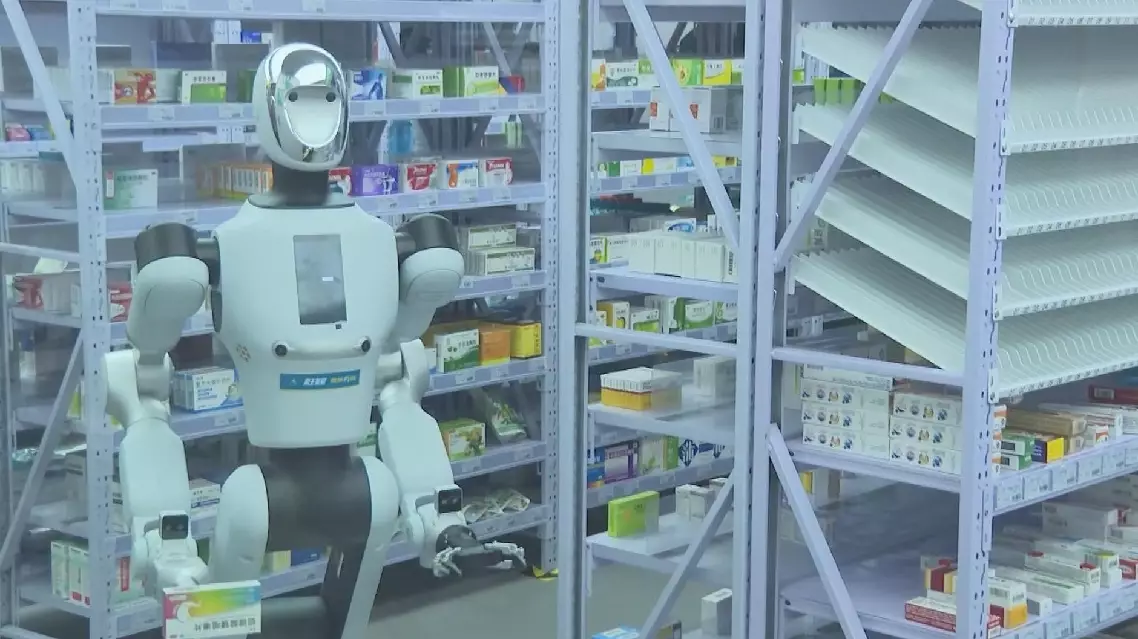
Humanoid robots land jobs as drugstore clerks in Beijing