Skip to Content Facebook Feature Image

Eco-friendly technology showcased at electronics fair in Shanghai

China

China

China

Eco-friendly technology showcased at electronics fair in Shanghai

2026-03-15 03:16 Last Updated At:03-16 13:20

From TV displays to air purifiers, environmentally-friendly devices take the center stage at the ongoing 2026 Appliance and Electronics World Expo (AWE2026) in Shanghai.

The AWE2026, which kicked off on Thursday, brings together more than 1,200 enterprises from all over the world to showcase their latest innovations.

China's Hisense Visual Technology presents an ultra-large TV screen featuring improved picture quality and 30-percent lower overall power consumption, by optimizing its light source structure, core chip and color management system.

"When we need red light, we simply turn on the corresponding set. Only the red light can pass through the red-green light filter. Our overall light utilization rate is very high, thanks to a high-efficiency chip and precise control," said Wang Yedong, a Hisense exhibitor.

A kitchen appliance manufacturer showcases highly energy-efficient and nature-friendly cooktop models by using green materials and technologies.

"Over 90 percent of the materials used are sustainable and environmentally-friendly. The internal circulation technology we developed addresses the root cause of air pollution from cooking fumes," said Zhang Yinfeng, the exhibitor from the manufacturer.

The compressor of an air conditioner, a major energy-consuming appliance for households, accounts for up to 80 percent of the machine's electricity consumption. The core component's upgrading is key to lowering air conditioners' emissions.

To address the issue, an air conditioner manufacturer shows dynamic energy-saving technology.

"Our dynamic energy-saving technology not only makes home healthier and more comfortable, but also contributes to a greener planet," said Zhu Lei from the air conditioner manufacturer.

An air purifier maker displays a multi-functional product using environmentally-friendly materials for both its internal filter and outer packaging.

"In terms of materials, our filter screens and filter frames are made from bamboo fiber, and our packaging materials are all biodegradable. These are just a few examples of our considerable efforts in environmental protection," said Yue Yue, an exhibitor representing the air purifier maker.

Green transition extends beyond products to services.

China has been promoting the trade-in program for home appliances and improved the recycling system, making it an important tool for expanding green consumption and driving industrial upgrading.

At the AWE2026, many e-commerce platforms and home appliance companies have upgraded their services covering sales, delivery and recycling, by introducing special subsidies, integrated disassembly and assembly, and door-to-door recycling. "Our services have extended to rural areas, truly achieving fast delivery and installation. This also solves the most difficult part of trade-in process -- collecting old machines," said Liu Xinyang, an exhibitor.

Data show that China has become the world's largest producer and consumer of home appliances, with the market share of high-efficiency and energy-saving household devices continuing to increase, and the penetration rate of green home appliances maintaining double-digit growth for many years.
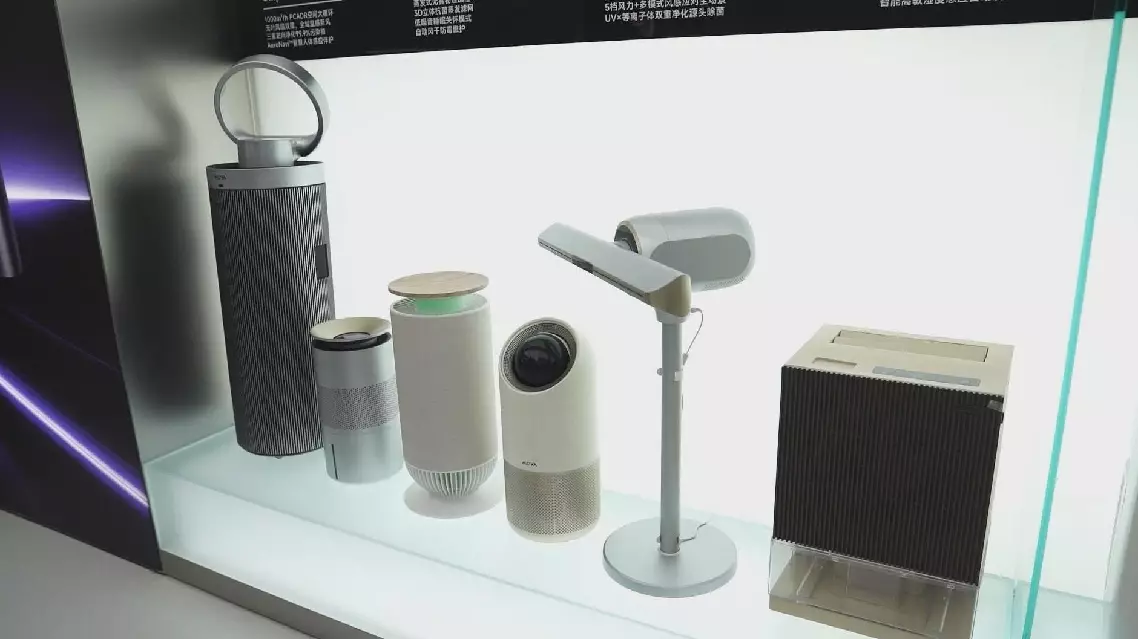
Eco-friendly technology showcased at electronics fair in Shanghai

Eco-friendly technology showcased at electronics fair in Shanghai

China's first 500-kV cross-border alternating-current power interconnection project entered service Monday, creating the highest voltage grid tie between the two countries and advancing Belt and Road energy cooperation.

The project raises two-way power transfer capacity between the two countries from 50,000 kW to 1.5 million kW, enabling the annual transmission of about 3 billion kWh of clean electricity, roughly 30 times the capacity of previous lines, according to China Southern Power Grid.

As the largest cross-border grid project and the highest-voltage power link between China and Laos, it connects southwest China's Yunnan Province with Oudomxay and Luang Namtha provinces in northern Laos.

Cross-border electricity trading began as the project entered operation. About 4.81 million kWh of power from clean energy bases in northern Laos was transmitted to Yunnan through the new line, marking a more regular and institutionalized phase of power connectivity between the two countries.

It is also the first time an overseas new energy project has participated in China's electricity market, the company said. The power involved in the transaction came from a large mountain photovoltaic project in Laos, one of the core supporting power sources for the interconnection line.

"This project is the cross-border power grid project with the highest voltage level between China and Laos. Leveraging the China-Laos power grid interconnection and the power markets in southern China, surplus hydropower from Laos can be transmitted to China during the rainy season, while China can supply supplemental power to northern Laos during the dry season. This project represents yet another landmark achievement between China and Laos in deepening power cooperation and jointly advancing the high-quality development of the Belt and Road Initiative," said Li Jingru, general manager of Electricite du Laos Transmission Company Limited (EDL-T), a joint venture of China Southern Power Grid and Lao state-run Electricite du Laos.

The solar project has an average annual power generation capacity of about 1.65 billion kWh. In 2026, it is expected to transmit about 1.1 billion kWh of solar power across the border, supporting energy complementarity between the two countries.

"In the future, efforts will be made to further promote normalized cross-border electricity trading, meet the trading needs such as electricity transmission from Laos to China's Yunnan, from China's Yunnan to Laos, and from Laos to China's Guangdong, and facilitate the optimal allocation of energy resources in the Lancang-Mekong region," said Li Minhong, marketing director of China Southern Power Grid.

Construction of the interconnection project began in late February last year. Spanning a total length of 177.5 km, the transmission line includes a 145-km Chinese section and a 32.5-km Lao section.

New China-Laos power link expands transfer capacity 30-fold, boosts electricity trading

New China-Laos power link expands transfer capacity 30-fold, boosts electricity trading

Recommended Articles