China's Shenzhou-21 astronauts have steadily carried out a series of tasks aboard the Tiangong space station over the past week, including in-orbit experiments, equipment maintenance and health monitoring, the China Manned Space Agency (CMSA) said on Sunday.
The crew, comprised of mission commander Zhang Lu and astronauts Wu Fei and Zhang Hongzhang, have spent more than four months in orbit and remain in good health, according to the CMSA.
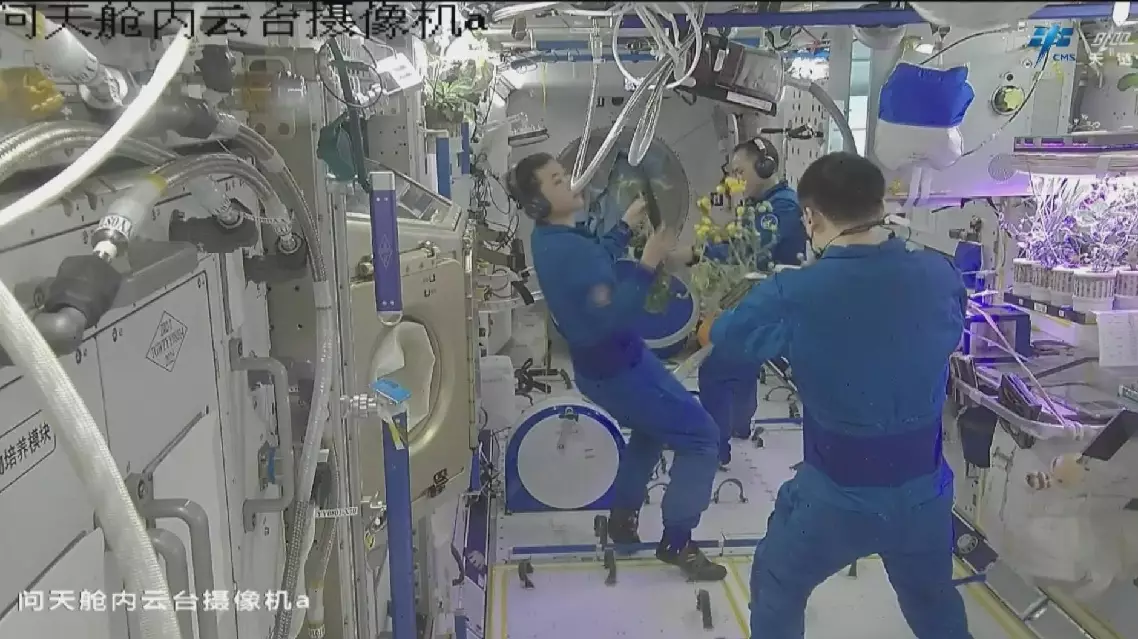
Inside the station's core module, cherry tomatoes cultivated using a water aeroponic device are thriving. The astronauts documented the plants with photos, harvested ripe fruit and sealed both plants and produce separately for preservation.
Building on the success of the cherry tomato cultivation, the team will conduct aeroponic experiments with wheat, carrots, and both medicinal and edible plants as planned. These trials aim to validate key technologies and expand the range of crops and technical capabilities for space cultivation.
In the field of space materials science, the crew completed several tasks, including cleaning the experimental chamber in the unpressurized compartment, replacing experimental samples, maintaining the electrodes of the central mechanism, and cleaning the window cover of the central mechanism.
They also completed related microgravity combustion science experiments, which included replacing the burner and sampling cover inside the experiment cabinet, as well as vacuumization and exhaust gas discharge.
Additional work included maintenance of the regenerative life support system equipment, microorganism monitoring and assessment and medical training, which helps familiarize the astronauts with the rescue operation methods and force application characteristics in a microgravity environment.
The Shenzhou-21 crewed spacecraft blasted off from the Jiuquan Satellite Launch Center in northwest China on Oct 31, 2025, sending the three astronauts to the orbiting space station on a six-month mission.
Shenzhou-21 crew advances space experiments, equipment maintenance on Tiangong
Shenzhou-21 crew advances space experiments, equipment maintenance on Tiangong
Shenzhou-21 crew advances space experiments, equipment maintenance on Tiangong
A special movie-themed flight campaign lifted off with Xiamen Airlines on Tuesday, blending film culture with tourism promotion to deliver a unique in-flight experience for passengers ahead of China's upcoming May Day holiday.
The campaign took off aboard a plane operated by Xiamen Airlines, which are based in east China's Fujian Province, bringing the magic of the big screen to the small screens on passengers' seats.
The aircraft's cabin has been adorned with film-themed posters and exclusive decorations, with brochures introducing the featured film content placed in seat pockets.
During the flight, the crew also hosted an interactive question-and-answer session, where they promoted some of the top films scheduled for release during the five-day May Day holiday which begins on Friday.
They also shared insights into the featured films, including the cultural and tourism resources of their shooting locations, giving passengers inside cinematic info and essential travel tips during their trip.
The immersive themed experience resonated well with passengers on the flight, who say they are now eager to check out some of the latest film releases.
"There are eight films recommended here, and I'm going to watch them when I get back. I'm keen to see Cold War 1994, because I'm a big fan of Aaron Kwok and the other cast members. I have been following the film all along," said Wang Jianghai, a passenger on the flight, as he expressed his interest in the upcoming crime thriller set in Hong Kong.
The flight attendants involved say they enjoyed having their role extend beyond the standard service duties during this particular plane ride, as they led passengers on this cinematic voyage.
"Today, we are more than just flight attendants. We are more like guides for this movie-themed journey. At 10,000 meters in the air, we get to plant a seed in our passengers' hearts that will make them want to take a trip or go watch that film. We want this to be the start of a beautiful memory for them," said Zhu Yanyan, the flight's chief attendant.
The launch of the themed flight comes as China braces for a surge in travel and cultural consumption during the May Day holiday. By integrating cinematic content with air travel scenarios, the campaign seeks to build a seamless link between the film and cultural tourism sectors, unlocking new growth momentum for both industries.
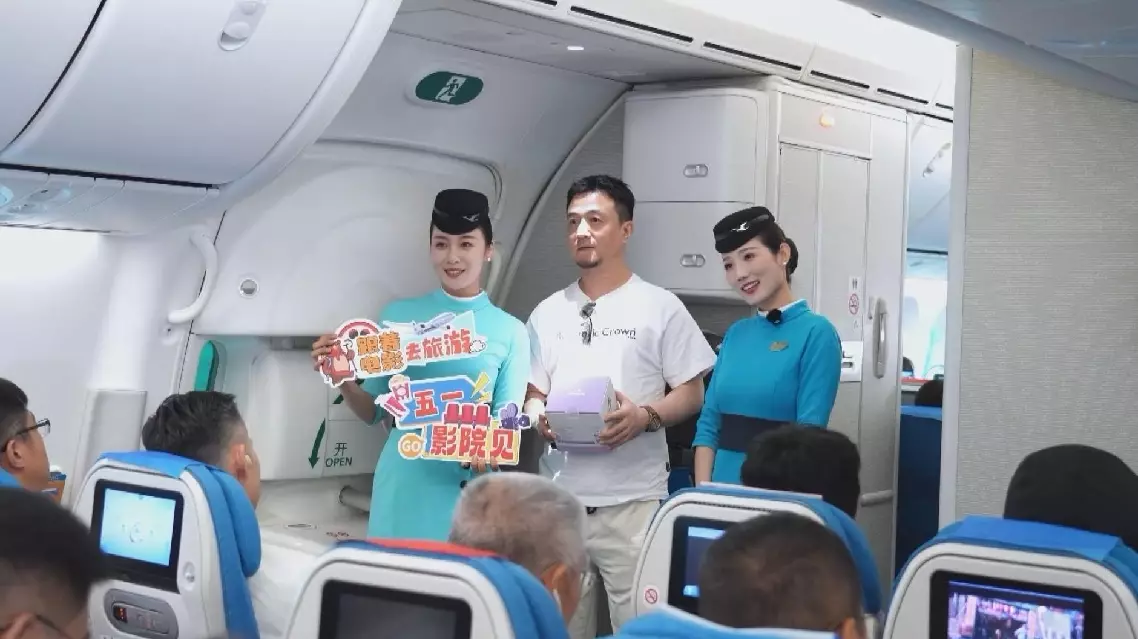
Movie-themed flight takes off in Fujian, integrating film culture with tourism